
Introduction: The April 1st Countdown and the Reveal of Patent US 20260061898 A1
As the automotive world marks its calendar for April 1, 2026—the highly anticipated reveal date for the production-ready next-generation Tesla Roadster—a quiet but seismic shift has occurred in the United States Patent and Trademark Office. On March 5, 2026, Tesla officially published Patent No. US 20260061898 A1, titled simply "Vehicle Seat System."
While mainstream media focuses on the Roadster’s theoretical 0-60 mph sprint or the rumored SpaceX cold-gas thruster package, this patent reveals where the real engineering "magic" is happening: the interior. For a car intended to blur the lines between automotive transport and aerospace performance, a traditional seat held together by bolts and heavy steel brackets simply would not suffice. Tesla has instead proposed a monolithic composite structure that promises to revolutionize not just the Roadster, but potentially the entire future of EV manufacturing.
Section 1: The Monolithic Construction—Ending the Assembly Nightmare
Traditional automotive seating is a legacy bottleneck. A standard premium seat is an assembly of over 50 individual metal parts, including stamped steel frames, manual or electronic reclining gears, rivets, and multi-piece foam pads. These components add significant weight and create dozens of potential failure points, such as squeaks, rattles, or mechanical jams.
Tesla’s monolithic approach follows the same "unboxed" philosophy that pioneered the large-scale Megacastings for the Model Y chassis.
-
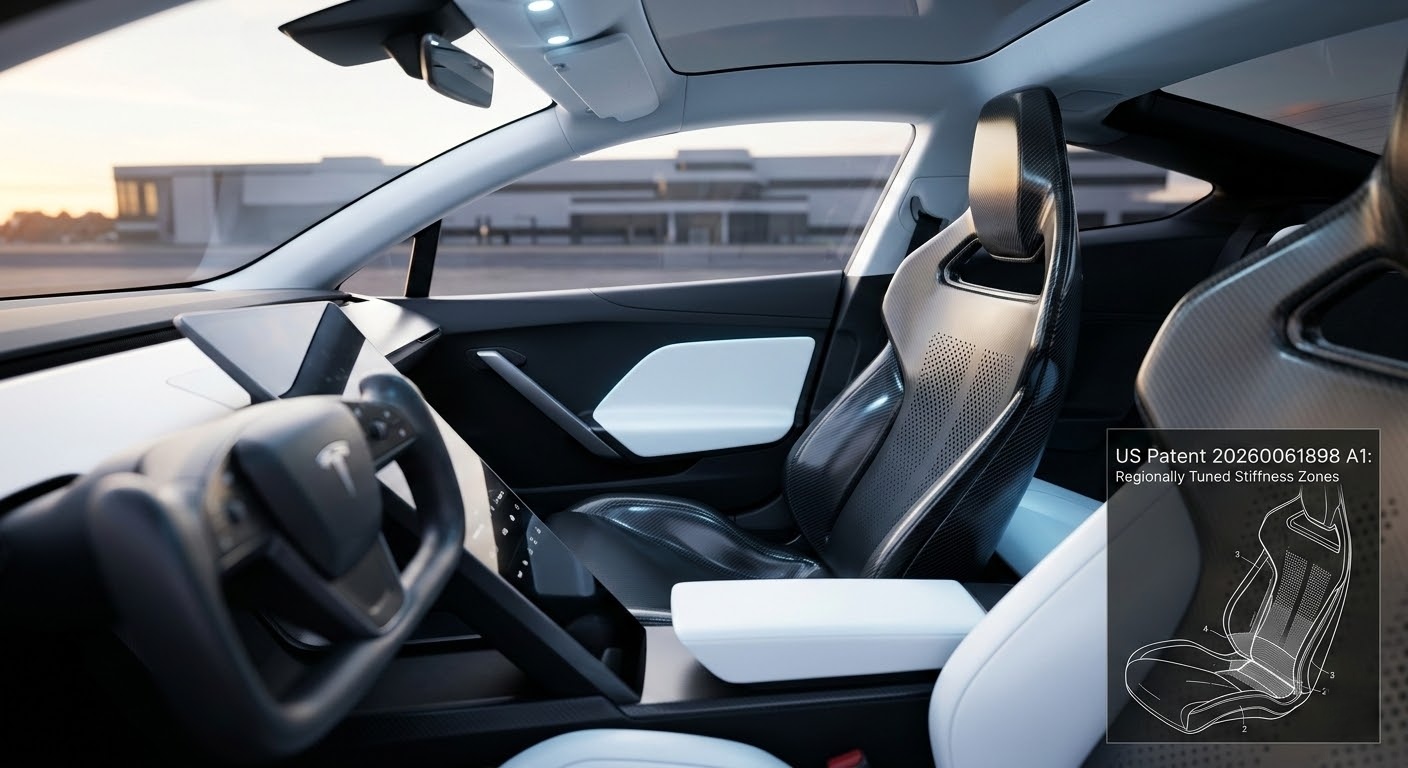
Unified Design: The patent describes a frame where the seat base, backrest, headrest, and lateral bolsters are all thermoformed as one unified piece.
-
Parts Reduction: By eliminating the modular metal-heavy construction, Tesla is targeting a part-count reduction of over 70% for the internal seat structure.
-
Weight Savings: Preliminary engineering estimates suggest this monolithic frame is up to 70% lighter than traditional steel frames while maintaining equivalent or superior structural integrity.
Section 2: Materials Science—Thermoformed Anisotropic Composites
The secret to making a one-piece seat that is both comfortable and "hyper-car tough" lies in a sophisticated field of materials science: Anisotropy.
Most materials used in cars are isotropic, meaning they have the same physical properties in every direction. However, Patent US 20260061898 A1 specifies the use of Thermoformed Anisotropic Composites, such as Carbon-Nylon, Kevlar-Nylon, or specialized Fiberglass-Polymers.
Why Anisotropy Matters:
-
Directional Strength: Engineers can align the fibers within the composite to be exceptionally rigid in the direction of G-forces (essential for a 1.1G lateral turn) while remaining flexible in others.
-
The "Live Hinge" Concept: Instead of a heavy mechanical recliner, the patent details an "integrated linkage assembly" or a "flexible hinge." The material itself is engineered to flex at specific points, acting like a high-tech leaf spring.
-
Durability: Unlike metal, which can suffer from work hardening or fatigue at joint points, these composites are designed for millions of flex cycles without losing their "memory" or structural shape.
Section 3: Ergonomics for Hyper-performance—The 1.1G Challenge
A car capable of sub-2-second acceleration presents a unique physiological challenge: the seat must support the human body against forces that would normally cause it to slump or shift, which could be dangerous at high speeds.
Regionally Tuned Stiffness Zones (R1–R6)
The patent reveals that the monolithic frame is divided into up to six distinct stiffness regions:
-
Zone R1 (Headrest): Rigid to prevent whiplash during the instant torque of a SpaceX-package launch.
-
Zone R3 (Lumbar/Hinge): Semi-flexible to allow for ergonomic adjustment and vibration dampening.
-
Zone R5 (Bolsters): High-stiffness lateral supports to "lock" the driver in place during high-speed cornering.
This "tuning" is achieved during the thermoforming process by varying the thickness and fiber density of the composite sheet, allowing Tesla to create a "smart" structure that reacts to the driver’s needs without adding a single extra bolt.
Section 4: The 6-Degree-of-Freedom Positioning System
A monolithic seat might sound restrictive, but Tesla’s solution is a Multi-Actuator Six-Degree-of-Freedom (6-DOF) Positioning System.
The seat utilizes four distinct actuator pairs controlled by a central ECU (Electronic Control Unit). Because the frame is one continuous piece, the actuators work in coordinated "symphony" to achieve:
-
Fore/Aft Movement
-
Height Adjustment
-
Cushion Tilt
-
Backrest Rotation (via the integrated flex-hinge)
This software-defined movement ensures that the seat profile remains perfectly ergonomic regardless of the occupant's size, effectively "morphing" the seat to the human body.
Section 5: Passive and Active Thermal Management
Weight and space are at a premium in the Roadster. Tesla’s patent solves the cooling problem by molding ventilation holes directly into the backrest portion of the frame.
By integrating these channels into the structure itself, Tesla raemoves the need for bulky separate fan assemblies and ducting found in traditional ventilated seats. This "structural ventilation" can be configured for passive airflow or connected to the vehicle’s main HVAC system for active cooling, ensuring the driver stays comfortable even during intense track sessions.
Conclusion: Setting the Standard for 2026 and Beyond
The publication of Patent US 20260061898 A1 is a clear signal that the 2026 Roadster is more than just a speed demon; it is a testbed for the next generation of Tesla’s manufacturing prowess. While this monolithic seat will debut in the high-margin Roadster, history shows that Tesla’s innovations—from the 15-inch screen to the heat pump—eventually migrate to the Model 3 and Model Y.
By reimagining the seat as a single, high-performance composite part, Tesla is proving that the future of the automobile is not just about changing the fuel source, but about fundamentally rewriting the laws of how machines are built.
FAQ
Q: Will the Monolithic Seat be available in current Model 3 or Model Y vehicles? A: Not immediately. The thermoformed carbon-nylon composites are currently too expensive for mass-market vehicles. However, a fiberglass-nylon variant mentioned in the patent suggests Tesla is already looking at a cost-effective version for future "Gen-3" platforms.
Q: Is a one-piece seat safe in a crash? A: Yes. The "Regionally Tuned Stiffness" allows the seat to act as a crumple zone for the human body, absorbing energy more efficiently than a rigid steel frame that might snap at the bolts.
Q: How does the seat "recline" if it’s one piece? A: The seat uses an integrated flexible hinge made of anisotropic materials. It doesn't "fold" like a traditional hinge; it "flexes" along a precise trajectory controlled by actuators, similar to how a high-end prosthetic limb or a carbon-fiber diving board moves.