
1. Introduction: The 2026 Paradigm Shift
As of March 16, 2026, the automotive world has moved past the debate of whether vision-only systems can drive. With the wide release of Tesla FSD v13 (delivered via the 2026.8 firmware), the conversation has shifted to a more critical technical frontier: Temporal Intelligence.
For years, Full Self-Driving (FSD) operated primarily on spatial optimization—identifying what is in front of the car and reacting to it. V13 marks the end of this "snapshot" era. By transitioning to a fully End-to-End Temporal Transformer architecture, Tesla has essentially given the car a sense of time and persistence. However, this leap forward has also exposed a harsh reality: the widening structural gap between Hardware 3 (HW3/AI3) and the newer AI4 (Hardware 4) platforms.
2. The Technical Core: End-to-End Temporal Transformers
The headline feature of v13 is its reliance on Temporal Transformers, the same class of neural network architecture that powers Large Language Models (LLMs) like GPT-4. But instead of predicting the next word in a sentence, v13 predicts the next "state" of the physical world.
2.1 The 15-Second Temporal Buffer
In previous versions (v11 and v12), if a pedestrian walked behind a parked truck, the occupancy network would occasionally "forget" they existed for a micro-second, leading to hesitant braking or jerky restarts.
-
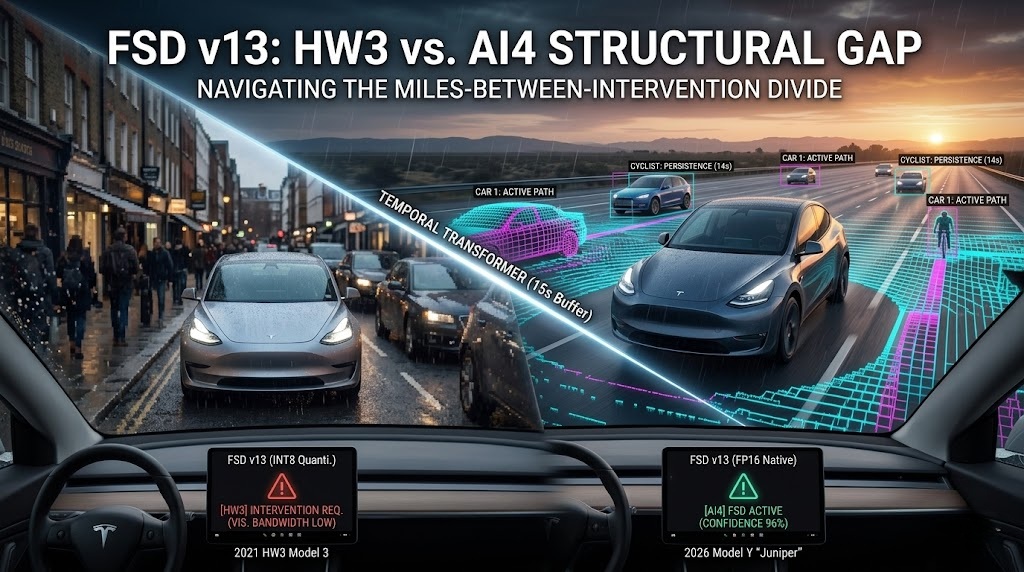
Object Permanence: V13 maintains a persistent 15-second buffer of video data. This allows the car to maintain "Object Permanence." Even when a target is occluded, the AI "knows" it is still there and calculates its likely trajectory based on the previous 15 seconds of motion.
-
Jerk-Limited Path Planning: By understanding the sequence of events rather than just the current frame, v13 can plan path movements that are significantly smoother. The result is a driving style that feels "fluid" rather than "robotic."
2.2 Voxelization and Occupancy Network 3.0
To support this temporal understanding, Tesla has upgraded its Occupancy Network to version 3.0. The system now discretizes the 3D world into high-resolution voxels (volumetric pixels).
-
8x Resolution Boost: For AI4 vehicles, the voxel resolution has been increased by 800% for the front-facing cameras.
-
Physics-Based Inference: Instead of just identifying "curb" or "car," the system evaluates the density and structural integrity of every cubic decimeter of space. This allows for near-perfect navigation in unstructured environments, such as European construction sites or narrow residential alleys in San Francisco.
3. The Performance Gap: HW3 vs. AI4 Structural Divergence
While v13 is available for both hardware suites, the 2026 data shows that we have reached a "performance ceiling" for older hardware.
3.1 Miles Between Intervention (MBI) Metrics
As of mid-March 2026, real-world fleet data from North America highlights a staggering disparity:
-
AI4 Platforms (Model 3 Highland / Model Y Juniper): Achieving an average of 450 miles between critical disengagements.
-
HW3 Platforms (Legacy 2019-2023 Models): Hovering around 120 miles.
The gap is no longer marginal; it is structural. AI4 vehicles utilize 5.44-megapixel cameras and have the compute headroom to run the v13 "World Model" at native precision (FP16). HW3, however, requires aggressive quantization to INT8 and "network pruning" just to fit the model into its aging buffers.
3.2 Perception Bandwidth: The Vision Problem
The most critical difference is "Perception Bandwidth."
-
AI4: Processes 36 frames per second at full resolution. It can identify a pothole or a stray nail on the road at twice the distance of HW3.
-
HW3: Due to the lower 1.2-megapixel camera resolution and limited RAM, the system often has to "guess" the details of distant objects, leading to what owners call "micro-hesitations" at complex junctions.
4. New Features in 2026.8: Comfort Braking and Beyond
Beyond the core AI, the 2026.8 update brings hardware-level refinements that enhance the "Juniper" and "Highland" experience.
4.1 The "Comfort Braking" Update
Exclusively for the Model Y Juniper and late-2025 Model 3 builds, Tesla has added Comfort Braking. This feature uses a new hydraulic channel upgrade in the braking system, controlled by the AI, to ensure that the transition from regenerative braking to a full stop is nearly imperceptible. This addresses a long-standing complaint from luxury buyers who found the "regen-to-stop" transition too abrupt.
4.2 Park-to-Park Autonomy
V13 integrates "Unpark," "Reverse," and "Park" into a single, unified model. For the first time, a Tesla can theoretically navigate from a driveway, through city streets, and into a parking spot at the destination without a single mode-switch. While still "Supervised," the level of integration makes the car feel like a cohesive digital entity rather than a machine switching between different cruise control modes.
5. Regulatory Compliance and Safety Standards
Tesla has introduced the "Black Box" Safety Shield in v13 to meet 2026 US and European safety mandates.
-
Proactive Takeover Alerts: If the AI's "Confidence Score" drops below 85% (due to heavy rain, mud on cameras, or complex geometry), the car now provides a 5-second lead time alert to the driver.
-
European Adherence: This feature is particularly crucial for the German and UK markets, where regulators have been skeptical of "sudden" disengagements.
6. Conclusion: The Road Ahead
FSD v13 is the most sophisticated software ever deployed to a consumer vehicle. It proves that vision-only autonomy is not just viable, but superior in its ability to adapt to new environments. However, for the Tesla blogger and owner, the message is clear: Hardware matters.
While HW3 remains a safe and capable "Supervised" driver, the "Unsupervised" future belongs to AI4 and beyond. As we approach the end of Q1 2026, the divergence in performance metrics suggests that a hardware upgrade or trade-in may soon be the only way to experience the full potential of Tesla’s AI revolution.
FAQ: What Every Tesla Owner Should Know
Q: Will my HW3 car ever get "Unsupervised" FSD?
-
A: While Elon Musk previously promised HW3 would support Level 5, the 2026 data on compute latency suggests HW3 will likely remain a "Supervised" (Level 2+) system for the foreseeable future.
Q: What is the "Comfort Braking" feature?
-
A: It is a software-hardware optimization in the 2026.8 update that ensures a smooth stop. It is currently primarily available on Model Y Juniper and newer Model 3s.
Q: Does v13 work in heavy rain or snow?
-
A: Yes. V13 uses "Occupancy Network 3.0" and the 15-second temporal buffer to "see" through visual noise, but manual cleaning of cameras is still required if they become physically blocked.