
Introduction
For European Tesla owners, the promise of true autonomous capabilities has long been trapped in a bureaucratic labyrinth. While North American drivers have actively participated in the iterative evolution of Full Self-Driving (FSD), strict European Union regulations have constrained Tesla’s software to legacy, rule-based Autopilot functions. However, the regulatory ice has officially broken.
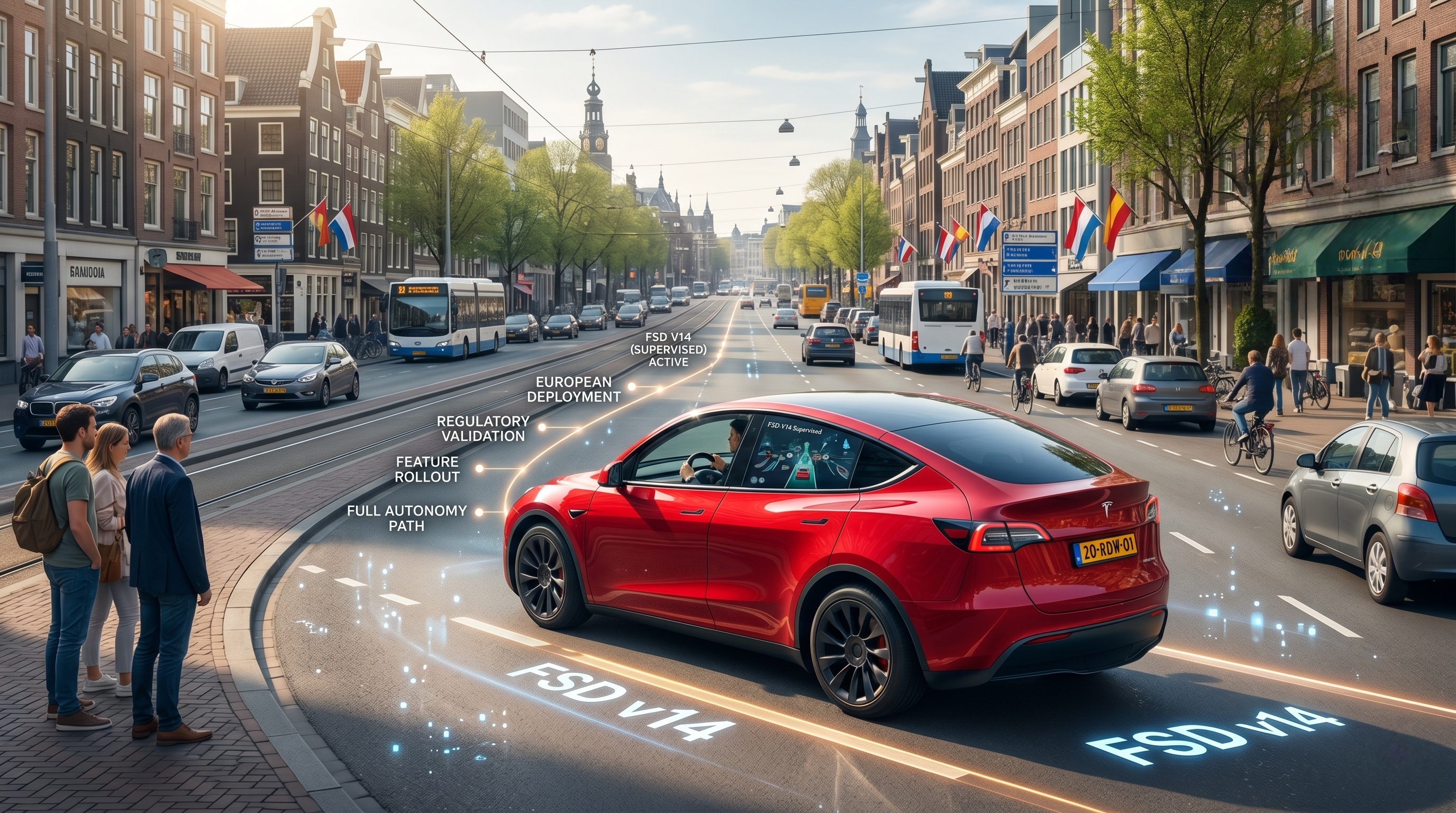
On April 10, 2026, the Dutch vehicle authority (RDW) officially granted type approval for Tesla's FSD (Supervised) under the newly adopted UN Regulation 171 framework for Driver Control Assistance Systems (DCAS). This is not just a localized policy update; it is a watershed moment. The RDW's approval serves as the definitive master key for unlocking end-to-end neural network driving across the entire European continent.
Chapter 1: Inside the RDW Approval Process
The approval of FSD v14 by the RDW was the culmination of an intense 18-month collaborative validation period. Unlike standard vehicle type approvals, evaluating an end-to-end AI driving system required regulators to shift from assessing hard-coded rules to evaluating probabilistic neural networks.
The Data Threshold
To satisfy the safety prerequisites of UN Regulation 171, Tesla submitted comprehensive telemetry encompassing over 1.6 million kilometers of localized European road data. This data was not simulated; it was harvested via the shadow-mode operations of the existing European fleet. Regulators meticulously reviewed intervention rates, focusing heavily on how the system reacts to unpredictable variables that are distinctly European.
Conquering European Infrastructure
North American roads are generally characterized by wide lanes and grid layouts. Europe presents a drastically different operational design domain (ODD). FSD v14 had to prove localized competence in three critical areas:
-
Vulnerable Road Users (VRUs): Cities like Amsterdam and Copenhagen have overwhelming bicycle traffic. The v14 neural net demonstrates enhanced trajectory prediction for cyclists, maintaining dynamic lateral buffers without unnecessary hard braking.
-
Complex Roundabouts & Narrow Streets: Traditional Autopilot struggled with the geometry of multi-lane European roundabouts. By shifting to an end-to-end architecture, FSD v14 processes the scene holistically, yielding to traffic within the roundabout and smoothly executing exits, even on roads lacking clear lane markings.
-
Dynamic Speed Limits: The system now seamlessly integrates with local European map data and real-time vision to handle abrupt speed limit changes (e.g., moving from a rural German Bundesstraße directly into an inner-city 30 km/h zone).
The Technical Catalyst: MLIR Compiler
A crucial backend update that facilitated this regulatory approval was the integration of the MLIR (Multi-Level Intermediate Representation) AI compiler. This optimization drastically reduced the neural network evaluation latency on both Hardware 3 and AI4 systems. In the chaotic, high-density traffic of European capitals, saving even 20 milliseconds in object classification and path planning latency is the difference between a smooth maneuver and an uncomfortable driver intervention.
Chapter 2: The Rollout Timeline for Germany, France, and Beyond
With the Netherlands acting as the vanguard, the question for owners in Germany, France, Italy, and Scandinavia is simply: When will the OTA update hit my car? Because the European automotive regulatory framework operates on a principle of harmonization, the RDW approval triggers a cascading rollout mechanism.
The "Mutual Recognition" Phase (May – June 2026)
Under EU law, once a vehicle system receives type approval from one member state's designated authority (in this case, the RDW), other member states operate under the principle of Mutual Recognition.
Throughout May 2026, authorities such as the KBA in Germany and UTAC in France are conducting fast-tracked administrative reviews of the RDW's technical report. Tesla has historically prepared localized localization packages (translating UI elements and verifying local traffic sign recognition) in tandem with these reviews. Expect the first waves of FSD v14 (Supervised) to hit early-access testers in Germany, Belgium, and France by late May, expanding to the wider public fleet by mid-June.
The TCMV Comitology Process
For true, frictionless, EU-wide harmonization—especially for nations outside the immediate core EU bloc—the Technical Committee on Motor Vehicles (TCMV) must finalize its comitology process. This ensures that UN Regulation 171 is uniformly interpreted regarding driver monitoring requirements (such as cabin camera engagement alerts). This legislative alignment is expected to conclude by Summer 2026, officially standardizing the FSD rollout across all UN ECE member states.
Chapter 3: Preparing Your Vehicle for FSD in Europe
As the rollout window approaches, owners must ensure their vehicles are both technically and commercially prepared to receive the update.
Hardware Capabilities and Fleet Readiness
FSD v14 is designed to run efficiently on both legacy Hardware 3 and the current AI4 platforms. However, owners utilizing older camera modules may experience delayed rollout waves as Tesla fine-tunes the software for legacy hardware permutations. The vehicle must be connected to a stable Wi-Fi network, as the initial neural network model download is substantial (typically exceeding 4GB).
Additionally, Tesla is currently running FSD v14 in "shadow mode" across the European fleet. Even if you cannot see the visualizations, your vehicle's computer is silently running the FSD code, comparing the AI's intended actions against your actual driving behavior, and uploading the deltas to Tesla's servers to ensure final safety validations before the consumer UI is unlocked.
The Subscription Model Shift
Historically, European owners had to purchase the Enhanced Autopilot (EAP) or FSD package outright for thousands of Euros—a tough sell for software crippled by regulations. Commensurate with the v14 rollout, Tesla is officially bringing its aggressive subscription model to Europe. The €99/month subscription lowers the barrier to entry, allowing owners to trial the true capabilities of FSD without a massive upfront capital expenditure.
Conclusion
The April 2026 RDW approval is the moment the European Tesla fleet wakes up. For years, European owners have possessed some of the most advanced automotive hardware on the planet, heavily restricted by a cautious regulatory framework. With UN Regulation 171 and FSD v14, the software finally matches the hardware. As the OTA updates cascade across the continent, the dynamic of European driving will shift permanently, transitioning the driver from a manual operator to an active supervisor of an advanced robotic system.
Frequently Asked Questions (FAQ)
Do I need to upgrade my cameras to use FSD in the EU?
No. If your vehicle is equipped with Hardware 3 (typically vehicles built after mid-2019) or the newer AI4, your current camera suite is fully capable of running FSD v14 Supervised. While AI4 provides a wider field of view and higher resolution, the core neural network is optimized to function safely within the parameters of HW3 optics.
Will the system operate across country borders during the staggered rollout?
Yes. Due to the EU's Mutual Recognition framework and geofencing architecture, FSD capabilities do not suddenly deactivate when you cross a border (e.g., driving from the Netherlands into Germany). Once the firmware is installed on your vehicle, it utilizes GPS and local map data to dynamically adjust to the specific traffic laws and speed limits of the country you are actively driving in.
What is the difference between standard Autopilot and FSD Supervised in the current EU regulatory framework?
Standard Autopilot (Traffic-Aware Cruise Control and Autosteer) operates under older, highly restrictive regulations (UN R79). It is a "rule-based" system that only functions on multi-lane highways and requires physical torque on the steering wheel. FSD Supervised operates under the new UN R171 (DCAS). It uses an "end-to-end" neural network to navigate city streets, handle intersections, process traffic lights, and navigate roundabouts. It also relies heavily on the internal cabin camera to monitor driver attentiveness, rather than just steering wheel torque.