
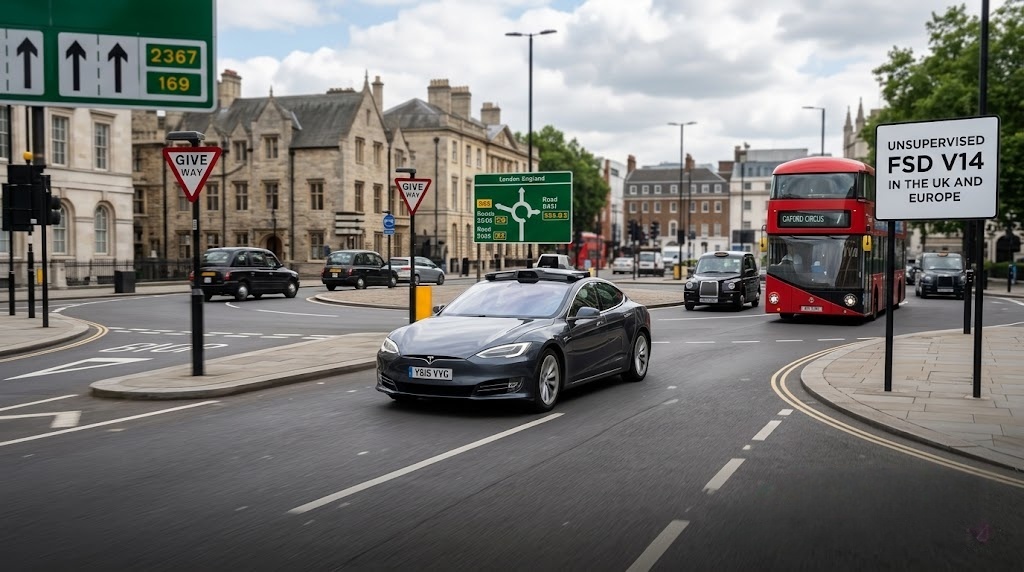
Chapter 1: The Legal "Icebreaking" – How Europe and the UK Opened the Gates
For years, Tesla owners in Europe were frustrated by the "hobbled" version of Autopilot, restricted by the outdated UNECE R79 regulations. However, April 2026 marks the culmination of a regulatory revolution.
The UK’s Automated Vehicles (AV) Act 2024: A Sovereign Advantage
The UK government, seeking to become a global AI hub, utilized its post-Brexit regulatory freedom to implement the Automated Vehicles Act. Unlike the EU, the UK established a clear "Statutory Liability" framework. When FSD v14 is engaged in "Unsupervised Mode" on approved UK motorways and urban A-roads, the Authorized Self-Driving Entity (ASDE)—in this case, Tesla—assumes legal liability for the vehicle's dynamic driving task. This shift from "driver-at-fault" to "manufacturer-accountable" is the cornerstone of the v14 rollout in London and Manchester.
The EU’s DCAS Phase 2: The Continental Shift
In Brussels, the transition has been more cautious but equally transformative. The Driver Control Assistance Systems (DCAS) regulations were updated in late 2025 (Phase 2). This update moved beyond simple lane-keeping to allow for "System-Initiated Maneuvers." FSD v14 leverages these new rules by utilizing Tesla's "Safety Case" data, proving that the neural networks can handle European-specific complexities—like multi-lane roundabouts and cyclist-heavy urban centers—with a safety profile 10x higher than a human driver.
Chapter 2: Technical Deep Dive – The Architecture of FSD v14
FSD v14 is not an incremental update; it is a total paradigm shift in "World Models."
From Predictive Text to Predictive Physics
V14 utilizes a Generative World Model (GWM). While v12 introduced end-to-end neural networks, v14 treats the environment as a fluid, 4D simulation. It doesn't just "see" a cyclist in Amsterdam; it predicts the cyclist's intent based on subtle head tilts and shoulder movements, processed through a transformer-based occupancy network.
Hardware AI5 and the "Inference Moat"
Most European v14 tests are being conducted on the latest AI5 hardware. With 10x the compute power of HW4, AI5 allows v14 to run multiple "what-if" scenarios in parallel. In the 50 milliseconds it takes for a pedestrian to step off a curb in Paris, FSD v14 has already simulated five different braking and swerving trajectories, selecting the one with the lowest G-force and highest safety margin.
The Death of C++ Guardrails
In v14, the last remnants of human-written code (heuristics) have been stripped away. There are no "if-then" statements for European traffic signs. Instead, the system has been trained on millions of hours of European driving data, allowing it to understand the nuance of a "Priority Road" sign in Germany versus a "Give Way" sign in the UK purely through visual context.
Chapter 3: First Test Drives – London, Paris, and the Autobahn
The "Milton Keynes Roundabout" Challenge
The UK’s Milton Keynes is famous for its relentless roundabouts. In early April 2026 tests, FSD v14 demonstrated a "human-like" assertiveness. It no longer waits for a 10-second gap; it identifies "micro-openings," uses subtle vehicle positioning to signal intent to other drivers, and executes entries with a smoothness previously only seen in veteran local drivers.
Navigating the "Etoile" in Paris
The Place de l'Étoile (Arc de Triomphe) is the ultimate test of chaotic emergent behavior. V14’s "Unsupervised" beta in Paris utilized "Vision-ONLY" depth perception to navigate the 12-way intersection. By treating the chaotic flow of traffic as a unified "vector field," the car successfully navigated from the Champs-Élysées to Avenue Victor Hugo without a single intervention, a feat that would paralyze most Level 3 systems from Mercedes or BMW.
Chapter 4: The Consumer Impact – Insurance, Resale, and the Robotaxi Pivot
Insurance Premiums: The Data Dividend
Tesla Insurance, now active in the UK and Germany, has introduced a "V14 Tier." Owners who utilize FSD v14 Unsupervised on their commutes are seeing premium reductions of up to 40%. Since Tesla assumes liability in this mode, the insurance risk shifts from personal behavioral data to fleet-wide software reliability.
The Resale Value of "Hardware Ready" Vehicles
The European used car market is seeing a massive surge in prices for HW4 and AI5 equipped Model 3s and Model Ys. As "Unsupervised" capability becomes a reality, a Tesla is no longer a depreciating asset; it is a productive AI node capable of joining the Tesla Network (Robotaxi).
Conclusion – The End of the Beginning
The "Unsupervised" rollout in Europe and the UK is more than a software update; it is a geopolitical statement. By harmonizing cutting-edge AI with progressive legislation, the UK and EU are finally catching up to—and in some ways, surpassing—the regulatory clarity of the United States. For the Tesla owner in London or Berlin, the car is no longer just a mode of transport. It is a time-saving machine, a safety bubble, and a glimpse into a future where the steering wheel is optional.
FAQ
Q: Can I sleep in my Tesla while FSD v14 is engaged?
A: In the UK, under the AV Act's "Unsupervised" mode on approved roads, the "user-in-charge" does not need to monitor the road, but must be available to take over within a specific transition period if the system issues a request. Sleeping is currently still restricted until "Level 5" certification is reached.
Q: Does v14 work in the rain and snow of Northern Europe?
A: Yes. V14’s "Thermal-Vision" integration and advanced de-noising algorithms allow it to "see" through heavy spray on the M1 or sleet in Oslo better than a human eye can.
Q: Will my HW3 (Intel/Atom) Tesla get v14?
A: HW3 will receive a "Supervised" version of v14, but "Unsupervised" status is currently exclusive to HW4 and AI5 due to the redundancy and compute requirements mandated by European safety standards.