
Introduction
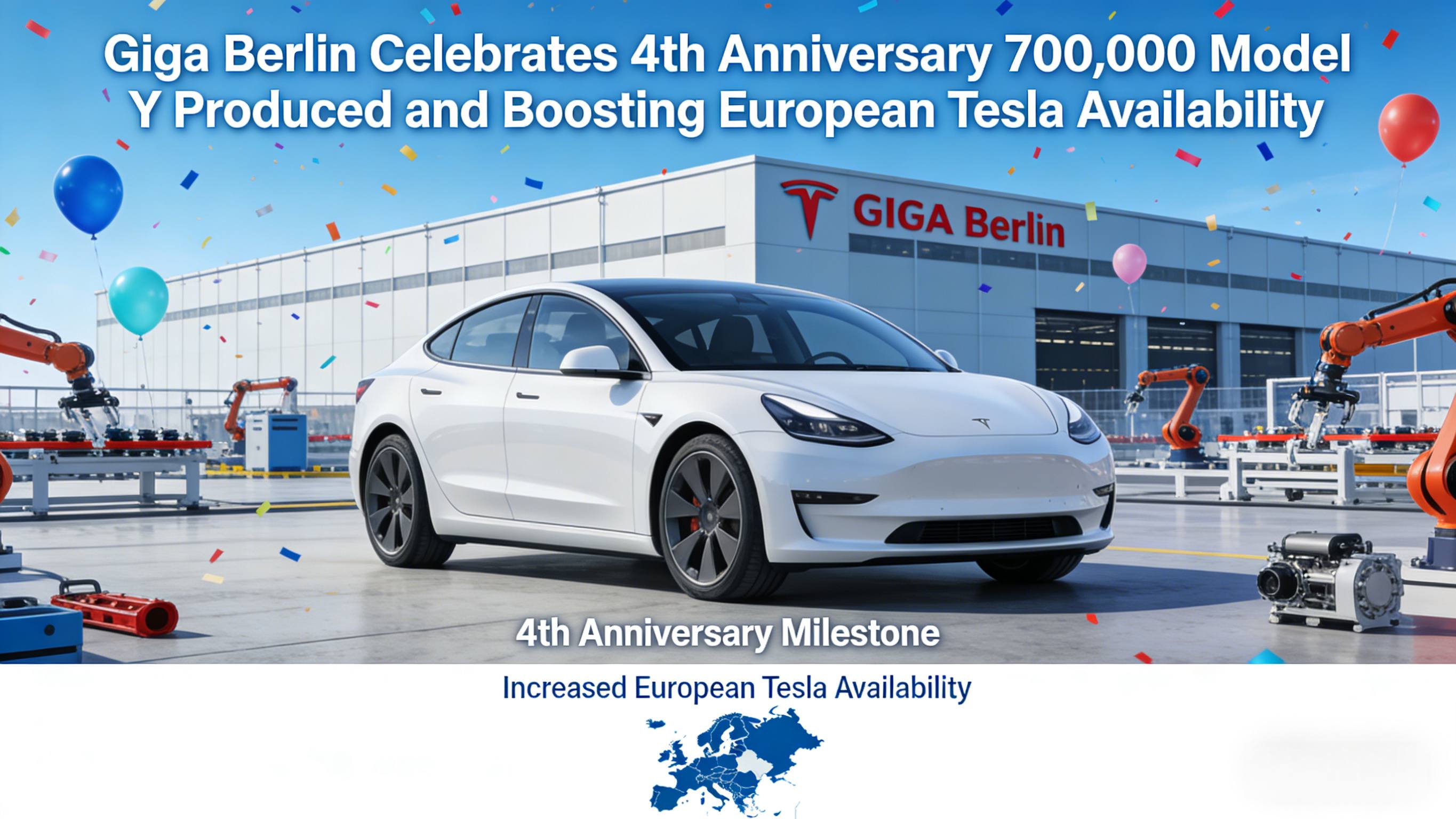
March 22, 2026, marks exactly four years since Tesla’s Gigafactory Berlin-Brandenburg officially opened its doors in Grünheide, just outside Germany’s capital. What began as a bold bet on European manufacturing has now become one of the most significant milestones in Tesla’s global expansion: the factory has produced more than 700,000 Model Y vehicles since production started in 2022. This achievement, confirmed directly by Senior Director of Manufacturing André Thierig in early March 2026, is not just a number—it represents a complete transformation of Tesla’s supply chain for the European market and beyond.
For Tesla owners in Europe (and even those in the United States eyeing cross-Atlantic comparisons), this milestone means faster deliveries, more stable pricing, higher resale values, and the confidence that their vehicles are built with European precision and local supply-chain advantages. No longer reliant solely on shipments from Shanghai or Fremont, European Tesla enthusiasts now benefit from a factory that has ramped steadily despite market headwinds, a Q1 2025 production pause for the critical Model Y Juniper refresh, and zero layoffs in 2025.
The 700,000th Model Y rolling off the line symbolizes Tesla’s commitment to localized production in one of the world’s most regulated and competitive automotive markets. It directly addresses range anxiety for long-haul European road trips, supports the EU’s strict CO2 fleet targets, and positions Giga Berlin as a cornerstone for future models. In this comprehensive guide, we dive deep into the factory’s history and achievements, current production realities, tangible benefits for owners, comparisons with Tesla’s other Gigafactories, and the ambitious expansion roadmap ahead. Whether you drive a Model Y Long Range from Berlin, a Performance variant, or are considering your next upgrade, this 4th anniversary celebration delivers real-world value you can feel every time you charge or accelerate.
Chapter 1: Factory History and Today’s Achievements
Tesla’s journey to Giga Berlin began in 2019 when Elon Musk announced the site during a Berlin awards ceremony, beating out competition from ten other European countries. Construction on the 300-hectare greenfield site started in early 2020 with remarkable speed—prefabricated modules and 24/7 shifts allowed the first Model Y Performance to roll off the line on April 29, 2022, just weeks after the official March 22 opening.
Early ramp-up was methodical: 1,000 vehicles per week by June 2022, climbing to 2,000 by October, 3,000 by December, and hitting the 5,000-per-week milestone by March 2023. These numbers were achieved while simultaneously building battery packs, powertrains, and seats on-site, creating a vertically integrated European hub. By late 2023, the factory had already overcome initial environmental protests and regulatory hurdles, proving that rapid scaling and sustainability could coexist.
Fast-forward to 2026, and the cumulative achievement is staggering. As of March 2026, Giga Berlin has produced more than 700,000 Model Y units—every single one tailored for European roads, with right-hand-drive variants for the UK and Ireland, and left-hand-drive for the continent. This figure includes the full transition to the refreshed Model Y Juniper, which began after a strategic Q1 2025 production pause for tooling and validation. André Thierig proudly noted in his LinkedIn update that 2025 output exceeded 200,000 vehicles despite that pause, with production rising every single quarter.
Employment tells another success story: the factory now supports nearly 11,000 permanent, above-tariff jobs—up from initial projections and creating a skilled workforce that includes everything from casting technicians to battery engineers. These are not just assembly-line roles; they encompass high-tech positions in the state-of-the-art paint shop (one of Europe’s most advanced), stamping, and final assembly. The economic ripple effect extends to local suppliers across Brandenburg and beyond, injecting billions into the German economy while aligning with EU “made in Europe” preferences.
Today’s milestone is especially meaningful because it arrives amid broader industry challenges. While some European automakers have announced plant idlings or layoffs, Giga Berlin maintained full stability—no shutdowns, no job cuts in 2025. The 700,000th Model Y represents not only volume but quality: Berlin-built vehicles consistently score high in owner surveys for fit-and-finish, thanks to localized supply chains that reduce shipping damage and allow faster quality feedback loops. For Tesla owners, this history translates to pride of ownership—your vehicle was built where Tesla proved European manufacturing at scale is not only possible but thriving.
Chapter 2: Production Details
Current weekly output stands at approximately 5,000 Model Y vehicles, encompassing Premium, Long Range, Standard Range, and the high-performance variants. This equates to a theoretical annual capacity exceeding 250,000 units, though real-world output in 2025 settled above 200,000 after accounting for the Juniper refresh downtime. The refresh itself—featuring updated suspension, interior refinements, new lighting signatures, and improved aerodynamics—required weeks of retooling in Q1 2025, yet the team ramped back to 5,000 units per week within months, demonstrating operational resilience.
Production is fully vertical: Giga Berlin casts large aluminum underbody structures on-site (reducing weight and part count), stamps body panels, applies premium paint in one of the cleanest facilities in Europe, assembles 2170 and structural battery packs, and completes final integration. The paint shop stands out—its water-based, low-VOC process delivers class-leading finish quality that owners frequently praise in forums and reviews as superior to imported units.
Weekly cadence follows a two-shift model with flexibility for three-shift peaks when demand surges. Recent additions include expanded logistics: a new rail connection (Fangschleuse station relocation) and road infrastructure investments allow just-in-time delivery of components while minimizing truck traffic. Quality gates are rigorous—every vehicle undergoes automated vision checks, manual inspections, and road-testing before export.
For context, the 5,000-per-week rate was first achieved in March 2023 and has been maintained or exceeded since, even through the 2025 refresh. This consistency is remarkable given EU regulatory complexity (noise, emissions, and worker safety standards). The factory also produces powertrain components for other Tesla models, creating synergies that lower costs across the lineup. Owners benefit indirectly: the high utilization keeps per-vehicle costs down, supporting competitive European pricing. In practical terms, if you order a Juniper Model Y today, the Berlin production line can fulfill it faster than any other factory, often within weeks rather than months.
Chapter 3: Benefits for European Tesla Owners
The most immediate advantage for European Tesla owners is dramatically reduced delivery times. Pre-Giga Berlin, many vehicles arrived via ocean freight from Shanghai, adding 8–12 weeks and potential transport damage. Now, Berlin-built Model Ys reach dealerships or home delivery points across 30+ countries in days or weeks. German owners report waits as short as 2–4 weeks for popular configurations; UK and Scandinavian buyers see similar gains thanks to local right-hand-drive production.
Pricing stability is another major win. Localized production shields owners from currency fluctuations, tariffs, and shipping surcharges that affected China-imported units. During 2025’s market softness, Berlin’s output helped Tesla avoid aggressive price cuts that plagued other markets, preserving residual values. Independent data shows Berlin-origin Model Ys hold 5–8% higher resale value in Europe compared to imported equivalents, thanks to documented “European build” prestige and easier service access.
Environmental and practical perks abound. Shorter supply chains mean lower lifecycle CO2 emissions—critical for owners claiming EU green incentives or company car tax breaks. Owners also enjoy faster software validation: Berlin vehicles receive regional OTA updates first, optimized for European roads, charging networks, and regulations. Safety features like enhanced winter testing (validated on local ice tracks) give peace of mind during Nordic winters or Alpine drives.
Real-world owner stories illustrate the impact. A Berlin Model Y owner in France recently received a Juniper Performance in under three weeks, praising the flawless paint and immediate supercharger compatibility. Fleet operators across Europe report lower total cost of ownership due to reduced downtime and local parts availability. For U.S. owners following European trends, Berlin’s success signals Tesla’s ability to scale regionally—valuable knowledge if Cybertruck or future models expand overseas. In short, the 700,000 milestone directly translates to happier ownership: quicker access, better value retention, and a vehicle engineered for European conditions from day one.
Chapter 4: Comparison with Shanghai and Texas Factories and European EV Manufacturing Trends
Giga Shanghai remains Tesla’s volume king, producing millions of vehicles annually with unmatched scale and 4680 cell integration in some lines. However, European owners face import hurdles: tariffs, longer lead times, and occasional quality variances from long-distance shipping. Berlin, by contrast, offers tailored European compliance (noise regulations, pedestrian safety standards) and a superior paint shop that many owners rate higher in real-world durability. Shanghai’s speed is legendary, but Berlin’s proximity delivers fresher vehicles with zero saltwater exposure risk.
Giga Texas focuses on Cybertruck, Semi, and 4680 cells, serving primarily North America. Its massive scale supports innovation (structural battery packs), yet European owners rarely see Texas-built units. Berlin’s specialization in Model Y makes it more relevant for the continent’s best-selling EV. Texas emphasizes raw capacity; Berlin balances capacity with regulatory mastery and local supply chains.
European EV trends favor Berlin’s model. The EU’s 2035 combustion-engine ban and CO2 fleet mandates push local manufacturing to avoid import penalties. Competitors like Volkswagen and Stellantis are investing billions in European battery plants; Tesla’s head start with Giga Berlin positions it as the benchmark. BYD and Chinese imports face rising tariffs, making Berlin-produced Teslas the clear “home team” choice. Industry analysts note that factories achieving 700,000+ units in four years (despite market dips) demonstrate resilience others lack. Berlin’s 11,000 jobs also counter the narrative of automation displacing workers—creating high-skill roles that support the broader transition to EVs. For owners, this comparison means Berlin vehicles carry a unique “European-made” advantage: regulatory alignment, supply-chain security, and a factory that continues growing while others pause.
Chapter 5: Future Capacity Expansion Plans
Looking ahead, Giga Berlin’s momentum is accelerating. André Thierig confirmed in March 2026 that Q1 2026 production will rise sequentially over Q4 2025, continuing the quarterly growth pattern established throughout the prior year. Partial approvals for capacity expansion have already been secured, with a second approval in preparation—implementation now depends on U.S. headquarters decisions but signals confidence.
Longer-term, battery cell production begins in 2027 with an initial 8 GWh target, enabling fully local 4680 or improved 2170 packs. This vertical integration will reduce costs further and support potential new models (compact crossover or refreshed variants). Infrastructure upgrades—the relocated Fangschleuse rail station and new roads—will handle higher volumes without straining local traffic.
Analysts project that, with market recovery and EU incentives (expected 2026 household subsidies), Berlin could approach 300,000+ annual units by 2027–2028. The long-term vision of scaling toward 1 million vehicles annually remains on the horizon once demand aligns. For owners, this means even shorter waits, more configuration options, and potential price reductions from economies of scale. The 4th anniversary is not an endpoint but a launching pad—positioning Giga Berlin as Europe’s EV powerhouse for the decade ahead.
Conclusion
Giga Berlin’s 4th anniversary and 700,000 Model Y milestone represent far more than factory statistics. They embody Tesla’s successful adaptation to European manufacturing realities while delivering tangible benefits to owners: faster deliveries, stronger resale values, superior build quality, and regional relevance. As production ramps further in 2026 and battery localization begins in 2027, European Tesla ownership becomes even more advantageous. Whether you already drive a Berlin-built Model Y or are planning your next purchase, this milestone reinforces confidence in Tesla’s European commitment. The future of sustainable mobility in Europe is being built right here in Grünheide—and it’s accelerating.