
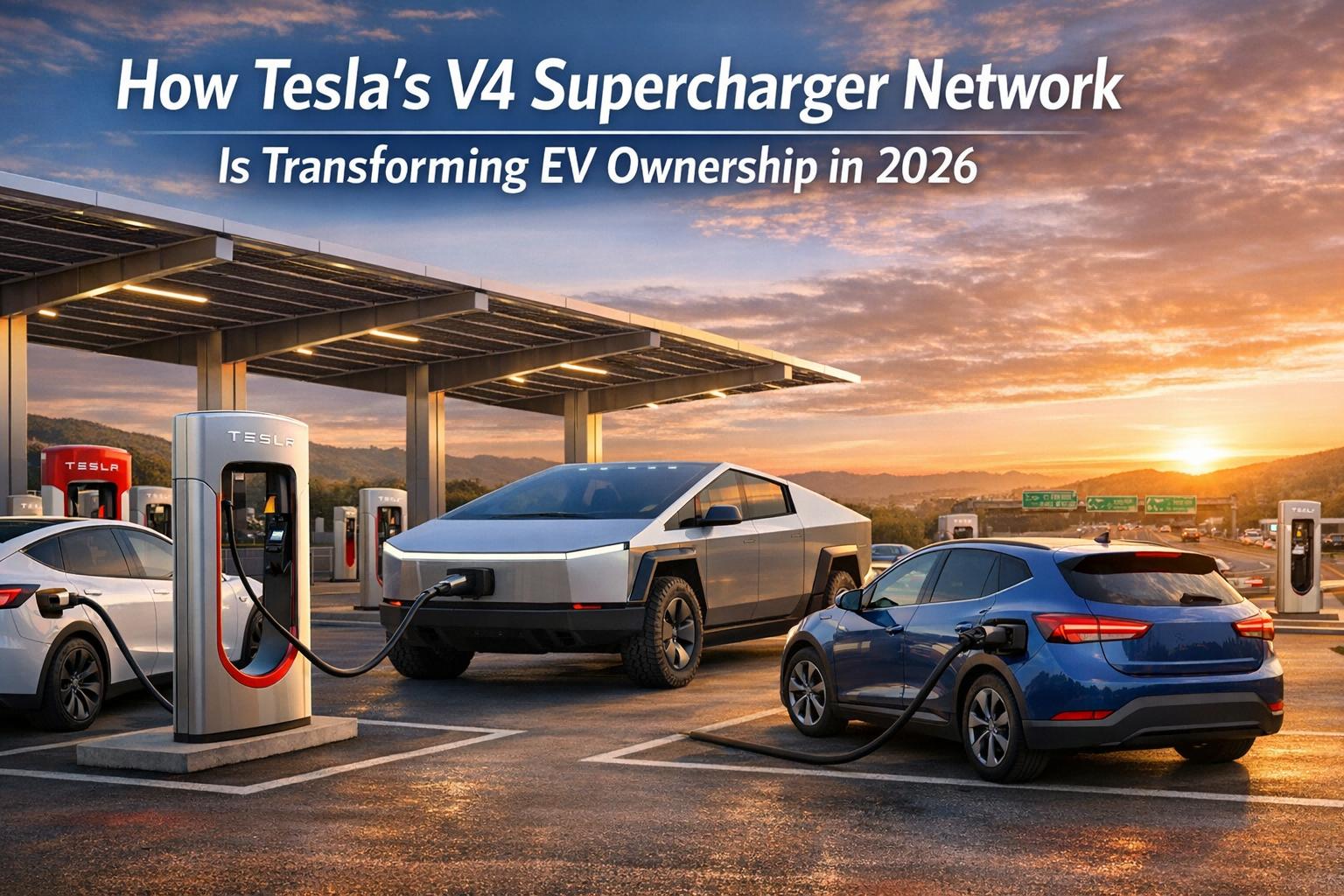
Introduction: The Year Charging Caught Up with Ambition
For as long as electric vehicles have existed, the conversation has been dominated by a single anxiety: range. How far can I go? Where will I charge? How long will it take? These questions have haunted EV adoption, fueled by early networks that were slow, unreliable, and sparse. But in early 2026, that narrative is finally shifting—and Tesla's V4 Supercharger network is leading the charge.
On January 23, 2026, Tesla Charging announced on X (formerly Twitter) the opening of an eight-stall Supercharger site in Taylorsville, Utah. Buried in the announcement was a specification that would have seemed like science fiction just a few years ago: "up to 500 kW max" charging speed. For context, Tesla's ubiquitous V3 Superchargers max out at 250 kW. The V4 cabinet now entering service delivers double that power—enough to add hundreds of miles of range in the time it takes to grab a coffee.
But 500 kW is only part of the story. Tesla is simultaneously preparing for 1.2 MW Megacharger deployments in Europe, expanding its network to accommodate non-Tesla vehicles, and retrofitting existing sites with longer cables and improved reliability. For owners in the United States and Europe, 2026 is shaping up to be the year that charging infrastructure finally catches up with vehicle capability.
Section 1: The V4 Supercharger—Technical Architecture and Capabilities
1.1 From V3 to V4: What Changed Under the Hood
Tesla's V3 Superchargers, which began deployment in 2019, represented a major leap forward with their 250 kW liquid-cooled cables and shared cabinet architecture. But V3 was fundamentally limited by its power electronics and thermal management. Each V3 cabinet could power up to four stalls, sharing 350 kW of total capacity—meaning that while one stall could peak at 250 kW, simultaneous usage reduced individual speeds.
The V4 Supercharger system, first formally unveiled in November 2024, reimagines this architecture from the ground up. According to Max de Zegher, Tesla's director of charging in North America, the new V4 cabinets deliver "three times the power density at a lower cost" while supporting up to eight stalls per cabinet—double the capacity of V3.
The key specifications of V4 include:
Power Output: Up to 500 kW for passenger vehicles, 1.2 MW for Tesla Semi trucks
Voltage Range: 400–1,000 V, enabling full-speed charging for 800 V architecture vehicles
Cabinet Capacity: Each cabinet supports up to 8 stalls, reducing site footprint and complexity
Deployment Speed: Simplified electrical requirements enable faster installation
Reliability: Hardware designed for higher uptime and lower maintenance
1.2 The 500 kW Breakthrough: What It Actually Means
When Tesla announced the Taylorsville, Utah site with 500 kW capability, it marked the first public deployment of true V4 power levels. Prior V4 installations, including those in Europe and select US locations, had been limited to V3-level performance (250 kW) while awaiting upgraded stall electronics.
The 500 kW capability is not merely incremental. At this power level, a compatible vehicle could add approximately 75 miles of range in five minutes, or 200 miles in 15 minutes—assuming the battery can accept that rate. For context, even Tesla's fastest-charging vehicles today typically taper from peak rates as state of charge increases. But the headroom provided by 500 kW infrastructure means that even when charging at lower rates, the hardware is never the bottleneck.
Tesla claims that the V4 cabinets, combined with the new stall electronics rolling out in 2026, will enable "up to 500 kW for cars" while requiring "less than 1 MW across 8 posts to deliver maximum power to cars 99% of the time". This statistical approach to power sharing ensures that sites can be built with less grid capacity than their theoretical peak would suggest, reducing connection costs and accelerating deployment.
1.3 The Megawatt Connection: V4 and the Tesla Semi
The V4 cabinet's capabilities extend far beyond passenger vehicles. By configuring the same hardware for higher power delivery, Tesla can support 1.2 MW charging for the Tesla Semi—a critical requirement for long-haul trucking operations.
This dual-use strategy is elegant. Rather than developing separate charging systems for cars and trucks, Tesla can deploy V4 cabinets universally, then allocate power based on vehicle type and site configuration. For owners, this means that as Semi production ramps at Giga Nevada in 2026, the charging infrastructure supporting those trucks will be compatible with passenger vehicles—and vice versa.
Max de Zegher framed this as "the tech that will make 1.2MW charging for Semi, and 0.5 MW charging for cars, ubiquitous around the world". The vision is a unified charging ecosystem where the same hardware serves everything from a Model 3 to a Class 8 truck, differentiated only by software and site planning.
Section 2: The State of the Network in Early 2026
2.1 Global Scale and Utilization
By the end of 2025, Tesla had deployed approximately 8,182 DC fast-charging stations and 77,682 connectors globally—a 17–19% increase in a single year for both metrics. The network delivered roughly 6.7 terawatt-hours of electricity in 2025, with the fourth quarter alone accounting for 1.8 TWh across approximately 52 million charging sessions.
These numbers reveal a network operating at a massive scale. Worldwide, each stall averaged about 7.5 charging sessions per day, delivering approximately 260 kWh daily. During the 2025 Thanksgiving holiday in the United States, Tesla recorded roughly two million charging sessions in just five days—a testament to both network utilization and the growing reliance on Supercharging for long-distance travel.
2.2 US Dominance and European Density
In the United States, Tesla's network has achieved remarkable market share. Estimates suggest Tesla operates roughly 37,000 fast-charging ports domestically—approximately 52% of all DC fast-charging ports in the country. More than half of America's fast-charging plugs belong to a single company, and those plugs are strategically concentrated along interstates, urban centers, and key travel corridors.
The scale of new sites has also increased. In 2025 alone, Tesla rolled out at least 353 US stations with ten or more ports, reducing congestion risk during peak travel periods.
Europe presents a different picture, shaped by CCS standardization and more fragmented deployment. Many Tesla Superchargers in Europe already use CCS connectors or are co-located with CCS hardware, making multi-brand integration more straightforward. Key countries—Germany, France, the UK, Norway, the Netherlands—have extensive coverage, enabling cross-continental road trips from Amsterdam to Barcelona or Berlin to Milan.
2.3 The V4 Deployment Pipeline
As of early 2026, true 500 kW V4 sites remain limited but are expanding rapidly. The Taylorsville, Utah, location joined an earlier site that began construction in September 2025, suggesting that Tesla is methodically rolling out upgraded hardware while continuing to build standard V4 cabinets that can be upgraded later.
Tesla has indicated that the V4 cabinets themselves are designed for reliability and rapid deployment. With each cabinet supporting up to eight stalls, new sites require less electrical equipment and smaller footprints, accelerating the pace of expansion. For owners, this means that the bottleneck for new Supercharger locations increasingly shifts from Tesla's manufacturing capacity to local permitting and grid connection timelines.
Section 3: The Multi-Brand Reality—NACS, Adapters, and Network Access
3.1 NACS as the North American Standard
The most significant structural shift in North American charging is the emergence of NACS (North American Charging Standard)—Tesla's proprietary plug design—as a de facto industry standard. Over the past two years, nearly every major automaker selling EVs in North America has announced plans to adopt NACS for future vehicles, including Ford, General Motors, Mercedes-Benz, Volvo, Hyundai-Kia, and others.
This transition has profound implications for Tesla owners. On one hand, opening the network to other brands generates additional revenue that funds further expansion and upgrades. More paying users justify larger sites, higher-power hardware, and better amenities. On the other hand, more vehicles competing for the same stalls could mean increased congestion, particularly at older or smaller sites in high-traffic regions.
Early evidence suggests localized crowding at some popular locations following pilot openings, but Tesla appears to be responding by building larger sites and deploying V4 hardware with longer cables designed to accommodate vehicles with different charge-port positions.
3.2 The Adapter Era
During the transition to universal NACS adoption, adapters will play a crucial role. Many existing non-Tesla EVs will rely on NACS-to-CCS adapters to use Superchargers, while Tesla owners may need CCS adapters to access third-party networks. This adapter complexity is expected to diminish over time as NACS ports become standard on new vehicles, but 2026–2028 will be a transitional period where connector types, power capabilities, and adapter limitations still matter.
For Tesla owners, the practical implication is straightforward: carry appropriate adapters if you plan to use non-Tesla charging networks, but expect the Supercharger experience to remain the gold standard for convenience and reliability.
3.3 European Access and Regulation
In Europe, the multi-brand dynamic is more mature. CCS has been the legal and practical standard for public DC charging for years, and many Tesla Superchargers already use CCS connectors. Tesla has selectively opened Supercharger sites to non-Tesla CCS vehicles in several European countries, guided by regulatory requirements and funding rules that favor open access infrastructure.
For European Tesla owners, this means the "privileged exclusivity" of Superchargers is already diminished in some markets, but it also ensures the network is more financially sustainable and integrated into national infrastructure plans.
Section 4: European Expansion—Megachargers and Semi Preparation
4.1 The Central Europe Hiring Push
Perhaps the most significant European charging news in early 2026 came from a LinkedIn post by David Forer, Tesla's Senior Project Developer for Charging. Forer announced that Tesla is hiring a dedicated Business Development lead for Commercial Charging in Central Europe, based in Munich. The role will focus on "closing large-scale deals across Tesla's entire commercial charging portfolio—including both Supercharging and Megacharging".
This hiring signals that Tesla is preparing for significant European charging infrastructure expansion, with a specific focus on commercial applications. While Supercharging is already well established in Europe, Megachargers—the ultra-high-power systems designed for the Tesla Semi—have so far been deployed exclusively in the United States.
4.2 Semi Certification and Timeline
The Semi itself is currently operating only on US roads, with early customers like PepsiCo using pre-production vehicles. Mass production is ramping at Giga Nevada in 2026, with a goal of eventually producing 50,000 units annually.
For European deployment, Tesla faces regulatory hurdles. The company has been working to certify the Semi for European roads since at least late 2024, a process that could prove quicker than FSD certification, which remains pending. Once certified, the Semi will require a network of Megachargers capable of delivering 1.2 MW—far beyond even the most powerful passenger vehicle chargers.
4.3 Implications for European Owners
Why should European Tesla owners care about the Semi charging infrastructure? Because Megacharger sites, once built, will likely be accessible to passenger vehicles as well. The V4 cabinets that power Megachargers are the same hardware that enables 500 kW passenger charging. As Tesla builds out commercial charging corridors for trucks, passenger vehicles will benefit from the same infrastructure—potentially opening new routes and reducing congestion at existing sites.
Additionally, Tesla's investment in European charging infrastructure generally benefits all owners. More sites mean more redundancy, shorter waits, and greater confidence for long-distance travel.
Section 5: The Owner Experience—What 500 kW Charging Actually Feels Like
5.1 The Charging Curve Reality
It's important to manage expectations around 500 kW charging. Battery chemistry and thermal limitations mean that even the most advanced vehicles can only sustain peak rates for a portion of the charging session. The shape of the charging curve—how power tapers as state of charge increases—matters more than the absolute peak number.
That said, 500 kW infrastructure provides substantial headroom. For vehicles capable of accepting high rates, the initial portion of a charging stop will be dramatically faster. More importantly, even as batteries age or temperatures vary, the charger itself will never be the limiting factor. Future vehicles with improved battery chemistry will be able to exploit this headroom more fully.
5.2 The Cable Difference
One of the most underappreciated improvements in V4 Superchargers is the cable itself. Longer cables, designed to reach vehicles with different charge-port positions, eliminate the awkward parking maneuvers required at some V3 sites. For owners of Cybertrucks, vehicles towing trailers, or simply those who prefer not to back in perfectly, this is a genuine quality-of-life improvement.
5.3 Payment and Pricing
Tesla's V4 sites include new physical payment terminals, making it easier for non-Tesla owners to charge without requiring the Tesla app. For Tesla owners, pricing at the Taylorsville, Utah site ranges from $0.27 to $0.37 per kWh, compared to $0.38–0.52 for non-Tesla vehicles. This pricing differential reflects Tesla's strategy of offering members (Tesla owners) preferential rates while still monetizing non-Tesla access.
In Europe, AFIR regulations mandate transparent pricing and contactless payment options, which Tesla has implemented across its network.
Section 6: Policy and Regulatory Landscape
6.1 US Policy Under the Trump Administration
The policy environment for EV charging in the United States has shifted significantly under the Trump administration. The traditional federal EV tax credit has been replaced by deductions for auto-loan interest on US-assembled vehicles, changing the economics of EV ownership. For charging infrastructure, federal grants and subsidies remain available but increasingly emphasize reliability standards, open payment methods, and support for the NACS standard.
Tesla's network is partially insulated from policy uncertainty by its scale and multi-brand strategy. With more than half of the US fast-charging ports in its network, Tesla generates sufficient revenue from charging sessions to continue expansion regardless of federal incentives.
6.2 European Regulation and AFIR
Europe takes a different approach. The EU's Alternative Fuels Infrastructure Regulation (AFIR) mandates minimum coverage on key transport corridors, transparent pricing, and non-discriminatory access. This means drivers can pay at fast chargers with contactless cards without needing proprietary apps, and prices must be clearly displayed.
For Tesla's European Superchargers, these rules have driven changes in pricing display, session initiation methods, and vehicle access policies at funded sites.
6.3 Data and Connectivity Considerations
Europe is also grappling with broader questions around connected vehicles and data, including concerns about vehicles built in or connected to China. While much of this debate focuses on data security and imports, it has indirect implications for Tesla because of its global manufacturing footprint and heavy reliance on over-the-air connectivity. Stricter rules on data handling could affect how vehicles and charging systems authenticate, communicate, and share data with grids and regulators.
Section 7: The Road Ahead—What 2026 and Beyond Hold
7.1 500 kW Proliferation
Tesla has indicated that V4 cabinets capable of 500 kW will become standard at new sites throughout 2026, with existing V4 locations upgraded as stall electronics become available. By year-end, major travel corridors in the US and Europe should have at least some 500 kW capability, though widespread coverage will take longer.
7.2 Megacharger Networks
The hiring push in Europe suggests that Megacharger deployment is approaching. Once the Semi certification is complete, Tesla will need to rapidly build out 1.2 MW charging along freight corridors. For passenger vehicle owners, this means even more infrastructure—and potentially access to high-power charging at locations designed for trucks.
7.3 Integration with Energy Storage
Tesla's energy storage business intersects with charging in interesting ways. Sites with Megapack batteries can buffer grid demand, reducing connection costs and enabling faster deployment. As storage costs decline, more Supercharger sites may incorporate on-site batteries, further accelerating expansion.
7.4 The Robotaxi Connection
Finally, Tesla's robotaxi ambitions depend on reliable, high-speed charging. Cybercabs and robotaxi fleet vehicles will need to charge quickly between trips to maximize utilization. V4's 500 kW capability—and the 1.2 MW capacity for potential robotaxi-specific vehicles—supports this vision.
Conclusion: The Network as Moat
For years, Tesla owners have enjoyed Supercharger access as a competitive advantage. That advantage remains, but its nature is evolving. In 2026, the Supercharger network is no longer just a private amenity for Tesla drivers; it is becoming the backbone of North American fast charging and a critical component of European infrastructure.
The V4 rollout—with 500 kW speeds, longer cables, multi-vehicle compatibility, and Megacharger integration—represents a generational upgrade. For owners, this translates into faster charging stops, more site availability, and greater confidence for long-distance travel. The network that once seemed like a nice-to-have is increasingly essential to the EV ownership experience.
Tesla's capital expenditure plans, with continued investment in charging infrastructure, ensure that this moat deepens even as competitors attempt to catch up. For owners in the United States and Europe, the message is clear: your charging experience will only get better.
Frequently Asked Questions
Q1: How do I know if a Supercharger site offers 500 kW?
Tesla typically indicates maximum power in the in-car navigation system and mobile app. Sites with 500 kW capability are still limited as of early 2026, but Tesla has announced the first such site in Taylorsville, Utah, with more to follow. Check the site details before your trip to understand the available power.
Q2: Will my current Tesla charge at 500 kW?
Only vehicles capable of accepting 500 kW will benefit from the full speed. Most existing Teslas have maximum charge rates below 500 kW, though newer vehicles with improved battery chemistry may approach higher rates. The Cybertruck, with its 800 V architecture, is expected to benefit significantly from V4's higher voltage range.
Q3: When will V4 Superchargers reach Europe?
Tesla has already deployed some V4 stalls in Europe, though initially limited to V3 power levels. The upgraded stall electronics, enabling 500 kW, are rolling out in 2026. European owners should expect gradual deployment, with major corridors receiving upgraded hardware over the course of the year.
Q4: Will non-Tesla EVs crowding Superchargers affect me?
In the short term, localized crowding is possible at popular sites following network openings to other brands. However, Tesla is responding by building larger sites with more stalls and deploying V4 hardware designed for mixed-vehicle usage. Over time, the revenue from non-Tesla access should fund even faster network expansion.
Q5: What adapters should I carry?
For Tesla owners in North America, carrying a CCS1-to-NACS adapter allows access to third-party CCS networks. In Europe, CCS is standard at most public chargers, so Tesla owners with CCS-compatible vehicles may not need adapters for most sites. Check your vehicle's connector type and plan accordingly.
Q6: Will Tesla build Megachargers in my country?
Tesla is actively preparing for European Megacharger deployment, with a hiring push focused on Central Europe. Initial Megacharger locations will likely follow freight corridors and major transportation routes, with expansion over time.
Q7: How much does Supercharging cost in 2026?
Pricing varies by location, time of day, and membership status. At the Taylorsville, Utah V4 site, Tesla owners pay $0.27–0.37 per kWh, compared to $0.38–0.52 for non-Tesla vehicles. European pricing varies by country but must be transparently displayed under AFIR regulations.
Q8: Can I charge a Tesla Semi at a standard Supercharger?
No. The Semi requires Megachargers capable of 1.2 MW output. However, the V4 cabinets that power Megachargers are the same hardware that enables 500 kW passenger charging, so sites may support both vehicle types with appropriate stall configurations.