
Introduction
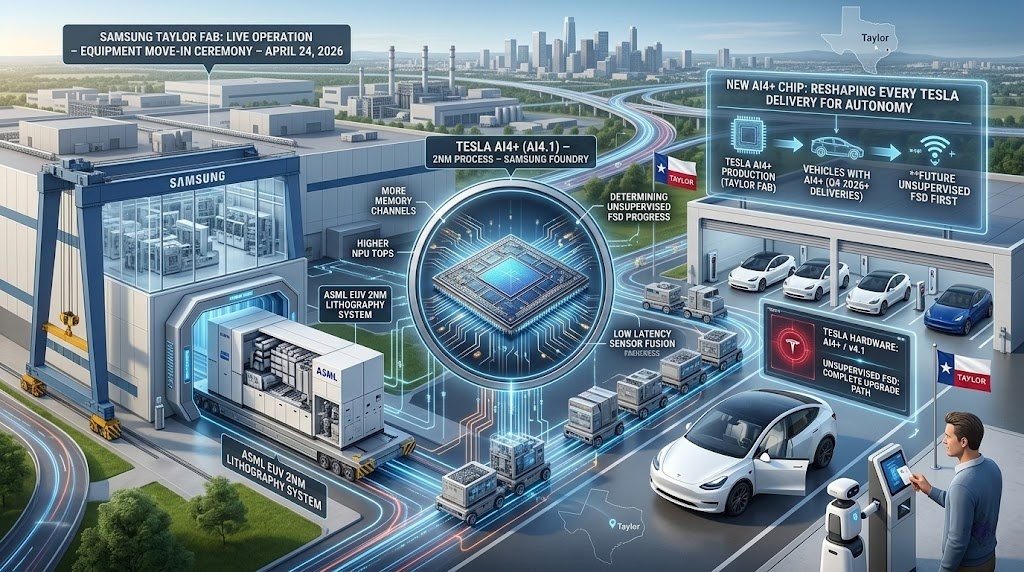
On a hot Friday morning in central Texas, Samsung Electronics took a decisive step toward salvaging a $37 billion bet. At its long-delayed chip fabrication plant in Taylor, just outside Austin, Samsung held an equipment move-in ceremony on April 24, 2026, formally installing the chipmaking machinery that will begin producing silicon for Tesla and other customers later this year. The event brought together Samsung Foundry chief Han Jin-man alongside executives from ASML and Lam Research — suppliers of the extreme ultraviolet lithography and etching tools that will carve circuits onto wafers at the sub-nanometer scale.
For Tesla owners, the Taylor ceremony marks far more than a factory milestone. It is the physical stage for a sweeping reconfiguration of how Tesla‘s self-driving brains are built: who makes them, on what process technology, and on what timeline. The same week, Musk confirmed on Tesla’s Q1 2026 earnings call that Samsung will produce an upgraded chip designated AI4+ (or AI4.1) — a third Tesla processor in the pipeline alongside AI5 and AI6, all three eventually destined for Samsung‘s 2-nanometer gate-all-around lines at Taylor.
Chapter 1: The Taylor Plant-From Delayed Groundbreaking to $37 Billion Symbol
Samsung broke ground on its Taylor chip factory in November 2022 with enormous fanfare and an initial investment of $17 billion. The plant was scheduled to begin operations in October 2024, but that timeline slipped badly due to setbacks in securing anchor customers. For nearly two years, the partially constructed facility stood as a monument to Samsung Foundry‘s broader struggles — billions spent, little to show, and mounting quarterly losses that local reports estimated at roughly 1 trillion won ($674 million) per quarter since 2022.
Everything changed in July 2025. Samsung secured a $16.5 billion (22.76 trillion won) contract from Tesla to manufacture its AI5 and AI6 chips for autonomous driving systems. It was the largest single‑client order in the history of Samsung‘s foundry division, and it unlocked a torrent of activity. Samsung began deploying advanced‑process engineers to Taylor, then followed up by sending mass‑production teams to prepare the fab for high‑volume output. The once‑delayed site accelerated into overdrive, and by April 2026, Samsung had pulled forward its internal break‑even target for the foundry division to the fourth quarter of 2026 — a full year ahead of the previous 2027 goal.
The April 24 equipment move‑in ceremony formalized what industry watchers had long anticipated: Taylor is finally ready to produce chips. The installation of ASML‘s EUV lithography machines — the most advanced patterning tools in semiconductor manufacturing — signaled that Samsung is not merely preparing for pilot runs but for full‑scale production. According to industry officials, the fab is on track to start producing Tesla’s AI5 chips by the second half of 2026, with AI6 following in 2027. But as we will see in Chapter 4, whether those timelines hold depends almost entirely on a single variable: yield.
Chapter 2: AI4+ -The In‑Between Chip No One Saw Coming
The most immediate news for Tesla owners is not AI5 or AI6, but AI4+ — a chip that Musk himself seemed to introduce almost as an afterthought during the Q1 earnings call. “Samsung is doing a revision on the chip,” Musk told analysts, referring to a variant internally designated AI4.1 or AI4 Plus.
What makes AI4+ noteworthy is its timing. It is not a clean generational leap. It is a mid‑cycle refresh of the current AI4 hardware — more memory, wider bandwidth, and higher compute, but built on the same fundamental architecture as the AI4 chips that have been shipping since late 2023. According to reports following the earnings call, each HW4 Plus system will feature two AI4 Plus chips paired with 32GB of RAM each, for a total system memory of 64GB — double the 32GB total in current HW4 vehicles. Musk also indicated that the chip would include roughly 10% more compute and memory bandwidth compared to the current AI4. Mass production is expected to begin at Samsung Foundry sometime next year, dependent on when Samsung completes the necessary facility modifications. The chip is widely expected to be fabricated on Samsung‘s 7nm process, the same node as today’s AI4.
Musk framed AI4+ not as an admission that current AI4 is inadequate, but as an operational bridge. “Samsung is doing a revision on the chip,” he explained, and noted that AI4+ would allow Tesla to keep its existing production lines running while the far more powerful AI5 — which completed its final design on April 15, 2026 — is routed first to the Optimus humanoid robot and to Tesla‘s AI data centers. AI5 is roughly five to ten times faster than the current AI4 setup, making it drastically overengineered for vehicles in the near term. “It may make sense to transition to AI5 for vehicles at some point, but it’s not urgent right now,” Musk said. “If AI4 hardware becomes too outdated, it could end up being the only reason to keep factories running”.
That last line is worth sitting with. Musk is implicitly acknowledging that AI4 hardware has a limited shelf life — and that AI4+ exists precisely to extend that shelf life without rushing AI5 into cars before the autonomy software stack is ready. But the existence of AI4+ also introduces a new point of confusion for buyers: how do you know whether the Tesla you purchase in late 2026 or 2027 has the current AI4, the unannounced AI4.5 (which Electrek reported quietly shipped in January 2026 for the Model Y built at Fremont), or the future AI4+?
Chapter 3: AI5 and AI6 -The Multi‑Foundry Future
Behind AI4+ lies a far more ambitious roadmap. On April 15, 2026, Musk announced on X that Tesla’s AI chip design team had “taped out” the AI5 processor — a milestone meaning the design is finalized and ready for manufacturing partners. In a notable break from Tesla‘s previous reliance on a single foundry, Musk confirmed that both Samsung and TSMC will produce AI5. TSMC will manufacture AI5 at its fabs in Taiwan and Arizona, while Samsung will produce AI5 at both its Taylor, Texas plant and its Pyeongtaek, Korea facility. Full‑scale mass production of AI5 is anticipated around 2027, though some sampling could begin in late 2026.
The AI5 chip features an intriguing detail that speaks to Tesla‘s deepening integration with Samsung’s broader capabilities. The KR2613 engraving on Musk‘s photo of the prototype indicates that it was manufactured in the 13th week of 2026 at Samsung’s South Korean plant — the first time a Tesla autonomy chip has been produced at a Samsung facility. Additionally, reports indicate that AI5 uses Samsung‘s next‑generation LPDDR5X memory and may incorporate SK hynix memory components, signaling a multi‑vendor memory strategy for Tesla’s most advanced AI chip yet. Samsung has also introduced a custom foundry process for Tesla called “SF2T,” which was originally under development for follow‑up chip AI6 but was applied earlier than planned to AI5 to create a lock‑in effect.
AI6 takes the relationship even further. Under the July 2025 contract, Samsung will produce AI6 exclusively on its 2‑nanometer gate‑all-around process at the Taylor fab. Musk has described AI6 as delivering roughly double the performance of AI5 at the same die size. Even more ambitiously, there is already talk of an AI6.5 variant, which will be manufactured on a 2nm node by TSMC in Arizona, offering further performance gains. Musk previously noted that the tape‑out for AI6 could happen as early as December 2026.
Taken together, Tesla’s chip pipeline now spans at least four major variants — AI4, AI4.5, AI4+, AI5, AI6, and AI6.5 — spread across two foundries, two continents, and multiple process nodes. For the average Tesla owner, this proliferation raises an uncomfortable question: how do you future‑proof a purchase when the hardware underneath the frunk changes every six to nine months?
Chapter 4: The Yield Problem-Can Samsung Deliver?
Behind all of these chips lies a sobering reality: advanced semiconductor manufacturing is brutally hard, and Samsung is not winning.
According to industry sources cited by South Korean media, Samsung‘s 2‑nanometer yield currently sits in the mid‑50% range — around 55% by many estimates — still below the 60% threshold typically considered stable for mass production. By comparison, TSMC has achieved yields of 80–90% for its competing 2nm‑class nodes. This yield gap is not a minor footnote; it is the central risk factor for every chip Samsung intends to produce for Tesla.
The technological roots of the gap are instructive. Samsung adopted Gate‑All-Around (GAA) transistor architecture for its 2nm process — a more advanced design than TSMC‘s FinFET approach — and brought GAA to market one to two years ahead of competitors. But being first with a new transistor architecture does not guarantee being first with manufacturable yield. Samsung’s GAA implementation has struggled to stabilize in high‑volume production, and the high defect rates that result directly translate into fewer usable chips per wafer and higher costs per good die.
For Tesla, the yield gap has cascading consequences. Lower yields mean fewer chips per wafer, which means higher prices per chip and potential supply constraints if Samsung cannot keep up with Tesla’s vehicle production rates. Samsung‘s foundry division has been unprofitable for years — posting roughly 1 trillion won in quarterly losses — and the division’s ability to reach break‑even by Q4 2026 hinges almost entirely on how quickly Taylor‘s 2nm yield improves. If yields stay in the 50–60% range, Samsung could struggle to supply enough AI5 and AI6 chips to meet Tesla’s production targets, and Tesla may need to lean more heavily on TSMC for AI5 volume.
This is not merely an abstract supply chain issue. Vehicle production lines cannot stop because chip yields are low. If Samsung‘s yield problems persist, Tesla may have to extend production of AI4‑and AI4+‑equipped vehicles longer than planned — which could delay the transition to AI5‑class autonomy. For owners, that means the hardware in your next Tesla may be further behind the cutting edge than you expected, simply because the cutting edge is not yet manufacturable in high volumes.
On the positive side, industry analysts see a path forward. Samsung Securities analyst Lee Jong‑wook estimated that Samsung Foundry’s operating loss will narrow to 376.9 billion won in Q1 2026, down dramatically from 1.9 trillion won a year earlier, and that utilization rates are expected to exceed 80%. With wafer prices continuing to rise, a quarterly turnaround could occur as early as Q3 2026. The NVIDIA CEO Jensen Huang also confirmed during GTC 2026 last month that Samsung is manufacturing Groq 3 inference chips, adding a second major AI customer to Samsung‘s roster beyond Tesla. Diversifying its customer base will help Samsung spread fixed costs, but Tesla remains the flagship client — and the one that will suffer most if yields do not improve.
Chapter 5: What This Means for Owners- Hardware Generations as a Buying Criterion
For Tesla owners, navigating the chip roadmap has become as important as understanding battery chemistry or motor types. Here is what each hardware generation means today and in the foreseeable future.
Current AI4 Vehicles (Late 2023 to May 2026 Production): These cars come with 16GB of RAM per chip (32GB total) and are, by Tesla‘s current stance, sufficient for unsupervised Full Self‑Driving when the software is ready. However, the very existence of AI4.5 (already shipping in some Model Y units) and AI4+ (planned for 2027) suggests that Tesla is already hedging. AI4 vehicles will receive FSD updates for the foreseeable future, but they may be the first generation to feel the squeeze as AI models grow larger and more demanding.
AI4.5 Vehicles (January 2026 onward in some models): This revision — never formally announced by Tesla — appears to use a three‑chip design instead of AI4’s original two‑chip architecture. It may offer modest performance improvements without a full generational leap. If you are buying a Tesla today, there is no reliable way to know whether you are getting AI4 or AI4.5 without accessing the vehicle information menu after delivery.
AI4+ Vehicles (Expected late 2026 or 2027): These will feature double the memory (64GB total) and modest compute improvements. Musk explicitly framed AI4+ as a way to “keep existing production lines running” while AI5 goes elsewhere. For buyers, an AI4+ vehicle will likely have a longer autonomy lifespan than current AI4 vehicles, but it remains to be seen whether Tesla will advertise the difference or treat it as an invisible mid‑cycle improvement.
AI5 Vehicles (Expected from 2028 onward, possibly later): AI5 is five to ten times more powerful than current AI4, but Musk has been clear that it is overengineered for near‑term vehicle needs and will go into Optimus robots and data centers first. When AI5 does reach vehicles, it should provide massive headroom for future updates — but that could be three or more years away.
Resale Value Implications: The hard lesson of HW3 — which Musk finally conceded cannot run unsupervised FSD — is that older hardware generation vehicles depreciate sharply once a software cutoff arrives. Broadly speaking, AI4, AI4.5, and AI4+ vehicles will hold value differently if Tesla eventually signals that unsupervised FSD requires 64GB of memory or a three‑chip architecture. Prospective buyers should treat hardware generation as a major factor in their purchase decision — more so than paint color, wheel size, or even battery range.
A Note for European Owners: European Teslas must comply with RDW regulations for FSD (Supervised), which require HW4 hardware as the baseline. The Dutch approval explicitly notes compatibility only with HW4 vehicles — a category that includes AI4 and above. HW3 vehicles cannot activate the approved FSD system in the Netherlands. European buyers should verify hardware generation carefully, as the leap from HW4‑compatible to HW4‑plus could matter when the EU moves toward bloc‑wide FSD approval.
Conclusion
The equipment move‑in ceremony at Samsung‘s Taylor fab on April 24, 2026, marks a genuine turning point — not just for Samsung Foundry’s attempt to claw back market share from TSMC, but for Tesla‘s ability to secure a diversified, Americas‑based supply of the chips that will power autonomy for the next decade. The addition of AI4+ to Tesla’s Samsung pipeline underscores a broader truth: hardware generations are accelerating, and the days of buying a Tesla and assuming it will have the latest hardware for years are over.
For owners, the path forward requires more diligence than ever. Check your vehicle‘s hardware version in the software menu. Research whether AI4.5 or AI4+ matters for your long‑term plans. Consider whether waiting for AI5 is worth an uncertain timeline. And remember that every chip discussed in this article — AI4, AI4+, AI5, AI6 — is ultimately just a means to an end. The real question is not which chip your car has, but whether that chip will be able to run the software updates that define the Tesla experience three, five, or seven years from now.
The Taylor fab may be installing its machines today. But the chips those machines produce will determine tomorrow’s driving experience. Pay attention to what is under the hood — or rather, under the frunk.
FAQ
1. How do I know which hardware generation my current Tesla has?
Tesla displays hardware version information in the vehicle settings menu. Navigate to Controls > Software > Additional Vehicle Information. Look for “Hardware” or “Autopilot Computer” designation, which should indicate HW3, HW4, or a variant thereof.
2. Will my AI4 car get left behind when AI4+ vehicles ship?
In the near term, no. Tesla has stated that AI4 hardware is intended to be sufficient for unsupervised FSD. AI4+ is an incremental improvement for future production, not a replacement for existing AI4 capabilities. However, owners should remain aware that no official long‑term guarantee has been issued.
3. Can I upgrade from AI4 to AI4+ after purchase?
Almost certainly not. Chip revisions involve different physical die designs, memory configurations, and potentially different printed circuit board layouts. Tesla does not offer hardware retrofits for silicon‑level improvements within the same generation.
4. When will AI5 vehicles actually reach customers?
While AI5 tape‑out is complete, Musk has indicated that transitioning AI5 to vehicles is “not urgent right now” and that AI5 will go to Optimus robots and data centers first. Realistic earliest consumer availability is likely 2028, though 2027 sampling cannot be ruled out entirely.
5. Does the Samsung yield problem affect vehicle delivery timelines?
Indirectly, yes. If Samsung’s 2nm yields do not improve, the supply of AI5 and AI6 chips could be constrained, which may push Tesla to rely longer on AI4 and AI4+ production. That could delay the introduction of AI5‑equipped vehicles. Mass‑market Model 3 and Model Y production is unlikely to be directly affected, as those will continue using AI4 variants during the transition.
6. I am buying a Tesla in North America. Should I wait for AI4+ or AI5?
Waiting carries risks. AI4+ is expected around 2027, AI5 later than that. If you need a vehicle in 2026, buy what is available today and focus on ensuring you get HW4 (AI4) at a minimum. For those who can wait until late 2026 or 2027, verifying AI4+ may provide incremental future‑proofing. Waiting for AI5 could mean waiting into 2028 without a firm commitment from Tesla on vehicle timing.
7. Is Samsung’s Taylor fab only making chips for Tesla?
No. Taylor will also produce image sensors for Apple’s iPhones at Samsung‘s Austin fab and is manufacturing Groq 3 inference chips for NVIDIA. However, Tesla’s AI5 and AI6 orders are the anchor volume that makes Taylor‘s economic case work.