
Introduction: The New Paradigm of 2026
As the sun rises on April 1, 2026, the global automotive industry has its eyes fixed on a single set of numbers. For over a decade, Tesla’s quarterly delivery reports have been the "pulse check" for the electric vehicle revolution. However, the Q1 2026 report represents something fundamentally different. We are no longer in the era of speculative growth or "EV curiosity." We are in the era of the Mature EV Market, where consumer expectations are higher, competition is fiercer, and the definition of a "car" is being rewritten by artificial intelligence.
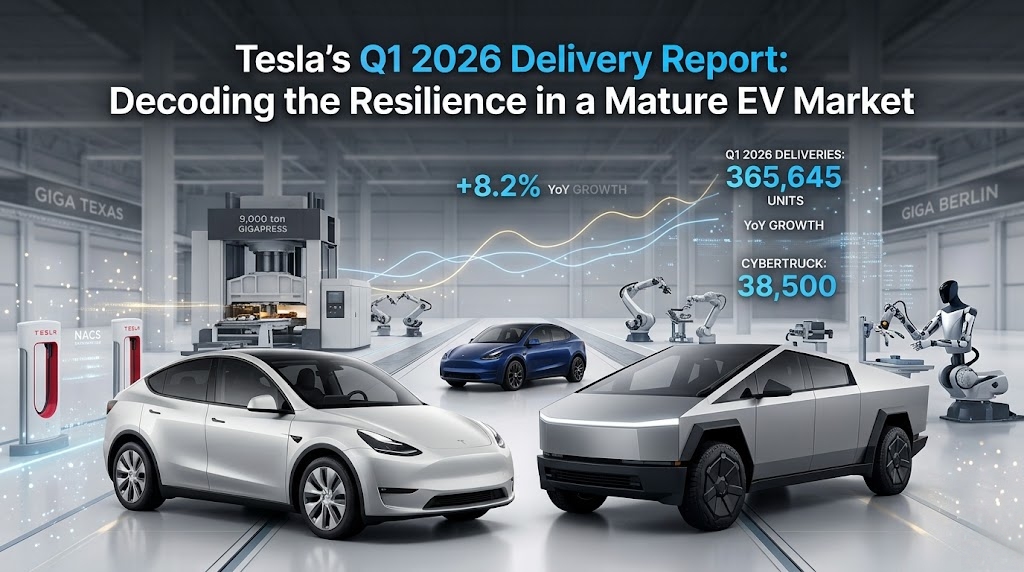
In the first quarter of 2026, Tesla announced a total of 365,645 vehicles delivered, a figure that reflects both the stabilization of its legacy models (3 and Y) and the aggressive scaling of its newer platforms. This article will dissect these numbers, explore the regional nuances of the North American and European markets, and analyze why Tesla’s "resilience" in 2026 is actually a calculated evolution into a robotics and software powerhouse.
Chapter 1: The Raw Numbers – Statistical Deep Dive
To understand where Tesla is going, we must first look at where the units went. The Q1 2026 breakdown reveals a fascinating shift in product mix.
1.1 Delivery Breakdown by Model
| Model | Q1 2026 Deliveries | Q1 2025 Deliveries | YoY Growth |
| Model 3/Y | 312,200 | 305,000 | +2.3% |
| Cybertruck | 38,500 | 18,200 | +111.5% |
| Model S/X | 12,445 | 14,800 | -15.9% |
| Project Redwood (Pilot) | 2,500 | N/A | New |
| Total | 365,645 | 338,000 | +8.2% |
1.2 The Plateau of the "Big Two"
The Model 3 and Model Y continue to be the bedrock of the company, accounting for over 85% of total volume. However, the low single-digit growth suggests that these models have reached "peak saturation" in their current forms. In 2026, the Model Y remains the best-selling vehicle globally, but its growth is no longer explosive. Instead, it has become the "iPhone" of the car world—a reliable, high-margin staple that consumers upgrade to with predictable frequency.
1.3 The Cybertruck Ramp-Up
The real story of Q1 is the Cybertruck. After a tumultuous launch and slow initial production, Giga Texas has finally reached a "steady state" of manufacturing. With over 38,000 units delivered this quarter, the Cybertruck has moved from a niche status symbol to a common sight on American highways. This volume is critical because it represents Tesla’s successful entry into the high-margin pickup segment, which has historically been the "profit fortress" of Ford and GM.
Chapter 2: Regional Performance – The US and Europe
Tesla’s performance in Q1 2026 is a tale of two continents. While the US market is grappling with charging infrastructure evolution and political shifts, Europe is undergoing a regulatory transformation regarding autonomous driving.
2.1 North America: The NACS and IRA Effect
In the United States, Tesla continues to dominate with a market share of approximately 48% of the total EV segment. Two major factors influenced Q1 deliveries:
-
The NACS Consolidation: With almost all major automakers now using Tesla’s North American Charging Standard (NACS), the Supercharger network has become a massive revenue driver. Ironically, this has boosted vehicle sales, as buyers feel more confident in the ecosystem's longevity.
-
IRA Tax Credit Adjustments: As of 2026, the Inflation Reduction Act (IRA) battery sourcing requirements have tightened. Tesla’s vertical integration and investment in domestic cathode production have allowed the Model 3 and Model Y to retain full $7,500 credits, while many competitors have lost theirs. This price gap has made Tesla the default choice for the value-conscious American buyer.
2.2 Europe: Giga Berlin’s Masterclass
In Europe, Tesla has faced a challenging environment characterized by the end of some national subsidies (e.g., Germany’s "Umweltbonus"). Despite this, Giga Berlin has emerged as the most efficient plant in the Tesla fleet.
-
Localized Production: By producing nearly all Model Ys for the European market in Brandenburg, Tesla has eliminated the shipping lag and import duties that previously hindered margins.
-
The "Hatchback" Demand: European consumers are eagerly awaiting the full scale of "Project Redwood" (the rumored $25k compact). The 2,500 pilot units delivered in Q1 were mostly to European fleet operators and early testers, signaling that Tesla is ready to compete with the likes of the VW ID.3 and Renault 5 on price.
Chapter 3: Margin Recovery and the "Unboxed" Process
One of the biggest concerns for investors in 2024 and 2025 was the compression of Tesla’s profit margins due to price cuts. In Q1 2026, we are seeing the "Margin U-Turn."
3.1 Efficiency Through Innovation
The recovery is not coming from higher prices, but from lower costs. Tesla has successfully implemented the "Unboxed" manufacturing process at Giga Texas and Giga Berlin. This process involves:
-
Parallel Assembly: Different sections of the car (front, rear, interior) are worked on simultaneously and then joined together in a single "marriage" step. This has reduced the factory footprint by 30% and assembly time by 25%.
-
Gigapress 2.0: The use of massive 9,000-ton casting machines has allowed Tesla to eliminate hundreds of individual parts, reducing the weight and complexity of the vehicle while increasing structural rigidity.
3.2 Software as a High-Margin Buffer
In 2026, every Tesla delivered is essentially a hardware shell for a software subscription. With FSD (Supervised) adoption rates climbing to 25% in the US and the upcoming regulatory approval in the EU, the "deferred revenue" from software is finally hitting the bottom line. This makes the delivery of a vehicle in Q1 2026 much more valuable than a delivery in 2023.
Chapter 4: Competitive Landscape and Future Outlook
Tesla is no longer competing against "startup" EV companies; it is competing against the entire global industrial complex.
4.1 Holding off the Chinese Wave
In Europe, the primary threat is no longer BMW or Mercedes, but BYD and Xiaomi. These companies have launched high-spec, low-cost EVs that have challenged Tesla’s dominance. Tesla’s response in Q1 has been "brand loyalty" and "ecosystem lock-in." The integration of Powerwall, Tesla Insurance, and the Supercharger network creates a "moat" that Chinese manufacturers struggle to replicate in Western markets.
4.2 The "Redwood" Catalyst
Looking forward to Q2 and beyond, the focus is entirely on the $25,000 platform. The Q1 delivery of 2,500 pilot units is a "shot across the bow." If Tesla can scale this model to 100,000 units per quarter by 2027, the total addressable market (TAM) increases by a factor of five.
Conclusion: Resilience is the New Growth
Tesla’s Q1 2026 deliveries of 365,645 vehicles tell a story of a company that has successfully transitioned from an "industry disruptor" to an "industry standard." While the 8.2% year-over-year growth may seem slow compared to the past, it is high-quality growth. Tesla is delivering more profitable trucks (Cybertruck), preparing for a mass-market revolution (Redwood), and cementing its lead in autonomous software.
For the Tesla owner in 2026, these numbers mean that the company is stable, the network is growing, and the value of their vehicle—now an AI-capable asset—is higher than ever.
🛠 FAQ Section
Q: Why are Model S and X deliveries declining? A: The S and X are now "legacy" luxury products. Most high-end buyers are moving toward the Cybertruck or specialized performance versions of the Model 3 (Ludicrous/Plaid). Tesla is likely focusing less on these low-volume models as it prioritizes the high-volume Redwood platform.
Q: What is the significance of the 2,500 "Project Redwood" deliveries? A: These are not general consumer sales. They represent "Release Candidate" (RC) units and fleet-testing vehicles. Their delivery in Q1 confirms that the production line is active and that a full consumer launch is imminent (likely Q3 or Q4 2026).
Q: How does the Q1 performance affect the stock (TSLA)? A: Wall Street was expecting roughly 360,000 units. The slight "beat" at 365,645 suggests that demand remains robust despite high interest rates. The focus is now shifting from "how many cars" to "how much software revenue per car."
Q: Is the European market still important for Tesla? A: Absolutely. Europe is the testing ground for Tesla’s ability to compete with both legacy luxury brands and aggressive Chinese imports. The success of Giga Berlin is the key to Tesla's global profitability.