
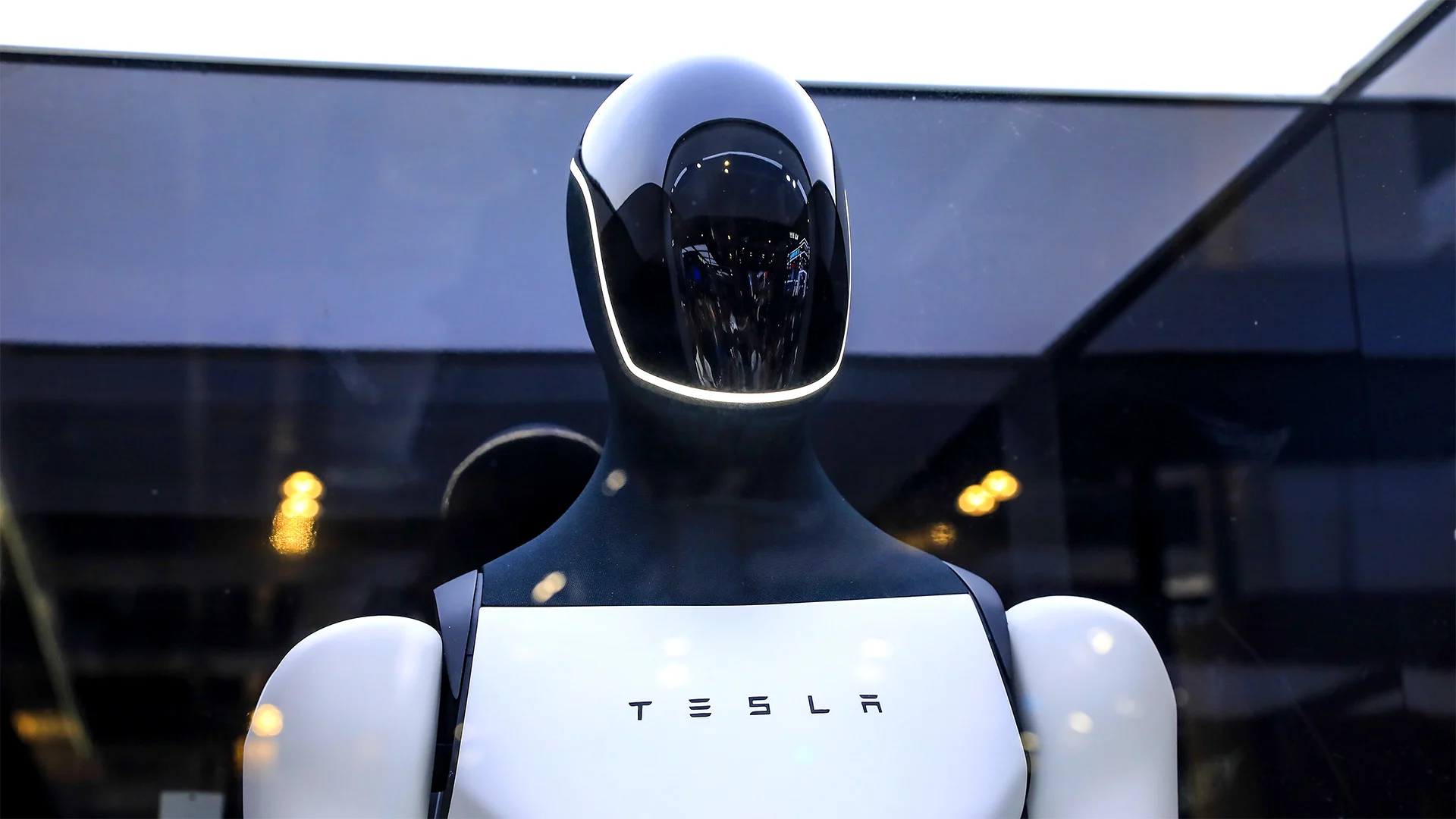
In November 2025, Tesla announced plans that sound like science fiction but represent the company's genuinely ambitious manufacturing strategy: constructing a dedicated humanoid robot production facility at Gigafactory Texas capable of manufacturing 10 million Optimus robots annually by 2027. Drone footage captured by independent observers showed ground clearing and site preparation for a massive new building on Giga Texas campus, marking the beginning of tangible construction toward this ambitious goal.
This announcement marks a fundamental inflection point in Tesla's strategic direction. For years, Elon Musk has articulated the vision that humanoid robots could eventually become Tesla's most valuable business—potentially exceeding automotive in long-term economic impact. The 2025 announcement and construction activity suggest this vision is transitioning from speculation to concrete manufacturing investment.
For Tesla shareholders, Optimus represents potentially transformative growth opportunity. For society more broadly, successful deployment of humanoid robots at 10-million-unit-per-year scale would fundamentally reshape labor economics, manufacturing productivity, and the global workforce. For Tesla employees and workers across manufacturing sectors, Optimus deployment triggers both opportunity (new technologies, higher-value work) and disruption (displacement of routine roles).
The ambition is staggering: manufacturing 10 million humanoid robots annually would represent unprecedented production scale for any robotics company. To contextualize, current global robotics manufacturing produces approximately 500,000 industrial robots annually across all manufacturers. Tesla's 10-million-unit goal represents 20x current global production. This suggests either extraordinary market demand and economics, or extraordinarily optimistic timelines.
This comprehensive exploration examines Tesla's Optimus vision, the production roadmap, technical capabilities, market opportunities, and realistic assessment of timelines and challenges.
CHAPTER 1: THE OPTIMUS VISION - FROM PROTOTYPE TO PRODUCTION REALITY
Tesla's humanoid robot project, code-named Optimus and also referred to as Tesla Bot, evolved from CEO Elon Musk's longstanding vision articulated since 2020. Unlike most robotics projects focused on narrow tasks, Optimus development targets general-purpose humanoid form factor—a robot resembling human proportions and capable of diverse tasks.
Historical Development and Current Specifications
Tesla's Optimus development progressed through multiple generations. Initial prototypes in 2021 demonstrated basic bipedal locomotion and simple manipulation. By 2023, Gen 1 prototypes achieved capabilities including walking, grasping, and performing simple assembly tasks. Gen 2 models in 2024 demonstrated improved dexterity, faster movement, and more refined autonomous behaviors.
Current Optimus specifications reflect hardware optimized for manufacturing tasks:
-
Dimensions: Approximately 5'7" tall (173 cm), weighing approximately 125 lbs (57 kg)
-
Dexterity: Five-finger hands with fine motor control enabling grasping and manipulation of small objects
-
Speed: Walking velocity approximately 5 mph (8 km/h) with balance and navigation capabilities
-
Sensors: Multiple cameras, force sensors, and depth sensing for environmental awareness
-
Computing: Onboard neural network processing enabling autonomous decision-making
-
Battery: Rechargeable battery pack enabling 8-12 hour operating duration
-
Communication: Network connectivity for remote oversight and software updates
Task Capability Evolution
Early Optimus prototypes demonstrated basic assembly and material handling tasks. More recent demonstrations showed capability for:
-
Component assembly (joining parts, fastening)
-
Machine tending (loading/unloading machinery)
-
Inventory management
-
Quality inspection
-
Packaging and labeling
-
Basic maintenance tasks
Video demonstrations from 2024-2025 showed Optimus performing tasks like folding laundry, pouring beverages, and playing games—demonstrations illustrating hand-eye coordination and task versatility that justify "general purpose" positioning.
Comparison to Alternative Robotics Approaches
Humanoid form factor represents contested choice in robotics. Alternative approaches include:
-
Task-specific robots: Designed for singular tasks (warehouse picking robots, specialized manufacturing machines)
-
Quadrupedal robots: Boston Dynamics' Spot platform, pursuing four-legged form factor
-
Wheeled platforms: Autonomous delivery robots relying on wheels rather than legs
Humanoid form factor advantages include: leveraging existing human-designed infrastructure (stairs, doorways, workspaces), familiarity reducing human psychological barriers, and theoretical versatility for diverse tasks. Disadvantages include: mechanical complexity, higher cost, stability challenges, and less efficiency for narrowly specified tasks than specialized alternatives.
Tesla's humanoid choice reflects Musk's long-term vision of robots operating across diverse environments and tasks rather than specialized narrow applications.
AI and Autonomous Capability Development
Optimus autonomy relies on neural network AI trained on video demonstrations and simulation data. Rather than programming specific behaviors, Tesla's approach involves training models to recognize situations and respond appropriately based on patterns learned from training data.
This approach offers tremendous advantages (capability emerges from training rather than requiring explicit programming) and significant challenges (AI systems may behave unexpectedly in novel situations, and failure modes are difficult to predict).
Tesla claims Optimus V2.5 (current development version) achieves behaviors competitive with narrow-task robots in manufacturing environments while maintaining capability flexibility across diverse tasks. Whether this claim withstands real-world deployment at scale remains to be determined.
CHAPTER 2: THE GIGAFACTORY TEXAS EXPANSION STRATEGY
Tesla's November 2025 announcement of a dedicated Optimus production facility at Giga Texas represents substantial capital commitment toward specific manufacturing target.
Why Giga Texas for Optimus Production?
Giga Texas already functions as Tesla's second major manufacturing complex, producing Model Y and Cybertruck alongside energy storage systems. The facility represents:
-
Established manufacturing infrastructure and workforce
-
Proximity to suppliers and logistics networks
-
Skilled labor force with automotive manufacturing experience
-
Tax incentives and government support from Texas authorities
-
Sufficient land area for facility expansion
Expanding Optimus production within existing Giga Texas campus rather than constructing new facility elsewhere suggests maximization of operational efficiencies, shared utilities and infrastructure, and coordinated supply chain management.
Facility Specifications and Timeline
Initial announcements described stand-alone facility within Giga Texas campus dedicated entirely to Optimus production. Projected specifications include:
-
Building footprint: Estimated 1-2 million square feet (roughly equivalent to typical large automotive assembly plant)
-
Production capacity target: 10 million units annually by 2027
-
Initial construction: 2025-2026
-
Production ramp: 2026-2027
-
Full capacity target: 2027+
The 10-million-unit annual target implies production pace of approximately 27,000+ robots daily—extraordinarily high production volume requiring sophisticated automation and supply chain maturity.
Comparison to Fremont Production Plans
Tesla simultaneously plans smaller Optimus production at Fremont Factory in California, targeting 1 million annual units initially. Fremont production serves dual purposes:
-
Pilot manufacturing for algorithm refinement before Texas scaling
-
Supply for internal Tesla use (factory operations, testing)
-
Research and development focus
This two-facility strategy (Fremont pilot, Texas scaling) mirrors Tesla's approach to other products—refining in California, scaling elsewhere.
Capital and Investment Requirements
Constructing and equipping a 1-2 million square foot facility to produce robots requires substantial capital investment. Estimates suggest facility construction and tooling would require $5-10 billion capital investment. This investment compares roughly to Tesla's annual capital expenditure across all operations.
This scale of capital commitment suggests Tesla's board accepted Optimus as strategically important initiative, despite uncertainty around timelines and market demand. The investment signals confidence in longer-term viability despite near-term execution risks.
Musk's Mars Aspiration and Long-Term Vision
In classic Elon Musk style, the facility announcement included speculative commentary about eventually requiring 100-million-unit production capacity, potentially located on Mars. While hyperbolic, this commentary reflects genuine Musk vision of humanoid robots as perhaps humanity's most significant technological development.
Whether 100-million-unit production on Mars is genuine aspiration or rhetorical flourish matters less than recognizing the scale of Musk's ambition for Optimus as world-changing technology.
CHAPTER 3: OPTIMUS PRODUCTION ROADMAP AND TIMELINE
Tesla's production roadmap for Optimus reflects measured acceleration rather than immediate exponential scaling.
2025: Pilot Production and Development
Current Fremont pilot line produces limited Optimus units for internal Tesla use and continuous development iteration. Estimated 2025 production targets several thousand units, primarily for:
-
Factory automation testing (internal Tesla manufacturing use)
-
Algorithm refinement through real-world deployment data
-
Reliability and durability testing
This pilot phase focuses on identifying and resolving issues before attempting large-scale production.
2026: Scaling Preparations and Market Development
2026 represents transition year where Optimus expands beyond internal use toward early commercial customers. Expected milestones include:
-
Fremont production scaling toward 1 million annual capacity (running production lines at full capacity)
-
Giga Texas facility construction completion and initial equipment installation
-
Expanded internal Tesla deployment (more factories implementing Optimus)
-
Initial commercial customers deploying pilot Optimus fleets
-
Pricing and business model finalization for commercial customers
-
Regulatory frameworks development for workplace robot deployment
Production targets for 2026 likely include 100,000-300,000 units across both Fremont and Texas facilities as scaling ramps.
2027: Scaling to Target Volumes
2027 targets production reaching substantial volumes approaching 10-million-unit annual target. However, realistic assessment suggests reaching 10 million units by 2027 requires:
-
Completely resolving technical challenges (humanoid bipedal robotics proved reliable at scale)
-
Global supply chain maturity supporting 10-million-unit volumes
-
Market demand validated across diverse customer categories
-
Manufacturing process optimization eliminating throughput constraints
-
Regulatory approval across major markets (US, Europe, Asia)
These conditions suggest 2027 reaching 2-5 million unit production rate, with progression to 10 million units during 2027-2029 timeframe more realistic than immediate 2027 achievement.
Production Scaling Challenges
Scaling production to 10 million units annually faces unprecedented challenges:
Supply Chain Complexity: Humanoid robots require thousands of components—motors, batteries, computing systems, sensors, structural materials. Sourcing sufficient quantities of specialized components at acceptable quality and cost requires either substantial supplier development or vertical integration by Tesla. This development process typically requires 2-3 years.
Quality Control at Scale: Manufacturing robots requires precision and reliability standards exceeding typical automotive. Producing 27,000+ robots daily while maintaining quality standards demands process control sophistication currently applied only to semiconductor or highest-precision manufacturing.
Workforce Development: Tesla must recruit, train, and manage tens of thousands of factory workers capable of complex robotics manufacturing. This workforce development can't be accelerated beyond certain pace without compromising quality or efficiency.
Regulatory Certification: Robots deployed in workplaces with humans require safety certifications. Each market (US, Europe, China, etc.) imposes different regulatory requirements. Achieving compliance across multiple markets requires parallel regulatory engagement, extending timelines.
Market Demand Validation: The business case assumes customer demand for 10 million annual units. Validating this demand through actual orders and deployments requires 12-24 months of market development preceding large-scale production.
CHAPTER 4: APPLICATIONS AND MARKET OPPORTUNITIES
The value proposition for Optimus hinges on identifying use cases where deployment economics prove favorable compared to human labor or specialized alternatives.
Manufacturing and Assembly Use Cases
Automotive Manufacturing: Tesla and other automakers face labor cost pressure and worker shortage challenges. Optimus deployment could automate assembly, welding, material handling, and quality inspection—potentially reducing labor requirements 20-30% while improving consistency. Economics work if Optimus cost is below multi-year human labor cost.
Electronics Manufacturing: Printed circuit board assembly, component testing, and device assembly employ millions globally. Optimus deployment could replace repetitive assembly work while maintaining flexibility across diverse product types.
Precision Assembly: High-value assembly operations benefit from consistency and precision robotic systems provide. Advanced manufacturing incorporating Optimus could potentially achieve higher quality and throughput than human-based alternatives.
Logistics and Warehousing
Order Fulfillment: Warehouse picking and packing represents labor-intensive process. Optimus deployment could automate picking from racks, packing boxes, and transporting merchandise. Economics depend on cost-per-unit handled versus human warehouse worker cost.
Material Handling: Moving materials between manufacturing steps, loading/unloading machinery, and inventory management employ millions. Optimus could potentially reduce labor requirements 40-50% in these applications.
Last-Mile Delivery: Optimus could potentially handle package delivery and customer service interactions for delivery—combining transportation robot with humanoid interaction capability.
Service and Hospitality Applications
Retail: Customer service roles, merchandise stocking, and facility maintenance could leverage Optimus. Humanoid form factor enabling direct human-robot interaction offers advantages over wheeled alternatives.
Food Service: Limited Optimus applications to food preparation and service exist currently, but potential exists for future capability development.
Healthcare: Elderly and dependent care increasingly rely on technology. Optimus could potentially assist with basic patient care tasks, lifting, and monitoring while supplementing human caregivers.
Hazardous Work Applications
Mining Operations: Underground mining involves worker safety risks. Optimus deployment could potentially replace workers in highest-risk tasks—tunnel inspection, equipment operation, material handling.
Chemical Processing: Hazardous chemical handling currently employs workers with significant injury risk. Robotic handling could potentially improve worker safety.
Construction: Repetitive construction tasks—brick laying, material handling, site preparation—could potentially be automated through Optimus deployment.
Economic Impact Across Applications
Successful Optimus deployment across these applications could generate economic value measured in trillions annually through:
-
Labor cost reduction across manufacturing, logistics, service sectors
-
Productivity gains exceeding human labor efficiency
-
Quality and consistency improvements
-
Safety improvements through hazard elimination
-
Reduced worker injury and compensation claims
Against this value must be weighed labor displacement impacts and social costs associated with workforce transition.
CHAPTER 5: FINANCIAL AND INVESTOR IMPLICATIONS
For Tesla shareholders, Optimus represents potential fundamental transformation of company financial profile.
Revenue Potential
Assuming 10 million units annually by 2030, and average selling price of $30,000-50,000 per robot (pricing comparable to higher-end vehicles), Optimus annual revenue could reach $300-500 billion. This revenue would exceed current Tesla revenue from all other businesses combined—fundamentally transforming company scale.
For perspective, current total Tesla annual revenue (2024-2025) approximates $80-100 billion. Adding $300-500 billion Optimus revenue would expand total company revenue to $400-600 billion, placing Tesla among world's largest revenue corporations.
Profitability and Margin Implications
Robotics businesses historically operate at higher gross margins than automotive (automotive: 10-15% gross margin; robotics: 30-50% potential). If Optimus achieves scale with 30%+ gross margins, operating profit expansion would be extraordinary.
However, near-term profitability remains constrained by production ramp inefficiency and market development costs. Optimus likely operates at losses or break-even through 2026-2027 before profitability materializes in 2028+.
Capital Requirements and Investment Impact
Optimus production scaling requires substantial capital investment (estimated $20-40 billion through 2030) for facilities, equipment, and supply chain development. This investment competes with capital allocations to other Tesla priorities (automotive manufacturing expansion, energy storage, charging infrastructure).
Investors must balance potential Optimus upside against capital required and risks of timelines slipping or market demand disappointing.
Stock Valuation Implications
Current Tesla valuation reflects market's expectations regarding autonomous vehicles, energy storage, and traditional automotive. Optimus introduction into valuation frameworks could either significantly increase or decrease share price depending on:
-
Timeline credibility (is 10 million units by 2030 realistic or fantasy?)
-
Technical feasibility validation (do robots actually work at required scale and reliability?)
-
Market demand demonstration (do customers actually want robots at prices supporting economics?)
-
Execution capability (can Tesla actually execute manufacturing this ambitious?)
If investors become convinced of Optimus viability, valuation could expand substantially. Conversely, if timelines slip or technical challenges emerge, stock could underperform.
Competitive Implications
Tesla's Optimus announcement creates competitive pressure on other robot developers (Boston Dynamics, Sanctuary AI, others) and labor-intensive manufacturers to accelerate automation investments. First-mover advantage in humanoid robotics manufacturing could prove enormously valuable if market demand validates assumptions.
CHAPTER 6: TECHNICAL, SAFETY, AND REGULATORY CONSIDERATIONS
Beyond business strategy, Optimus deployment raises profound technical, safety, and societal questions.
AI and Autonomous Decision-Making
Optimus autonomy relies on AI systems trained on vast datasets and simulation environments. Deploying millions of robots with AI decision-making capabilities raises questions about:
-
How to ensure AI systems make safe decisions in novel situations?
-
What happens when AI systems encounter scenarios outside training experience?
-
How to validate that millions of robots won't fail simultaneously due to shared AI vulnerabilities?
Tesla's approach (neural network training on real-world data) offers advantages but provides fewer guarantees than traditional rule-based systems.
Physical Safety
Humanoid robots operating in shared human-robot workspaces create physical safety considerations:
-
Collision detection preventing robot-human contact
-
Force limiting preventing injury if contact occurs
-
Emergency shutdown capabilities
-
Durability ensuring long operational lifetime without failure
Tesla must demonstrate these safety features work reliably before widespread workplace deployment approval.
Cybersecurity
Robots connected to networks and capable of physical actions represent cybersecurity vulnerabilities. Ensuring robot systems can't be hacked to cause damage requires sophisticated security architecture and continuous monitoring for emerging threats.
Workplace Safety Regulations
OSHA (U.S. Occupational Safety and Health Administration) and equivalent European agencies regulate workplace safety. Robot deployment in human-shared workspaces requires compliance with evolving regulations addressing human-robot interaction safety.
Ethical Considerations
Beyond technical safety, Optimus deployment raises ethical questions:
Labor Displacement: Millions of workers could be displaced by robot automation. Society must address workforce transition—retraining, income support, and economic model adaptation.
Economic Inequality: If automation benefits concentrate among robot owners while displaced workers struggle, inequality could expand significantly. Policy frameworks addressing benefit distribution are uncertain.
Long-Term Economic Model: If robots can perform most economic tasks with minimal human involvement, what happens to human employment and consumer income? Addressing this fundamental economic question likely requires policy innovations (universal basic income, reduced work weeks, etc.).
Responsible Deployment Principles: Technology companies deploying transformative technologies like humanoid robots should adopt responsible deployment frameworks addressing safety, inclusivity, and equitable benefit distribution.
CONCLUSION
Tesla's Optimus production facility at Gigafactory Texas represents genuine commitment toward humanoid robot manufacturing at unprecedented scale. If successfully executed, Optimus could transform Tesla from automotive manufacturer to general-purpose robotics company while fundamentally reshaping labor economics globally.
However, substantial execution risks remain. The technical challenges of manufacturing humanoid robots at 10-million-unit scales are genuinely unprecedented. Market demand for robots at projected scales remains speculative. Regulatory approval across major markets faces uncertain timelines. Supply chain development for supporting billions of robot components requires years of supplier engagement.
Realistic timeline assessment suggests:
-
2026-2027: Pilot and small-scale production (10,000-500,000 annual units) focusing on reliability validation
-
2027-2029: Production scaling toward millions annually as technical maturity and market demand increase
-
2030+: Achievement of 10-million-unit annual production (or significant delay/reduction if challenges emerge)
For Tesla shareholders, Optimus represents enormous potential upside offset by real execution risks. The investment thesis hinges on believing Tesla can execute manufacturing at scale while market demand materializes.
For society, Optimus success would require corresponding policy innovation addressing labor displacement, economic opportunity access, and benefit distribution. The technology's transformative potential demands proactive societal response rather than reactive adaptation.
Tesla's Optimus ambition is genuinely revolutionary. Whether execution matches aspiration will be determined through 2026-2030 production milestones and real-world market deployment outcomes.