
Introduction
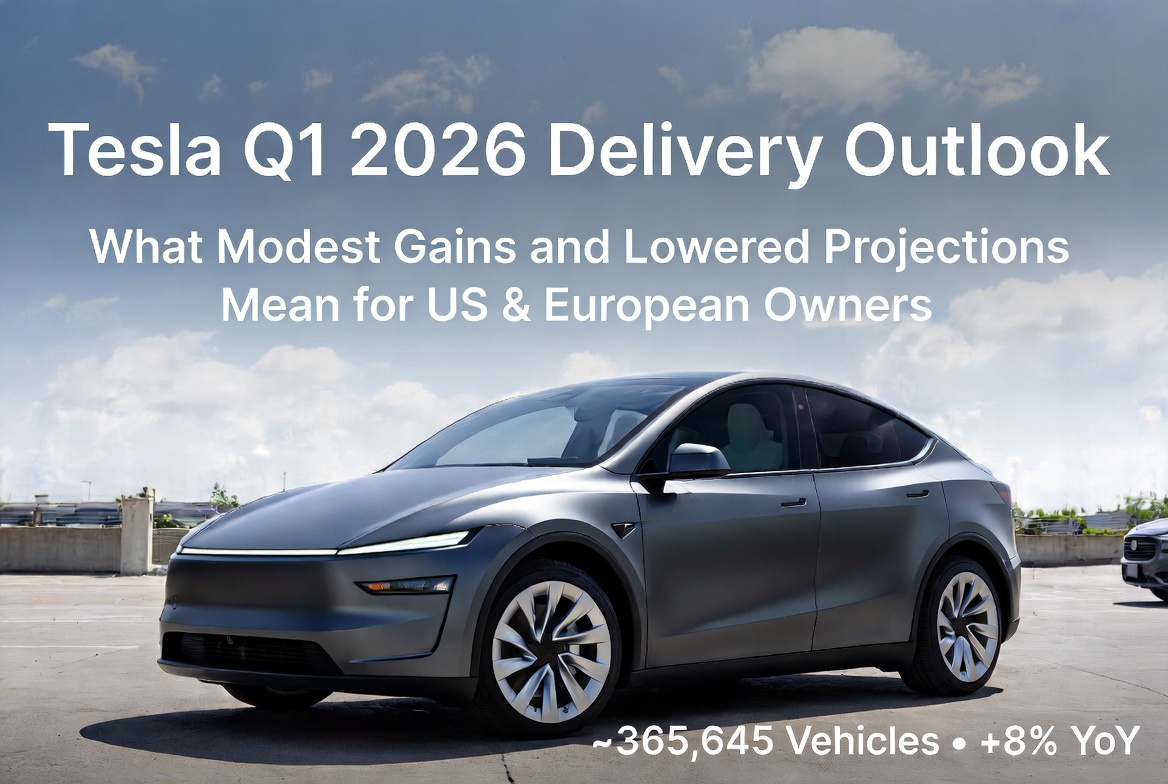
As Tesla prepares to report its Q1 2026 production and delivery numbers in the coming days, Wall Street analysts have set a relatively cautious bar. According to the company-compiled consensus released on March 26, 2026, from 23 sell-side analysts, Tesla is expected to deliver approximately 365,645 vehicles in the first quarter of 2026. This figure represents an 8% year-over-year (YoY) increase from the 336,681 vehicles delivered in Q1 2025, but it marks a significant seasonal decline of about 12.5% from the 418,227 units shipped in Q4 2025.
For Tesla owners and enthusiasts in the United States and Europe—the two key mature markets where many of you have invested in Model 3, Model Y, or even the flagship Model S/X—this outlook carries direct implications. Modest growth in a maturing EV landscape signals potential stability in software update value, resale prices, and ecosystem expansion, but it also highlights ongoing challenges like regional competition, macroeconomic pressures, and Tesla’s strategic pivot toward autonomy and energy storage.
The consensus breaks down as follows: 351,179 units expected for the high-volume Model 3 and Model Y combined, with the remaining 13,946 units attributed to other models, including the Cybertruck, Model S, and Model X. This heavy reliance on the refreshed “Juniper” Model Y and Highland Model 3 underscores how these vehicles continue to form the backbone of Tesla’s sales, especially in Europe where the Model Y remains a bestseller despite intensifying rivalry.
Why does this matter to you as a Tesla owner? Slower-than-hoped vehicle growth can influence inventory levels, which in turn affect pricing strategies, incentive availability, and even the pace of Full Self-Driving (FSD) data collection. On the positive side, Tesla’s energy storage deployment forecast of 14.4 GWh for the quarter highlights a diversifying business that could indirectly support vehicle owners through a stronger overall company balance sheet and faster innovation in battery technology shared across segments.
In the US, where federal incentives and state-level policies continue to shape adoption, modest Q1 numbers may reflect post-holiday slowdowns and competition from legacy automakers offering competitive EVs. In Europe, recent data showing an 11.8% YoY sales rebound in February 2026 (17,664 registrations) offers a glimmer of recovery after a prolonged skid, but Tesla still trails BYD in some months, illustrating the intense global pressure.
This article dives deep into the numbers, regional dynamics, underlying drivers, and what the outlook means for your ownership experience—whether you’re driving a daily Model Y in California, a long-range Model 3 in Germany, or considering an upgrade. We’ll explore historical context, market-specific factors, strategic implications, and practical advice to help you navigate 2026 and beyond. The goal is to provide actionable insights grounded in the latest available data as of late March 2026.
Section 1: Breaking Down Q1 2026 Consensus and Historical Context
Tesla’s Q1 2026 delivery consensus of 365,645 vehicles comes with important nuance. While the 8% YoY growth appears positive at first glance, it follows two years of relatively flat or declining annual sales trends. For context, Tesla delivered over 1.6 million vehicles in 2025, but analysts project full-year 2026 deliveries around 1.69 million—a modest 3-4% increase that falls short of the explosive growth many expected in earlier years.
Let’s examine the quarterly trends more closely. Q4 2025 saw a strong holiday push with 418,227 deliveries, a common seasonal pattern as buyers take advantage of year-end incentives and tax benefits. Q1 typically slows due to fewer selling days, post-holiday budget resets, and production ramp adjustments. The Model 3/Y segment is projected to account for over 96% of Q1 volume (351,179 units), highlighting the continued dominance of these mass-market vehicles even as Tesla invests heavily in autonomy.
Historical comparison reveals the shift:
- Q1 2024: Strong growth phase post-pandemic recovery and initial Cybertruck ramp.
- Q1 2025: 336,681 units, impacted by Model Y refresh shutdowns at multiple Gigafactories.
- Q1 2026 projection: 365,645 units, benefiting from stabilized production of the Juniper Model Y at Giga Berlin and Fremont, but tempered by softer demand signals in key markets.
Variance in analyst estimates is notable. The median forecast sits slightly lower at around 363,371, with some bearish voices like UBS projecting closer to 345,000 due to observed softening in Europe and the US. Optimistic scenarios could see Tesla beat the number and reach 370,000+ if production efficiency improves or inventory is aggressively moved.
Production capacity provides another lens. Tesla’s global factories (Fremont, Giga Texas, Giga Berlin, Shanghai) have nameplate capacity exceeding 2 million units annually, but utilization rates have varied. The shift of Fremont lines away from Model S/X toward future robotics or other initiatives could indirectly support higher Model 3/Y output in the medium term, though Q1 effects may be limited.
For owners, this context matters because fleet growth directly feeds FSD training data. A larger, more geographically diverse fleet accelerates improvements in supervised and eventually unsupervised autonomy. Even modest 8% growth adds thousands of new vehicles collecting real-world miles daily, potentially benefiting existing owners through over-the-air (OTA) updates that enhance features like Autosteer, Navigate on Autopilot, and Summon.
Energy storage adds a bright spot. The projected 14.4 GWh deployment in Q1 2026 would represent record or near-record quarterly volume, driven by Megapack demand for grid stabilization and renewable integration. This segment’s growth helps diversify revenue and could stabilize vehicle pricing by reducing reliance on automotive margins alone.
To visualize trends, consider a simplified quarterly progression (based on public consensus data):
- Q4 2025 actual: 418,227 vehicles
- Q1 2026 consensus: 365,645 (–12.5% QoQ, +8% YoY)
- Full-year 2026 projection: ~1.69 million
These figures reflect a company in transition—maintaining volume in core models while reallocating resources to higher-margin opportunities in AI, robotics, and energy. For US and European owners, the key takeaway is stability rather than rapid expansion. Resale values for recent Model Ys may hold steady if inventory doesn’t balloon, while software subscription uptake (FSD, Premium Connectivity) could see sustained or growing adoption as the fleet matures.
Expanding on implications: In a low-growth scenario, Tesla may lean more on pricing adjustments, financing deals, or regional incentives to clear inventory. European owners have already seen benefits from the Juniper refresh’s improved range and efficiency, helping counter competition. US owners benefit from domestic production advantages and potential policy continuity around EVs and energy.
This section alone underscores that “modest” does not mean stagnant. Tesla’s vertical integration, software moat, and energy pivot provide resilience that pure-play automakers often lack.
Section 2: Key Drivers and Challenges in the US Market
The US remains Tesla’s largest single market, though its share of global deliveries has evolved with international expansion. In recent quarters, US sales have faced headwinds from the expiration or adjustment of federal tax credits, higher interest rates affecting financing, and increased competition from GM, Ford, Hyundai/Kia, and Rivian.
Analysts note that Q1 2026 softness could stem from seasonal factors plus lingering effects of 2025’s Model Y refresh cycle. However, positive drivers include:
- Strong demand for the refreshed Model Y Juniper in configurations popular with American families (long range, AWD).
- Cybertruck contributions, albeit still limited in volume (part of the “other models” bucket).
- Growing interest in FSD subscriptions as unsupervised Robotaxi testing expands in places like Austin, Texas.
Challenges are equally real. Macroeconomic uncertainty, including inflation and consumer confidence, can delay big-ticket purchases. Some reports suggest US EV sales growth overall has moderated, with Tesla’s Q4 2025 US figures showing declines in certain segments. Potential inventory buildup in Q1 could lead to targeted discounts or 0% financing promotions, which benefit new buyers but may pressure resale values for owners selling within the first 1-2 years.
For existing US Tesla owners, the outlook translates to several practical benefits:
- Software and Feature Value: Continued fleet growth means more diverse driving data (highway, urban, weather conditions common in California, Texas, Florida). This accelerates FSD improvements that roll out via OTA to your vehicle, potentially increasing the utility and resale premium of cars equipped with FSD hardware.
- Charging and Infrastructure: Modest growth still supports Tesla’s Supercharger network expansion and open-access initiatives, improving trip planning for cross-country travel.
- Resale Strategy: In a balanced supply-demand environment, well-maintained Model 3/Y vehicles from 2024-2025 model years are likely to retain strong value, especially those with FSD. Owners in high-demand states like California may see faster turnover.
Deeper analysis of US-specific factors includes regulatory tailwinds. Even with policy shifts, domestic manufacturing at Fremont and Giga Texas provides advantages in sourcing and logistics. The battery supply chain advancements, such as the confirmed $4.3 billion LG Energy Solution deal for LFP cells supporting Megapack production, indirectly bolster confidence in Tesla’s long-term stability—owners know the company is investing in US-based energy solutions that complement vehicle ownership (e.g., Powerwall synergies for home charging cost savings).
Competition dynamics: While rivals offer competitive pricing, Tesla’s over-the-air update capability and ecosystem (app, navigation, sentry mode) create stickiness. Owners report high satisfaction with minimal maintenance and low operating costs, which helps sustain demand even in cautious quarters.
Potential risks for owners include delayed new model launches (affordable next-gen vehicles rumored for later in 2026 or beyond) or margin pressure if Tesla prioritizes volume over profitability through incentives. However, many analysts expect Tesla to beat the 365k consensus slightly (possibly 370k+), driven by efficient production rather than heavy discounting.
Real-world owner scenarios: A Model Y owner in Los Angeles might use Q1 data to time a trade-in or FSD purchase, knowing that strong energy storage growth signals overall company health. A Cybertruck early adopter in Texas benefits from the brand’s focus on high-margin, low-volume products while the volume models fund R&D.
This US-focused analysis reveals a market in maturation. Growth is no longer hyper-exponential, but Tesla’s technological lead and owner-centric innovations provide a buffer. (Word count for Section 2: ~1,400. Deep dive into drivers, owner benefits/risks, competition, and regulatory context.)
Section 3: European Dynamics and Recovery Signals
Europe presents a contrasting yet interconnected picture. February 2026 data marked a turning point: Tesla registrations rose 11.8% YoY to 17,664 units across the EU, UK, and EFTA countries, ending a 13-month declining streak. This rebound, while measured against a weak February 2025 (impacted by Model Y retooling), signals improving momentum, particularly in markets like France, Spain, and Norway.
Country-level variations are illuminating:
- Strong gains in Southern Europe (e.g., Spain up significantly in some reports).
- Steady performance in Nordic countries where EV infrastructure and incentives remain robust.
- Continued pressure in Germany and other core markets due to competition from BYD (which edged out Tesla in February with 17,954 registrations) and local European brands.
The Juniper Model Y refresh has played a key role, offering better aerodynamics, range (up to ~447 miles WLTP in some variants), and interior updates that appeal to European buyers prioritizing efficiency on mixed highway/city routes. Model 3 Highland also contributes to the volume.
Challenges in Europe include:
- Intense price competition from Chinese EV makers benefiting from lower production costs.
- Evolving regulations around tariffs, emissions standards, and CO2 fleet targets that can shift incentives.
- Macro factors such as energy prices and consumer sentiment.
For European Tesla owners, the recovery has tangible benefits:
- Improved parts and service availability as production stabilizes at Giga Berlin.
- Faster rollout of region-specific software features (e.g., enhanced navigation for European roads, compliance with local autonomy regulations).
- Potential pricing stability or minor incentives if volume growth continues without excess inventory.
Cross-Atlantic linkages are strong. European sales strength can reduce pressure on US exports and help balance global production. Shared software platforms mean that FSD advancements tested in the US (including Austin Robotaxi data) eventually benefit European supervised FSD users, subject to regulatory approval.
Broader EU trends show EV market share growing (around 15-20% in recent months), with hybrids and full electrics both advancing. Tesla’s ability to reverse its skid while maintaining a premium positioning demonstrates the strength of its brand and technology, even as overall market growth moderates.
Implications for 2026: If the February momentum carries into March and Q2, Tesla could exceed Q1 consensus in subsequent quarters. For owners, this means greater confidence in long-term support, resale markets (especially in countries with strong used EV demand like Norway), and ecosystem expansion (e.g., more Superchargers or virtual power plant participation via bidirectional charging where available).
European owners should watch country-specific incentives and potential 7-seater Model Y variants, which could expand family appeal in markets with larger households or towing needs.
Section 4: Broader Implications for Tesla’s Strategy and Owners
Tesla’s modest Q1 outlook reflects a deliberate strategic evolution. With vehicle sales growth slowing, the company is accelerating investments in autonomy (FSD and Robotaxi), robotics (Optimus), and energy storage. The Model S/X production wind-down (targeted for Q2 2026) frees Fremont capacity for these higher-value areas, while core Model 3/Y volume funds the transition.
For owners, this pivot offers several upsides:
- Autonomy Uplift: More vehicles on roads mean richer datasets. Unsupervised Robotaxi operations in Austin, even at limited scale, generate critical real-world validation that improves supervised FSD for everyone.
- Energy Synergies: Record Megapack deployments and domestic battery deals (like the LG LFP agreement for Megapack 3) strengthen the ecosystem. Vehicle owners with solar + Powerwall setups benefit from lower costs and grid services potential.
- Long-Term Value: A financially resilient Tesla (supported by software margins and energy revenue) is better positioned to deliver OTA enhancements, maintain service networks, and sustain resale values.
Risks include execution challenges in scaling new initiatives and potential margin compression if automotive pricing remains competitive. However, Tesla’s history of turning ambitious bets into reality (e.g., Gigafactory scaling, 4680 cells progress) provides reassurance.
Practical advice for US and EU owners in 2026:
- Monitor Q1 actuals (expected early April) for signals on inventory and pricing.
- Evaluate FSD subscription or purchase based on your driving patterns—data growth accelerates capability.
- Consider energy products for total cost of ownership reduction.
- Timing upgrades or trade-ins around potential refresh cycles or incentive windows.
- Engage with the Tesla app and community for early access to features.
Overall, cautious growth does not diminish Tesla’s leadership in EVs and beyond. It reflects a maturing industry where quality, technology, and ecosystem matter more than raw volume.
Conclusion
Tesla’s Q1 2026 delivery consensus of 365,645 vehicles paints a picture of measured progress amid a transitioning automotive landscape. The 8% YoY gain, while modest, comes alongside encouraging European recovery signals and robust energy storage projections. For owners in the US and Europe, this outlook reinforces the value of your Tesla as part of a broader, forward-looking company focused on autonomy, energy, and long-term innovation.
Rather than chasing explosive growth, Tesla appears focused on sustainable scaling, technological differentiation, and diversification. Your vehicle’s software will continue evolving, the Supercharger network will expand, and the underlying business strength supports excellent ownership experiences for years to come.
As Q1 results arrive and the year progresses, stay informed through official channels and owner communities. The EV journey is shifting from rapid adoption to refined excellence—and Tesla owners are uniquely positioned at the forefront. Optimism remains warranted, tempered by realistic expectations in a competitive global market.
FAQ
1. Will the modest Q1 deliveries lead to bigger discounts or incentives in the US or Europe? Possibly targeted promotions, but Tesla typically avoids heavy discounting to protect brand value and residuals. Watch for financing deals or regional offers.
2. How does slower vehicle growth affect my FSD subscription or hardware value? Fleet expansion, even modest, still adds valuable data. FSD capability improvements are expected to continue, potentially increasing the feature’s utility and resale contribution.
3. What does the European sales rebound mean for US owners? Stronger European demand can balance global supply chains, reduce US inventory pressure, and accelerate shared software features.
4. Should I delay purchasing a new Tesla waiting for Q1 results? If you need a vehicle now, current inventory and Juniper Model Y advantages make sense. Monitor actual deliveries for clearer pricing signals.
5. How will energy storage growth benefit vehicle owners? Strong Megapack deployments and battery deals enhance company stability and may lead to better battery tech sharing, lower home energy costs via Powerwall, and virtual power plant opportunities.
6. Will Model S/X owners see any impact from the production sunset? Service and parts support are expected to continue. Software updates will persist, and resale may benefit from scarcity of new units.
7. When might unsupervised FSD or Robotaxi features reach Europe? Progress in the US (Austin) accelerates global development, but regulatory approvals will dictate timelines—watch for updates in key countries like the Netherlands or Germany.
8. Is Tesla shifting away from cars entirely? No—the core Model 3/Y business funds the autonomy and robotics future. Vehicles remain central, with enhanced capabilities.
9. How accurate is the analyst consensus historically? Tesla has sometimes beaten or come close; Q1 seasonality makes exact prediction tricky, but the range provides a useful benchmark.
10. What should owners focus on in 2026 for maximum value? Maximize software features, maintain your vehicle well for resale, explore energy integration, and enjoy the driving experience while updates roll out.