
Introduction
As a Tesla owner in the US or Europe, one of the most exciting aspects of ownership is the regular arrival of over-the-air (OTA) software updates. These free updates continuously improve your vehicle’s performance, safety, comfort, and entertainment features without requiring a visit to a service center. In mid-March 2026, Tesla began the wide rollout of software version 2026.8, a relatively focused update that delivers meaningful refinements rather than revolutionary new capabilities.
The standout additions in 2026.8 include Comfort Braking — exclusive to the refreshed Model Y Juniper (model year 2025/2026 and newer) — and the Blind Spot Warning While Parked for the Cybertruck. Additional fleet-wide enhancements cover Spotify navigation, Grok AI voice options, navigation customization, and various minor fixes plus security improvements. Point release 2026.8.3 later added further security patches and bug fixes.
This update exemplifies Tesla’s philosophy: hardware capabilities laid down at production enable ongoing software enhancements that make daily driving smoother, safer, and more enjoyable. For US owners dealing with varied road conditions from California highways to Midwest winters, or European drivers navigating narrow city streets, dense traffic, and strict safety regulations, these changes translate into tangible benefits.
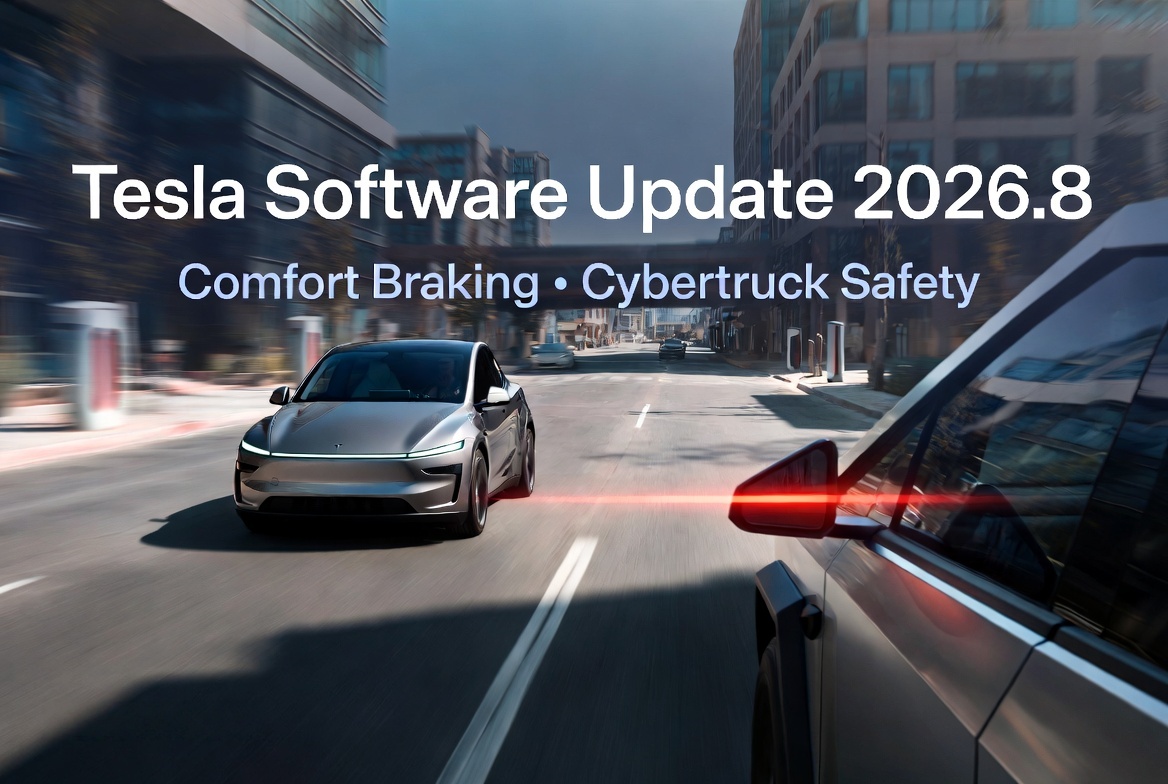
Comfort Braking addresses a subtle but noticeable aspect of EV driving — the final moments of deceleration when regenerative braking transitions to friction brakes. Many owners have described a slight “jerk” or abruptness in older models during routine stops. The new feature delivers a more linear, chauffeur-like stop. Meanwhile, Cybertruck owners gain an intelligent door-protection system that prevents accidental door strikes from cyclists, pedestrians, or passing vehicles — a practical safety net for a vehicle with its large size and distinctive styling.
The update is rolling out globally, with strong adoption in North America and Europe. As of late March 2026, a significant portion of the fleet has received 2026.8 or its point releases. Whether you drive a Model Y in Los Angeles, a Cybertruck in Texas, or a Model 3 in Germany, this update enhances your ownership experience.
In this in-depth article, we’ll explore each major feature in detail: how it works technically, real-world benefits for US and European owners, compatibility considerations, installation tips, and what it signals about Tesla’s future OTA roadmap. We’ll also cover additional quality-of-life improvements and provide practical advice to help you maximize the update. By the end, you’ll understand why even seemingly minor refinements like smoother braking contribute to Tesla’s reputation for continuous improvement.
Section 1: Deep Dive into Comfort Braking for Model Y Juniper
What Is Comfort Braking?
According to Tesla’s official release notes for 2026.8: “Your Tesla now provides a smoother feel as you come to a complete stop during routine braking.” This deceptively simple description hides sophisticated engineering that leverages hardware unique to the refreshed Model Y (often called Juniper).
The refreshed Model Y features a revised braking architecture, including a dual master brake cylinder setup. Unlike earlier Teslas that relied primarily on a single hydraulic system blended with regenerative braking, the Juniper model incorporates separate hydraulic channels. This redundancy and flexibility allow the vehicle’s computer to decouple the brake pedal input from the physical calipers with greater precision.
In normal driving, Tesla vehicles prioritize regenerative braking to recapture energy and maximize efficiency. As the car slows and approaches a full stop (typically below 5–10 km/h or 3–6 mph), the system traditionally transitions to friction brakes. This handoff can sometimes produce a minor jerk or nose dive feel, especially if the driver applies light pedal pressure or if road conditions vary.
Comfort Braking intervenes in those final seconds. The software modulates hydraulic pressure more gradually, “feathering” the friction brakes to create a linear deceleration curve. The result is a smoother, more predictable stop that feels closer to a professional chauffeur gently bringing the vehicle to rest. Owners report it reduces the abruptness many noticed in previous Model Y generations, making everyday driving — stop-and-go traffic, city intersections, or parking maneuvers — more refined and less fatiguing for passengers.
Why Hardware Matters: Juniper’s Advantage
This feature is hardware-locked to 2025+ Model Y Juniper vehicles. Legacy Model Ys (pre-refresh) use a different brake system without the same level of independent hydraulic control, so the software cannot achieve the same level of modulation without risking performance or safety. Tesla has chosen not to force the feature on older hardware, prioritizing precision over universal availability.
European owners benefit particularly here. Many EU cities feature frequent stops due to traffic calming measures, roundabouts, and pedestrian zones. A smoother stopping experience reduces wear on components and improves passenger comfort — important in markets where family haulers like the Model Y are popular. In the US, where longer highway drives mix with urban crawling in cities like New York or Los Angeles, the feature enhances the premium feel owners expect from a Tesla.
Real-World Scenarios and Owner Benefits
- City Driving: Imagine approaching a red light in downtown London or San Francisco. Instead of a slight jolt as the car settles, the stop feels progressive and natural. Passengers notice less forward head movement, reducing motion sickness on short trips.
- Traffic Jams: In heavy congestion on the M25 or I-405, repeated gentle stops accumulate comfort. The feature helps maintain a calm cabin environment.
- Parking and Low-Speed Maneuvers: When backing into a tight European parking spot or parallel parking in the US, the refined control at very low speeds aids precision.
- Passenger Experience: Families or rideshare drivers report smoother rides for rear-seat occupants, who are more sensitive to abrupt changes.
Early feedback from owners who received the update indicates the difference is subtle yet consistently positive. It doesn’t transform aggressive braking — it targets “routine” stops where most daily driving occurs. Tesla appears to have tuned it conservatively to maintain the responsive feel drivers love while eliminating the minor imperfection at the end of deceleration.
Technical Explanation for Enthusiasts
The dual master cylinder allows the brake-by-wire system to manage pressure independently across circuits. During the final phase of stopping, the vehicle’s AI-driven dynamics controller blends regen fade-out with precise hydraulic application. Sensors monitor wheel speed, pedal input, vehicle pitch, and road surface to adjust in real time. This is another example of Tesla using software to extract more from existing (or slightly upgraded) hardware.
Compared to traditional ICE vehicles or even other EVs, Tesla’s approach stands out because updates can refine these behaviors months or years after delivery. In Europe, where WLTP efficiency testing and comfort standards matter for ratings and incentives, such refinements help maintain competitive positioning.
US vs. Europe Differences
US owners may notice the feature most in states with strict emissions or efficiency programs (e.g., California’s CARB rules), where smooth operation indirectly supports perceived vehicle refinement. European drivers, subject to stricter pedestrian safety and noise regulations, appreciate how the feature contributes to a more composed driving character in urban environments regulated for low-emission zones.
Owners with mixed fleets (e.g., an older Model 3 alongside a new Juniper Model Y) often comment that the refreshed model now feels distinctly more polished in daily use.
Section 2: Cybertruck Parked Blind-Spot Warning and Other Safety Enhancements
The Cybertruck’s size and angular design make it iconic but also introduce unique safety considerations. Its wide doors and high ground clearance mean that when parked, especially on busy streets, there’s greater risk of door strikes from passing cyclists, scooters, pedestrians, or vehicles.
How Blind Spot Warning While Parked Works
Tesla’s 2026.8 update brings this feature exclusively to the Cybertruck (it previously rolled out to Model 3/Y in certain markets). The description in release notes is clear:
“If you attempt to open a door while an approaching object is detected in your blind spot (for example, a bicyclist approaching from behind), the blind spot indicator light flashes, a chime sounds, and your door will not open upon initial button press. Wait a short time and press the button a second time to override the warning.”
The system relies on the vehicle’s existing vision-based cameras and sensors — no new hardware required. While the truck is parked or stationary with low speed, it continues monitoring the sides and rear for approaching objects in the blind spot zones. When the driver or passenger presses the door release, the system checks in real time.
- Visual feedback: The mirror-mounted blind spot indicator flashes.
- Audible alert: A chime warns the occupant.
- Physical prevention: The door initially refuses to unlatch on the first press.
This “anti-dooring” protection gives the approaching object (cyclist, e-scooter, car) time to pass safely. After a brief delay, a second press overrides the system, allowing the door to open if the driver confirms it’s clear.
This feature builds on similar implementations introduced earlier on sedans and crossovers, now adapted for the Cybertruck’s geometry and door mechanics. It uses the same camera array that powers Autopilot and FSD, demonstrating how Tesla reuses vision data for multiple safety layers.
Safety Impact for Cybertruck Owners
Cybertruck adoption is growing strongly in the US, particularly in states like Texas, Florida, and California, where its utility and presence suit both urban and rural use. In Europe, regulatory approvals and import/registration processes are progressing more slowly, but early owners in countries like Germany or the Netherlands will welcome this addition.
Real-world benefits include:
- Protection in bike-heavy European cities (Amsterdam, Copenhagen, Berlin) where cyclists frequently pass parked vehicles.
- Urban US parking in dense areas like Austin or Los Angeles, where delivery bikes and scooters are common.
- Family safety: Rear passengers or children are less likely to swing doors into traffic.
The override mechanism prevents the system from becoming frustrating in low-risk situations while still providing a strong default safety layer. Tesla’s vision-only approach keeps costs down and allows the feature to improve over time through neural network refinements in future updates.
Integration with Existing Safety Suite
This new warning complements Cybertruck’s other active safety systems, including automatic emergency braking, blind-spot monitoring while driving, and 360-degree camera views. When parked, the vehicle remains “awake” enough to monitor its surroundings without significant battery drain, thanks to efficient low-power camera processing.
Early owner reports on forums and social channels praise the feature for adding peace of mind, especially when parked on streets with high foot or bike traffic. Some compare it favorably to ultrasonic or radar-based systems in other trucks, noting Tesla’s software-driven solution feels more predictive.
Regional Considerations
In the US, where pickup trucks dominate certain markets and dooring incidents involving cyclists are a known concern, this feature strengthens the Cybertruck’s safety credentials. In Europe, where pedestrian and cyclist safety regulations are stringent (e.g., EU Vision Zero initiatives), it helps align the vehicle with local expectations. Regulatory bodies may view such software enhancements positively when evaluating type approvals or fleet incentives.
Section 3: Additional Features – Spotify Upgrades, UI Improvements, Grok Voice, Navigation Customization, and Fleet-Wide Benefits
While Comfort Braking and Cybertruck safety grab headlines, 2026.8 includes several smaller but welcome enhancements available across most of the fleet (Model S, 3, X, Y, Cybertruck).
Spotify Navigation Improvement
Spotify users frequently complained about long playlists or podcast episode lists requiring endless scrolling. The update adds a down-arrow button that lets you jump directly to the bottom of the list. A corresponding up-arrow improves navigation in the other direction.
This small change saves time and reduces frustration during drives. Whether queuing a long workout playlist on a US road trip or catching up on European podcasts during a commute, the feature streamlines in-car entertainment. It works with Tesla’s native Spotify integration, requiring a Premium account linked to your Tesla account.
Grok AI Voice Options
A new British male voice named “Leo” joins the Grok AI assistant options. This is especially relevant for UK and European English speakers who prefer a familiar accent. Grok, Tesla’s in-car AI (powered by xAI), handles voice commands, questions, and conversational interactions more naturally in some contexts than traditional voice assistants.
The addition expands personalization. US owners might stick with default voices, while British or European drivers can choose Leo for better intonation and cultural familiarity. It highlights Tesla’s ongoing investment in making the cabin experience more engaging and regionally attuned.
Navigation Enhancements
Owners can now hide suggested destinations in the navigation interface via settings. This reduces visual clutter on the map screen, particularly useful for drivers who prefer a cleaner view or who know their route well. In busy European cities with complex routing or US highway networks with frequent suggestions, this customization improves focus.
Security Improvements and Minor Fixes
The accompanying 2026.8.3 point release emphasizes security patches and general bug fixes. Tesla regularly strengthens vehicle cybersecurity — critical as vehicles become more connected. These behind-the-scenes improvements protect against potential vulnerabilities without affecting daily use.
Other minor updates may include UI responsiveness tweaks, better handling of certain edge cases in energy management or climate control, and compatibility refinements for different hardware configurations (HW3, HW4, Ryzen MCU, etc.).
Fleet-Wide Benefits and Regional Rollout
The update deploys similarly in the US and Europe, with no major artificial regional delays reported. Rollout occurs in waves; by late March 2026, a substantial percentage of vehicles had received it or the .3 variant. Owners in both regions report smooth installation, typically taking 30–45 minutes while the car is parked and connected to Wi-Fi.
For European owners, features like improved media controls and navigation customization align well with preferences for minimal distraction and regulatory compliance around driver attention. US owners benefit from the same refinements plus the model-specific safety and comfort boosts.
These smaller changes accumulate. Tesla’s OTA strategy means your car gains value over time, often addressing pain points owners didn’t even realize were solvable through software.
Section 4: How to Maximize the Update and Future OTA Roadmap
Checking for and Installing the Update
- Ensure your vehicle is connected to a strong Wi-Fi network (preferably home or Supercharger Wi-Fi).
- Go to Controls > Software in the car touchscreen. If 2026.8 (or 2026.8.3) is available, tap to download and install.
- The car must be parked and not in use. Schedule the install for overnight if preferred.
- After installation, test new features: perform routine stops to feel Comfort Braking (if applicable), try opening doors on a Cybertruck in a safe simulated scenario, and explore Spotify and navigation settings.
Troubleshooting Tips
- If the update doesn’t appear, check for pending prerequisites or restart the touchscreen (hold both scroll wheels).
- Battery level should be above 20–30% for smooth installation.
- In Europe, ensure your car’s region settings and language are correctly configured for optimal voice and UI behavior.
- For Cybertruck owners, test the blind spot feature in a controlled environment first to understand the timing and override.
Maximizing Comfort Braking
Drive normally — the feature activates automatically during routine braking. Avoid aggressive stops to experience the refined behavior at low speeds. Over time, you may notice passengers comment on the smoother ride. If you have a Juniper Model Y, compare before/after by noting the feel in stop-and-go traffic.
Cybertruck Safety Best Practices
Treat the warning as an alert, not a guarantee. Always visually confirm it’s safe before overriding. In high-traffic European bike lanes or busy US urban areas, the feature adds a valuable extra layer but doesn’t replace mirror checks and caution.
Future OTA Expectations
2026.8 continues Tesla’s pattern of iterative refinement. Future updates are expected to build on FSD advancements, energy management, entertainment, and regional customizations. Owners in the US may see faster integration of certain AI features, while Europe focuses on regulatory alignment for features like expanded autonomy.
The roadmap suggests more comfort, safety, and personalization features. Tesla’s ability to deliver value years after purchase remains a key differentiator versus traditional automakers.
Ownership Tips Across Regions
- US Owners: Leverage the update for long-distance comfort on interstate trips. Combine with Supercharger stops for seamless experiences.
- European Owners: Use smoother braking and navigation tweaks in dense traffic and regulated zones. British Grok voice enhances usability in the UK.
- Multi-Vehicle Households: Note which profiles are active via the Tesla app improvements in related updates.
Conclusion
Tesla’s 2026.8 software update, with its Comfort Braking for the Model Y Juniper, Blind Spot Warning While Parked for the Cybertruck, and thoughtful fleet-wide enhancements, demonstrates the power of OTA software in elevating the ownership experience. These aren’t flashy headline features but practical refinements that make daily driving smoother, safer, and more enjoyable.
For US and European Tesla owners, the update reinforces why many chose the brand: continuous improvement without additional cost. Whether you value the refined stopping feel in your refreshed Model Y, the added door safety on your Cybertruck, or the small conveniences in Spotify and navigation, 2026.8 delivers across the board.
As Tesla pushes toward greater autonomy, energy integration, and personalized experiences, updates like this serve as steady building blocks. They keep your vehicle feeling fresh and ahead of the curve. If you haven’t received 2026.8 yet, monitor your software screen — it’s worth the short wait.
Tesla owners know that today’s car is only a fraction of what it will become. Embrace the updates, provide feedback through official channels when appropriate, and enjoy the evolving drive.
FAQ
1. Is Comfort Braking available on my Model Y? Only on refreshed Juniper Model Y vehicles (generally 2025/2026 model year and newer) due to the specific dual master brake cylinder hardware. Pre-refresh Model Ys do not receive this feature.
2. How does the Cybertruck Blind Spot Warning While Parked actually prevent door opening? It uses existing cameras to detect objects in the blind spot. On first door button press, it flashes the indicator, chimes, and temporarily prevents unlatching. A second press after a short delay overrides it.
3. Does the update require new hardware? No. All features leverage existing cameras, sensors, and braking hardware (where applicable). It’s a pure software enhancement.
4. Will older models eventually get similar Comfort Braking? Tesla has not announced plans. The feature is tied to Juniper’s unique brake architecture. Future models may receive equivalent or improved versions.
5. How do I get the British Grok voice “Leo”? It appears in Grok voice selection settings after the update. Available for owners who prefer that accent, particularly useful in the UK and parts of Europe.
6. Does the Spotify jump-to-bottom button work with all playlists? Yes, it functions with long playlists and podcast episode lists in the native Spotify app.
7. Is the update available in both the US and Europe simultaneously? Rollout is global and generally simultaneous, though exact timing varies by wave. No major regional restrictions reported for these features.
8. Will this update affect my vehicle’s range or performance? No negative impact expected. Comfort Braking may even feel more efficient in gentle driving by optimizing transitions.
9. Can I test the blind spot feature safely? Yes — in a controlled, low-speed environment with no actual traffic. Always prioritize safety and never rely solely on the system.
10. What if the update causes issues? Rare, but you can report via the car’s voice command or Tesla app. Tesla quickly addresses bugs in point releases like 2026.8.3.
11. Does Comfort Braking work with Autopilot or FSD? It primarily targets manual/routine braking. Integration with assisted driving systems continues to evolve in separate updates.
12. How long does installation take? Typically 30–60 minutes. The car must be parked and on Wi-Fi.
13. Are there any differences in feature availability between US and European software branches? Core features like Comfort Braking and blind spot warning are consistent. Voice options and minor UI elements may have regional tuning for language and regulations.
14. Will future updates build directly on 2026.8? Yes. Tesla’s OTA system is cumulative. Subsequent versions will include these improvements plus new additions.
15. How can I provide feedback on these features? Use the in-car voice command “Bug report” or feedback options, or contact Tesla support. Owner input helps shape future refinements.