
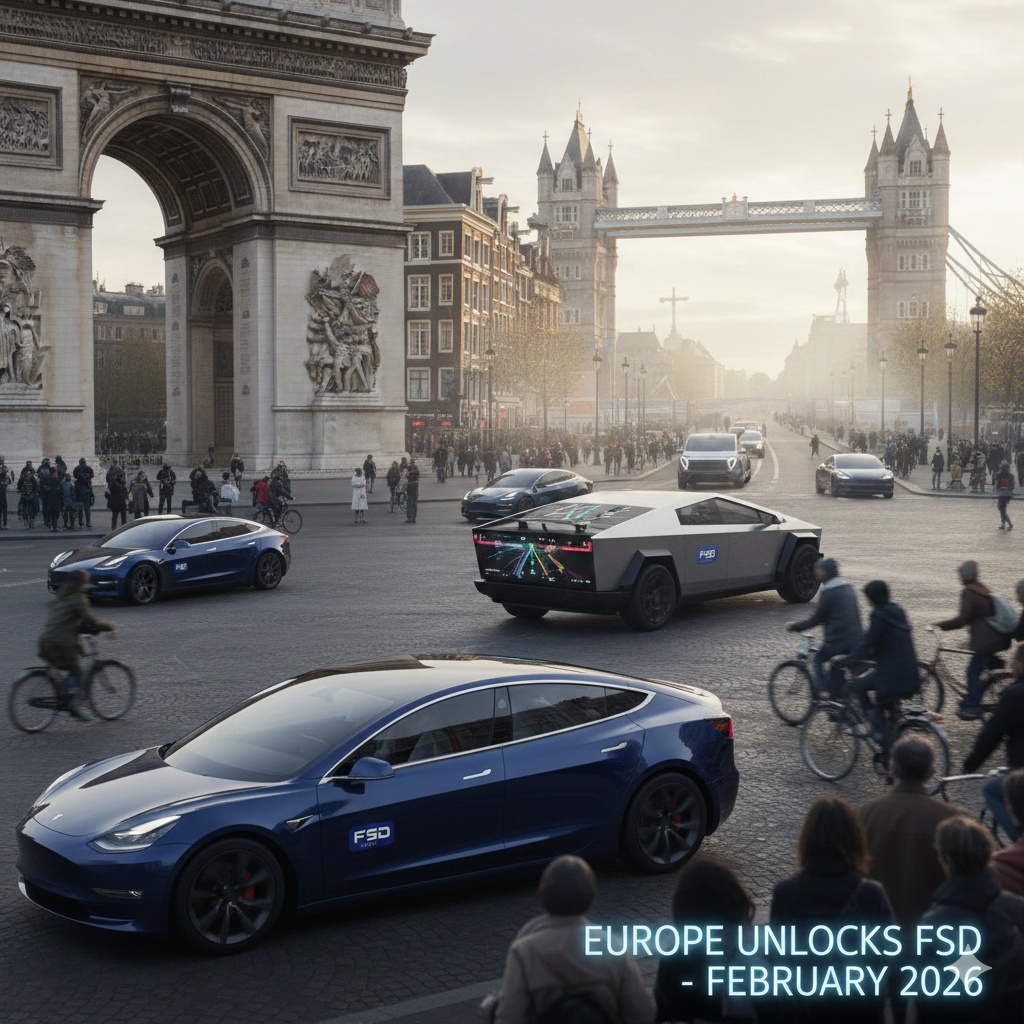
Introduction: The Great European Unlock
For over half a decade, Tesla owners across the European continent and the United Kingdom have lived in a state of "Autopilot Limbo." While their North American counterparts were testing the boundaries of Full Self-Driving (FSD) Beta and later the "Supervised" versions, European drivers were tethered to a system restricted by the UNECE R157 regulations. These rules, often criticized as being designed for a pre-AI era, effectively "neutered" Tesla’s capabilities—limiting steering torque, enforcing aggressive "hands-on" reminders, and making automatic lane changes nearly unusable.
However, as of today, January 23, 2026, the narrative has fundamentally changed. Following Elon Musk’s keynote at the World Economic Forum in Davos and recent filings with the Dutch Vehicle Authority (RDW), Tesla has confirmed that the "Great Unlock" is scheduled for February 2026.
This article explores the technical, regulatory, and economic implications of this shift. We will analyze why this moment is a turning point for Tesla’s valuation, how the software adapts to European complexity, and what owners can expect when the "Download Update" button finally brings the full FSD stack to the streets of London, Berlin, and Paris.
Chapter 1: The Regulatory Breakthrough — Breaking the UNECE Chains
1.1 The Shift from Rule-Based to Performance-Based Standards
For years, the primary barrier in Europe wasn't Tesla’s technology, but the regulatory philosophy of the UNECE (United Nations Economic Commission for Europe). The old framework was "rule-based," meaning it dictated how a car should perform a task (e.g., "a lane change must take exactly X seconds and requires Y amount of steering force").
Tesla’s FSD, which operates on an "End-to-End" neural network, cannot be easily governed by such granular, hard-coded rules because the AI makes decisions based on the totality of the environment. The breakthrough in early 2026 comes from the RDW (Netherlands) and the UK's Department for Transport shifting toward "Performance-Based" validation. Regulators are now looking at the safety outcome—does the car drive safer than a human?—rather than the specific lines of code used to achieve it.
1.2 The Role of the Dutch RDW as the European Gateway
The Netherlands has long been the entry point for Tesla into the European market. Because the RDW provides Type Approval for the entire EU, their decision to move forward with a "National Approval" in February 2026 acts as a domino. Once the Netherlands approves the FSD v13+ stack, other member states can choose to recognize the exemption immediately. This avoids the "fragmented" rollout that many feared and allows for a cohesive Continental experience.
Chapter 2: Localizing the Brain — How FSD Adapts to Europe
2.1 The "Old World" Challenge: Roundabouts and Narrow Streets
American FSD was trained on wide, grid-based American cities. Europe presents a "final boss" level of complexity:
-
The Roundabout Mastery: In the UK and France, roundabouts are the primary intersection type. Tesla’s latest training data includes millions of miles specifically from European test fleets to handle multi-lane roundabouts with aggressive traffic flow.
-
Vulnerable Road Users (VRUs): Cities like Amsterdam and Copenhagen have a density of cyclists and pedestrians that far exceeds most US cities. The v13 stack utilizes an "enhanced occupancy network" that prioritizes the prediction of erratic cyclist behavior.
2.2 Vision-Only in Northern Climates
A major point of contention for European regulators was Tesla's removal of ultrasonic sensors and radar. To secure the February 2026 approval, Tesla had to demonstrate that its "Vision-Only" system could handle the low-visibility, high-glare, and heavy-precipitation environments typical of a German or British winter. The solution lies in the AI5 (Hardware 5) and Hardware 4 computers, which now process high-resolution frames at a frequency that allows the car to "see" through heavy rain better than a human eye.
Chapter 3: The Economic Impact — Software as a Service (SaaS) Evolution
3.1 The $99 Subscription in the Eurozone
With the formal rollout, Tesla is expected to unify its pricing. For European owners, the €7,500 upfront cost has been a hard sell for a "neutered" system. The introduction of the €95/month subscription (mirroring the US $99 model) is expected to skyrocket adoption rates from the current <3% to an estimated 15-20% within the first year of approval.
3.2 Residual Value and the "Tesla Network"
For the blogger and owner community, the most exciting prospect is the impact on resale value. A Tesla with "Full FSD Capability" in Europe will transition from a speculative asset to a functional one. Furthermore, this approval is the prerequisite for the Tesla Network (Robotaxi) launch in Europe. Owners will soon have the legal framework to eventually opt their cars into a revenue-generating fleet, though "Unsupervised" operation in Europe likely remains 18-24 months away.
Chapter 4: Hardware Requirements & Fleet Compatibility
4.1 The HW3 vs. HW4 Divide
As we move into 2026, a significant technical question arises: will older Hardware 3 (HW3) cars be able to handle the complex European FSD stack? While Elon Musk has promised "parity," the reality is that the European neural net requires more parameters to account for the diversity of signage and road types.
-
HW4/AI5 Advantage: These owners will receive the "native" high-resolution stack.
-
HW3 Retrofits: There is increasing talk in the service community about potential computer upgrades for early Model 3/Y owners in Europe to ensure they aren't left behind by the new regulatory standards.
Conclusion: A New Era for the European Owner
The February 2026 approval is more than just a software update; it is the moment Tesla truly becomes a global AI company. For the European owner, it means their vehicle is no longer a "lesser" version of the American product. It is a validation of their investment and a glimpse into a future where the commute from London to Manchester, or Munich to Berlin, is managed by a silicon brain that never sleeps and never gets distracted.
FAQ: Everything You Need to Know
Q: Does the February 2026 date mean I can take my hands off the wheel? A: No. This is for "FSD Supervised." Under current European law, you must remain the "Responsible Actor." However, the car will now perform maneuvers (like navigating roundabouts and lane changes) without the "nags" and torque-checks that plagued the old system.
Q: Will FSD be available for the Highland Model 3 and the Juniper Model Y? A: Yes. These models are equipped with HW4 and are the primary targets for the initial rollout in February.
Q: What about the UK? Is it separate from the EU approval? A: While technically separate post-Brexit, the UK’s Automated Vehicles Act (passed in late 2024/early 2025) was designed specifically to fast-track systems like FSD. The UK is expected to mirror the RDW's timeline almost exactly.
Q: How much will the subscription cost in the UK? A: Expected pricing is £80–£90 per month, aligning with global currency parity.