
Introduction
On May 10, 2026, Tesla posted a brief message on its official X account. The words were simple, but their weight was immense: the final Model S and final Model X had rolled off the Fremont factory production line. Fourteen years of Model S history. Eleven years of Model X. Over 610,000 vehicles produced between them. The post carried a single image of factory workers gathered around the last cars, their signatures scrawled across the body panels — a farewell ritual for machines that had reshaped the global automotive landscape.
The announcement did not come as a shock. Elon Musk had telegraphed this moment months earlier. During the January 29, 2026, earnings call, he stated plainly: "We expect to wind down S and X production next quarter and basically stop production." He added words that struck a rare note of sentimentality from a CEO known for looking relentlessly forward: "That is slightly sad, but it's time to bring the S and X programs to an end, and it's part of our overall shift to an autonomous future".
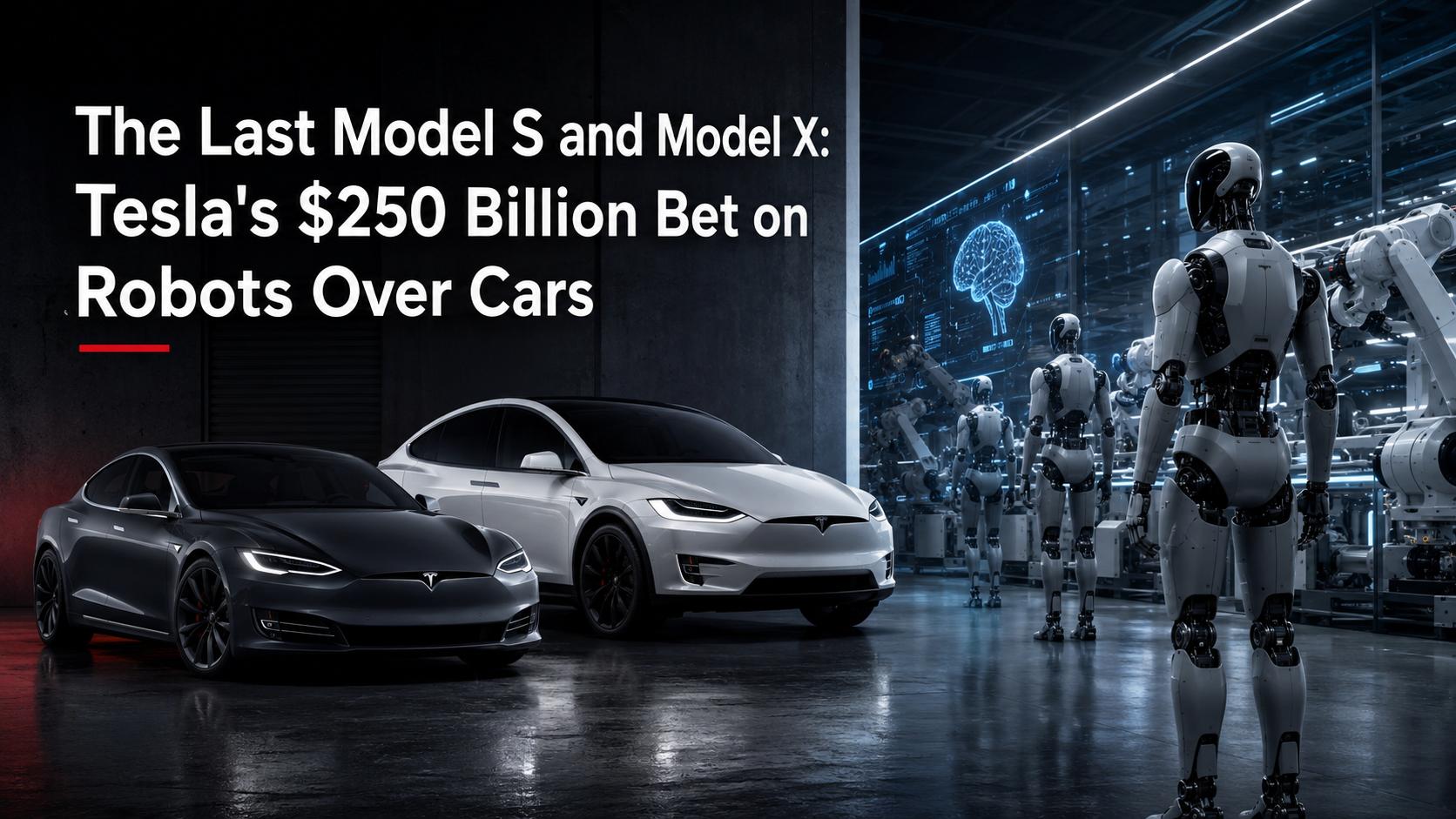
What makes this moment genuinely historic is not simply that two iconic vehicles are disappearing from showrooms. It is what Tesla intends to do with the factory space they occupied. The Fremont production lines that built every Model S since 2012 and every Model X since 2015 are being dismantled — not to make way for a next-generation sedan or SUV, but to be completely rebuilt as a manufacturing facility for the Optimus humanoid robot. Tesla is betting that a single year of robot production on those lines will generate more value than both flagship vehicles combined ever could.
Chapter 1: The Cars That Changed Everything
A Fourteen-Year Legacy
The Model S did not just launch a car company. It fundamentally altered the public's understanding of what an electric vehicle could be. When the first Model S sedans left Fremont in June 2012, the EV landscape was dominated by low-range compliance cars and glorified golf carts. The Model S arrived with an 85 kWh battery pack, an EPA-rated range of 426 kilometers, and a starting price of $57,400 — numbers that seemed improbable at the time. In 2013, it became the first non-internal-combustion vehicle to win Motor Trend's coveted "Car of the Year" award, a milestone that sent shockwaves through the automotive establishment.
Three years later, Tesla doubled down on audacity. The Model X arrived in 2015 with falcon-wing rear doors, a panoramic windshield that stretched over the front occupants' heads, and a Plaid performance variant that could launch a three-row SUV to 60 miles per hour in under three seconds. Nothing like it had ever existed, and in many ways, nothing like it has existed since. These two vehicles — the sedan and the SUV — established Tesla not as an environmental statement but as a legitimate luxury performance brand capable of competing with Mercedes-Benz, BMW, and Porsche on their own terms.
By the time production ended, total cumulative output of Model S and Model X had reached approximately 610,000 units — a figure that encompasses roughly 75,000 sedans and SUVs built over 14 years. For context, Tesla now sells more Model Y crossovers in a single quarter than it built Model S and Model X vehicles in their entire combined production history.
The Mathematical Case for Killing a Legend
The decision to end Model S and Model X production, however emotional for longtime owners and enthusiasts, follows brutal arithmetic. In 2025, Tesla delivered 1,636,129 vehicles globally. Of those, Model 3 and Model Y accounted for 1,585,279 units — approximately 97% of total deliveries. The Model S, Model X, Cybertruck, and Tesla Semi combined for just 50,850 units. Industry analysts estimate actual Model S and Model X sales at roughly 25,000 to 30,000 units for the full year 2025.
The Fremont production lines dedicated to Model S and Model X were designed to build approximately 100,000 vehicles annually. For the past several years, they had been running at roughly one-third of that capacity — and sometimes far less. In manufacturing, underutilized production capacity is not merely inefficient; it is financially corrosive. Fixed costs continue regardless of output. Depreciation schedules march forward. Floor space, utilities, and labor represent ongoing expenditures that must be spread across fewer and fewer units, eroding per-vehicle margins to unsustainable levels.
Musk characterized the decision in language that reveals how thoroughly Tesla's identity has shifted. "If we maintain the S/X production capacity of 30,000 units per year," he explained during the first-quarter 2026 earnings call, "we would be occupying space that could produce one million robots — and each robot has the potential to be worth far more than a single Model S". This is not the math of an automotive executive. It is the math of someone who views cars as a legacy business.
What Owners Are Losing
For current Model S and Model X owners, the end of production raises practical questions that go well beyond sentiment. Tesla has stated that it will continue to provide service, parts, and software updates for existing vehicles "for as long as people have them". Historically, Tesla has maintained parts availability for discontinued models — Roadster owners can still obtain certain components through Tesla's service network — but the long-term parts supply for vehicles with complex bespoke systems like the Model X's falcon-wing doors remains an open question.
The resale market presents a more complex picture. On one hand, the end of production creates instant scarcity. There will never be a new Model S or Model X again, and for buyers who value the unique combination of performance, range, and the Tesla ecosystem, well-maintained examples could appreciate — particularly the 350 limited Signature Edition units and ultra-rare Plaid variants. On the other hand, Tesla's ongoing shift toward autonomy and robotics raises legitimate questions about how much software development resources will be allocated to vehicles running on what is now officially a legacy platform. Over-the-air updates have been one of Tesla ownership's greatest selling points; a future where Model S and Model X receive fewer meaningful updates could erode their long-term value proposition.
Chapter 2: The Signature Edition Fiasco
A $159,420 Promise, Broken
To mark the historic end of production, Tesla created something genuinely special: the Signature Edition — a limited run of 250 Model S and 100 Model X vehicles, each priced at $159,420. These were not ordinary final-edition cars. They featured exclusive "Garnet Red" paint unavailable on any other Tesla, gold interior piping, individually numbered dashboard plates, and a host of performance and luxury upgrades befitting a collector-grade farewell to the cars that built the company.
Tesla promised these 350 buyers something equally exclusive: an invite-only celebration at the Fremont factory — scheduled for May 12, 2026 — billed as "the first of the last deliveries of Model S and Model X Signature Edition — ever." Buyers booked flights from across the United States. They reserved hotels. They arranged time off work and told friends and family they would be part of automotive history. Many spent thousands of dollars on non-refundable travel arrangements.
Then, on May 9, 2026 — three days before the event — Tesla sent an email. Its complete text read: "The Signature Edition Delivery Event scheduled for May 12, 2026, has been postponed. We apologize for any inconvenience." That was it. Two sentences. No explanation for why the event was being postponed. No rescheduled date. No mention of reimbursement for travel costs. No acknowledgment that buyers had spent thousands of dollars based on Tesla's invitation.
The Backlash
The reaction was immediate and furious. Brooks Weisblat of DragTimes, who had traveled to the Bay Area specifically for the event, posted on X: "Spent thousands on this trip… @Tesla." Others were less restrained. One Signature Edition buyer wrote that Tesla should "compensate owners or hold the event on the originally planned date."
What made the situation particularly galling was the contractual straitjacket Signature Edition buyers had already accepted. Every purchaser had signed a one-year no-resale agreement carrying a 50,000penaltyforviolations.Thesebuyers—Tesla′smostloyalandhighest−spendingcustomers—werelegallyprohibitedfromsellingtheircarswhilebeingtreatedtowhatoneownerdescribedas"atwo−sentencebrush−offafterspending160,000 and thousands more on travel"
The postponement was not entirely unprecedented. Tesla has a documented history of last-minute event changes: the first Model S Plaid deliveries in 2021 were delayed by a week because Musk said the car needed "one more week of tweak," and the Robotaxi unveiling was pushed from August to October 2024 to allow more time for prototype development. But those prior delays came with at least some explanation. This time, Tesla gave nothing.
As of this writing, Tesla has not announced a rescheduled date, nor has it addressed the question of travel reimbursement. The company — which dissolved its public relations department years ago — appears to be handling the situation with silence.
Chapter 3: From Assembly Lines to Robot Factories — The Optimus Production Plan
The Factory Transformation
What happens next at Fremont is arguably the most ambitious factory retooling in modern manufacturing history. Tesla plans to completely dismantle the Model S and Model X production lines — from upstream components like battery packs and motors to final assembly — and install entirely new manufacturing equipment designed specifically for the Optimus humanoid robot. The target: to have this transformation completed and the new Optimus line operational by late July or August 2026.
Musk has described this four-month transition in characteristically sweeping terms: "If we could go from stopping production on one line, dismantling that entire line, installing a brand new line, and getting it running in just four months, that's an incredibly high speed. I don't think any other company on Earth has ever done that before." Whether this timeline proves achievable or aspirational remains to be seen. Tesla's manufacturing track record includes both extraordinary achievements and significant delays, and building a production line for a product that has never been manufactured at scale introduces variables no amount of planning can fully anticipate.
The first-generation Fremont Optimus production line is designed for an annual capacity of one million robots. This is not a speculative target or a long-term ambition — it is what the factory is physically being built to achieve. Tesla has already begun recruiting for battery cell production roles to support the expanded operation, and the company is simultaneously preparing a second-generation production line at Gigafactory Texas with a long-term target of 10 million robots per year.
A History of Missed Targets
Any assessment of Tesla's Optimus ambitions must reckon with the company's track record on humanoid robot production — and that record is sobering. In January 2025, Musk stated that Tesla would build "approximately 10,000 Optimus robots" during that calendar year. By January 2026, exactly zero Optimus robots were performing useful work in Tesla's factories. The target had been missed entirely, with no public acknowledgment of the shortfall beyond a brief admission during an earnings call.
The Optimus Gen 3 reveal — originally expected in the first quarter of 2026 — has been pushed to "probably mid-year." Tesla's explanation is that competitors are "doing frame-by-frame analysis of every release" and that the company must protect its designs. Whether this is prudent competitive strategy or a reflection of development challenges is impossible for outsiders to determine, but the pattern of shifting timelines is unmistakable.
Even as Tesla acknowledges that initial production will be "quite slow" and "literally impossible to predict," the company is investing staggering sums. The total capital commitment to Optimus-related infrastructure — encompassing the Fremont retooling, the Texas second-generation line, and associated supply chain build-out — has been pegged at $250 billion. This is not research and development spending. This is factory construction, equipment installation, and supply chain capitalization on a scale that exceeds the GDP of many nations.
Musk has stated that the Optimus business could ultimately be worth more than Tesla's entire automotive operation. If the robots can be built at scale and deployed effectively, the math is not obviously wrong. A million robots sold at even 20,000eachrepresents20 billion in annual revenue — roughly equivalent to what Model S and Model X generated in their best years combined, but with vastly higher growth potential. The question is whether Tesla can execute on manufacturing a product that consists of over 10,000 unique parts, none of which have been used in mass production before, on a production line that has not yet been built.
Chapter 4: The Competitive Landscape — Tesla Is Not Alone
Who Else Is Building Humanoid Robots
Tesla's pivot to humanoid robotics positions it in a field that is far more crowded than many Tesla enthusiasts may realize. Several well-funded competitors are already deploying robots in commercial settings — and some have multi-year head starts.
Boston Dynamics, widely regarded as the pioneer of advanced legged robotics, is supplying its Atlas humanoid robot to Hyundai factories. The company is targeting annual production of 30,000 units — a fraction of Tesla's ambitions, but based on a platform that has been in development for over a decade and has accumulated thousands of hours of real-world operational data. When it comes to balance, locomotion, and physical manipulation in unstructured environments, Atlas currently represents the state of the art.
Figure AI, valued at $39 billion, is piloting its humanoid robot at a BMW manufacturing facility in South Carolina. The Figure robot is designed specifically for industrial tasks — parts handling, assembly assistance, and logistics within factory environments. Unlike Tesla, which is building its robot business largely from internal demand, Figure AI has designed its platform to integrate into existing manufacturing workflows at customer sites.
Agility Robotics has taken perhaps the most pragmatic approach. Its Digit robot — a two-legged machine optimized for warehouse and logistics environments — is already in commercial use at a Toyota facility in Canada. Digit is not designed to look human; it is designed to move boxes, and it is doing so in production settings today. This puts Agility in a position Tesla will not reach for at least several more quarters: generating revenue from robots performing useful work.
Tesla's Advantages and Disadvantages
Tesla enters this competitive field with several unique advantages. The first is vertical integration. Tesla manufactures its own batteries, designs its own chips (the AI5 inference chip has completed tape-out and will power Optimus's onboard intelligence), and controls its own manufacturing infrastructure. Most robotics competitors must source batteries, actuators, and compute hardware from third-party suppliers, adding cost, complexity, and supply chain vulnerability.
The second advantage is scale of ambition. Tesla is building factories designed for millions of units per year while competitors are targeting tens of thousands. If Tesla's manufacturing approach succeeds — and that "if" carries enormous weight — the cost advantages of producing at such volumes could make Optimus dramatically cheaper than any competing humanoid robot.
The third advantage is Tesla's internal demand. The company's own factories — Fremont, Austin, Berlin, Shanghai, and Nevada — represent immediate deployment opportunities for thousands of robots. Optimus does not need to conquer external markets to prove its value; it simply needs to perform useful work inside Tesla's existing operations.
The disadvantages are equally significant. Tesla has never built a humanoid robot at scale. It has never built most of the components that go into a humanoid robot at scale. The manufacturing challenge of producing millions of articulated, sensor-laden, AI-driven machines annually bears little resemblance to building cars, and Tesla's automotive manufacturing expertise may transfer only partially. Moreover, Tesla enters this market with a history of missed robotics production targets and a CEO whose timelines have consistently proven over-optimistic.
Chapter 5: What Replaces Model S and Model X in Tesla's Lineup
The Future of Tesla's Vehicle Portfolio
With Model S and Model X gone, Tesla's passenger vehicle lineup consists of exactly three models: Model 3, Model Y, and Cybertruck. This is a dramatic simplification for a company that once aspired to offer a vehicle for every segment. But it reflects a deliberate strategic choice — and it is not the whole story.
Tesla has confirmed that a next-generation Roadster remains in development. The specifications are extraordinary by any standard: a claimed CLTC range of 1,000 kilometers, a top speed exceeding 400 km/h, and 0-100 km/h acceleration in under 2.1 seconds. An optional SpaceX rocket thruster package — yes, actual cold-gas thrusters — would push performance into territory no production car has ever approached. However, the Roadster's release date has been pushed back repeatedly, with the latest expectations pointing to mid-2026 or later.
More significantly, Tesla is building an entirely new category of vehicle around autonomy. The Cybercab — a dedicated robotaxi with no steering wheel and no pedals, designed for two passengers — is positioned to become Tesla's highest-volume product. Musk has stated that Cybercab production will eventually exceed the combined output of all other Tesla vehicles. The company envisions a platform similar to Airbnb, allowing millions of Tesla owners to deploy their vehicles into an autonomous ride-hailing fleet and earn revenue when the cars would otherwise be parked.
The Cybertruck as Freight Platform
In a move that connects Tesla's vehicle and autonomy strategies, the company plans to repurpose the Cybertruck as an autonomous freight platform — essentially a driverless cargo carrier that could operate on fixed routes between logistics hubs. This positions Cybertruck as a bridge between Tesla's consumer vehicle business and its commercial transportation ambitions, leveraging the same Full Self-Driving technology that powers the Cybercab in a different form factor.
The strategic picture that emerges is coherent even if its components are still under development. Tesla is withdrawing from the low-volume luxury vehicle segment — where margins are high but total revenue is limited — and redirecting resources toward technologies it believes will generate exponentially larger returns: autonomous ride-hailing, autonomous freight, and humanoid robotics. Whether this bet pays off will depend on execution timelines that remain, to put it generously, uncertain.
Conclusion
The end of Model S and Model X production on May 10, 2026 marks far more than the discontinuation of two car models. It represents a fundamental identity shift for one of the world's most consequential companies. Tesla is no longer primarily an automaker in its own strategic self-conception. It is an artificial intelligence and robotics company that happens to manufacture vehicles as one revenue stream among several.
For the hundreds of thousands of Model S and Model X owners around the world, the news carries practical and emotional weight. These were not just cars; for many, they were the vehicles that converted them to electric driving, that demonstrated performance could coexist with sustainability, that made them Tesla believers. The company has promised ongoing support, and there is little reason to doubt that service and parts will remain available for the foreseeable future. But the software updates that have made Tesla ownership uniquely dynamic may, over time, prioritize newer platforms.
The Signature Edition fiasco — a genuinely avoidable unforced error — has left a bitter aftertaste among Tesla's most loyal customers. A company that asks its biggest supporters to spend $159,420 on a collector's item and thousands more on travel should, at minimum, communicate with basic decency when plans change. Tesla's failure to do so is a reminder that its customer relations philosophy, like its corporate structure, remains unconventional in ways that sometimes hurt the people who believe in it most.
The Optimus bet is the largest unknown in Tesla's future. The Fremont factory that once built the cars that changed the auto industry will soon build robots that could, if successful, change how work itself is performed. Tesla has bet $250 billion and its flagship product line on this vision. The math is audacious. The timelines are uncertain. The execution will determine whether the end of Model S and Model X is remembered as a strategic masterstroke or as the moment Tesla abandoned the business that made it great.
One thing is already certain: an era has ended. The final Garnet Red Model X Plaid — signed by the workers who built it, marked "Last One" on its tail — will never be sold. It will remain at Tesla as a museum piece, a marker of what was. The future those workers are now building looks nothing like the past they helped create.
Frequently Asked Questions
Q: Can I still buy a new Model S or Model X?
No. Tesla stopped accepting custom orders for Model S and Model X on April 1, 2026. Production of both vehicles ended entirely on May 10, 2026. Some Model X inventory vehicles may remain available on Tesla's website depending on your region, but Model S inventory has been depleted. Once existing stock is sold, no new units will ever be built.
Q: Will Tesla still service my existing Model S or Model X?
Yes. Tesla has committed to providing ongoing service, parts, and software updates for existing Model S and Model X vehicles. The company has stated it will support these vehicles "for as long as people have them." However, as with any discontinued vehicle, parts availability for certain bespoke components — particularly Model X falcon-wing door mechanisms — may become more constrained over time.
Q: Why did Tesla discontinue the Model S and Model X?
The official reason is strategic reallocation of manufacturing resources. The Fremont factory space previously dedicated to Model S and Model X production is being converted to manufacture the Optimus humanoid robot. Tesla determined that maintaining a production line running at roughly 30% capacity for two low-volume vehicles was less valuable than using that space for a product line with significantly higher growth potential.
Q: Will my Model S or Model X increase in value now that production has ended?
Possibly. The end of production creates instant scarcity, particularly for limited editions like the Plaid and the 350 Signature Edition units. Well-maintained, low-mileage examples — especially those with unique specifications — could appreciate. However, resale value will also depend on Tesla's continued software support, the broader EV market, and the availability of service and parts over time. The one-year no-resale agreement on Signature Edition vehicles (with a $50,000 penalty for violations) temporarily restricts the market for the most collectible units.
Q: When will the Optimus robot be available for purchase?
Tesla has not announced a commercial sale date for Optimus. Initial production at Fremont is scheduled to begin in late July or August 2026, but those early units will almost certainly be used internally in Tesla's own factories. The company has not indicated when external customers will be able to purchase Optimus robots, and given Tesla's history of timeline revisions, any commercial availability date should be treated as provisional until the robots are actually being delivered.
Q: Is Tesla completely abandoning the luxury car market?
Not entirely. Tesla has confirmed that a next-generation Roadster is in development, though its release date has been delayed multiple times. The Roadster — with its claimed 1,000-kilometer range and sub-2.1-second 0-100 km/h time — is positioned as a halo vehicle rather than a volume seller. For practical luxury, Tesla appears content to let the Model Y and Model 3 occupy the premium space while Cybertruck covers the high-end truck segment. The company's strategic focus has clearly shifted away from competing with traditional luxury automakers.