
Introduction
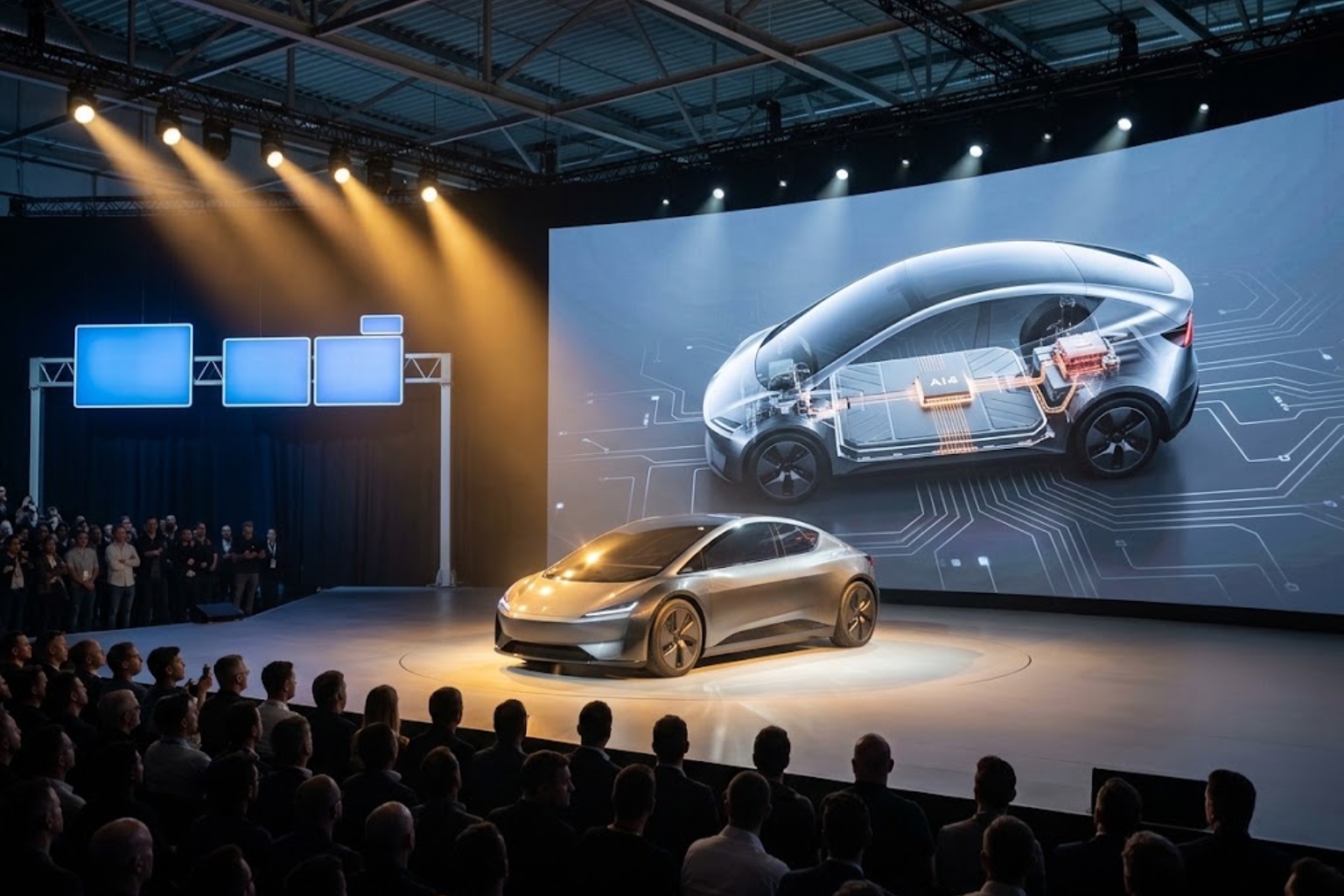
The official unveiling of the production-specification Cybercab at Gigafactory Texas represents a decisive break in Tesla’s corporate trajectory. For over eight years, the autonomous narrative centered entirely on consumer vehicles—promising that Model 3, Model Y, and Model S sedans sitting in suburban driveways would effortlessly morph into revenue-generating robotaxis via overnight over-the-air updates.
The Cybercab launch reframes this vision. While consumer fleet integration remains an aspirational future feature, Tesla has realized that commercial, unattended, Level 4/5 operations require specialized, purpose-built hardware. Stripped of traditional mechanical controls, steering columns, pedals, and side mirrors, the Cybercab is built from the ground up to achieve the lowest possible cost-per-mile in transport history.
Chapter 1: Technical Deep Dive: Efficiency, Mass, and Compute
The engineering specifications of the production Cybercab highlight ruthless optimization over brute-force performance:
-
Structural Architecture & Curb Weight: The vehicle hits a total curb weight of only 3,113 pounds. By utilizing an aggressive structural casting philosophy and completely eliminating driver controls, HVAC ducting for secondary passenger zones, and mechanical linkages, Tesla achieved an unprecedented mass reduction.
-
Battery Pack & Powertrain: Power is supplied by a compact 48 kWh structural battery pack coupled to a single 219-horsepower front-mounted motor. Because aerodynamic drag and vehicle weight are kept low, the car achieves an unadjusted highway and urban combined range of 418 miles on a single charge. This represents an energy efficiency rating exceeding 8.7 miles per kilowatt-hour.
-
AI4 Vision Processing Core: Autonomous navigation relies entirely on an upgraded AI4 hardware computer. High-resolution 5-megapixel cameras are integrated flush into the roof perimeter, B-pillars, and front bumper fascia. Tesla has rejected LiDAR, radar, and HD mapping, asserting that the neural network's visual-spatial reasoning is capable of operating purely on visual input.
-
Inductive Wireless Charging: The vehicle does not feature an external NACS charge port. Instead, it relies entirely on high-speed inductive resonance charging pads installed flush in depot stalls, enabling hands-free turnaround times in dedicated urban staging hubs.
Chapter 2: The Deployment Matrix: Real-World Service Footprint
The transition from pilot tests to production deployment has moved rapidly across key American metro markets:
-
Current Operational Footprint: Commercial unsupervised rides are active across six major cities: Austin, Dallas, and Houston in Texas, alongside Miami, Orlando, and Tampa in Florida.
-
Expanded Operating Hours: Fleet operations currently run from 6:00 AM to 10:00 PM, seven days a week. This schedule is intentionally designed to avoid early morning black-ice conditions and late-night edge cases while ensuring 100% driverless deployment without safety fallbacks.
-
Fleet Ramping: As Gigafactory Texas ramps Cybercab production lines, these vehicles will progressively displace the retrofitted Model Y units that handled the initial rollout phase.
Chapter 3: What Cybercab Means for Existing Tesla Owners
The launch of a dedicated, company-owned robotaxi creates mixed reactions among retail Tesla owners:
-
The "Consumer Robotaxi" Reality Check: Owners who purchased FSD expecting their personal daily drivers to generate thousands of dollars per month while parked at work must reconcile with regulatory and hardware realities. Tesla's primary focus is expanding its closed, vertically integrated fleet rather than underwriting insurance liabilities for customer vehicles.
-
Vehicle Residual Values: A low-cost, ultra-efficient Cybercab platform could create pricing pressure on older entry-level Model 3s on the secondary market. If hailing a driverless vehicle costs $0.35 per mile, car ownership becomes an active financial calculation rather than an automatic default.
-
FSD Feature Pull-Through: On the positive side, every improvement developed for the Cybercab fleet's neural network instantly trains the foundation models powering consumer FSD (Supervised), ensuring that privately owned cars benefit from massive enterprise-scale fleet validation.
Conclusion
The production Cybercab cements Tesla’s transition into an applied AI powerhouse. By pairing an ultra-lightweight 48 kWh architecture with proprietary AI4 compute and hands-free inductive charging, the vehicle establishes a daunting benchmark for ride-hailing economics.
Frequently Asked Questions (FAQ)
-
Q1: Can an individual retail customer buy a Cybercab today?
No. Production capacity at Gigafactory Texas is prioritized for Tesla's internal commercial fleet. Tesla has teased potential private-fleet ownership models for verified fleet operators in late 2027.
-
Q2: Why does the vehicle use front-wheel drive instead of rear-wheel drive?
Packaging efficiency. Positioning the 219-hp motor at the front axle frees up significant rear chassis volume for an oversized luggage compartment, which is critical for airport passenger transport.
-
Q3: How does the car clean its vision cameras without human attendants?
The Cybercab integrates high-pressure micro-fluidic washer jets and heated resistive glass coatings over all primary camera lenses, allowing automatic purging of mud, bugs, and ice during operation.
-
Q4: What happens if a Cybercab encounters an unmapped road closure?
The vehicle does not rely on static maps; its end-to-end vision system evaluates physical drivable space dynamically, executing U-turns or alternate route detours in real time without teleoperation intervention.