
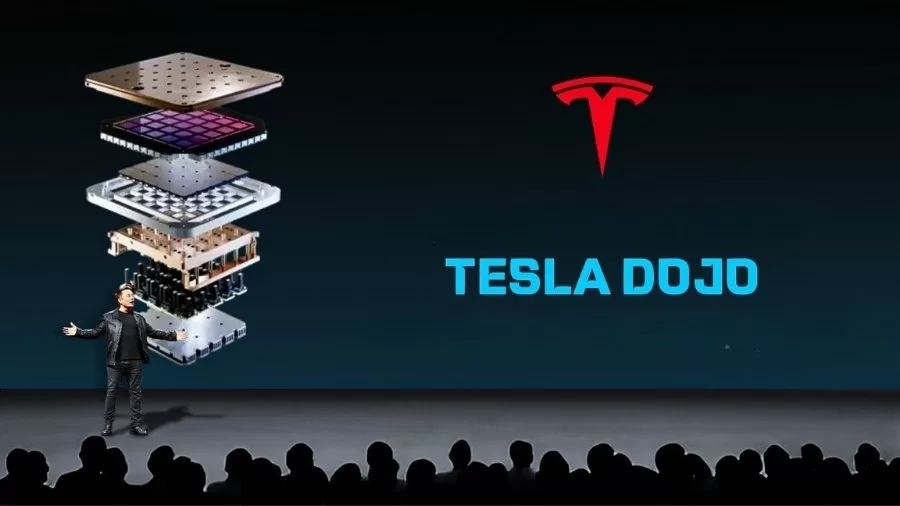
Tesla is no longer just an EV company — it is building a vertically integrated AI stack designed to power Full Self-Driving, Robotaxi services, and future autonomous mobility. Dojo and Tesla’s in-house AI chips are central to this strategy.
1. Introduction: Why Tesla’s AI Strategy Matters More Than Ever
For most Tesla owners, software updates appear quietly overnight, adding small features, interface changes, or incremental improvements to Autopilot and Full Self-Driving (FSD). Behind these updates, however, lies one of the most ambitious artificial intelligence projects in the automotive industry.
Tesla’s long-term competitive advantage is no longer defined solely by battery efficiency, drivetrain performance, or vehicle design. Instead, it is increasingly driven by data, computing power, and AI training efficiency. At the center of this transformation is Tesla’s Dojo supercomputer, paired with its custom-designed AI chips and a rapidly evolving neural-network architecture.
Recent statements from Tesla leadership confirm that AI chip design iterations are stabilizing, and Dojo’s role in large-scale training is expanding. This has significant implications not only for Full Self-Driving performance but also for Tesla’s future services, including Robotaxi networks and autonomous logistics.
For Tesla owners in the United States and Europe, understanding Dojo is no longer optional — it directly affects vehicle capability, long-term value, and the pace of autonomy deployment.
2. What Is Tesla Dojo? A Plain-English Explanation
2.1 Dojo Is Not a Consumer Product
Dojo is not installed in Tesla vehicles, nor is it a data center that customers interact with directly. Instead, it is a centralized AI training supercomputer built to process massive volumes of real-world driving data collected from Tesla’s global fleet.
Every Tesla vehicle equipped with cameras continuously generates labeled driving data — intersections, lane markings, pedestrians, signage, edge cases, and rare events. This data feeds into Tesla’s AI pipeline.
Dojo exists to train neural networks faster, cheaper, and at a larger scale than traditional GPU-based systems.
2.2 Why Tesla Built Its Own Supercomputer
Most AI companies rely heavily on third-party hardware, primarily GPUs from Nvidia. Tesla chose a different path for several reasons:
-
Cost control at a massive training scale
-
Tight hardware–software integration
-
Optimization for video-based neural networks
-
Reduced dependency on external suppliers
Tesla’s autonomy problem is fundamentally different from text-based AI systems. FSD relies on continuous, multi-camera video streams, not static images or language prompts. Dojo is architected specifically for this workload.
3. The AI5 Chip and Tesla’s In-House Silicon Strategy
3.1 Why Custom AI Chips Matter
Tesla designs its own AI chips for two distinct purposes:
-
Inference chips — installed inside vehicles to run FSD in real time
-
Training chips — used in Dojo to train large neural networks
Recent updates indicate that Tesla’s next-generation AI chip design (often referred to as AI5) has reached a more mature stage. This suggests improved efficiency, lower power consumption, and higher throughput for training autonomy models.
3.2 Training vs. Inference: A Key Distinction
Many Tesla owners confuse in-car hardware upgrades with Dojo’s role. The distinction is critical:
-
Inference hardware determines how well your car can run FSD today
-
Training hardware (Dojo) determines how fast FSD improves tomorrow
Dojo does not replace in-vehicle hardware. Instead, it accelerates the learning loop, allowing Tesla to:
-
Train larger models
-
Incorporate more edge cases
-
Iterate software faster
This shortens the gap between real-world driving experience and software improvement.
4. How Dojo Improves Full Self-Driving Performance
4.1 From Rule-Based Logic to End-to-End Neural Networks
Tesla has largely abandoned traditional rule-based autonomy logic. Modern FSD relies on end-to-end neural networks trained on real driving data.
Dojo enables Tesla to:
-
Process petabytes of video data
-
Train unified networks for perception, planning, and control
-
Reduce hand-coded heuristics
This approach allows FSD to behave more like a human driver — predicting intent, reacting to uncertainty, and handling ambiguous road situations.
4.2 Edge Case Learning at Scale
One of the hardest challenges in autonomy is dealing with rare but critical events, such as:
-
Unprotected left turns
-
Construction zone lane shifts
-
Emergency vehicles behaving unpredictably
-
Poor weather and low visibility
Dojo allows Tesla to rapidly retrain models when these events occur anywhere in the global fleet. A rare scenario encountered in Europe can improve FSD performance for drivers in the U.S. within weeks, not years.
5. The Role of Tesla’s Global Fleet as an AI Advantage
5.1 Fleet Scale as a Data Engine
Tesla operates millions of vehicles worldwide, creating an unmatched real-world dataset. Unlike competitors that rely on limited test fleets, Tesla trains autonomy systems on everyday driving performed by real customers.
Dojo’s purpose is to turn this raw data into actionable intelligence.
5.2 Why This Matters for U.S. and European Drivers
Driving environments differ significantly:
-
European cities feature narrow roads, complex roundabouts, and dense pedestrian traffic
-
U.S. roads emphasize high-speed highways and wide intersections
Dojo allows Tesla to train geographically adaptive models, improving FSD performance across regions without fragmenting the software base.
6. Dojo, Robotaxi, and Tesla’s Long-Term Vision
6.1 Autonomy as a Platform, Not a Feature
Tesla does not view FSD as a premium add-on alone. Instead, it is positioning autonomy as a platform for future services, including:
-
Robotaxi ride-hailing networks
-
Autonomous vehicle sharing
-
Logistics and delivery applications
None of these is viable without a scalable AI training infrastructure.
6.2 Why Dojo Is Critical for Robotaxi Deployment
Robotaxi networks require:
-
Near-perfect perception
-
Predictable behavior in complex urban environments
-
Continuous learning from fleet feedback
Dojo provides the compute backbone necessary to maintain and update a global autonomous fleet in near real time.
For owners, this raises long-term questions about vehicle monetization, autonomy subscriptions, and residual value.
7. Challenges and Skepticism Around Tesla’s AI Approach
7.1 Regulatory Barriers
Even with advanced AI, regulatory approval remains a major constraint — especially in Europe, where autonomy regulations are stricter and fragmented across countries.
Dojo accelerates technical readiness, but legal acceptance may lag.
7.2 Compute Costs and Energy Demands
Training AI at Dojo’s scale consumes enormous energy. While Tesla emphasizes efficiency, large-scale AI training remains expensive.
The long-term economics of autonomy depend on:
-
Energy efficiency per training run
-
Model reuse and optimization
-
Software monetization success
7.3 Competition from Established AI Giants
Tesla competes not only with automakers but also with:
-
AI chip manufacturers
-
Cloud computing providers
-
Autonomous driving startups backed by major tech firms
Dojo represents a bold vertical-integration strategy, but its ultimate advantage depends on execution.
8. What Tesla Owners Should Expect Next
8.1 Short-Term (2026)
-
Gradual FSD behavior improvements
-
More consistent city-driving performance
-
Reduced intervention frequency
8.2 Medium-Term (2027–2028)
-
Region-specific autonomy refinements
-
Expanded FSD feature sets
-
Possible regulatory pilots for higher autonomy levels
8.3 Long-Term
-
Vehicle autonomy as a revenue-generating asset
-
Software-driven resale value differentiation
-
Increased reliance on AI updates rather than hardware changes
9. Conclusion: Dojo Is Tesla’s Most Underrated Asset
While battery technology and vehicle design dominate public discussion, Tesla’s AI infrastructure may ultimately define the company’s future.
Dojo is not about flashy announcements — it is about compounding advantage. Each mile driven improves the system, and each training cycle shortens the path to autonomy.
For Tesla owners in the U.S. and Europe, this means your vehicle is not static. Its value and capability increasingly depend on Tesla’s ability to execute its AI vision — and Dojo sits at the center of that execution.
10. Frequently Asked Questions (FAQ)
Q1: Does Dojo directly improve my car today?
Indirectly. Dojo improves FSD models during training, which are later delivered to your vehicle via software updates.
Q2: Is Dojo replacing Nvidia GPUs entirely?
No. Tesla uses a hybrid approach, gradually increasing Dojo’s role alongside traditional GPU clusters.
Q3: Will Dojo reduce the need for new vehicle hardware?
In many cases, yes. Better models can extract more performance from existing hardware.
Q4: Does this mean full autonomy is guaranteed?
No. Technical readiness is only one part of autonomy. Regulation, safety validation, and public acceptance remain critical factors.