
Tesla’s engineering philosophy has long been characterized by a symbiotic relationship between hardware capability and software ingenuity. When the Cybertruck first arrived on the global stage, critics and enthusiasts alike were captivated by its stainless-steel exoskeleton, its disruptive design, and its polarizing aesthetic. However, as these geometric beasts become more common on the streets of metropolitan hubs from New York City to Berlin, the discussion has shifted from sheer novelty to real-world integration.
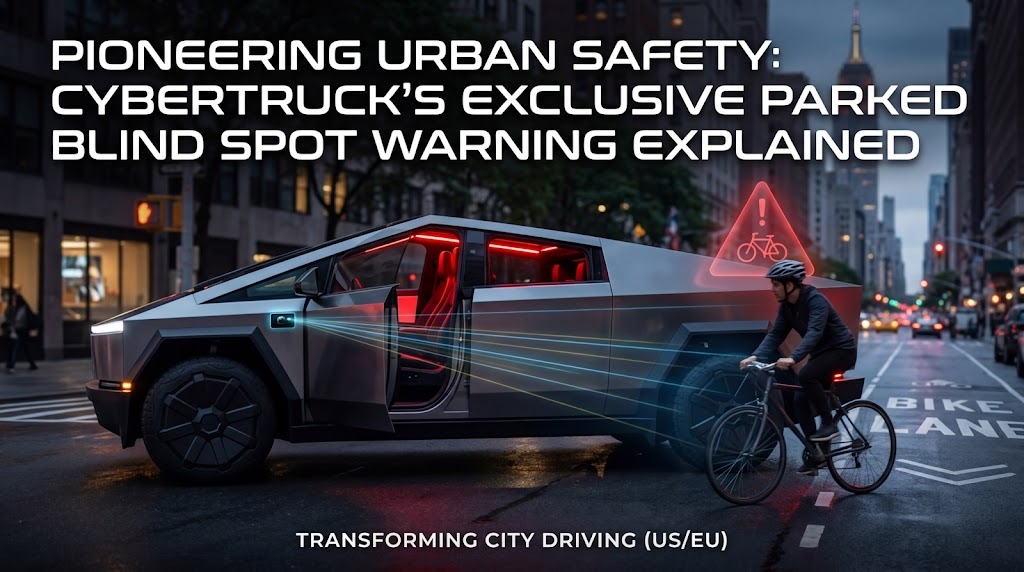
The Cybertruck presents unique safety challenges due to its massive footprint, high beltline, and thick structural pillars, which inherently create significant physical blind spots. On March 31, 2026, within the widespread global rollout of software version 2026.8, Tesla addressed these concerns with a groundbreaking innovation. Titled "Parked Blind Spot Warning," this feature is currently exclusive to the Cybertruck. It is not merely a convenience tweak; it is a vital safety intervention directly targeting the acute crisis of "dooring" accidents in dense urban environments across North America and Europe.
This article provides an exhaustive technical and contextual analysis of the Cybertruck's exclusive Parked Blind Spot Warning. We will explore the crisis it addresses, the advanced neural network operations that power it, the regional implications, and the potential for this feature to propagate to the broader Tesla fleet.
Chapter 1: Defining the Urban Danger: The "Dooring" Crisis
To appreciate the significance of Tesla’s Parked Blind Spot Warning, one must first understand the devastating impact of the phenomenon it combats: "dooring." Dooring occurs when an occupant of a parked vehicle opens their door directly into the path of an oncoming cyclist, e-scooter rider, or sometimes another vehicle.
The Dynamics of Vulnerability
Cyclists are disproportionately affected by dooring. In modern urban infrastructure, bicycle lanes are often placed in the "door zone"—the immediate space adjacent to parked cars. When a door is opened suddenly, a cyclist frequently has zero reaction time. The result is often catastrophic: the cyclist either collides violently with the door itself, often being flipped over it (the "dooring impact"), or is forced to swerve abruptly into traffic, leading to collisions with other moving vehicles.
For e-scooter riders, whose numbers have exploded across European capitals and major US cities, the risk is amplified by higher average travel speeds. What might have been a minor scrape for a pedestrian becomes a severe, sometimes fatal, injury at 20-25 mph (32-40 km/h).
Statistical Reality in the US and Europe
The crisis is supported by sobering statistics across Tesla's primary markets.
United States Context: According to data collated by various urban safety advocates and municipal transportation departments (such as Vision Zero initiatives in New York and San Francisco), dooring accidents account for a significant percentage of severe cyclist injuries. In dense, car-centric cities where cycling infrastructure is still playing catch-up, the conflict between parked vehicles and micro-mobility users is acute. The massive scale of American SUVs and trucks, including the Cybertruck, exacerbates the danger, as their heavy doors can deliver lethal force.
European Context: The reality is even more pressing in Europe. Cities like Amsterdam, Berlin, Paris, and Copenhagen are global benchmarks for cycling adoption. In many of these cities, bicycles outnumber cars. A single dooring incident on a busy artery like Berlin's Karl-Marx-Allee can cause a chain reaction, paralyzing traffic and injuring multiple road users. Europe has traditionally addressed this through intense driver education, famously popularizing the "Dutch Reach"—the practice of opening the door with the hand furthest from the door, forcing a shoulder check. However, education has limits in an era of multi-tasking and smartphone distraction. The need for a technological safeguard is undeniable.
Chapter 2: The Neural Network at Rest: How the Feature Operates
The Parked Blind Spot Warning is a prime example of software maximizing advanced hardware. While other manufacturers might require dedicated radar sensors for such functionality, Tesla relies entirely on its Hardware 4 (AI4) vision suite and its powerful neural networks.
The Power of "AI4" and Vision-Only
The Cybertruck exclusively ships with Tesla's latest-generation Hardware 4 (HW4). This suite features significantly upgraded cameras compared to the legacy Hardware 3 fleet. Key improvements include higher resolution sensors, vastly superior low-light performance (essential for evening urban safety), and wider angles of view. These cameras are not just "on" when the car is driving; they are the vehicle’s constant window to the world.
When the Cybertruck is placed into "Park," the neural network does not deactivate. Instead, it transitions into a specialized, low-power monitoring state. The critical sensors for this feature are the rear-facing side repeater cameras, located near the front fenders. These cameras have a sweeping view along the entire flank of the vehicle, covering the exact space an occupant must monitor before exiting.
Advanced Threat Detection: Temporal Analysis and Vector Calculation
The sophistication lies in how the neural network interprets the visual data. The challenge of a stationary vehicle monitoring a complex environment is immense. The AI computer must instantly distinguish between a harmless stationary object (a lamppost), a slow-moving pedestrian, and a rapidly approaching high-threat object (a cyclist or e-bike).
Tesla’s neural network achieves this through two main processes:
-
Object Classification (The What): The vision system analyzes shape, size, and movement patterns to immediately classify objects as "cyclist," "motorcycle," "pedestrian," or "vehicle."
-
Temporal Vector Calculation (The Where and When): This is the crucial step. The neural network doesn't just look at a single snapshot. It analyzes multiple sequential frames of video over milliseconds to calculate the trajectory, velocity, and closing speed of the moving object. By determining the object's vector relative to the vehicle's position, the AI calculates a potential "Collision Time Estimate." If that estimate falls below a critical threshold and the trajectory intersects with the opening radius of the Cybertruck’s heavy stainless-steel doors, a threat is flagged.
The Chain of Intervention
The feature is integrated directly into the Cybertruck's existing occupant interfaces. The critical moment of potential dooring occurs when the occupant presses the electronic door release button. This action serves as the "trigger" for the active intervention sequence:
-
Pre-Conditioning: The vehicle detects an occupant (via seat sensors or interior cameras) preparing to exit, keeping the side repeater cameras alert.
-
The Trigger: The occupant presses the internal door release button.
-
Threat Check: In less than a blink of an eye, the neural network verifies if a high-threat vector is currently approaching the door’s flank.
-
Multi-Modal Alert: If a threat is detected, the Cybertruck immediately launches a sophisticated auditory and visual warning.
-
Auditory: A distinct, high-priority chime sounds in the cabin, tailored to cut through music or conversation.
-
Visual (Ambient): Crucially, the Cybertruck utilizes its integrated interior ambient lighting strips. These strips (located on the door panels and dashboard) instantly flash a vibrant, urgent red on the side corresponding to the threat. This provides an immediate, subconscious warning to the occupant, even if they are not looking at the main screen.
-
Visual (Main Display): The main visualization display overlays a clear warning graphic, often featuring a flashing red bicycle icon or vehicle, corresponding to the rear-quarter of the truck.
-
By combining the temporal vector calculation with these multi-modal alerts, Tesla ensures that the warning is delivered exactly when it is needed, preventing "false positive" alarms that could cause drivers to ignore the system.
Chapter 3: Efficiency vs. Efficacy: Balancing Power and Phantom Drain
A primary concern with any EV feature that utilizes active sensors while parked is energy consumption. "Phantom drain"—the loss of battery range while a vehicle is stationary—is a persistent worry for owners, especially those without home charging or who leave their vehicles parked for extended periods.
Optimizing the Sensor Suite
Leaving multiple high-resolution HW4 cameras and the massive AI4 computer fully energized while the car is parked would deplete the battery in a matter of days. To avoid this, Tesla’s engineers integrated Parked Blind Spot Warning deeply with the vehicle’s existing power management architecture and Sentry Mode logic.
The feature is highly situational. It does not run continuously 24/7. When the vehicle goes to "Sleep" mode, the intense power requirements for neural net processing are minimized. However, the system utilizes high-speed wake-up protocols triggered by occupant proximity (via the interior cameras or seat sensors). This ensures the AI is alert and cameras are running before the door release button is ever pressed, minimizing unnecessary drain while maximizing efficacy.
Furthermore, this feature benefits from being a shared architecture with Sentry Mode. If an owner already has Sentry Mode active, the cameras are already running, and the incremental power draw to perform the vector calculations is negligible.
Customization and Control for the US/EU Owner
Tesla understands that a feature that is too intrusive can become a nuance. Version 2026.8 allows owners to customize the sensitivity and activation of the Parked Blind Spot Warning.
In massive, spread-out US suburbs where parking spaces are 10 feet wide and bicycle traffic is non-existent, the feature might be unnecessary for daily use at home. Owners can set the system to remain off when "at home" or in designated geofenced "Safe Locations."
Conversely, in European city centers where streets are narrow, parallel parking is tight, and cyclists pass mere inches from your flank, the system's maximum sensitivity setting is essential. European users will likely keep the feature active globally to manage the consistent urban complexity.
Chapter 4: Future Implications: Bringing Dooring Protection to the Broad Fleet
The Cybertruck’s exclusivity of this feature is not intended to be permanent, but rather a strategic utilization of its advanced hardware suite. It is highly probable that a modified version of Parked Blind Spot Warning will eventually propagate across the broader Tesla fleet, including the Model 3 (Highland refresh), Model Y (and the upcoming Juniper refresh), and the flagship Model S/X.
Hardware Limitations: HW3 vs. HW4
The primary hurdle for fleet-wide implementation is hardware capability. The advanced neural network required for accurate, real-time temporal vector calculations while stationary is computationally intensive. The massive gap in processing power (TOPS) and the memory bandwidth between the legacy Hardware 3 computer and the advanced AI4 unit is the bottleneck.
While HW3 vehicles might be capable of a rudimentary threat detection (using the lower-resolution cameras), achieving the reliability and split-second precision required to guarantee dooring prevention without annoying false positives may be beyond HW3’s capabilities.
The Path to Integration (e.g., Model Y/Juniper)
For newer HW4-equipped vehicles, such as the current-generation Model S/X and the imminent Model Y (Juniper) refresh, integration is far more straightforward. The sensor suite and neural network architecture are nearly identical to the Cybertruck’s, lacking only the angular physical platform. Tesla will likely wait until they have gathered sufficient data from the Cybertruck rollout to refine the algorithms for different vehicle form factors before pushing a fleet-wide update in late 2026 or 2027.
Conclusion: A Commitment to the Ecosystem
The Cybertruck’s exclusive Parked Blind Spot Warning is a powerful statement about Tesla's maturing view of vehicle safety. It proves that a modern automotive company’s responsibility to safety does not cease the moment the vehicle is placed into "Park."
For owners in the US, this feature makes the daily challenge of navigating high-density urban infrastructure in a large vehicle feel manageable. It provides peace of mind that a minor distraction while exiting will not lead to a severe accident.
For European owners, it represents a crucial olive branch to the surrounding micro-mobility ecosystem. By deploying software that actively protects cyclists and e-scooter riders from dooring, Tesla is showing it can adapt its polarizing and robust vehicle to be a cooperative, aware, and responsible citizen of the complex European urban landscape.
Frequently Asked Questions (FAQ)
Q: Does the Parked Blind Spot Warning physically lock the Cybertruck door if a cyclist is approaching?
A: No, for reasons of redundancy and occupant safety (emergency egress), the system does not physically disable the electronic door release or lock the door. The system provides multiple urgent auditory (chime) and visual (ambient red lighting, screen graphic) warnings to immediately force the occupant to pause their action.
Q: Does this feature require Sentry Mode to be active, and how much phantom drain does it cause?
A: It does not strictly require Sentry Mode to be active, but they share the camera architecture. The system is designed to minimize phantom drain by using high-speed "wake-up" triggers (like occupant detection) rather than running the AI4 computer at full power continuously. If Sentry Mode is active, the incremental drain is negligible, as the cameras and AI process are already active.
Q: Will my Model Y or Model 3 receive this feature later in 2026?
A: Currently, Parked Blind Spot Warning is officially exclusive to the Cybertruck. While newer HW4-equipped vehicles (Model S, Model X, and current production Model 3/Y) have the hardware capability to support this, Tesla has not provided a timeline. Implementation will likely happen once sufficient data is gathered from the Cybertruck rollout to adapt the neural networks to different vehicle form factors, possibly in late 2026 or early 2027.