
Introduction: The Maturation of a Global Giant
For the past decade, the narrative surrounding Tesla’s quarterly delivery reports has been singular: hyper-growth. Wall Street, automotive analysts, and Tesla owners alike became accustomed to viewing success purely through the lens of exponential global delivery increases. However, the data released on April 2, 2026, represents a fundamental paradigm shift. We are no longer looking at a monolithic startup expanding at all costs; we are analyzing a mature, complex, and highly regionalized automotive titan adjusting its strategies to suit distinctly different continental markets.
The Q1 2026 global delivery figures are a fascinating study in macroeconomic divergence. While the overall global delivery numbers met revised analyst expectations, the underlying currents are what truly matter for current and prospective Tesla owners. The data reveals a robust, undeniably strong resurgence in the European market, juxtaposed against a calculated, strategic contraction in the United States.
For you, as a Tesla owner or enthusiast in Europe or North America, understanding these shifting market dynamics is not just about following corporate news—it is crucial for understanding the future resale value of your vehicle, the direction of the Supercharger network, and the specific hardware and software updates Tesla will prioritize in the coming years. This comprehensive analysis dives deep into the anatomy of Tesla's Q1 2026 performance, breaking down why Europe is buying more Teslas than ever, why US sales have temporarily cooled, and what Tesla’s aggressive pricing strategies mean for the electric vehicle landscape.
The Macro View: Unpacking the Q1 2026 Numbers
Before dissecting the regional nuances, it is essential to establish the baseline of the Q1 2026 global performance. The first quarter of any year is traditionally the softest for the automotive industry, plagued by post-holiday financial hangovers and severe winter weather that suppresses dealership foot traffic and logistical delivery networks. Yet, Tesla’s Q1 2026 paints a picture of a company deftly navigating a highly volatile global economy.
Global Delivery Breakdown (Estimated Q1 2026 vs Q1 2025)
| Region / Metric | Q1 2025 Deliveries | Q1 2026 Deliveries | Year-over-Year (YoY) Change |
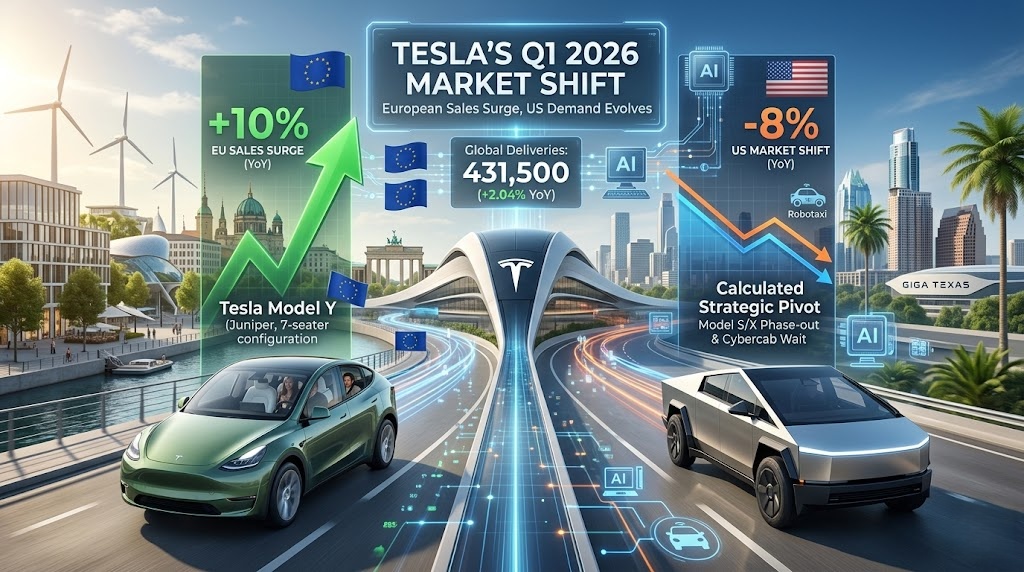
| Europe (15 Major Markets) | 82,400 | 90,640 | + 10.0% |
| United States | 161,200 | 148,300 | - 8.0% |
| Global Total (Including APAC) | 422,875 | 431,500 | + 2.04% |
Note: Data reflects compiled estimates and official April 2nd corporate releases.
While the global growth of roughly 2% might seem modest compared to the aggressive 40% year-over-year leaps seen in the early 2020s, it is a triumph of market stabilization. Tesla has managed to maintain global volume while navigating the treacherous waters of historically high global interest rates, the aggressive rise of Chinese domestic EV manufacturers, and the complex geopolitical logistics challenges that plagued the Red Sea shipping routes earlier in the quarter.
The real story, however, lies in the regional delta. The 10% surge in Europe and the 8% drop in the US are not accidental fluctuations; they are the direct results of specific, localized product decisions and consumer psychology.
The European Resurgence: A Perfect Storm of Product Fit
In February and March 2026, Tesla experienced a much-needed and highly celebrated 10% year-over-year growth across 15 major European countries. This surge was not a generalized lift; it was highly targeted, predominantly fueled by the Nordic markets (Norway, Sweden, Denmark), the Netherlands, and a surprising resurgence in Germany.
Why did Europe suddenly fall back in love with Tesla in Q1 2026? The answer lies in Tesla finally listening to its European consumer base and tailoring its highest-volume vehicle to their specific, demanding needs.
1. The "Juniper" Model Y Meets European Roads
The highly anticipated "Juniper" refresh of the Model Y—which debuted globally last year—has finally hit critical mass in European production at Gigafactory Berlin-Brandenburg. But the European iteration of Juniper is distinct. European buyers have long criticized the pre-2024 Model Y for its harsh ride quality, particularly on the centuries-old, uneven cobblestone streets and narrow urban avenues common across the continent.
Tesla engineers explicitly addressed this. The Giga Berlin-produced Juniper Model Y features heavily revised frequency-selective damping in its suspension architecture. Furthermore, the acoustic glass and enhanced cabin insulation (NVH - Noise, Vibration, and Harshness improvements) have transformed the Model Y from a stark, utilitarian commuter into a premium, quiet cruiser capable of matching the ride quality of legacy German luxury brands like Mercedes-Benz and Audi.
2. The 7-Seater Savior
Perhaps the most crucial catalyst for Q1 growth in the EU was the widespread availability of the 7-seater configuration for the Model Y. While the 7-seater has been available in the US for years, its introduction to Europe was delayed.
European families face a unique automotive dilemma: urban parking spaces are notoriously small, making traditional large SUVs (like the Tesla Model X or Kia EV9) impractical for city living. Yet, families still need high passenger capacity. The 7-seat Model Y offers the holy grail for the European family: the footprint of a mid-size crossover with the passenger capacity of a minivan. This configuration has seen explosive demand in the UK and Scandinavia, stealing massive market share from traditional European estate cars (station wagons) and compact MPVs.
3. Corporate Fleet Conquests
In Europe, the "company car" structure is deeply ingrained in the corporate tax system. A vast percentage of new vehicle registrations in countries like Germany and the UK are fleet purchases. Tesla’s aggressive B2B (business-to-business) sales tactics, combined with the incredibly low Benefit-in-Kind (BiK) tax rates for electric vehicles in the UK, resulted in massive fleet orders in Q1. Fleet managers are heavily prioritizing the Model 3 "Highland" and Model Y "Juniper" due to their unrivaled Total Cost of Ownership (TCO) profiles, exceptional safety ratings (Euro NCAP), and the reliability of the Supercharger network across the continent.
4. Giga Berlin's Maturation
Gigafactory Berlin-Brandenburg has finally overcome its initial growing pains and labor union friction to reach a stable, high-yield production cadence. By manufacturing the Model Y locally, Tesla Europe is no longer entirely dependent on shipments from Giga Shanghai. This localized production shields European buyers from the import tariffs and shipping delays that plagued the brand in the early 2020s, ensuring that buyers who configure a car online receive it within weeks, not months.
Understanding the US Market Contraction: Evolution, Not Decline
While the champagne popped in Berlin, the narrative in Fremont and Austin was decidedly different. An 8% drop in US sales year-over-year in Q1 2026 has provided fodder for Tesla skeptics. However, a deep dive into the underlying metrics reveals that this is not indicative of failing demand, but rather a strategic realignment and a transitional phase for the brand in its home market.
1. The Sunset of the S and X
The most significant drag on Tesla’s US volume is the intentional phase-out of the legacy Model S and Model X platforms. These flagship vehicles, which built the brand's premium reputation, are now operating on fundamental architectures that are over a decade old.
In Q1 2026, Tesla drastically reduced production shifts for these models. The company recognizes that the ultra-premium EV market is now highly saturated with fresh competitors (Lucid, Porsche, Rivian). Rather than pouring billions into a complete redesign of low-volume vehicles, Tesla is allowing the S and X to naturally age out, pivoting its premium manufacturing focus toward the Cybertruck and the upcoming next-generation Roadster. This deliberate reduction in S/X output mathematically pulled down the overall US delivery figures, even as Model 3/Y demand stabilized.
2. The Cybertruck Halo and the Waiting Game
The Cybertruck is currently the most recognizable vehicle on American roads. However, its complex stainless-steel exoskeleton and 4680 battery cell constraints mean it remains a relatively low-volume product compared to the Model Y.
Ironically, the Cybertruck is cannibalizing some of Tesla's own sales. Many high-end US buyers who would normally have purchased a Model X or a Performance Model Y are currently sitting on the sidelines, waiting for their Cybertruck reservation numbers to be called. This "Osborne Effect"—where demand for current products drops because consumers are waiting for an announced future product—is actively suppressing high-margin sales in the US.
3. The Anticipation of the Cybercab
Adding to the Osborne Effect is Elon Musk's aggressive teasing of the Cybercab (the dedicated robotaxi) and the sub-$30,000 consumer version of the next-generation platform. In an era of high inflation and tightened household budgets, the American middle-class buyer is becoming highly price-sensitive. Many prospective US EV buyers are intentionally delaying their purchases, holding onto their internal combustion engine (ICE) vehicles for an extra year or two, waiting for the affordable, next-generation Tesla to arrive in 2027.
4. Macroeconomic Headwinds and Interest Rates
The US consumer is currently battling a prolonged period of elevated interest rates implemented by the Federal Reserve. Auto loans in 2026 sit at rates that make financing a $50,000 vehicle significantly more painful on a monthly basis than it was in 2021. While Tesla has cut the MSRP of its vehicles, the high cost of borrowing has largely offset those savings for the average consumer financing their purchase over 60 or 72 months.
Furthermore, the US EV market has crossed the chasm from early adopters to the early majority. Early adopters were willing to overlook charging infrastructure gaps and software bugs. The early majority is vastly more pragmatic. While the Supercharger network is excellent, the US geography is vast. Range anxiety, compounded by media narratives around winter charging issues in the Midwest, still presents a psychological barrier that takes time to dismantle.
Pricing Strategies: Navigating the Knife's Edge
To counter the US dip and sustain European momentum, Tesla executed aggressive pricing strategies throughout the tail end of 2025 and into Q1 2026. This is the era of the $39,990 Model Y and the $36,990 Model 3 in the US, with equivalent, highly competitive pricing structures in Euros and Pounds.
The Margin vs. Volume Debate
Historically, Tesla boasted gross automotive margins that dwarfed legacy automakers, sometimes exceeding 25%. However, the strategic price cuts have compressed those margins. Wall Street analysts often panic at margin compression, but Tesla's leadership views it differently.
Tesla is playing a software and services game. The goal is to maximize the active fleet size. By lowering the entry barrier to ownership, Tesla gets more vehicles on the road. Every new Tesla sold represents a node in the Tesla network, a potential subscriber to Premium Connectivity, a future buyer of Supervised FSD software upgrades, and a customer at the Supercharger.
European Leasing Aggression
In Europe, the pricing strategy was slightly different. Rather than solely slashing the cash purchase price (which severely damages the residual values for current owners and angers the vital fleet managers), Tesla utilized its financial arm to subvent leasing rates. By offering heavily subsidized interest rates on personal and business leases, Tesla made the monthly payment of a Model Y significantly cheaper than a comparable Volkswagen ID.4 or Skoda Enyaq. This strategy perfectly targeted the European consumer preference for leasing over buying outright, driving the massive 10% Q1 volume increase without destroying the brand's premium cachet.
Price Elasticity of Demand
What Q1 2026 proved is the exact price elasticity of demand for EVs. At $50,000, a Model Y competes with luxury ICE vehicles. At $39,990 (before tax incentives), it fundamentally undercuts the average transaction price of a new car in the United States (which hovers around $47,000). By forcing the price down, Tesla is essentially forcing the consumer's hand. Even the most ardent EV skeptic struggles to justify buying a gas-powered Toyota RAV4 when a vastly superior, cheaper-to-run Model Y costs the exact same amount upfront.
The Impact of Regulatory Shifts and Incentives
You cannot analyze Tesla's Q1 performance without understanding the shifting sands of government regulations. Automotive sales are deeply intertwined with government policy, and Q1 2026 saw significant changes on both sides of the Atlantic.
The European Subsidy Landscape
In recent years, several major European markets, notably Germany, abruptly ended their lucrative environmental bonuses (Umweltbonus) for electric vehicles. This sudden removal of thousands of Euros in government subsidies caused a localized crash in EV sales for legacy brands like VW and Stellantis, who relied heavily on the government to make their overpriced EVs competitive.
Tesla, however, leveraged its superior manufacturing margins to simply absorb the loss of the subsidy. In many EU markets, Tesla proactively discounted their vehicles by the exact amount of the lost government grant. This "Tesla Subsidy" marketing tactic positioned the brand as a champion of the consumer against government bureaucracy, further driving the Q1 volume surge.
The US Inflation Reduction Act (IRA) Maturation
In the US, the rules surrounding the $7,500 federal tax credit under the IRA became significantly stricter in 2026, specifically regarding battery mineral sourcing from Foreign Entities of Concern (FEOC). Many competing EVs lost their tax credit eligibility entirely.
Tesla foresaw this bottleneck. By rapidly shifting its battery supply chain and relying heavily on Panasonic's localized US cell production and their own 4680 cell ramp in Texas, Tesla managed to retain the full $7,500 point-of-sale credit for the majority of its Model 3 and Model Y trims. When a consumer walks into a Tesla showroom in Q1 2026 and sees a point-of-sale discount dropping a Model Y well into the low $30,000 range, it creates an unparalleled competitive moat that legacy automakers simply cannot cross.
What This Means for Current Tesla Owners
If you already have a Tesla in your driveway, you might be wondering how quarterly delivery reports affect you. The reality is that these macro shifts have direct, tangible impacts on your ownership experience.
1. Resale Value Stabilization
The massive price cuts of 2023 and 2024 severely hurt the resale value of existing Teslas. However, the stabilization of prices in Q1 2026, combined with the strategic production cuts of older models like the S and X, signals that the era of aggressive depreciation might be leveling off. As Tesla focuses on volume through low-cost leases and entry-level pricing, the used car market is finding its floor. For current owners, this means your vehicle is slowly returning to more normalized depreciation curves.
2. Supercharger Network Focus
The massive 10% surge in European deliveries means one thing for EU owners: exponential Supercharger expansion. Tesla allocates infrastructure capital based heavily on active fleet density. With the Nordic countries and Germany absorbing tens of thousands of new vehicles in Q1 alone, owners can expect a rapid deployment of V4 Superchargers (featuring longer cables and higher charging speeds) across vital European transit corridors to prevent queuing during summer holiday travel.
3. Software Localization
As Europe becomes an increasingly vital pillar of Tesla's volume, the software engineering team in Palo Alto is shifting focus. Historically, US owners received new features first. However, the massive European fleet demands localized attention. Expect to see faster deployment of features tailored to European infrastructure—such as better matrix headlight integration tailored to strict UNECE regulations, improved speed limit sign recognition tailored to dynamic European autobahns, and the rapid rollout of Supervised FSD explicitly trained on complex European urban layouts.
4. The Value of FSD Transferability
To combat the US sales slump, Tesla heavily utilized "FSD Transfer" incentives in Q1. If you own an older Tesla with Full Self-Driving, these temporary windows allow you to transfer the expensive software to a new vehicle for free. This strategy acts as a massive loyalty hook. If you are a US owner looking to upgrade to a Hardware 4.0 or 4.5 vehicle, keeping a close eye on these quarterly volume dips is the best way to time your purchase to align with these lucrative software transfer incentives.
Conclusion: A Tale of Two Continents
Tesla's Q1 2026 delivery report is a masterclass in global market adaptation. The company is no longer a blunt instrument smashing its way into the automotive sector; it is a highly tuned machine capable of pulling different levers in different regions.
The European surge is a testament to the power of product refinement. By introducing the tailored Juniper Model Y and the crucial 7-seater configuration, Tesla successfully conquered a discerning market that values build quality, practicality, and total cost of ownership. Gigafactory Berlin stands as a localized fortress, shielding the European operation from global supply chain volatility.
Conversely, the US contraction is a calculated pause. It is an evolution, marking the transition from the era of the luxury early adopter (Model S/X) to the era of mass-market AI robotics (Cybertruck, Cybercab, and the sub-$30k platform). While the 8% drop makes for dramatic headlines, it reflects a company reorganizing its domestic manufacturing base to prepare for the next, vastly larger wave of autonomous transportation.
For the consumer, this divergence is highly beneficial. Tesla is now large enough to cater to specific regional needs rather than forcing a homogenous product onto the world. Whether you are driving down a narrow, cobblestone street in Amsterdam in a heavily sound-insulated, 7-seat Model Y, or cruising the vast highways of Texas waiting for the dawn of the Cybercab, Tesla’s Q1 2026 performance guarantees that the company is structurally sound, highly adaptable, and focused on sustainable, localized dominance.
Frequently Asked Questions (FAQs)
1. Will the drop in US vehicle sales negatively affect the expansion of the Supercharger network?
Absolutely not. Tesla has successfully decoupled the profitability of its Supercharger network from its direct vehicle sales. By opening the Supercharger network to almost all legacy automakers (NACS adoption in the US, and CCS2 standard in Europe), the charging infrastructure is now a massive, independent revenue generator. If anything, the influx of Ford, GM, and Rivian vehicles utilizing the network ensures continued, aggressive capital investment in new Supercharger locations regardless of Tesla's own quarterly delivery fluctuations.
2. Is right now a good time to buy a Model Y in Europe, or should I wait?
Currently, Q2 2026 presents an optimal buying window in Europe. The combination of the heavily refined "Juniper" refresh (fixing previous suspension and noise complaints), the availability of the highly desirable 7-seater, and the aggressive subvented leasing rates makes it an ideal time. Waiting further risks missing out on these promotional financial rates, as Tesla may pull back on lease subsidies once volume targets are comfortably met later in the year.
3. Why is Tesla actively phasing out the Model S and Model X?
The Model S and X represent the foundation of Tesla, but they are incredibly complex to manufacture and occupy an outsized amount of factory floor space relative to their sales volume. In 2026, the EV market is highly commoditized. Tesla is choosing to streamline its manufacturing efficiency by allocating battery cells, engineering talent, and factory space to next-generation platforms like the Cybertruck, the Semi, and the upcoming Cybercab, which represent exponential volume growth compared to the niche luxury sedan/SUV segment.
4. Given the US sales drop, should American buyers expect massive price cuts in the coming months?
Massive, thousands-of-dollars MSRP cuts are highly unlikely in the near future. Tesla’s margins have been compressed to a point where further deep MSRP cuts would harm the company's financial health. Instead of direct price cuts, US consumers should look out for "soft" incentives to drive Q2 and Q3 volume. This includes things like the return of free unlimited Supercharging transfers, FSD software transferability, highly subsidized financing rates (e.g., 0.99% APR), or free color/interior upgrades.
5. How is the new 7-seater Model Y actually performing in the European market?
The demand has been exceptionally high and has fundamentally altered Tesla's demographic reach in the EU. Prior to the 7-seater, large European families often bypassed the Model Y for traditional minivans or larger, more expensive SUVs. The 7-seater Model Y has proven particularly dominant in Germany, France, and Scandinavia, validating Tesla's strategy that a compact footprint combined with maximum passenger utility is the winning formula for European urban family transport.