
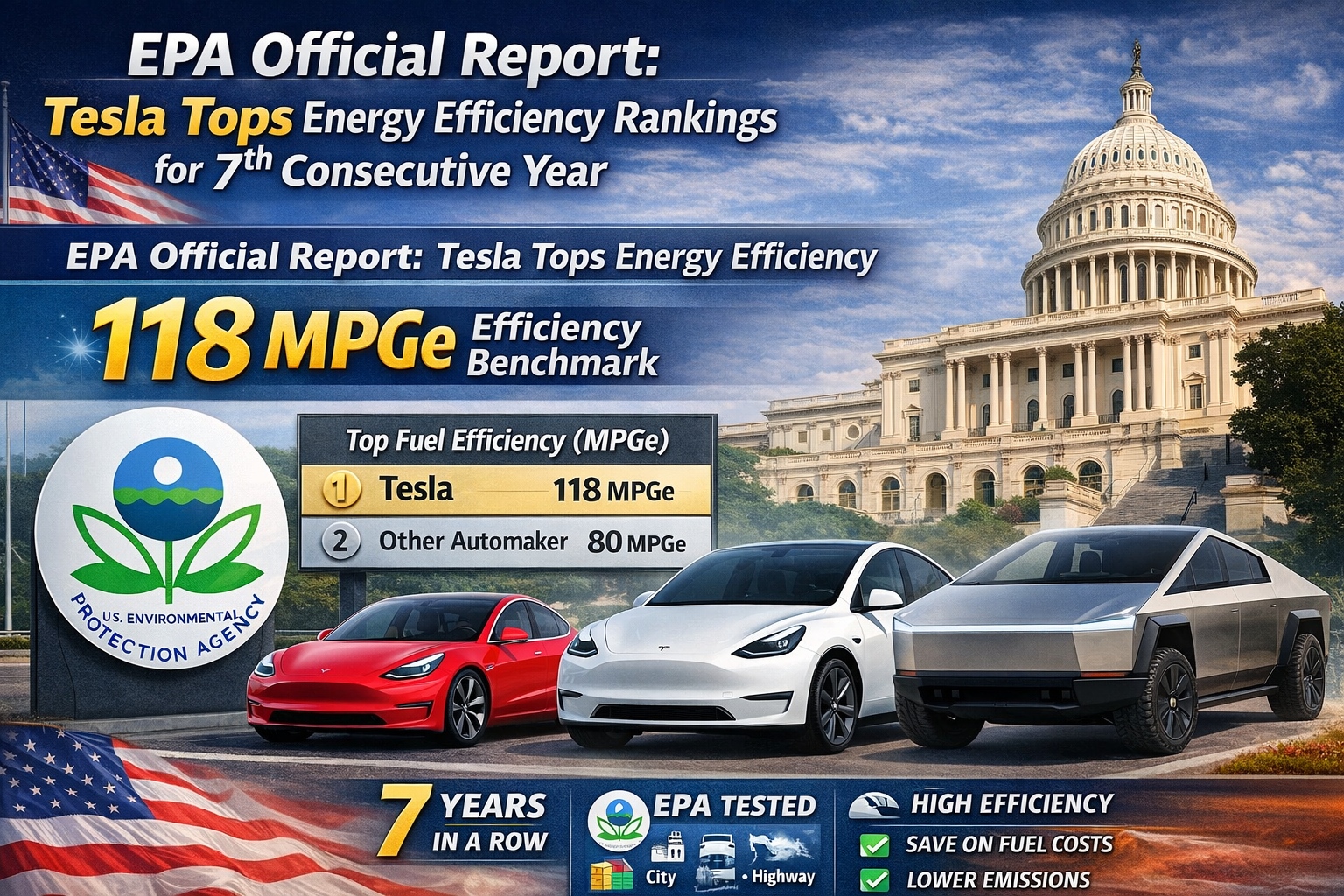
Introduction: The Seventh Consecutive Victory
When the U.S. Environmental Protection Agency (EPA) published its latest edition of the "Light-Duty Automotive Technology, Carbon Dioxide Emissions, and Fuel Economy Trends" report earlier this week, the headline was predictable to anyone who has followed the electric vehicle industry over the past decade. Tesla Inc. secured the top position among all automotive manufacturers in fleet-wide energy efficiency for the seventh consecutive year .
The numbers tell a compelling story. Tesla achieved an average of 118 miles per gallon equivalent (MPGe) across its 2026 model year lineup, maintaining a significant gap between itself and every other automaker selling vehicles in the United States . For context, this means that for every unit of energy consumed, a Tesla travels further than any other production vehicle available to American consumers.
Chapter 1: Understanding MPGe-The EPA's Scientific Framework
What MPGe Actually Measures
The Environmental Protection Agency developed the MPGe metric specifically to help consumers compare energy consumption across different powertrain types . One gallon of gasoline contains approximately 33.7 kilowatt-hours of chemical energy. Therefore, a vehicle rated at 100 MPGe can travel 100 miles using the energy equivalent of one gallon of gasoline — approximately 33.7 kWh of electricity.
Tesla's fleet-wide average of 118 MPGe means that across its entire model lineup, the company's vehicles consume approximately 28.6 kWh per 100 miles of travel. This figure represents the combined average of city, highway, and high-speed driving cycles as measured by the EPA's rigorous five-cycle test procedure .
The Five-Cycle Test Methodology
Unlike simplified range estimates, the EPA's five-cycle test exposes vehicles to a comprehensive set of driving conditions designed to mirror real-world usage patterns:
1. The FTP-75 (Urban Dynamometer Driving Schedule): This 11-mile test simulates stop-and-go city driving with an average speed of 21.2 mph and a maximum of 56.7 mph. The test includes extended idling periods and frequent accelerations that challenge regenerative braking systems.
2. The HFET (Highway Fuel Economy Test): Covering 10.3 miles at an average speed of 48.3 mph with a maximum of 60 mph, this cycle evaluates efficiency during steady-state highway cruising.
3. The US06 (High Speed/Acceleration Schedule): This aggressive 8-mile test pushes vehicles to 80 mph with rapid acceleration events, measuring efficiency during highway merging and high-speed passing maneuvers.
4. The SC03 (Air Conditioning Test): Conducted at 95°F with full air conditioning load, this cycle quantifies the parasitic drain of cabin cooling on overall efficiency.
5. The Cold Temperature Test: Performed at 20°F, this procedure measures the impact of low temperatures on battery chemistry and cabin heating requirements.
Tesla's consistent outperformance across all five cycles demonstrates the holistic nature of its thermal management and powertrain control strategies .
The Adjustment Factor: Tesla's Procedural Expertise
An often-overlooked aspect of EPA testing involves the "adjustment factor" applied to laboratory results. To account for real-world variables not captured in controlled testing, the EPA typically reduces measured range by approximately 30% .
However, manufacturers can earn smaller adjustment factors by completing additional drive cycles that demonstrate superior real-world performance consistency. Tesla has consistently qualified for reduced adjustment factors across its entire lineup, which partially explains why Tesla vehicles often achieve range figures closer to their EPA estimates than competitors' vehicles do .
This procedural expertise represents years of accumulated knowledge about how the EPA's testing protocols interact with vehicle control systems. Tesla engineers have optimized regenerative braking calibration, thermal management strategies, and powertrain mapping specifically to perform well under the exact conditions defined in federal test procedures — knowledge that translates directly to real-world benefits for owners.
Chapter 2: Model-by-Model Breakdown of Tesla's 2026 Efficiency Leadership
Model 3: The Efficiency Benchmark
The Tesla Model 3 continues to set the standard for energy efficiency in the mainstream premium sedan segment. According to EPA documentation, the rear-wheel drive Model 3 achieves an estimated 132 MPGe combined rating, making it one of the most energy-efficient vehicles ever certified by the agency regardless of price point .
Several engineering decisions contribute to this exceptional figure:
Aerodynamic Optimization: With a drag coefficient of just 0.23 Cd, the Model 3 cuts through air with less resistance than any competitor in its class. At highway speeds, where aerodynamic drag dominates energy consumption, this translates to approximately 10-12 percent lower energy demand than the class average.
Drive Unit Efficiency: Tesla's proprietary permanent magnet synchronous motors achieve peak efficiency exceeding 97 percent across a broad operating range. The inverters utilize silicon carbide MOSFETs that minimize switching losses, particularly at the partial loads typical of highway cruising.
Thermal System Integration: The Model 3's octovalve-based heat pump system captures waste heat from the powertrain and electronics to condition the cabin, reducing the energy penalty of winter driving by as much as 30 percent compared to resistive heating systems.
Model Y: SUV Efficiency Without Compromise
Given its larger frontal area and higher curb weight, the Model Y's efficiency achievement is arguably more impressive than the Model 3's. The all-wheel drive Long Range configuration achieves 123 MPGe combined according to EPA testing .
This figure becomes particularly significant when compared to competing electric SUVs. The Ford Mustang Mach-E, in its most efficient configuration, achieves approximately 100 MPGe. The Volkswagen ID.4 manages 102 MPGe. The Hyundai Ioniq 5, despite its advanced 800-volt architecture, peaks at around 114 MPGe in its most efficient rear-wheel drive configuration.
The Model Y's advantage stems from several factors:
Structural Battery Integration: By incorporating the battery pack as a structural element of the vehicle, Tesla reduces overall mass while improving rigidity. The Model Y's 2170-format cells are arranged in a thermally efficient array that minimizes internal resistance losses.
Induction Motor Optimization: The front induction motor in all-wheel drive models engages only when needed, decoupling completely during steady-state cruising to eliminate parasitic drag. This "dual motor torque sleep" feature was refined through millions of miles of fleet learning data.
Low Rolling Resistance Tires: Tesla worked closely with tire manufacturers to develop compounds and tread patterns that minimize rolling resistance without compromising wet weather safety. The Model Y's factory tires contribute approximately 0.5 MPGe improvement over off-the-shelf alternatives.
Model S: Flagship Efficiency at Scale
The 2026 Model S, despite producing up to 1,020 horsepower in Plaid configuration, maintains surprisingly strong efficiency credentials . The Long Range variant achieves 124 MPGe combined according to TrueCar's EPA documentation, with a 410-mile range rating that remains the benchmark for luxury electric sedans .
Several technologies enable this combination of performance and efficiency:
Carbon-Sleeved Motor Rotors: The Model S Plaid's carbon-sleeved rotor containment allows extreme rotational speeds without centrifugal expansion, enabling a smaller, lighter motor package that operates efficiently across a broader rpm range.
Wide Bandgap Semiconductors: Tesla's transition to advanced silicon carbide power electronics in the Model S reduces switching losses by approximately 5 percent compared to previous generations.
Predictive Thermal Conditioning: The Model S learns owner navigation patterns and preconditions the battery at optimal times, ensuring that energy spent on thermal management delivers maximum range benefit.
Cybertruck: Redefining Pickup Efficiency
The 2026 Cybertruck achieves 340 miles of EPA-estimated range in its dual-motor all-wheel drive configuration . While the raw range figure captures headlines, the efficiency story is more nuanced. The Cybertruck achieves approximately 87 MPGe — substantially lower than Tesla's sedans and crossovers, but class-leading for full-size pickups.
The Ford F-150 Lightning manages approximately 70 MPGe in its most efficient configuration. The Rivian R1T achieves around 74 MPGe. The Silverado EV, GM's most aerodynamic truck offering, peaks at approximately 78 MPGe.
The Cybertruck's efficiency advantage stems from its unique architecture:
Exoskeleton Structure: By using the stainless steel body as a stressed structural member, Tesla reduces the mass penalty typically associated with body-on-frame truck construction.
Aerodynamic Optimization: Despite its angular appearance, the Cybertruck's shape was extensively optimized in computational fluid dynamics simulations. A fully sealed underbody, active air shutters, and carefully managed wake turbulence reduce drag to approximately 0.34 Cd — remarkable for a vehicle of this size and capability.
48-Volt Architecture: The Cybertruck's transition to 48-volt electrical systems reduces current draw for accessories by a factor of four, minimizing parasitic losses throughout the vehicle.
Chapter 3: Independent Validation-ADAC Winter Testing Results
The Importance of Third-Party Verification
While EPA certification provides the legal foundation for range and efficiency claims, independent testing organizations offer valuable real-world validation. Germany's Allgemeiner Deutscher Automobil-Club (ADAC), Europe's largest automobile club, conducts some of the most rigorous independent vehicle testing on the continent.
In February 2026, ADAC published results from its annual winter range test, evaluating 14 popular electric vehicles under controlled but realistic cold weather conditions . The test protocol involved highway-speed driving at temperatures averaging 32°F (0°C) with cabin heating active — conditions that typically reduce EV range by 20-30 percent.
Model Y's Winter Performance
The Tesla Model Y emerged as the efficiency leader in ADAC's testing, consuming just 22.2 kWh per 100 kilometers (approximately 35.7 kWh per 100 miles) under these demanding conditions . This figure translates to an effective range of approximately 220 miles from the Model Y Long Range's usable battery capacity.
Several factors explained the Model Y's winter advantage:
Heat Pump Effectiveness: While many EVs in the test relied on resistive heating elements that draw 5-7 kW continuously, the Model Y's heat pump delivered cabin heating with approximately one-third the energy consumption.
Battery Preconditioning: The Model Y's thermal management system maintained optimal battery temperature through intelligent heat distribution, ensuring that regenerative braking remained available even in cold conditions.
Predictive Energy Management: The navigation-integrated thermal strategy ensured that battery heating occurred at optimal times, typically during charging when grid power rather than battery reserves could supply the energy.
Comparative Analysis
ADAC's test results revealed significant disparities between EPA ratings and winter performance across manufacturers. While the Model Y's winter efficiency represented approximately 78 percent of its EPA combined rating, several competitors saw winter efficiency drop to 60-65 percent of certified values.
This consistency gap has important implications for owners. A vehicle that maintains efficiency across diverse conditions provides more predictable range, reducing range anxiety and enabling more confident long-distance travel planning.
Chapter 4: The Engineering Philosophy-Watts, Not Just Kilowatt-Hours
Lars Moravy's Design Philosophy
Tesla's Vice President of Vehicle Engineering, Lars Moravy, articulated the company's efficiency philosophy in a recent technical presentation. "Blindly increasing battery capacity is a brute-force solution that creates new problems," Moravy explained . "More cells mean more mass, which requires more energy to move. More mass also means longer charging times and higher vehicle cost. The elegant solution is reducing energy consumption at the source."
This philosophy manifests in Tesla's approach to vehicle development. Rather than asking "how many cells can we fit," engineers ask "how can we make each electron travel further." This mindset permeates every aspect of vehicle design.
Milliwatt-Level Optimization
Tesla's efficiency obsession extends to components that traditional automakers might overlook. Engineering teams scrutinize every electrical load in the vehicle, from the power consumption of individual electronic control units to the standby current of door handle actuators .
Examples of this milliwatt-level optimization include:
Domain Controller Architecture: By consolidating functions into fewer electronic control units with more efficient processors, Tesla reduces the always-on power consumption of the vehicle's computing infrastructure.
Intelligent Sensor Management: Cameras and radar units operate at reduced duty cycles when full performance isn't required, waking to full capability only when the vehicle's situation awareness system detects relevant events.
Display Technology: The center display utilizes local dimming and variable refresh rate technology to minimize power consumption, particularly when showing static information like charging screens.
HVAC Efficiency: The cabin ventilation system uses occupancy sensing to direct conditioned air only to occupied seats, avoiding the energy waste of conditioning empty space.
System-Level Integration
Perhaps the most significant efficiency advantage stems from Tesla's vertical integration. Unlike traditional automakers who purchase subsystems from tier-one suppliers, Tesla designs its own motors, inverters, battery packs, and thermal systems. This integration enables optimization across component boundaries that competitors cannot match.
The heat pump system exemplifies this advantage. Tesla's system integrates the battery thermal circuit, powertrain cooling loop, and cabin HVAC into a unified architecture controlled by a single software algorithm. When the cabin requires heat, the system first scavenges waste heat from the motors and power electronics before engaging the heat pump's compressor. When the battery needs cooling, waste heat can be directed to the cabin rather than rejected to the atmosphere.
This system-level thinking delivers efficiency gains that component-level optimization alone cannot achieve.
Chapter 5: Real-World Implications-Total Cost of Ownership
Atlas Public Policy's 7-Year Analysis
Efficiency isn't merely an engineering curiosity — it directly impacts owner finances. Research institution Atlas Public Policy published a comprehensive analysis of total cost of ownership (TCO) across popular vehicle models, examining costs over a 7-year ownership period .
The findings confirmed what Tesla owners have long suspected: superior efficiency translates directly to lower operating costs. The Tesla Model 3 and Model Y demonstrated lower 7-year TCO than comparable gasoline-powered vehicles from Toyota, Honda, and BMW, even before accounting for potential fuel price volatility.
Charging Cost Calculations
To understand the financial impact of efficiency, consider a typical owner driving 15,000 miles annually. At Tesla's 118 MPGe fleet average, annual energy consumption equals approximately 4,290 kWh (15,000 miles ÷ 118 MPGe × 33.7 kWh/gallon equivalent).
At the U.S. average residential electricity rate of $0.16 per kWh, annual charging costs total approximately $686. Compare this to a gasoline vehicle achieving 30 mpg: 500 gallons annually at $3.50 per gallon equals $1,750 in fuel costs. The Tesla owner saves over $1,000 annually on fuel alone.
For owners with access to off-peak charging rates or solar generation, savings increase further. Time-of-use plans offering $0.08 per kWh overnight charging reduce annual costs to $343. Home solar with net metering can effectively eliminate fuel costs entirely.
Efficiency as Range Confidence
Beyond direct cost savings, efficiency provides a less tangible but equally important benefit: range confidence. A vehicle that consumes less energy per mile can achieve the same range with a smaller, lighter, less expensive battery pack. Alternatively, with a given battery capacity, higher efficiency yields greater range.
Tesla's fleet average of 118 MPGe means that even the entry-level Model 3, with its relatively modest 57.5 kWh usable capacity, achieves over 270 miles of EPA range. Achieving similar range with the industry average efficiency of approximately 100 MPGe would require a 67 kWh pack — adding approximately 110 pounds of mass and several thousand dollars to vehicle cost.
Chapter 6: European Market Context-CO2 Compliance and Efficiency
The EU Regulatory Framework
While EPA efficiency certification applies specifically to the U.S. market, its implications extend globally. European Union regulations mandate fleet-average CO2 emissions of approximately 95 grams per kilometer for new passenger cars, with stricter targets scheduled for implementation through 2030.
Tesla's efficiency leadership positions the company advantageously within this regulatory framework. Because Tesla sells only zero-emission vehicles, its fleet average CO2 emissions are effectively zero — generating valuable regulatory credits that other manufacturers purchase for compliance.
Changes to the 2026 EU Pool
March 2026 brought significant changes to Tesla's European CO2 pooling arrangements. Toyota and Stellantis both announced their withdrawal from Tesla's pool for the 2026 compliance year, according to EU filings documented by Electrek .
Toyota believes it can meet EU emissions targets independently, leveraging its strong hybrid sales and expanding battery-electric lineup including the Urban Cruiser and bZ4X. Stellantis plans to pool exclusively with Leapmotor, the Chinese EV manufacturer in which it holds majority stake, using those zero-emission vehicle sales to offset its fleet average .
Ford, Honda, Mazda, and Suzuki remain in Tesla's pool for 2026, but the direction of travel suggests the regulatory credit business will continue contracting as traditional automakers electrify their lineups .
For Tesla owners, this evolution has indirect but meaningful implications. Regulatory credit revenue has historically subsidized vehicle development and pricing. As this revenue stream declines, maintaining manufacturing efficiency and vehicle efficiency becomes increasingly important to preserving profitability without raising prices.
Chapter 7: Technical Deep Dive-How Tesla Achieves 118 MPGe
Powertrain Architecture
Tesla's current generation drive units represent the culmination of nearly two decades of electric motor development. Key features include:
Segmented Magnets: The rotor magnets are segmented to reduce eddy current losses, improving high-speed efficiency by approximately 2 percent compared to single-piece magnet designs.
Hairpin Stator Windings: Rectangular cross-section copper windings increase slot fill percentage, reducing resistive losses while improving heat transfer to the cooling system.
Direct Oil Cooling: Automatic transmission fluid circulates through the stator and rotor, extracting heat directly from the windings and magnets. This enables higher continuous power output while maintaining efficiency.
Integrated Inverter Design: The power electronics package mounts directly to the motor housing, eliminating high-voltage cabling between components and reducing weight.
Battery Cell Chemistry
Tesla's approach to battery chemistry prioritizes energy density and cycle life, but efficiency considerations also influence cell design. Lower internal resistance means less energy lost as heat during discharge, particularly at the high power demands of acceleration and highway cruising.
The 4680 format cells introduced in recent years offer reduced internal resistance compared to smaller 2170 cells, partially due to the tabless electrode design that shortens the current path within each cell. This architectural advantage translates to approximately 3-5 percent improvement in pack-level efficiency at typical discharge rates.
Thermal Management Innovation
Tesla's thermal management strategy has evolved significantly over the company's history. Current vehicles feature:
Octovalve-Based Distribution: An eight-port coolant control valve enables sophisticated routing of thermal energy between battery, motors, electronics, and cabin.
Heat Pump Integration: The climate control system can extract heat from ambient air, powertrain components, and even the battery pack itself, concentrating this thermal energy for cabin heating with exceptional efficiency.
Preconditioning Logic: Machine learning algorithms predict charging events and navigation routes, preconditioning the battery at optimal times to minimize energy consumption while maximizing performance.
Software Optimization
Perhaps Tesla's most significant efficiency advantage lies in software. Over-the-air updates continuously refine motor control algorithms, regenerative braking calibration, and thermal management strategies based on fleet learning.
Recent updates have improved efficiency by:
-
Refining torque distribution between dual motors to minimize combined losses
-
Optimizing regenerative braking blending with friction brakes for seamless energy recovery
-
Adjusting thermal management targets based on learned driving patterns
-
Improving voltage control during charging to reduce conversion losses
This software advantage compounds over time — a 2018 Model 3 today is more efficient than when it left the factory, thanks to continuous algorithmic improvements.
Chapter 8: Comparative Analysis-Tesla vs. The Competition
Legacy Automakers' Efficiency Challenges
Traditional automakers face structural disadvantages in achieving electric vehicle efficiency. Their development processes historically optimized for internal combustion attributes, and transitioning to electric powertrains requires fundamental rethinking.
The Porsche Taycan, despite its engineering excellence and 800-volt architecture, achieves approximately 90 MPGe in real-world driving. The disparity with Tesla's 118 MPGe average reflects fundamental design choices: the Taycan's two-speed transmission adds weight and complexity, its thermal management system lacks Tesla's integrated approach, and its electrical architecture wasn't designed from the ground up for efficiency optimization .
The Hyundai-Kia Challenge
Hyundai and Kia have emerged as Tesla's most credible efficiency competitors. The Hyundai Ioniq 6 received EPA recognition as the most energy-efficient vehicle of 2024 with a 137 MPGe rating . This achievement demonstrates that Tesla's efficiency leadership isn't unassailable.
However, the Ioniq 6's efficiency advantage applies only to that specific model, not across Hyundai's entire lineup. The Ioniq 5, Kia EV6, and Genesis GV60 achieve 110-114 MPGe — competitive but not class-leading. Tesla's advantage lies in consistency across its entire product range.
The Chinese Manufacturer Factor
BYD and other Chinese manufacturers have not yet achieved significant U.S. market presence, but their European expansion provides preview of competitive threats. BYD's Seal sedan achieves approximately 115 MPGe in European testing, approaching Tesla's efficiency levels at lower price points.
For Tesla owners, Chinese competition creates positive pressure. Tesla must continuously improve efficiency and reduce costs to maintain market position, accelerating the pace of innovation that benefits all owners.
Chapter 9: The Future-Maintaining the Efficiency Edge
Next-Generation Platform
Tesla's next-generation vehicle platform, expected to underpin the affordable model announced in investor presentations, will incorporate lessons learned from current vehicles while introducing new efficiency technologies.
Expected features include:
48-Volt Architecture Expansion: Following the Cybertruck's lead, next-generation vehicles will expand 48-volt systems to additional accessories, further reducing parasitic losses.
Structural Battery Pack Evolution: Refinements to cell-to-pack integration will improve volumetric efficiency while reducing mass.
Next-Generation Drive Units: Improved magnet materials and winding techniques will push motor efficiency toward 98 percent peak.
Solid-State Battery Prospects
While solid-state batteries remain in development, their potential efficiency impact is substantial. Eliminating liquid electrolyte reduces internal resistance, potentially improving discharge efficiency by 5-8 percent. Reduced cooling requirements would also lower parasitic loads.
Tesla's internal battery development efforts, combined with partnerships with academic institutions and potential acquisitions, position the company to adopt solid-state technology when it reaches commercial viability.
Software-Defined Efficiency
The trend toward software-defined vehicles will accelerate efficiency improvements. Future Tesla vehicles will likely feature:
Route-Optimized Preconditioning: More sophisticated prediction of driver behavior will enable even more precise thermal management.
Personalized Efficiency Calibration: Machine learning will adapt vehicle behavior to individual driving patterns, optimizing efficiency for each owner's typical usage.
Grid-Integrated Charging: Bidirectional charging capabilities will enable vehicles to support grid stability while optimizing charging timing for lowest cost and highest renewable energy availability.
Conclusion: Efficiency as Tesla's Unseen Advantage
The EPA's seventh consecutive recognition of Tesla as America's most efficient automotive manufacturer validates a decade of engineering focus on the metric that matters most for electric vehicle adoption. While range captures headlines and acceleration generates YouTube views, efficiency quietly determines real-world usability and ownership costs.
Tesla's 118 MPGe fleet average represents more than a number on a government report. It reflects thousands of engineering decisions, millions of miles of fleet learning, and a corporate culture obsessed with extracting maximum utility from every electron. This efficiency advantage translates directly to owner benefits: lower charging costs, more predictable range, reduced environmental impact, and ultimately, a better ownership experience.
As competition intensifies and regulatory credit revenue declines, Tesla's efficiency leadership becomes increasingly valuable. The company that moves furthest on each kilowatt-hour wins the long game of electric vehicle adoption. By this measure, after seven consecutive years at the top, Tesla shows no signs of slowing down.
For owners, the message is clear: when you charge a Tesla, you're not just powering a vehicle — you're benefiting from the most efficient electric propulsion system ever certified for mass production.
Frequently Asked Questions
Q: What does MPGe actually mean for my daily driving?
A: MPGe (miles per gallon equivalent) measures how far a vehicle can travel on the amount of energy contained in one gallon of gasoline (33.7 kWh). Higher MPGe means lower energy consumption and lower charging costs. Tesla's 118 MPGe average translates to approximately 28.6 kWh per 100 miles.
Q: How does Tesla achieve such high efficiency compared to competitors?
A: Tesla's efficiency advantage stems from system-level integration — designing motors, inverters, batteries, and thermal systems as unified architectures rather than assembled components. Milliwatt-level optimization, advanced thermal management, and continuous software refinement all contribute.
Q: Does cold weather reduce Tesla's efficiency advantage?
A: Independent testing by ADAC in Germany confirms that Tesla maintains its efficiency advantage in winter conditions. The Model Y consumed just 22.2 kWh/100km in freezing temperatures with highway driving — the lowest of 14 tested EVs.
Q: How much money does Tesla's efficiency save me annually?
A: Based on 15,000 annual miles and U.S. average electricity rates, a Tesla owner spends approximately $686 on energy. A comparable gasoline vehicle achieving 30 mpg would cost $1,750 at $3.50 per gallon — an annual savings exceeding $1,000.
Q: Where can I verify EPA efficiency ratings for specific Tesla models?
A: The official EPA website (fueleconomy.gov) provides certified efficiency and range data for all vehicles sold in the United States, including detailed breakdowns by model and configuration year.