
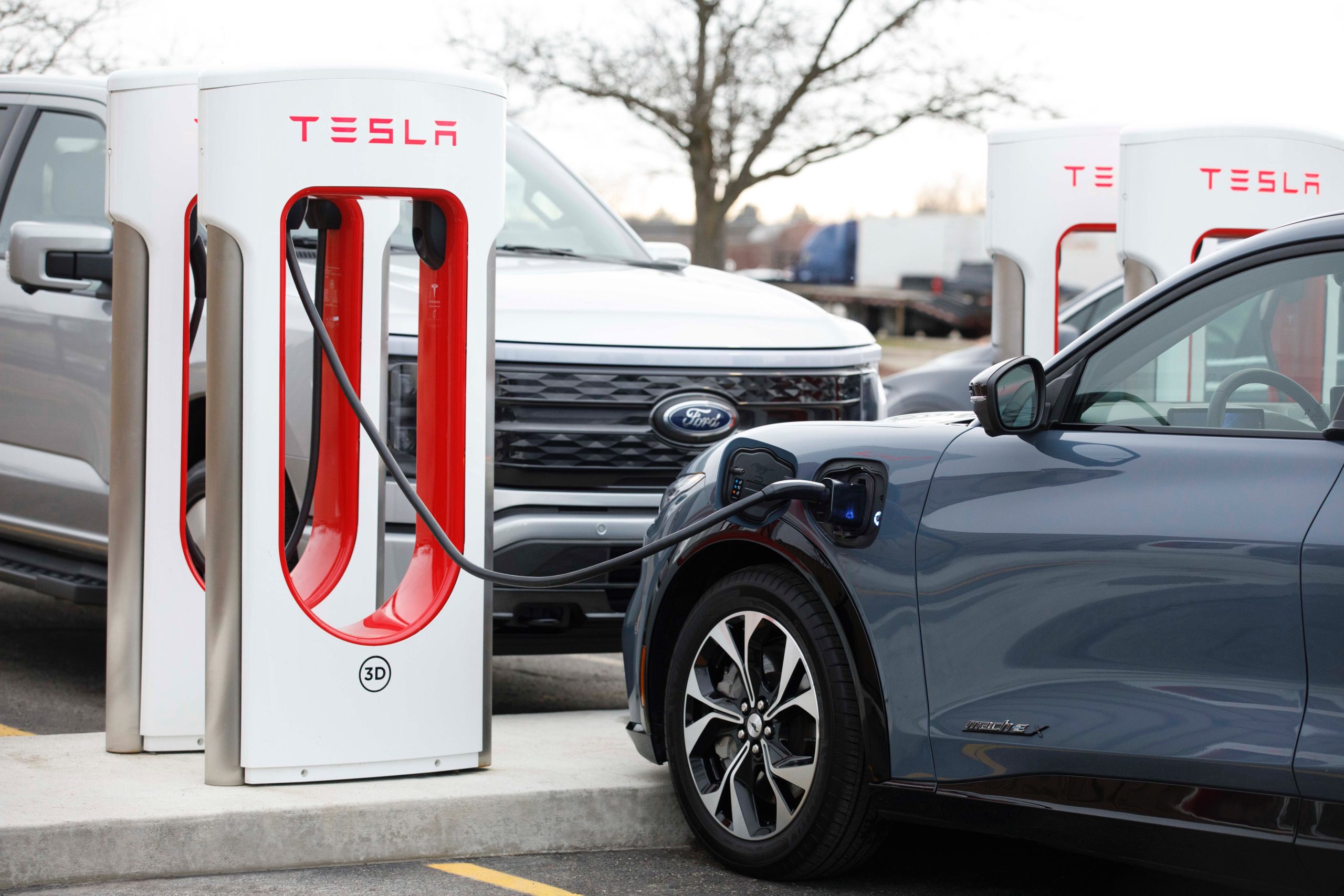
For more than a decade, Tesla has maintained one of the most robust and advanced electric vehicle (EV) charging networks in the world. The Supercharger system, with over 50,000 fast-charging stalls globally, has not only underpinned Tesla’s dominance in the EV market but also provided a critical edge over competitors struggling to offer equally seamless charging experiences. In September 2025, Tesla formally expanded Supercharger access in both the U.S. and Europe to Ford and General Motors (GM) electric vehicles. This strategic move marks one of the most consequential developments in the EV industry, reshaping the competitive landscape and setting new standards for interoperability.
This article provides a deep exploration of Tesla’s decision: why it happened, how it affects Tesla owners, Ford and GM customers, the EV market in the U.S. and Europe, and the broader trajectory of sustainable transportation. It examines the technical, financial, regulatory, and lifestyle dimensions of opening Superchargers to non-Tesla EVs, offering clarity for stakeholders ranging from Tesla loyalists to policymakers to prospective EV adopters.
Chapter 1: The Evolution of Tesla’s Supercharger Network
1.1 Origins and Purpose
Tesla launched the Supercharger network in 2012 to eliminate “range anxiety” and accelerate mass adoption of EVs. Unlike third-party charging providers such as Electrify America or Ionity, Tesla designed its network with high-speed DC fast chargers, proprietary connectors, and a seamless software experience integrated directly into Tesla vehicles.
1.2 The Global Footprint
-
U.S.: More than 20,000 Superchargers across interstates and metropolitan hubs.
-
Europe: Widespread coverage, especially in Norway, Germany, the Netherlands, France, and the U.K., with compatibility already using the CCS2 connector standard.
-
Asia-Pacific: Rapid expansion in China, South Korea, and Australia.
1.3 A Competitive Advantage
Until recently, Superchargers were a Tesla-only benefit. This exclusivity reinforced brand loyalty, helping Tesla owners enjoy superior convenience compared to drivers of Ford, GM, or Volkswagen EVs, who often faced broken chargers, inconsistent payment systems, and slower charging speeds.
Chapter 2: Why Tesla Opened Superchargers to Ford and GM
2.1 Industry Shift Toward NACS
Tesla’s charging connector, now rebranded as the North American Charging Standard (NACS), became the de facto charging standard in the U.S. after Ford and GM agreed in 2023 to adopt it in future models. This gave Tesla leverage to unify the industry while retaining ownership of its ecosystem.
2.2 Regulatory and Policy Pressure
-
The U.S. federal government has tied billions in EV infrastructure subsidies to “open access” requirements, encouraging interoperability.
-
European regulators have long required CCS compatibility, creating a precedent for Tesla’s eventual openness.
2.3 Financial Incentives
By granting Ford and GM access, Tesla monetizes its infrastructure by charging non-Tesla users, while still offering discounted rates for its own customers. This provides Tesla with recurring revenue streams beyond vehicle sales.
2.4 Strategic Partnerships
Ford and GM collectively represent millions of vehicles in the U.S. and Europe. Their partnership with Tesla ensures that Superchargers become the backbone of EV adoption, rather than fragmented networks.
Chapter 3: What This Means for Tesla Owners
3.1 Increased Traffic at Charging Stations
Tesla drivers may face longer wait times as Ford F-150 Lightnings, Mustang Mach-Es, GM’s Chevrolet Blazer EVs, and Cadillac Lyriqs start using Superchargers.
3.2 Exclusive Perks Still Apply
Tesla owners retain certain advantages:
-
Lower per-kWh charging rates.
-
Seamless plug-and-charge integration.
-
Priority software access for navigation and stall availability.
3.3 Community Reactions
Tesla owners are divided: some welcome the broader EV adoption that comes with shared infrastructure, while others worry that their long-standing perk—exclusive access—is being diluted.
Chapter 4: Benefits for Ford and GM Drivers
4.1 Reliable Charging for the First Time
Many Ford and GM drivers in the U.S. previously depended on Electrify America or ChargePoint, both plagued by reliability issues. Supercharger access eliminates these pain points, making EV ownership more attractive.
4.2 Integration with Native Software
Ford and GM have announced software updates that allow route planning to include Superchargers, similar to Tesla’s system.
4.3 Accelerated Adoption in Rural and Suburban Areas
In regions like the U.S. Midwest and Southern Europe, where charging infrastructure is sparse, Ford and GM customers now gain access to dependable networks, encouraging adoption in previously hesitant markets.
Chapter 5: Implications for the U.S. Market
5.1 EV Adoption Acceleration
Supercharger expansion will directly address range anxiety, boosting EV sales for Ford, GM, and Tesla alike.
5.2 Competitive Dynamics
While Ford and GM benefit, they also strengthen Tesla’s dominance in charging. Tesla now monetizes its competitors’ growth, creating a “win-win” scenario.
5.3 Regulatory Synergy
Tesla’s decision aligns with U.S. government EV mandates and incentives, making Tesla eligible for federal infrastructure subsidies.
Chapter 6: Implications for the European Market
6.1 CCS Already the Standard
Tesla’s European Superchargers have long been compatible with CCS, so the inclusion of Ford and GM vehicles is less dramatic than in the U.S. However, the formalization of agreements ensures smoother access and standardized pricing.
6.2 Cross-Border Travel
European EV owners highly value interoperability, especially for long-distance travel across countries. The Tesla-Ford-GM alignment enables more consistent charging experiences across borders.
6.3 Impact on Competitors
Networks such as Ionity, Fastned, and EnBW face stronger competition, forcing them to improve reliability and pricing.
Chapter 7: Technical and Operational Challenges
7.1 Connector Compatibility
In the U.S., Ford and GM vehicles will require adapters until their future models ship with NACS ports. Tesla has ramped production of these adapters to ensure smooth rollout.
7.2 Software and Billing
Tesla must integrate billing for FordPass and GM’s Ultium Charge 360 users, ensuring seamless plug-and-charge without friction.
7.3 Capacity Management
Tesla is actively expanding station capacity with V4 Superchargers, which deliver higher power output and longer cables, designed for larger non-Tesla EVs.
Chapter 8: Financial Implications for Tesla
8.1 Direct Revenue
Supercharger usage fees from Ford and GM drivers will significantly boost Tesla’s services revenue segment.
8.2 Infrastructure Subsidies
Tesla becomes eligible for public funding programs tied to open access, reducing expansion costs.
8.3 Strengthened Ecosystem Lock-In
By controlling the dominant charging infrastructure, Tesla ensures that even non-Tesla EV drivers rely on its services, subtly reinforcing Tesla’s centrality in the EV world.
Chapter 9: Broader Industry Implications
9.1 Standardization Momentum
Tesla’s NACS becoming the industry norm in the U.S. will drive harmonization globally, reducing fragmentation.
9.2 Consumer Confidence
Reliable charging will encourage broader EV adoption, benefitting the climate agenda and accelerating the decline of internal combustion vehicles.
9.3 Competitive Responses
-
Volkswagen and Stellantis may accelerate their own charging alliances.
-
Oil companies investing in EV chargers (Shell, BP) will face stiffer competition.
Conclusion
Tesla’s decision to open its Supercharger network to Ford and GM EVs represents a pivotal moment in the global EV transition. While Tesla owners may need to share space with more drivers, the long-term benefits—accelerated EV adoption, stronger infrastructure funding, and a unified charging standard—far outweigh the drawbacks. For Ford and GM drivers, the move solves a long-standing pain point of unreliable charging, removing one of the last major barriers to mainstream EV ownership.
Ultimately, this shift underscores Tesla’s transformation from an automaker to an infrastructure and energy ecosystem leader, shaping not just its own destiny but the future of the entire electric mobility landscape.
FAQs
Q1: Will Tesla owners still have priority at Superchargers?
Tesla owners will enjoy lower rates and more seamless integration, but they will not have exclusive priority access over Ford or GM drivers.
Q2: Do Ford and GM EVs need adapters to use Tesla Superchargers?
Yes, in the U.S., adapters are required until Ford and GM launch models with built-in NACS ports from 2025 onward. In Europe, CCS compatibility makes adapters unnecessary.
Q3: Will charging rates be the same for all drivers?
No. Tesla typically charges higher rates for non-Tesla drivers, ensuring Tesla owners retain cost advantages.
Q4: Will this expansion cause congestion at Superchargers?
There may be increased traffic, but Tesla is expanding capacity with V4 Superchargers to reduce congestion.
Q5: How does this benefit Tesla financially?
Tesla earns revenue from charging fees and qualifies for federal subsidies, making Superchargers a lucrative business unit.