
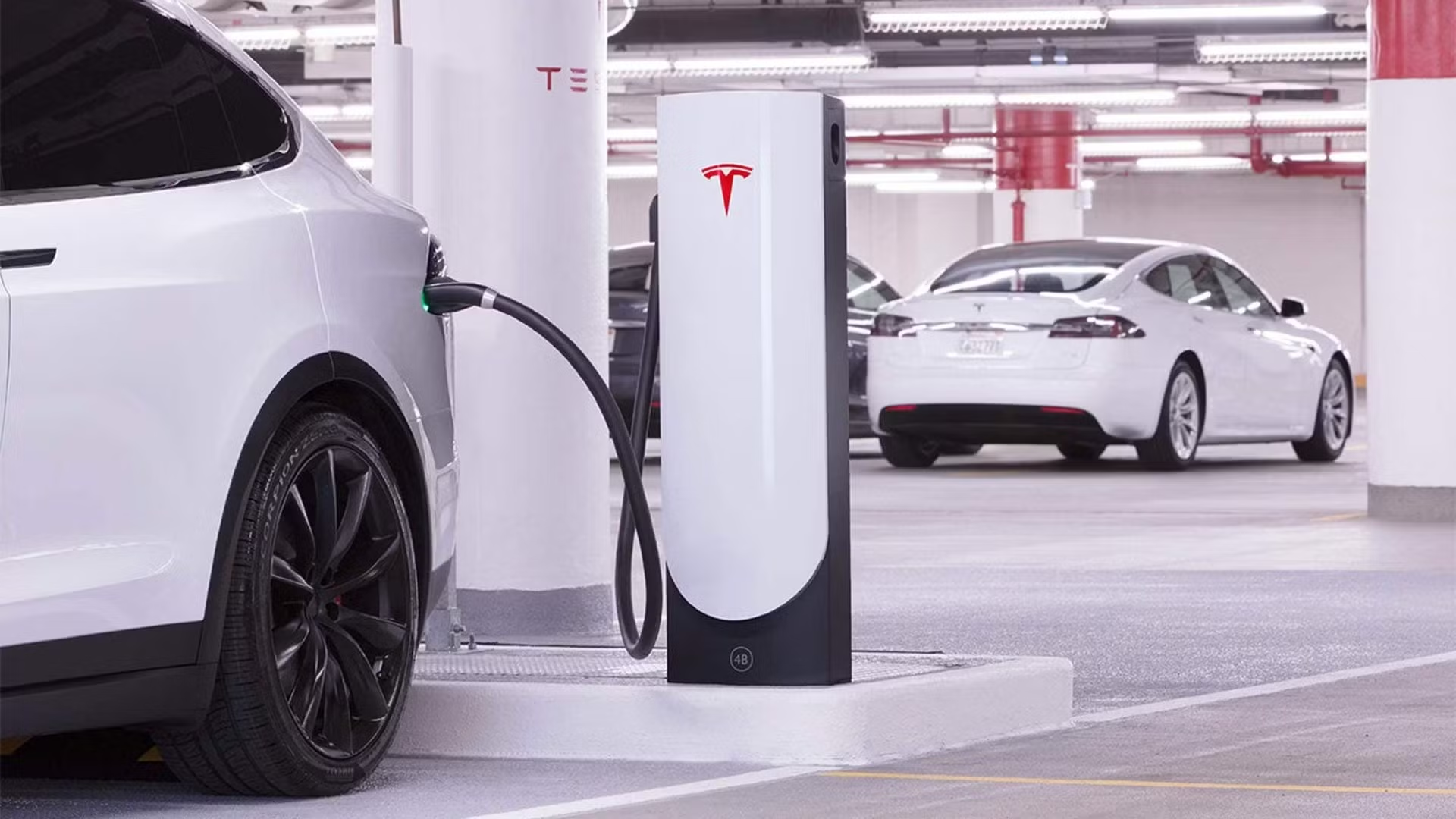
I. Overview of the Tesla Supercharger Network
The Tesla Supercharger network stands as a dominant force in the electric vehicle (EV) charging landscape, renowned for its exceptional reliability, speed, and user-friendliness. In North America, Superchargers account for a remarkable "three out of four fast chargers," effectively setting the benchmark for EV charging infrastructure across the continent.
As of July 1, 2025, the United States alone boasts 58,614 DC fast charging ports, with Tesla Superchargers comprising a significant 31,990 ports, representing a commanding 54.6% market share. Globally, as of January 2025, Tesla operates over 7,000 Supercharger stations equipped with more than 65,800 connectors. It's worth noting a slight recent shift in the U.S. market, where Tesla's share has marginally decreased from 55% to 54.6% over the past two months, indicating a faster growth rate among other charging networks. Despite this minor fluctuation, Tesla's network remains the undisputed leader in terms of sheer scale and accessibility.
II. Network Expansion and Evolving Usage Trends
The Supercharger network has demonstrated robust expansion throughout 2025. In the first quarter of 2025, Tesla added approximately 2,200 new Supercharger stalls worldwide, marking a 17% year-over-year growth. This momentum continued into the second quarter of 2025, with an additional 3,500 new stalls deployed globally, bringing the total number of Supercharger stalls to an impressive 70,000 by the end of June – a new quarterly record for the company.
Network utilization has also seen consistent and significant growth. In Q1 2025, Tesla delivered 1.4 terawatt-hours (TWh) of energy to vehicles through 42 million charging sessions, representing year-over-year increases of 26% and 27%, respectively. This upward trend accelerated in Q2 2025, with energy delivery reaching 1.6 TWh and charging sessions totaling 45 million, both achieving new historical highs.
Efficiency within the network has also improved, with the average energy delivered per charging session in Q2 2025 reaching 35.5 kilowatt-hours (kWh). Globally, the average daily throughput per charging stall hit 251 kWh. Regionally, North America recorded an even higher average of 10 charging sessions per stall per day in June, while Europe saw 7 sessions per day, and the Asia Pacific region (excluding China) averaged 5.3 sessions per day.
Future enhancements to the Supercharger network include the planned introduction of 500kW Supercharging capabilities for the Cybertruck by Q3 2025, coinciding with the initial deployment of V4 Supercharger cabinets. Furthermore, Tesla is implementing a virtual queuing system designed to prevent users from waiting in physical lines at congested Supercharger stations, thereby improving efficiency and user convenience. A notable development is the world's largest Supercharger station in Lost Hills, California, featuring 168 stalls, an 11-megawatt solar canopy, and 10 Megapack batteries, enabling 100% off-grid solar-powered charging. The continued strong growth of the Supercharger network, coupled with its leading market share, indicates that it is more than just a convenience for Tesla owners; it is a critical strategic asset for the entire EV ecosystem. By rapidly expanding its footprint and introducing advanced features like 500kW charging and virtual queuing, Tesla is actively addressing two major barriers to widespread EV adoption: range anxiety and charging congestion. This suggests that Tesla is leveraging its significant infrastructure advantage to accelerate the overall transition to electric vehicles, solidifying its pioneering and leadership role in the industry, even for non-Tesla owners.
III. The North American Charging Standard (NACS) Revolution
Tesla's proprietary North American Charging Standard (NACS) has rapidly emerged as the de facto industry standard. All major automakers and charging network operators are committed to transitioning to NACS by 2025. This widespread adoption was spearheaded by Ford, which broke the "logjam" in June 2023 by announcing its embrace of NACS, a move swiftly followed by all other major U.S. automakers. Even Mazda has declared that its EVs sold in Japan will adopt NACS starting in 2027, signaling a broader international trend.
The Supercharger network is progressively opening its doors to non-Tesla EVs throughout 2025. Initially, this involves automakers providing adapters to their customers, with future new EV models expected to feature integrated NACS ports. Currently, approximately two-thirds of all Tesla Superchargers in North America (23,691 stalls, or 67.5%) are accessible to non-Tesla EVs, primarily through built-in NACS-to-CCS1 adapters, often referred to as "Magic Docks."
A direct comparison between NACS and CCS connectors highlights the advantages of Tesla's design. NACS is notably smaller, lighter, and more ergonomic, allowing for convenient single-handed operation and combining both AC and DC charging capabilities. In contrast, CCS connectors are often described as bulkier and more cumbersome. Tesla's network is widely praised for its reliability, speed, and ease of use, boasting an impressive 96% uptime for its Superchargers, significantly higher than the 72.5% uptime reported for some CCS chargers in the Bay Area.
Other charging networks, such as Electrify America, have faced substantial criticism, primarily concerning their lack of reliability and maintenance. Issues include inoperable chargers, faulty payment systems, and charging speeds that fall short of advertised rates. Electrify America has announced plans to begin incorporating NACS connectors starting in 2025, acknowledging the growing industry shift. The rapid and widespread adoption of NACS by major automakers, following Ford's initial move, signifies a powerful network effect. Tesla's established, reliable, and user-friendly Supercharger network has become an undeniable competitive advantage for EV buyers, effectively compelling other manufacturers to adopt its standard to provide comparable charging services to their customers. This indicates that Tesla has successfully leveraged its early infrastructure lead to become the de facto standard for EV charging in North America, fundamentally reshaping the charging landscape and creating a more unified and convenient ecosystem. The stark contrast in reported reliability between Tesla Superchargers (96% uptime) and other networks (e.g., Electrify America, 72.5% uptime) reveals reliability as a critical competitive differentiator, often outweighing mere charger count or raw charging speed. The persistent issues faced by Electrify America underscore that simply installing chargers is insufficient; consistent operation, robust maintenance, and a seamless user experience are paramount for user satisfaction and trust. This suggests that Tesla's focus on a vertically integrated, high-uptime network has been a key factor in NACS adoption, as other automakers seek to provide their customers with a charging experience comparable to Tesla's reliability.
IV. Non-Tesla User Experience and Pricing Structure
For non-Tesla vehicle owners, accessing the Supercharger network involves a straightforward process. Typically, it requires a CCS-compatible vehicle (for European/UK pilot sites), downloading the Tesla app (version 4.30.5 or later), creating a Tesla account, and linking a payment method. At a limited number of sites, direct payment via credit card or text-to-pay at the Supercharger terminal is also available.
While a membership is not mandatory, non-Tesla EV owners have the option to subscribe to a Supercharging Membership. This monthly subscription allows them to charge their vehicles at the same preferential rates enjoyed by Tesla owners. Without a membership, non-Tesla users generally face higher per-kilowatt-hour pricing (e.g., £0.30-£0.50/kWh compared to approximately £0.24/kWh for Tesla owners).
It is important to note that both Tesla and non-Tesla users are subject to idle fees and congestion fees. These charges apply if a vehicle remains connected to a charging stall after it is fully charged or if it occupies a stall during peak demand periods. These fees are designed to ensure fair access to charging infrastructure for all users.
Currently, non-Tesla EVs can only charge at the newer V3 (250kW) or V4 Supercharger stalls. Older V2 (150kW) charging stalls are not compatible, which may limit cross-country travel options for some non-Tesla vehicles in certain regions. Tesla's tiered pricing structure, offering lower per-kilowatt-hour rates to Tesla owners or non-Tesla users who opt for a monthly membership, indicates a strategy to monetize its extensive Supercharging infrastructure while simultaneously reinforcing customer loyalty. By making Supercharging more affordable for its own customers, Tesla enhances the value proposition of owning a Tesla, even as it opens its network to competitors. This suggests that Tesla is striking a delicate balance between generating revenue from the broader EV market and maintaining a competitive advantage for its core customer base, ensuring the network remains a compelling reason to choose a Tesla.
V. Conclusion: A Unified Charging Ecosystem
Tesla has played a pivotal role in standardizing electric vehicle charging infrastructure in North America and influencing global trends, primarily through the widespread adoption of its North American Charging Standard (NACS). This strategic move has reshaped the EV charging landscape, fostering greater interoperability and convenience.
The emergence of this unified charging ecosystem has profound implications for the broader adoption of electric vehicles. It significantly enhances convenience for all EV drivers, alleviates range anxiety by providing reliable and widespread charging options, and ultimately accelerates the transition to electric mobility. By continuing to innovate and expand its Supercharger network, Tesla is not only securing its own future but also actively shaping the future of electric transportation for all EV owners.
VI. Frequently Asked Questions
-
Can non-Tesla EVs use Tesla Superchargers? Yes, in North America, approximately two-thirds of Superchargers are open to non-Tesla EVs, primarily through NACS-to-CCS1 adapters (Magic Dock) or built-in NACS ports. In Europe and the UK, pilot programs allow CCS-compatible vehicles to use them.
-
What is the North American Charging Standard (NACS), and why is it important? NACS is Tesla's compact, user-friendly charging connector. It has become the de facto standard in North America due to Tesla's extensive and reliable Supercharger network, adopted by all major automakers, simplifying the charging process for all EVs.
-
How fast are the latest Tesla Superchargers? Superchargers currently output up to 325 kW. Tesla plans to increase power output to 500 kW in the future, with 500kW Supercharging for the Cybertruck expected by Q3 2025.
-
How do non-Tesla owners pay for Supercharging? Non-Tesla owners must download the Tesla app, create an account, and add a payment method. They can also opt for a Supercharging Membership to receive lower per-kilowatt-hour rates.
-
How will virtual queuing improve the charging experience? Virtual queuing is an upcoming feature designed to prevent users from having to wait in physical lines at congested Supercharger stations, thereby improving efficiency and user convenience.