
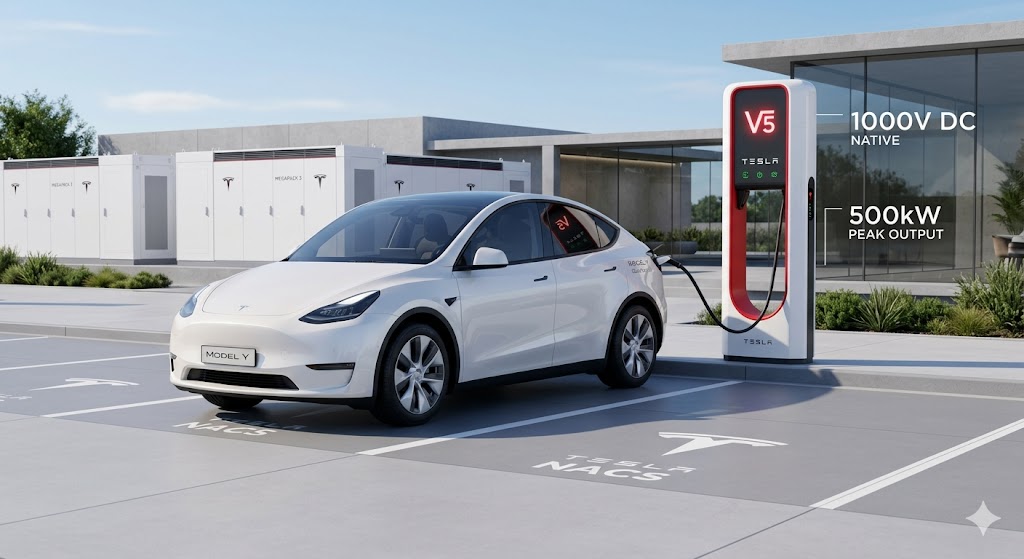
Introduction: The Death of Range Anxiety and the Birth of Energy Supremacy
Today, April 16, 2026, the automotive world is no longer debating whether electric vehicles are viable. Instead, the conversation has shifted to a new frontier: the speed of energy transfer and the stability of the grids that support it. With the official rollout of the Supercharger V5 across North America and Europe, Tesla has effectively silenced the last remaining critics of long-distance EV travel.
The V5 isn't just a faster plug; it is the central nervous system of a new energy economy. For our readers in the US and Europe, where infrastructure has often struggled to keep pace with the explosion of EV adoption, the V5 represents a "Great Decoupling." It decouples the vehicle from the limitations of the local power grid and decouples the driver from the 20-minute wait time. We are entering an era where charging a car takes no longer than a traditional espresso break—a literal "splash and dash" that provides 400km of range in just 5 minutes.
Technical Deep Dive: The Architecture of the 1000V Beast
To understand why the V5 is a generational leap, we must look under the sleek, taller white-and-red monoliths. The shift from V4 to V5 is not incremental; it is a fundamental architectural reimagining.
2.1 The 1000V DC Native Bus
While the V4 cabinets began the transition toward higher voltages, the V5 is the first to utilize a native 1000V DC bus architecture. Most legacy EVs, including the early Model 3 and Model Y, operate on a 400V system. However, the 2026 lineup—led by the Cybertruck, the refreshed Model S/X, and the new "Project Redwood" vehicles—demands higher voltage to reduce current and heat.
By doubling the voltage from 500V to1000V, Tesla can deliver massive power—up to 500kW for passenger vehicles and over 1MW for the Semi—without requiring cables as thick as a human thigh. This is the magic of P=VxI. By increasing V, you can keep I (current) manageable, which is the primary driver of heat.
2.2 Immersion-Cooled Cable Technology
One of the most significant engineering breakthroughs in the V5 is the next-generation liquid-cooled cable. Traditional cooling involves circulating fluid around the outside of the conductors. The V5 cable uses a proprietary dielectric coolant that has 40% higher thermal conductivity than the fluid used in V4.
This allows the cable to remain flexible and light—crucial for accessibility—while handling a staggering 1000 Amps of peak current. Our European readers will appreciate that this cable is significantly easier to handle than the heavy, rigid cables found at many 350kW Ionity or Electrify America stations.
2.3 Silicon Carbide (SiC) Power Electronics
The V5 cabinets utilize Tesla’s latest Silicon Carbide inverters, which boast a conversion efficiency of over 98%. This means less energy is wasted as heat during the AC-to-DC conversion process. In a world where energy prices in Germany and California are volatile, this efficiency translates directly to lower charging costs for the consumer and higher margins for Tesla.
3. The "Energy Flywheel": Megapack 3 and Solar Integration
The V5 rollout is rarely a standalone event. In 2026, a "Supercharger Hub" is no longer just a row of stalls; it is a localized microgrid.
3.1 Peak Shaving and the Megapack 3 Buffer
The biggest challenge for charging providers in 2026 is "Demand Charges" from utility companies. If ten Cybertrucks plug in simultaneously at a V5 station, they could theoretically pull 5MW from the grid—enough to power a small town. To avoid massive surcharges and grid strain, Tesla pairs V5 stations with the Megapack 3.
The Megapack acts as an "Energy Flywheel." It slowly sips power from the grid during low-demand hours (when electricity is cheap) and discharges it at lightning speed when vehicles plug in. This "buffer" ensures that the V5 can always deliver its peak 500kW rate, regardless of the local grid's capacity.
3.2 The Virtual Power Plant (VPP) Connection
In Europe, particularly in the UK and Netherlands, these V5 hubs are now functioning as part of Tesla’s Virtual Power Plant. When the grid is stressed, the Megapacks at Supercharger stations can feed energy back into the grid, earning Tesla (and by extension, the charging network) significant revenue. This secondary income stream allows Tesla to keep "at-the-pump" prices lower than any competitor while maintaining 30%+ profit margins on its Energy segment.
4. User Impact: The 5-Minute Range Revolution
What does this mean for you, the Tesla owner in London, Oslo, or New York? It means the charging curve has been "flattened" and raised.
|
Feature |
Supercharger V3 (2020) |
Supercharger V4 (2024) |
Supercharger V5 (2026) |
|
Peak Power |
250kW |
350kW |
500kW--1MW |
|
Voltage |
400V |
400-800V |
1000V Native |
|
5-Min Range Add |
≈120km |
≈200km |
≈400km |
|
Efficiency |
92% |
95% |
98%+ |
5. Competitive Landscape: Tesla vs. The World
In 2026, the charging wars have largely been won by the NACS (North American Charging Standard). However, the hardware war continues.
5.1 The European Front: Porsche and Hyundai
European manufacturers like Porsche and Hyundai were early adopters of 800V architectures. For years, they mocked Tesla’s 400V v3 stations. The V5 is Tesla’s decisive counter-attack. Not only does it match the 800V capability of the Taycan or Ioniq 6, but it exceeds them with its 1000V ceiling.
Furthermore, Tesla’s "Magic Dock 2.0" (integrated natively into V5 stalls) allows non-Tesla vehicles to access the network with zero friction. In Europe, where CCS2 was the standard, Tesla’s move to open 95% of its V5 network to third parties has turned the Supercharger network into the "Gas Station of the 21st Century."
5.2 Reliability: The 99.9% Uptime Standard
While Ionity and Electrify America continue to struggle with broken screens and payment failures, the V5 remains a "no-UI" experience. There are no screens on a V5 post. Everything is handled via ISO 15118 (Plug & Charge). You plug in, the car and stall perform a cryptographic handshake, and charging begins in under 2 seconds. In 2026, reliability is the greatest luxury.
6. The "Cyber-Synergy": Wireless and Autonomy
As we discussed in the Cybercab launch, the V5 is designed for a world without human drivers.
6.1 Robotic Arm Integration
Select V5 "Premiere" stations in Los Angeles and Berlin are now equipped with the automated snake-arm charger. For the Cybercab fleet—which has no human to plug it in—this arm uses vision-based AI to locate the charging port and connect automatically. For private Tesla owners, this is an optional "Valet Charging" service that allows you to leave your car at a stall while you shop, and the car will unplug itself and move to a parking spot when finished.
6.2 Inductive (Wireless) Pads
Hidden beneath the asphalt of new V5 stalls are high-efficiency inductive charging pads. While slower than the cable (25 kW vs 500 kW), these pads allow for "trickle-maintenance" for autonomous vehicles waiting in a queue, ensuring that every Cybercab is at 100% readiness without ever needing a physical tether.
7. Future Outlook: The $1.5 Trillion Infrastructure Play
Wall Street is finally realizing that Tesla’s charging network is more than a "feature" to sell cars—it is a standalone utility. By the end of 2026, it is projected that 30% of Tesla’s total revenue will come from non-Tesla charging and grid services facilitated by V5/Megapack hubs.
As Tesla continues to roll out V5, the barrier to entry for other EV manufacturers becomes insurmountable. Why would a consumer buy a car that can't access the 1000V V5 network? The network has become the product.
8. Conclusion: The Grid of Liberty
The Supercharger V5 is the final piece of the puzzle for a post-gasoline world. By combining 500kW technical supremacy with AI-driven economic efficiency, Tesla has created a network that is both a public utility and a private profit engine. For the Tesla owner, it means freedom. For the competitor, it means an uphill battle against the laws of physics and economics.
As we look at the data from today, April 16, 2026, the message is clear: The transition is over. The era of the 1000V grid has begun.
FAQ
Q: Can my older Model 3 (2018-2023) use the V5 Supercharger?
A: Absolutely. The V5 is fully backward compatible. However, since older models are limited to 250kW and 400V, you won't see the 500kW peak speeds. You will, however, benefit from the increased reliability and the longer, more flexible cables.
Q: How much does V5 charging cost compared to V3?
A: Thanks to Megapack 3 integration and peak-shaving, Tesla has managed to keep V5 pricing roughly equivalent to V3, despite the much faster speeds. In some regions, "Dynamic Pricing" may even offer lower rates during mid-day solar peaks.
Q: Does the V5 support the Tesla Semi?
A: Yes. The V5 "Mega-Stall" variant is specifically designed for the Semi, delivering up to 1.2MW through a specialized MCS (Megawatt Charging System) connector.
Q: Are V5 Superchargers open to non-Tesla EVs in the US?
A: Yes. Following the NACS adoption by Ford, GM, Rivian, and others, almost all V5 stations in North America are open to any vehicle with a NACS port or a NACS-to-CCS adapter.
Q: Is there a risk of battery degradation with 500 kW charging?
A: Tesla’s 2026 battery management systems (BMS) use advanced "Pre-conditioning" and "Active Cooling" to ensure that the heat from a $500 kW burst is dissipated before it can cause lithium plating or cell damage.