
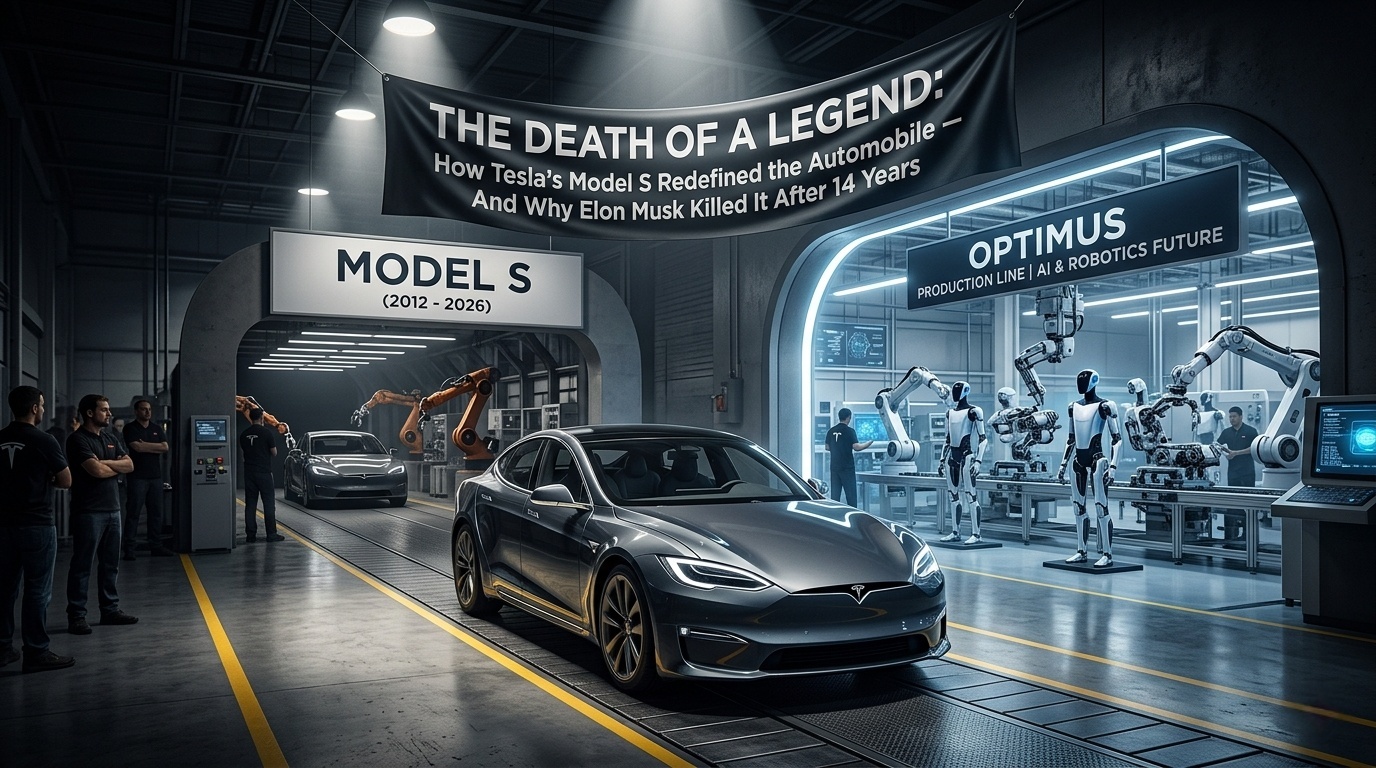
Introduction: A Bittersweet Farewell
On April 1, 2026, Elon Musk posted a message on X that sent waves through the automotive world: Tesla would formally cease production of the Model S and Model X, stop accepting custom orders, and only sell the remaining inventory vehicles. The global stockpile was down to roughly 600 units, Musk later confirmed — a number that would vanish within weeks. In a characteristic mix of nostalgia and forward-looking bravado, Musk described the moment as “bittersweet.”
The announcement, while dramatic, was not unexpected. Tesla had been signaling this pivot for months. During the Q4 2025 earnings call on January 28, Musk had already told investors: “It‘s time to basically bring the Model S and X programs to an end with an honorable discharge, because we’re really moving into a future that is based on autonomy”. The Fremont factory‘s Model S and X production lines would be dismantled and repurposed, making way for something entirely different: the mass production of Optimus, Tesla’s humanoid robot, at a projected rate of one million units per year.
Thus ended the 14-year journey of the vehicle that, more than any other single product, transformed the electric car from an oddity into an object of desire. The Model S was never just a car. It was a provocation, a manifesto on wheels, and the machine that forced the entire global automotive industry to reckon with the electric future. Its discontinuation is not merely the sunsetting of an aging product line — it is the most visible symbol yet of Tesla‘s metamorphosis from an electric vehicle manufacturer into an artificial intelligence and robotics company.
I. The Car That Changed Everything: Model S and the Birth of the Modern EV
The World Before Model S
To understand what the Model S achieved, one must first recall the automotive landscape of 2012. The electric vehicle market was essentially nonexistent as a consumer proposition. The Nissan Leaf, launched in 2010, offered a range of just 73 miles — adequate for short urban commutes but useless for anything resembling a road trip. The Honda Fit EV managed 123 miles. These were compliance cars, built to satisfy regulatory requirements rather than to excite consumers. They were practical, boxy, and utterly devoid of the emotional appeal that had defined automotive desire for a century.
The broader industry viewed electric vehicles with a mixture of skepticism and outright dismissal. When Tesla brought the Model S to market, “the industry laughed: An electric car from a startup? That‘s never going to work,” as one industry observer later noted. Tesla had only previously produced the Roadster, a low-volume sports car built on a modified Lotus chassis — a proof of concept, not a serious manufacturing enterprise. The idea that this California startup could design, engineer, and mass-produce a full-size luxury sedan that would rival the offerings of Mercedes-Benz, BMW, and Audi seemed preposterous.
Charging infrastructure was equally primitive. In January 2012, there were approximately 6,000 chargers nationwide in the United States, mostly 240-volt units requiring overnight charging for meaningful range. Early adopters recount stories of having to phone ahead to hotels, asking permission to plug in their vehicles overnight. Long-distance travel in an EV was an adventure in logistical planning, not a practical reality.
Launch Day: June 2012
In June 2012, Tesla hosted a launch event at its Fremont, California factory — a facility that had once been the NUMMI joint venture between General Motors and Toyota. The first customer deliveries of the Model S were hyped under the guise of an investor relations meeting, but the excitement was genuine. “In 20 years more than half of new cars manufactured will be fully electric,” Musk told journalists in attendance. “I feel actually quite safe in that bet. That‘s a bet I will put money on.” Even if the precise timeline proved aggressive, the characteristic bluster was on full display — thrusting the Model S into the zeitgeist.
The base price was $49,900 after the $7,500 federal tax credit — positioning the Model S squarely in luxury sedan territory. But what buyers received for that price was unlike anything the automotive world had seen. The 85-kilowatt-hour battery pack delivered an EPA-rated range of up to 265 miles, more than double that of any other electric vehicle on the market. The 2012 Model S produced 416 horsepower and could accelerate from 0 to 60 mph in roughly 4.4 seconds — performance figures that embarrassed many gasoline-powered luxury sedans of the era.
Redefining What a Car Could Be
It was not merely the electric powertrain that distinguished the Model S. Tesla introduced a series of innovations that would set the template for the next decade of automotive design.
The 17-inch touchscreen that dominated the center console was the most visible departure from convention. At a time when most luxury vehicles still relied on physical buttons, knobs, and small LCD displays, the Model S replaced nearly all physical controls with a responsive, smartphone-like interface. The design was polarizing — traditionalists derided the absence of tactile feedback — but it was undeniably forward-looking. Today, large central touchscreens are standard equipment across the automotive industry, from the Mercedes-Benz EQS Hyperscreen to the Ford Mustang Mach-E‘s vertically oriented display.
Equally significant were the flush, retractable door handles that extended automatically as the driver approached. This feature, borrowed from high-end sports cars, served both aerodynamic and aesthetic purposes. It made the car feel alive, responsive to the driver’s presence. Combined with the absence of a front grille — unnecessary for an electric vehicle — the design language communicated unmistakably that this was a vehicle from the future.
But perhaps the most consequential innovation was over-the-air (OTA) software updates. Before the Model S, improving a car meant buying a new one or visiting a dealership for expensive hardware upgrades. Tesla transformed the vehicle into a software platform that could gain new features, improved performance, and enhanced safety capabilities over time — without the owner ever leaving their garage. This shift from hardware-defined to software-defined vehicles is now the central strategic imperative of every major automaker on the planet.
The cumulative effect was transformative. The Model S “effectively changed the way many consumers perceived electric vehicles, proving that they can be just as practical, sporty and luxurious as internal combustion engine vehicles,” as USA TODAY summarized. It made people “think that EVs could be cool, could be fast, could be luxurious, could be for enthusiasts” — a dramatic departure from the utilitarian image that had previously defined the category.
An Ongoing Project, Not a Car
One of the most remarkable aspects of the Model S‘s 14-year production run was Tesla’s approach to product evolution. Most automakers would have replaced the Model S with three or four all-new generations over such a span. Toyota, for example, introduced eight generations of the Corolla between 1966 and 2026. BMW cycled through multiple iterations of the 3 Series. Tesla, however, “kept chiseling away at the same car, changing its hardware, software, and manufacturing philosophy while keeping the basic silhouette familiar”.
The numbers tell a striking story. The original Model S comprised roughly 5,000 parts; the latest iteration before discontinuation had been reduced to approximately 3,000. Only about 3% of the original car’s components were shared between the initial and final versions. Underneath the familiar exterior, nearly everything had changed: the battery chemistry, the electronic architecture, the drive units, the interior materials, and the safety systems.
This approach — treating a vehicle as an ongoing engineering project rather than a static product replaced at fixed intervals — was unprecedented in automotive manufacturing. It reflected Tesla‘s Silicon Valley DNA: iterate continuously, improve relentlessly, and never wait for a model year change to roll out a better version. The approach had its drawbacks — early Model S vehicles aged more visibly than their traditional luxury competitors — but it demonstrated a fundamentally different philosophy of what a car company could be.
Sparking the Electrification Era
The Model S did not merely succeed as a product; it triggered an industry-wide response. “The success of the Tesla Model S wasn’t a one-off, but the culmination of the industry‘s foray into electrification that stretched back into the 1990s,” notes an industry analysis. “It wasn’t until 2012, with the launch of the Model S, that Tesla proved EVs could be an exciting and viable vehicle for the average driver. That success sparked a frenzy as other automakers stepped up their game”.
The response came in waves. In 2013, BMW launched the i3, though its range was significantly shorter than the Model S. In 2014, Kia introduced the Soul EV and Volkswagen the e-Golf — electrified versions of existing gasoline models rather than purpose-built EVs. It wasn‘t until several years later that a flood of all-new electric vehicles hit the market: the Chevrolet Bolt in 2017, the Hyundai Kona Electric and Jaguar I-Pace in 2018, the Audi e-tron in 2019, and the Porsche Taycan and Ford Mustang Mach-E in 2020.
Each of these vehicles, in its own way, was a response to the challenge the Model S had laid down. The established automakers “began following Tesla by hiring programmers to create their own software-defined cars, although even now, in 2026, they have not yet caught up on that front”. The estimated $1.7 billion Tesla invested in developing the Model S triggered what some analysts estimate to be over $300 billion in cumulative industry investment in electric vehicle development over the subsequent decade.
The Model S also revolutionized how cars were sold. Tesla bypassed the traditional franchise dealership model entirely, selling directly to consumers online. Car dealers revolted; state legislatures debated; lawsuits were filed. But the direct-to-consumer model has since been adopted, in various forms, by numerous EV startups and is increasingly being explored by legacy automakers as they transition to electric vehicles. The Model S proved that consumers were willing to purchase a $50,000 to $100,000 vehicle the same way they might order a laptop — a proposition that would have seemed absurd before 2012.
II. The Numbers That Sealed Its Fate: Why Tesla Walked Away
A Steep and Sustained Decline
For all its historical significance, the Model S had become a commercial afterthought for Tesla by the mid-2020s. The sales trajectory tells an unambiguous story of decline.
In 2019, Model S and Model X combined deliveries still represented roughly 17-20% of Tesla‘s quarterly totals — a meaningful, if already minority, share of the business. By the fourth quarter of 2022, that contribution had fallen to approximately 4%. And by the fourth quarter of 2025, it had collapsed to just 2.78%.
The 2025 full-year figures were stark. According to Kelley Blue Book data cited by USA TODAY, Tesla sold just 5,889 Model S sedans in the United States — a decline of 52.6% year-over-year. The Model X fared somewhat better at 13,066 units, but still fell 34.2% from 2024 levels. Combined, the “Other Models” category — which also included the Cybertruck and Tesla Semi — delivered just 50,850 units globally in 2025. Stripping out the Cybertruck (20,237 units) and the Semi, the actual Model S and X figure was likely closer to 30,000 units globally for the full year.
These numbers represented barely 1-3% of Tesla‘s total annual deliveries of approximately 1.64 million vehicles in 2025. Meanwhile, the Model 3 delivered 192,440 units, and the Model Y — the world’s best-selling vehicle of any kind — moved an astounding 357,528 units in the U.S. alone.
The trend was not limited to the American market. In China, Tesla‘s second-largest market, the company had already stopped accepting orders for Model S and Model X as early as April 2025. Chinese annual sales of the two models had fallen below 2,000 units combined — a negligible figure in a market where Tesla delivered over 600,000 Model 3 and Model Y vehicles in the same period.
Production Capacity: A Factory Running on Empty
The sales decline was made more painful by the enormous waste it represented in manufacturing terms. Tesla’s Fremont factory had an annual production capacity of approximately 100,000 units for the Model S and Model X lines combined. By 2025, those lines were operating at well below 30% utilization — meaning that more than 70,000 units of potential annual output were simply going to waste.
In the brutally efficient world of automotive manufacturing, where production lines represent billions of dollars in capital investment, such underutilization is almost unheard of for a volume manufacturer. Toyota, for comparison, typically runs its production lines at 85-95% utilization. The contrast highlights the unsustainable economics that Tesla faced in maintaining dedicated assembly lines for vehicles that had become a rounding error in its sales reports.
A Half-Hearted Farewell: The June 2025 “Refresh”
Compounding the sense of neglect was the last major update the Model S and Model X received — a “refresh” in June 2025 that industry observers described as “a very mild update, to say the least.” The changes included a new paint color, a front bumper camera, slightly improved range figures, and ambient interior lighting — features that the more affordable Model 3 and Model Y had already received. The “biggest change” was a $5,000 price increase, pushing the Model S starting price to $84,990 and the Model X to $89,990.
Electrek‘s assessment at the time was prescient: “When Lars Moravy announced that Tesla would refresh the vehicles later this year, he said that they will show the Model S and Model X lineup ‘some love,’ but that doesn’t look like love to me. It looks like an afterthought.” As subsequent events would confirm, “it wasn‘t just an afterthought, it was a farewell tour”.
The half-hearted nature of the refresh reflected a deeper reality: Tesla’s engineering talent, capital investment, and executive attention had long since moved on. The company‘s best designers were working on the Cybercab robotaxi. Its best AI engineers were focused on Full Self-Driving. Its manufacturing teams were consumed with ramping Model Y production across four continents and preparing for Optimus. The Model S and Model X had become legacy products in the purest sense — maintained out of inertia and a residual sense of obligation, but no longer central to the company’s future.
Competition Catches Up — and Surpasses
For over a decade, the Model S enjoyed a remarkable competitive advantage: it had no real rivals. The luxury electric sedan segment was essentially a market of one. That era is now definitively over.
The Lucid Air, launched in 2021, surpassed the Model S in range (up to 516 miles EPA vs. 410 miles for the 2026 Model S) and matched or exceeded it in interior quality and luxury appointments. The Porsche Taycan, BMW i7, and Mercedes-Benz EQS all entered the segment with vehicles that — while not always matching the Model S in raw performance metrics — offered the build quality, dealer support, and brand prestige that traditional luxury buyers expected.
Most dramatically, Chinese manufacturers have entered the luxury electric sedan space with formidable products. In late April 2026 — the very week of this writing — BYD‘s Fang Cheng Bao brand unveiled the Formula SL at the Beijing Auto Show. The vehicle boasts 1,000 horsepower from a tri-motor all-wheel-drive powertrain, an advanced 800-volt electrical architecture, and magnetic ride control. It explicitly targets the Tesla Model S Plaid and Porsche Taycan. Other Chinese entrants, including the Zeekr 001 with its 680kW combined output, have also set their sights on the segment Tesla once owned.
It is a bitter irony: the Model S spent 14 years demonstrating to the world that electric vehicles could be fast, luxurious, and desirable — and in doing so, it spawned a generation of competitors that ultimately made the original irrelevant.
The Financial Imperative
Tesla’s broader financial picture provided additional urgency for the decision to end Model S production. The company‘s total revenue for 2025 came in at $94.8 billion — 3% lower than the previous year. Automotive sales fell 16% year-over-year in the fourth quarter. Overall vehicle deliveries declined 9% to 1.64 million units. These were not catastrophic numbers, but they represented Tesla’s first annual revenue decline in nearly a decade, and they arrived at a moment when the company was planning to ramp capital expenditures to over $250 billion in 2026 — a sum earmarked for AI infrastructure, Optimus production lines, Cybercab manufacturing, and a semiconductor fabrication facility.
In this context, maintaining two dedicated production lines for vehicles that collectively represented 1-3% of deliveries was financially unsustainable. The cost of retooling the aging Model S and X platforms for a shrinking market segment could not be justified — especially when the same factory space, supply chain resources, and manufacturing talent could be redirected toward a business that Musk described as a “multi-trillion dollar opportunity”.
III. From Fremont Factory to Optimus Factory: The Strategic Pivot
The Grand Transformation
The Fremont factory — the birthplace of the Model S — is now being converted into the world‘s first large-scale humanoid robot production facility. Tesla’s Q1 2026 earnings materials confirmed that the company plans to begin preparing the first Optimus mass-production line in Q2 2026, with the line directly replacing the existing Model S and Model X assembly infrastructure.
The scale of the transformation is staggering. The first-generation Optimus production line at Fremont is designed for an annual capacity of one million robots. And this is only the beginning: the Texas Gigafactory is being prepared as a second-generation facility with a long-term target of producing 10 million Optimus robots per year. To put that number in perspective, global automobile production in 2023 — across all manufacturers worldwide — was approximately 76 million units. Tesla is envisioning a future in which its robot factory alone produces roughly one-seventh of that volume.
Musk confirmed on the April 22 earnings call that Optimus V3 — the third-generation design and the first meant for true mass production — will begin rolling off the Fremont assembly line as early as late July or August 2026. The V3 was originally scheduled for an April unveiling, but Musk delayed the reveal, explaining that he did not want to expose the design or intellectual property to competitors prematurely — an indication of how seriously Tesla is treating the competitive dynamics in the emerging humanoid robotics space.
What Is Optimus — And Why Is It Worth More Than Cars?
Optimus is Tesla‘s general-purpose humanoid robot, standing approximately 5 feet 8 inches tall and designed to perform a wide range of physical tasks. Musk has described its capabilities in ambitious terms: “This Optimus will really be a general-purpose robot that can learn by observing human behavior. You can demonstrate a task, or literally verbally describe a task, or show it a task, even show it a video, and it will be able to do that task”.
The V3 version promises significant advances over earlier prototypes. Crucially, it will feature a completely redesigned hand — Musk confirmed that the previously patented hand design has been discarded in favor of a “completely different” approach. The robot will have sufficient onboard intelligence to operate for extended periods without a network connection and will be capable of functioning without human supervision for hours at a time.
What makes Optimus so central to Tesla’s future strategy is the scale of the opportunity Musk envisions. “Every person on Earth will have one or two robots,” he has repeatedly stated — implying a total addressable market measured in the billions of units. Wall Street analysts are more measured but still bullish. Alexander Perry of Bank of America noted: “While we don‘t expect any significant profits from Optimus in the short term, we see it as a long-term opportunity. We forecast global robot shipments to reach 1.2 million to 10 million units by 2030-2035”.
The Synergies That Make It Possible
Tesla’s entry into humanoid robotics is not a random diversification. The company possesses several unique advantages that make the Optimus project more than an ambitious science project.
First, Tesla has accumulated an enormous trove of real-world AI training data through its Full Self-Driving program. As of the latest safety report, Tesla vehicles have logged over 93.8 billion miles of cumulative driving — including more than 33.7 billion miles in complex urban environments. While driving data is not directly transferable to bipedal locomotion and object manipulation, the underlying computer vision, spatial reasoning, and path-planning capabilities developed for FSD share deep architectural similarities with the AI systems required for humanoid robots.
Second, Tesla‘s vertical integration in hardware — batteries, electric motors, power electronics, and now AI chips — maps directly onto the components needed for a humanoid robot. An Optimus robot requires energy-dense batteries (Tesla’s 4680 cell program), efficient electric actuators (derived from vehicle drive units), sophisticated vision systems (based on the cameras and neural networks developed for Autopilot), and powerful edge-computing chips (the Dojo and AI5 programs).
Third, Tesla‘s experience in high-volume manufacturing — the hard-won expertise in building millions of complex electro-mechanical products at scale — is a competitive moat that few robotics companies can match. Boston Dynamics, for example, makes remarkable robots but has never demonstrated the ability to manufacture them by the millions. Tesla’s entire corporate culture is built around production at scale.
The Fremont Factory‘s New Role
The conversion of the Fremont factory is proceeding on an accelerated timeline. According to Q1 2026 earnings reports, the existing Model S and X production lines were scheduled for dismantling beginning in May 2026. The Fremont facility will continue manufacturing the Model 3 and Model Y — the city‘s mayor confirmed that “through production line improvements and operational efficiencies, Tesla expects to maintain current vehicle throughput at Fremont” — but the space formerly occupied by the flagship vehicles will be entirely dedicated to robot production.
Notably, the conversion will not result in job losses. Tesla stated that “the retooling will not result in job losses, but that Fremont headcount may increase”. The city of Fremont itself has embraced the transformation: Mayor Raj Salwan called the decision “a vote of confidence in our workforce, supplier ecosystem, and advanced manufacturing base”.
This dynamic — a manufacturing workforce transitioning from building luxury electric sedans to humanoid robots — captures the essence of Tesla’s transformation as vividly as any earnings presentation or investor slide deck. The same factory, the same workers, the same production engineering expertise — now applied to an entirely different product category. It is industrial evolution in real time.
The Broader Capital Commitment
The Optimus pivot is part of a much larger capital allocation shift at Tesla. CFO Vaibhav Taneja indicated that the company‘s 2026 capital expenditure would exceed $250 billion, directed toward six new or expanded factories, AI infrastructure supporting both the Robotaxi and Optimus programs, and a research-grade semiconductor fabrication facility in Austin.
The scale of this spending reflects Musk’s conviction that AI and robotics represent a generational opportunity. He used the Q1 2026 earnings call to explain the logic: “Obviously, Tesla‘s certainly not alone in this. I think you’ve seen most, if not certainly the major technology companies are substantially increasing their capital investments, and we‘re going to be doing the same. I think it’s going to pay off in a very big way”.
IV. The Human Cost: What Model S Owners Are Saying
A Community in Mourning
For the passionate community of Tesla owners and enthusiasts, the discontinuation of the Model S has been met with a complex mixture of sadness, nostalgia, anger, and — in many cases — understanding. The Model S was Tesla‘s “halo car” — the vehicle that, like the Chevrolet Corvette for General Motors, the Porsche 911, or the Ford Mustang, defined the brand’s capabilities and aspirations.
“It‘s sad in that it’s the end of an era in terms of what it did for the EVs,” said Joel Szirtes, 46, an early Model S adopter and Tesla investor from Birmingham, Michigan. Szirtes, who has owned every Tesla model from the original Model S to the Cybertruck, added: “Now comes the robot transition. If you look at what Musk‘s done with Full Self Driving cars in just the last 10 years — self-driving, cameras on cars observing the physical world, artificial intelligence — the logical next iteration of this is Optimus”.
Sean Maloney, who bought his first Model S in Chicago in 2012 — at a time when Michigan actually banned Tesla sales — expressed a sentiment echoed by many early adopters: “It’s only surprising in that it seems like S and X were halo vehicles for the brand. But with a company led by Elon Musk, things shouldn‘t be surprising. I think back to when I made a reservation for the Model S in 2011. For me, it’s still the vehicle that redefined what an EV could be”.
Anger and Abandonment
Not all reactions have been so philosophical. Current owners have expressed frustration — not just with the discontinuation itself, but with the broader implications for their vehicles‘ long-term value and support. On Tesla owner forums and Reddit communities, threads proliferated with titles like “Did Tesla just make a billion-dollar mistake?” and “So sad Tesla is shutting down production of this car. Always wanted to own one and always kept hoping for the the ‘next big thing’”.
The concerns are practical as well as emotional. Owners worry about parts availability for a vehicle that, while sharing some components with other Tesla models, relies on unique parts for its body structure, suspension, and interior. There are concerns about software support — will a discontinued vehicle continue to receive the latest FSD updates? And there are concerns about resale value: a “discontinued” luxury vehicle is unlikely to command the same premium as one in active production.
Dan Markey of Rochester Hills, who has owned seven Teslas since 2013 — including three Model S vehicles, among them the Plaid edition that became the first production car to achieve 0-60 mph in under two seconds — captured the sense of loss: “Being such a fan, it‘s really kind of sad, because it looks like they’re leaving the traditional car business.” He noted the long-delayed next-generation Roadster and wondered: “I‘m concerned that maybe that’s their last new vehicle”.
A Calculated Risk
Industry analysts have characterized the Model S discontinuation as “a calculated risk, trading the prestige of its luxury models for a shot at dominating the next frontier of technology: humanoid robotics”. The risk is not trivial. By exiting the luxury sedan segment — a segment that, while relatively low in volume, traditionally carries higher profit margins per vehicle — Tesla cedes ground to competitors like Lucid, Porsche, Mercedes-Benz, and the increasingly capable Chinese entrants.
But the bet Tesla is making is that the luxury sedan market, as traditionally defined, is a shrinking pond in a world moving toward autonomous mobility services and AI-driven robotics. From this perspective, fighting to preserve a few percentage points of market share in a mature segment would be a misallocation of resources — a case of focusing on the battle while losing the war.
The transition “away from personal transportation toward robots is a pivotal moment for the company’s mercurial CEO and the cult-like customer base that has followed him,” noted one analysis. Whether that customer base — many of whom became wealthy through their early Tesla investments — will follow Musk into the robotics era with the same enthusiasm remains to be seen.
V. The Legacy: What the Model S Leaves Behind
The Industry It Created
The most enduring legacy of the Model S is not a specific technology or design feature — it is the entire competitive landscape of the modern electric vehicle industry. “The success of the Model S forced other automakers to spend hundreds of billions of dollars to develop electric models,” notes a New York Times analysis. The vehicle “completely flipped the auto industry on its head and kicked off a new era”.
Consider the cumulative impact across manufacturers: Volkswagen Group committed over €52 billion to its electric transition following the Model S‘s market validation. Ford invested $50 billion. General Motors pledged $35 billion. Hyundai Motor Group allocated $18 billion. Mercedes-Benz committed €40 billion. These investments — totaling well over $300 billion globally — were not inevitable. They were responses to the competitive threat that the Model S represented. Before 2012, no major automaker had a serious, well-funded electric vehicle program. Today, there is not a single major manufacturer without one.
Every major trend in modern automotive design can trace its lineage, directly or indirectly, to the Model S. The flush door handles now found on vehicles from the Range Rover Velar to the Lucid Air. The giant touchscreens that dominate the interiors of the Ford Mustang Mach-E, the Mercedes-Benz EQS, and the BMW iX. Over-the-air software updates, now offered by virtually every automaker from Volkswagen to Volvo. The concept of the car as a continuously improving software platform rather than a static hardware product. All of these were pioneered — or at least popularized — by the Model S.
The Vehicle That Proved the Skeptics Wrong
Perhaps the Model S‘s most profound contribution was psychological. Before 2012, the electric car was widely viewed as a compromise — a vehicle you bought despite its limitations, not because of its capabilities. The Model S inverted that equation. It was faster than most sports cars, smoother than any luxury sedan, and more technologically advanced than anything on the road. It made the gasoline-powered competition feel obsolete.
Doug DeMuro, one of the most influential automotive reviewers on YouTube, called the Model S “the number one most important car of the last 30 years.” His reasoning: the Model S did what no other vehicle had done — it proved that an electric car could be a legitimate object of automotive desire.
Design schools noticed the shift as well. Educators at transportation design programs reported a surge of students “who were interested in mobility and not only traditional gasoline-powered sports cars” following the Model S‘s debut — an indication that the vehicle had changed not just consumer preferences, but the aspirations of the next generation of automotive designers.
A Bridge from the Past to the Future
In the final analysis, the Model S served as a bridge between two eras. It took Tesla from the Roadster — a boutique product for wealthy early adopters — to the Model 3 and Model Y, the mass-market vehicles that now account for 97% of the company’s sales and have made Tesla one of the world‘s most valuable corporations. And it served as a bridge between the age of the automobile and the age of artificial intelligence — generating the revenue, the manufacturing expertise, and the brand loyalty that have enabled Tesla to pivot toward Optimus and Cybercab.
When Musk described the Model S’s retirement as an “honorable discharge,” he was not merely deploying a rhetorical flourish. The phrase captures something genuine about the vehicle‘s role in Tesla’s history. It served far beyond any reasonable expectation. It remade an industry. And it is now yielding its place on the factory floor to the machines that its creator believes will remake the world.
Whether that belief proves prescient or hubristic will be determined in the years to come. What is beyond dispute is that the Model S earned its retirement. No other vehicle of the 21st century has done more to reshape what we expect from our cars — and what we imagine they might become.
Conclusion: The End of the Beginning
The death of the Model S is not a tragedy. It is a transition — and one that was, in retrospect, inevitable. The vehicle had fulfilled its purpose. It had proven that electric cars could be fast, luxurious, desirable, and technologically superior to their gasoline-powered rivals. It had generated the capital — financial, intellectual, and reputational — that enabled Tesla to become one of the most consequential companies of the 21st century. It had sparked an industry-wide transformation that is still unfolding, with every major automaker now committed to an electric future.
But the company that built the Model S no longer exists. Tesla in 2026 is not an electric vehicle manufacturer that dabbles in AI; it is an AI and robotics company that still happens to make electric vehicles. The $250 billion in capital expenditure planned for 2026 is directed primarily at AI infrastructure, Optimus production, and full self-driving capabilities — not at developing new vehicle platforms. The Fremont factory‘s transformation from a luxury EV assembly line to the world’s first high-volume humanoid robot plant is the physical manifestation of this corporate metamorphosis.
This transformation carries risks. Abandoning the luxury sedan segment cedes ground to competitors. Betting billions on robots that have not yet demonstrated commercial viability tests the patience of shareholders. And alienating the passionate community of early adopters who made the Model S a success risks severing the cultural connection that differentiates Tesla from other corporations.
But the greater risk — from Tesla‘s perspective — would be to cling to the past. The luxury sedan market is mature, competitive, and unlikely to generate the exponential growth that has defined Tesla’s valuation and cultural significance. Robotics and autonomous systems, by contrast, represent a genuinely open frontier — one where Tesla‘s unique combination of AI expertise, manufacturing scale, and vertical integration could create advantages that no competitor can easily replicate.
Model S, the car, is gone. But its legacy lives on in every electric vehicle on the road today — and in the robots that will soon occupy the factory where it was born. That is a fitting epitaph for a machine that spent 14 years proving that the future is not something you wait for. It is something you build.
FAQ
Q1: Can I still buy a new Model S?
A: As of late April 2026, Tesla has stopped accepting custom orders for the Model S. The only way to purchase one is through remaining inventory — and Musk confirmed in early April that the company was down to “only a few hundred” vehicles. These will sell out quickly. If you are determined to own a new Model S, you should check Tesla‘s existing inventory immediately. Once that supply is gone, the Model S will only be available on the secondary market.
Q2: Will Tesla continue to support Model S vehicles with parts and service?
A: Yes. Tesla has explicitly committed to continuing after-sales service for Model S vehicles in the United States and other markets. Parts availability is expected to continue for the foreseeable future, though owners of older Model S vehicles (particularly those from 2012-2015) may eventually face challenges with components unique to those early production years.
Q3: How does this affect the resale value of my Model S?
A: The short-term impact is uncertain. On one hand, the discontinuation may increase desirability among collectors and enthusiasts who recognize the Model S’s historical significance. On the other hand, discontinued vehicles often experience faster depreciation due to concerns about long-term support and parts availability. Early indications suggest that well-maintained, low-mileage examples — particularly rare variants like the original P85+ or the Plaid — may hold value better than average. However, this is an evolving situation, and definitive trends will not be clear for several months.
Q4: Will the Model X also be discontinued?
A: Yes. Musk confirmed in both the Q4 2025 and Q1 2026 earnings calls that both the Model S and Model X programs are ending. The two vehicles share the same production lines at the Fremont factory, and the entire line is being converted to Optimus production. There has been no indication that Model X production will continue at any other facility.
Q5: Why did Tesla choose to end Model S/X production rather than move it to another factory?
A: Tesla‘s decision was driven by economics and strategy. The Model S and X lines at Fremont had a combined capacity of approximately 100,000 units annually but were operating at well below 30% utilization. Moving production to another factory would have required hundreds of millions of dollars in retooling costs for vehicles that collectively represented only 1-3% of Tesla’s sales. From Tesla‘s perspective, using that factory space for Optimus — a product Musk believes represents a multi-trillion dollar opportunity — made more strategic sense than preserving two legacy vehicle lines with shrinking demand.
Q6: Is the Model S Plaid also discontinued?
A: Yes. The Plaid — the high-performance variant of the Model S capable of 0-60 mph in under 2 seconds — is discontinued along with all other Model S configurations. Remaining Plaid inventory is likely to be among the most sought-after by collectors and performance enthusiasts.
Q7: Will Tesla ever build another luxury sedan?
A: Possibly, but not in the traditional sense. Tesla‘s focus has shifted toward the Cybercab robotaxi — a vehicle with no steering wheel or pedals, designed for autonomous ride-hailing — and the long-delayed second-generation Roadster. Musk has stated that “long term, the only car that will be driven by a human is the next-generation Tesla Roadster.” This suggests that a traditional luxury sedan — one built for a human driver — is unlikely. However, Tesla’s future plans could include premium autonomous vehicles that provide luxury sedan comfort without the driving experience.
Q8: What should Model S owners do now?
A: Continue to enjoy your vehicle. Tesla has committed to ongoing software support, and the Model S will continue to receive FSD updates (within the limits of its hardware — note that HW3-equipped vehicles will not be capable of unsupervised FSD). For those concerned about long-term parts availability, consider stocking up on wear items like brake pads, tires, and specific Model S components that may become harder to source. And consider documenting your ownership experience — the Model S is now a piece of automotive history.
Q9: How does the Model S compare to current competitors now that it is discontinued?
A: Even at the end of its production run, the 2026 Model S remained a competitive vehicle, particularly in its Plaid specification. With a range of up to 410 miles and acceleration performance that still ranks among the fastest production cars in the world, it remained a formidable presence in the luxury EV segment. However, competitors like the Lucid Air, Porsche Taycan, and Mercedes-Benz EQS offer interior quality and luxury features that the aging Model S platform could not match. The Model S‘s primary competitive advantage in its final years was its integration with Tesla’s Supercharger network and FSD software ecosystem — features that competitors are only now beginning to match.
Q10: Is this the beginning of Tesla exiting the car business entirely?
A: That is an overstatement — but it contains a kernel of truth. Tesla will continue to produce and sell the Model 3, Model Y, and Cybertruck, and the Cybercab robotaxi is entering production. However, Musk‘s public statements and Tesla’s capital allocation decisions make clear that the company views its long-term future as being primarily in AI and robotics, not traditional automotive manufacturing. The end of Model S production is a symbolic milestone in that transition — the moment when Tesla definitively prioritized its post-automotive future over its automotive past.