
Introduction
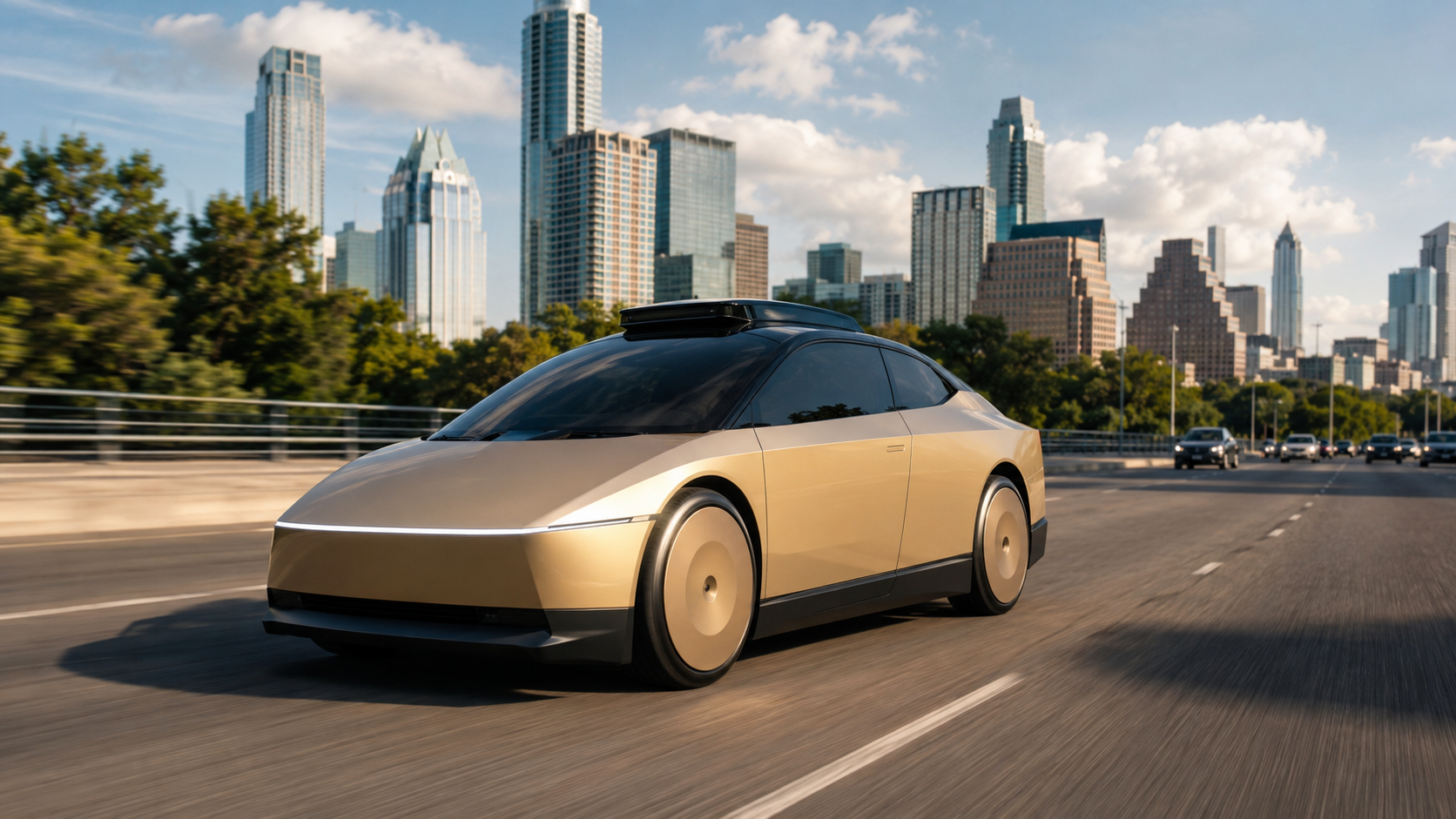
The pursuit of autonomous transportation has historically been defined by incremental software iterations retrofitted onto conventional vehicular platforms. For over a decade, the global automotive ecosystem has watched as autonomous vehicle developers integrated costly arrays of LiDAR, radar, and compute blocks onto consumer sedans and sports utility vehicles. On June 30, 2026, Tesla Inc. fundamentally altered this developmental paradigm by commencing public on-road engineering tests of its first production-spec Cybercab in Austin, Texas.
This validation milestone represents more than a routine software test; it marks the first time a purpose-built autonomous vehicle completely devoid of manual driving controls—such as a steering wheel, accelerator assembly, or brake pedal linkage—has entered real-world validation tracks on public infrastructure. As Tesla prepares to scale its Level 4 self-certified platform across Western markets, understanding the precise hardware architecture, regulatory pathways, and operational challenges of the Cybercab becomes essential for every stakeholder within the ecosystem.
Chapter 1: The Transition from Prototype to Production Validation
To accurately evaluate the engineering tests currently occurring on the streets of Austin, one must trace the vehicle's rapid progression from conceptual design to manufacturing reality. Tesla initial assembly lines at Gigafactory Texas achieved a critical milestone on February 17, 2026, when the first customer-spec Cybercab chassis completed its final assembly cycle. During the subsequent Q1 earnings call in April, corporate executives confirmed that manufacturing infrastructure had moved past initial tooling phases into steady-state, low-volume validation runs.
The tests initiated on June 30 represent a significant departure from prior public road operations observed in previous months across various metropolitan centers in the United States. Those early configurations utilized developmental mules or highly modified Model Y architectures disguised to test structural sub-systems. Crucially, those test vehicles retained emergency manual control linkages. The production units deployed in Austin are structural pure-plays; they are built from the ground up without the physical cavities or electronic control modules required to house a steering column or a hydraulic pedal cluster.
The on-road testing configuration employs a specific human-in-the-loop safety protocol tailored to a vehicle lacking manual controls. Tesla's video documentation confirms that while the driver's side of the cabin remains entirely vacant, an engineering safety monitor is positioned in the front right passenger seat. This monitor does not possess direct mechanical override capabilities. Instead, their intervention toolkit relies entirely on a secondary electronic interface—a dedicated engineering terminal capable of triggering an immediate safe-stop maneuver, overriding routing objectives, or signaling remote teleoperation centers to assume control via the vehicle’s redundant cellular array. This configuration underscores Tesla's absolute reliance on its Vision-only software stack to execute real-time lateral and longitudinal path planning.
Chapter 2: Hardware Architecture and EPA Certification Disclosures
The structural configuration of the Cybercab has been thoroughly illuminated by recent regulatory filings with the Environmental Protection Agency (EPA). These documents provide an empirical baseline that dispels long-standing industry speculation regarding the weight, thermal management, and electrical efficiency of Tesla's dedicated robotaxi platform.
The Cybercab registers an official curb weight of exactly 3,113 pounds (1,412 kg). In the context of contemporary electric vehicle design, this represents an aggressive weight reduction achievement, making the vehicle roughly 1,000 pounds lighter than a standard Model Y. This mass reduction is primarily achieved via two structural choices: the absolute omission of the secondary passenger cabins (the vehicle is strictly a two-seat configuration) and the deployment of a highly compact structural battery pack.
The powertrain is anchored by an electric motor generating 219 horsepower, driving the rear axle. This output profile is precisely calibrated for urban and suburban environments rather than high-performance acceleration vectors. It balances the high torque requirements of frequent stop-and-go city traffic with long-term thermal stability. Powering this drive unit is a 48-kilowatt-hour (kWh) battery pack utilizing a specialized structural configuration integrated directly into the vehicle's casting architecture.
The most compelling metric revealed in the EPA documentation is the vehicle's volumetric efficiency rating, which clocks in at an unprecedented 165 watt-hours per mile (Wh/mi). This marks the Cybercab as the most aerodynamically and electrically efficient vehicle ever manufactured by Tesla. This efficiency is a direct byproduct of the vehicle's specialized exterior topography, which completely eliminates drag-inducing elements such as traditional side mirrors, door handles, and wiper assemblies. The glass surfaces utilize advanced hydrophobic coatings alongside deep-recessed airflow channels to clear precipitation, eliminating the mechanical overhead of a conventional wiper motor.
Chapter 3: Regulatory Tailwinds and Infrastructure Preparedness
The timing of Tesla's public road validation matrix is deeply synchronized with shifting regulatory frameworks within the United States Department of Transportation. Historically, the Federal Motor Vehicle Safety Standards (FMVSS) presented an insurmountable legal barrier to mass-producing vehicles lacking physical steering wheels and brake pedals. Traditional rules explicitly required mandatory physical mechanisms for human intervention.
However, a pivotal shift occurred when the National Highway Traffic Safety Administration (NHTSA) proposed a comprehensive revision to federal requirements. This policy update removes the mandatory inclusion of mechanical brake pedals and steering columns for vehicles certified exclusively for automated driving systems (ADS). This regulatory alignment removes a primary legal barrier, allowing Tesla to self-certify the Cybercab under a Level 4 SAE operational design domain without requiring perpetual, highly restricted federal exemptions.
Simultaneously, Tesla has laid the groundwork for emergency infrastructure integration through the formal distribution of its First Responders Guide to Cybercab. This technical brief details how municipal emergency services must interact with an unmanaged, autonomous asset during an accident or hardware failure:
24/7 Robotaxi Assistance Channel: A dedicated wireless uplink allowing first responders to instantly command the vehicle to enter a hard-electronic lock state, isolating the high-voltage pack.
Localized Geofencing Re-Routing: The integration of real-time municipal data feeds that enable emergency dispatchers to push ad-hoc boundary limits directly to the vehicle's localization stack, forcing autonomous units to completely avoid active fire, construction, or accident zones.
Physical Override Access Points: Explicit blueprints detailing the location of external cut-loops and low-voltage access panels designed to safely discharge the pyrotechnic disconnects within the 48 kWh pack in the event of severe chassis deformation.
Conclusion
The on-road engineering tests of the Cybercab in Austin indicate that Tesla’s transition from a consumer-focused automotive manufacturer to an autonomous mobility provider has entered its operational execution phase. By validating a production-line, control-free vehicle on public corridors, the company is testing both the technical boundaries of its Vision software and the commercial infrastructure necessary to support it. If the 165 Wh/mi efficiency and sub-$30,000 production targets hold true under continuous real-world duress, the unit economics of urban transportation will shift permanently, solidifying Tesla’s structural moat against legacy competitors still dependent on human-centric vehicle architectures.
FAQ
Q: How does the Cybercab charge its battery pack without a standard charge port?
A: The Cybercab utilizes a high-efficiency inductive charging system located on the underbelly of the chassis. When the vehicle maneuvers over a compatible resonant pad at a staging depot, energy is transferred wirelessly via an alternating electromagnetic field, eliminating the failure points associated with automated mechanical plug solutions.
Q: What protocols execute if the vehicle experiences a sudden, catastrophic loss of low-voltage power?
A: The vehicle is engineered with an entirely redundant low-voltage power architecture, including secondary lithium-ion backup cells. If the primary low-voltage circuit fails, the backup system immediately takes over to maintain the compute stack, emergency signaling, and cellular telemetry long enough to guide the vehicle to a safe curbside stop.
Q: Can an individual consumer purchase a Cybercab for personal garage storage today?
A: No. The units currently rolling off the production lines at Gigafactory Texas are dedicated exclusively to internal engineering validation runs and Tesla's captive robotaxi network operations. While a broader retail strategy targeting private ownership has been discussed by corporate leadership, initial allocations are strictly restricted to fleet deployment.