
Introduction: The Paradigm Shift of March 2026
For nearly a decade, the narrative surrounding Tesla’s Full Self-Driving (FSD) has been one of "spatial optimization." The car’s neural networks were tasked with a singular, Herculean goal: look at a series of snapshots from eight cameras and correctly identify every pixel. While this approach led to the groundbreaking v12 "End-to-End" architecture, it still suffered from a fundamental human flaw: a lack of context over time.
As of today, March 30, 2026, that era has officially ended. With the wide-scale release of FSD v13 (Firmware 2026.8.3), Tesla has introduced Temporal Intelligence. This isn't just a software patch; it is an architectural rebirth that moves the vehicle from a "reactive" machine to a "predictive" entity. For the Tesla blogger and the enthusiast owner, understanding this shift is the key to navigating the current landscape of automotive AI.
Section 1: What is Temporal Intelligence? The 15-Second Buffer
The headline innovation in v13 is the implementation of End-to-End Temporal Transformers. To understand this, we must look at how previous versions handled "Object Permanence."
The "Flicker" Problem
In v12.5, if a pedestrian walked behind a parked van, the AI’s confidence in that object would drop almost instantly. To the car, if it couldn't see the person, the person effectively ceased to exist until they "re-emerged." This led to the infamous "micro-hesitations"—the car braking suddenly because it was startled by a person it should have known was there.
The 15-Second Memory
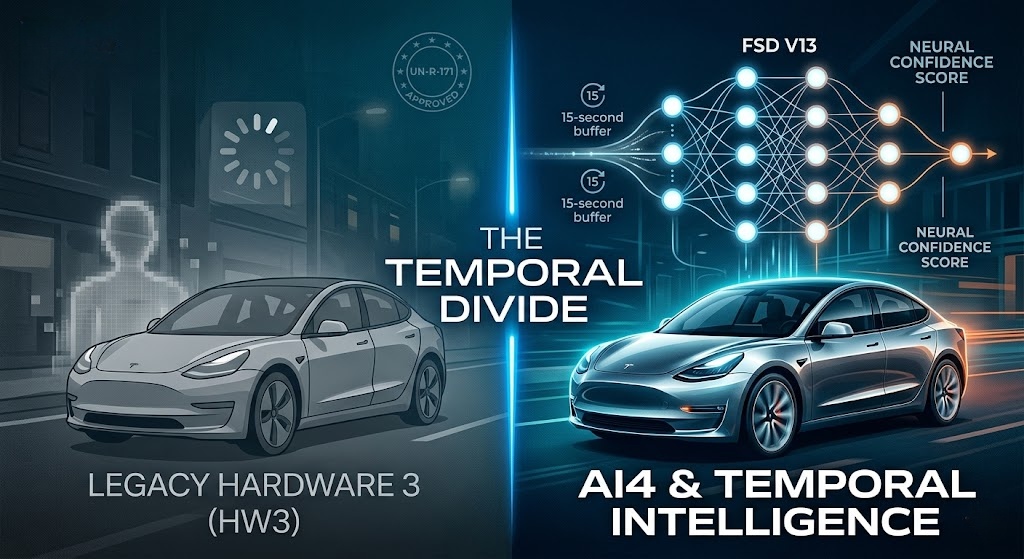
V13 solves this by maintaining a 15-second temporal buffer of video data. Instead of processing individual frames, the AI now processes "video clips" in real-time.
-
Object Permanence: The car now "remembers" the trajectory, speed, and intent of occluded objects. If a ball rolls into the street, v13 "expects" a child to follow, even if that child is still behind a fence.
-
Jerk-Limited Path Planning: By understanding the sequence of events rather than just the current moment, v13 plans its path with a smoothness that mimics a professional chauffeur. The "robotic" corrections of 2025 are replaced by fluid, predictive steering.
Section 2: The Hardware Paradox—The HW3 vs. AI4 Performance Gap
As v13 rolls out across the fleet, a structural divide is appearing between legacy Hardware 3 (HW3) and the newer AI4 (Hardware 4) platforms. For the first time, the data suggests we have hit a "compute ceiling."
The Voxelization Divergence
Tesla has upgraded its Occupancy Network to version 3.0, which discretizes the 3D world into high-resolution voxels (volumetric pixels).
-
AI4 Performance: On the new Model Y "Juniper" and Model 3 "Highland," v13 runs at a full 36 FPS with an 8x increase in voxel resolution. This allows the car to detect fine-grained hazards—like a stray nail or a shallow pothole—at twice the distance compared to older models.
-
HW3 Constraints: To run v13 on the older HW3 silicon (found in 2019-2023 models), Tesla engineers had to "prune" the neural network and "quantize" the weights from 16-bit to 8-bit. While the car remains safe, the March 2026 fleet data shows a clear disparity: AI4 vehicles are achieving 450 miles between critical disengagements, while HW3 is hovering around 120 miles.
Neural Confidence Scores
A new feature in v13 is the Real-Time Confidence Score. Displayed on the service menu (and used internally by the safety kernel), this score dictates how much the car trusts its own perception. If mud blocks a camera or heavy rain obscures a lane line, the system now provides a proactive 5-second warning before requiring a takeover—a direct response to new safety mandates.
Section 3: Navigating the Streets of London and Paris—European Regulatory Compliance
For our European readers, March 2026 is the most significant month in Tesla's history. The Dutch vehicle authority (RDW) has officially moved into the final vehicle testing phase for UN-R-171 approval.
The RDW Breakthrough
Following 1.6 million kilometers of testing on EU roads, the RDW has signaled that Tesla's FSD (Supervised) meets the strict "Black Box" requirements and cybersecurity standards (UN-R-155).
-
The "Safety Shield" Logic: European versions of v13 include a specialized "Safety Shield" that logs neural confidence in real-time to comply with EU transparency protocols.
-
Summer 2026 Rollout: While currently limited to pilot groups in the Netherlands, a "domino effect" is expected. Germany's KBA is slated to review the Dutch data in April, potentially unlocking FSD for 80% of the EU fleet by mid-summer.
Section 4: Beyond Driving—Unified Park-to-Park Autonomy
V13 isn't just about the highway or city streets; it is the first "Unified" stack. It integrates Unpark, Drive, Reverse, and Park into a single neural model.
The "End-to-End" Journey
In previous iterations, the car had to switch "modes" when entering a parking lot or a driveway. V13 treats a driveway exactly like a highway—a series of probabilistic paths.
-
Reverse Autonomy: The car can now confidently reverse out of a complex driveway, navigate around a trash can, and transition to "Drive" without human input.
-
Siren Recognition: Using the vehicle's external microphones (on newer models), v13 can now "hear" and categorize emergency vehicle sirens (Police, Fire, Ambulance) and proactively pull over before the lights are even visible.
Conclusion: The Road to Unsupervised Level 4
FSD v13 represents the "End of the Beginning." By solving the temporal dimension of AI perception, Tesla has removed the final logical hurdle to true autonomy. However, the hardware divergence remains the "elephant in the room." As we move toward the 2027 "Cybercab" era, HW3 owners may find themselves in a "legacy support" tier, while AI4 owners begin to experience what feels like true Level 4 autonomy in geofenced areas of Texas and California.
For the欧美 (Western) Tesla owner, the message is clear: the car you bought as a "driving machine" has officially transitioned into an "AI computer on wheels."
FAQ: Common Questions on v13
Q: Can I upgrade my HW3 car to AI4? A: Currently, no. The power requirements, wiring harnesses, and camera resolutions of AI4 are fundamentally incompatible with the HW3 architecture. Tesla is focusing on optimizing v13 for HW3 through "model pruning."
Q: What is a "Neural Confidence Score"? A: It is a real-time assessment by the AI of its environment's clarity. If the score drops below 85% (due to weather or lighting), the system will proactively alert the driver to be ready to take over.
Q: Is "Park-to-Park" available in Europe yet? A: High-speed "Drive" autonomy is currently the focus of RDW testing. Low-speed maneuvers like "Actually Smart Summon" are expected to follow shortly after the primary FSD approval this summer.