
Introduction: A Seven-Year Wait
It has been seven years since Tesla last launched an entirely new vehicle platform. The Model Y, introduced in 2019, remains the company‘s core SUV offering — a vehicle that has sold millions of units but has never truly satisfied families needing genuine three-row practicality. The Model X, with its falcon-wing doors and $80,000+ price tag, has always been a niche product, and Tesla has now announced plans to discontinue it entirely in 2026. The Cybertruck, while visually striking, is a pickup truck, not a family SUV.
This product gap has become increasingly difficult to ignore. Families seeking an electric vehicle with three rows of seating and substantial cargo space have turned to competitors: the Rivian R1S, the Kia EV9, the Volvo EX90, the Mercedes EQS SUV, and more recently, the Lucid Gravity and Cadillac Vistiq. Tesla, the company that pioneered the modern electric vehicle market, has no answer in this rapidly growing segment.
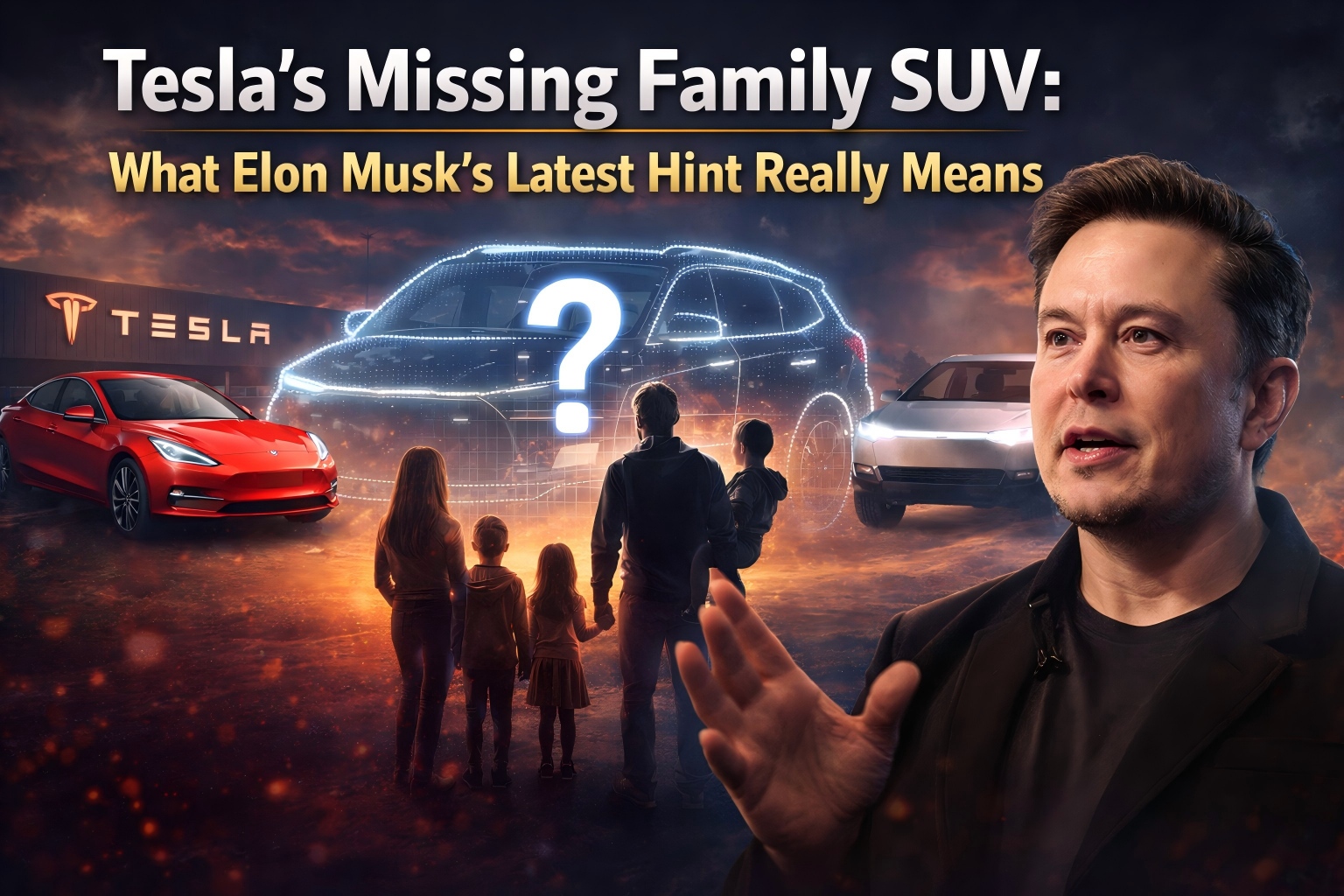
That may be about to change. On March 26, 2026, Elon Musk responded to an X user discussing the difficulty of fitting three child seats in a Tesla with a simple but telling statement: “Well, I guess we should solve this.” The remark followed an earlier tease in which Musk suggested Tesla has something “way cooler than a minivan” in the pipeline. Together, these comments have reignited speculation about a larger, family-focused Tesla SUV — a vehicle that could finally fill the most obvious gap in the company‘s lineup.
Chapter 1: What Elon Musk Actually Said — And What It Means
The March 26, 2026 X Post
The latest round of speculation began with a seemingly casual exchange on X. A user posted about the challenges of fitting three child seats in a Tesla, a common complaint among growing families who have chosen the brand. Musk responded directly: “Well, I guess we should solve this.”
For anyone unfamiliar with Musk’s communication style, this might read as a non-committal acknowledgment. But within the Tesla community, Musk‘s public hints have often preceded actual product announcements — sometimes by years, but rarely by accident. When Musk says “we should solve this,” he is not merely agreeing with a complaint; he is signaling that a solution is already in development.
The Earlier “Cooler Than a Minivan” Tease
Musk’s March 26 post was not his first hint on this subject. In previous months, he had suggested that Tesla has something “way cooler than a minivan” in the pipeline. This phrasing is significant. Minivans, despite their practicality, carry a stigma in many markets, particularly in the United States, where they are associated with suburban parenthood rather than style or performance. By promising something “way cooler,” Musk signaled that Tesla‘s family vehicle would not be a traditional box-on-wheels but something more distinctive — likely an SUV with the edgy design language of the Cybertruck.
The Design Director‘s Previous Comments
Franz von Holzhausen, Tesla’s design director, has previously hinted at a “Cyber SUV” in the company‘s future lineup. In an impromptu interview, von Holzhausen suggested that Tesla was exploring an SUV built on the Cybertruck’s full-size chassis, with the same angular stainless steel design language extended to create a three-row family vehicle. Multiple prototype models of such a vehicle have reportedly been spotted on shelves at Tesla‘s design studio, displayed prominently as scale models.
These prototypes suggest a vehicle approximately 18.6 feet (5,683 mm) in length — significantly larger than the Model Y (4,750 mm) and even slightly longer than the Model X (5,036 mm). If accurate, this would place the Cyber SUV in the full-size SUV category, competing directly with vehicles like the Rivian R1S and the Cadillac Escalade IQ.
The Model Y L Confusion
Adding to the speculation is Tesla‘s recent launch of the Model Y L in select markets. In March 2026, Tesla began selling the Model Y L in Australia and Singapore — a six-seat, extended-wheelbase version of the Model Y offering three rows of seating and a longer range. Priced from approximately $75,000 in Australia, the Model Y L carries a $6,000 premium over the standard Model Y and offers 378 kW of power, 590 Nm of torque, a 116-liter frunk, and 420 liters of cargo space with all six seats upright.
However, the Model Y L is not the vehicle Musk was hinting at. It is an incremental extension of an existing platform, not a ground-up new vehicle. Moreover, Tesla has not announced plans to bring the Model Y L to the United States or Europe, suggesting that the company views it as a market-specific solution rather than a global family SUV answer. The “cooler than a minivan” vehicle is something else entirely — and all evidence points to a full-size, three-row SUV built on the Cybertruck‘s platform.
Chapter 2: The Product Gap — Why Tesla Needs a Larger SUV
The Current Lineup‘s Limitations
Tesla’s current vehicle lineup has a conspicuous hole. The Model 3 is a sedan. The Model Y is a compact crossover that offers an optional third row, but that third row is widely criticized as unusable for anyone other than small children on short trips. The Model S is a sedan. The Model X is a large SUV, but it starts at over $80,000, features complex falcon-wing doors that many buyers find impractical, and is now slated for discontinuation. The Cybertruck is a pickup truck.
There is no mainstream, three-row, family-oriented SUV in Tesla‘s lineup — the very segment that represents one of the largest and most profitable categories in the automotive industry, particularly in North America.
The Model Y remains Tesla’s core SUV offering, but buyers seeking more cabin space and true three-row practicality have limited options in the company‘s lineup. This is why speculation around a bigger Tesla family vehicle keeps resurfacing. The demand is there; the supply is not.
The Competitive Landscape: A Crowded and Growing Segment
While Tesla has hesitated, competitors have flooded the three-row electric SUV segment. The early 2026 models leading the charge include:
-
Kia EV9: Starting at $54,900, up to 305 miles of range, seating for 6-7, and up to 500 horsepower. Widely regarded as one of the best values in the segment.
-
Rivian R1S: Starting at $76,900, up to 410 miles of range, seating for 7, and up to 1,025 horsepower in the quad-motor configuration. A direct competitor to any full-size Tesla SUV.
-
Volvo EX90: Starting at $81,290, seating for 7, with Volvo‘s signature safety and Scandinavian design.
-
Lucid Gravity: Starting at $79,900, with over 440 miles of range and seating for 7. Lucid’s first SUV leverages the company‘s industry-leading powertrain efficiency.
-
Cadillac Escalade IQ: Starting at $127,405, with a massive 200+ kWh battery and seating for 7. The ultra-luxury entry in the segment.
-
Cadillac Vistiq: Starting at $77,395, with up to 305 miles of range and seating for 7.
-
Hyundai Ioniq 9: Starting at $58,955, with seating for 7 and a competitive range.
This is not a niche segment; it is one of the fastest-growing categories in the EV market. AutoPacific research has found that 59% of three-row crossover and SUV buyers intend to spend less than $50,000, indicating significant demand at the lower end of the segment — a space that Kia has successfully captured with the EV9. Tesla, with its brand cachet and manufacturing scale, could compete effectively across the entire price spectrum, from a $55,000 base model to an $80,000+ luxury version.
The Market Opportunity: US and Europe
The opportunity is substantial in both the United States and Europe, the two primary markets for this article‘s audience.
In the US, full-size SUVs are a cultural institution. The segment generates billions in annual revenue for automakers like Ford (Expedition), GM (Suburban, Yukon, Escalade), and Stellantis (Wagoneer). As these vehicles transition to electric powertrains — driven by both regulatory pressure and consumer demand — Tesla has an opportunity to capture a significant share of a market that is currently underserved by EVs. The Rivian R1S has demonstrated that there is appetite for an electric full-size SUV; the vehicle has consistently been one of Rivian’s best-selling models. Tesla could do what Rivian has done, but at greater scale and with a more established brand.
In Europe, the opportunity is different but no less significant. European families tend to prefer smaller vehicles than their American counterparts, but the three-row SUV segment is still substantial, particularly in markets like Germany, France, and the UK. The Kia EV9 has been well-received in Europe, and the Volvo EX90 is designed with European preferences in mind. Tesla‘s European sales rebounded sharply in February 2026, driven almost entirely by the Model Y — a vehicle that is not optimal for larger families. A true three-row Tesla SUV could capture customers who are currently choosing the EV9 or the EX90 because Tesla has no alternative.
Chapter 3: What Could a Larger Tesla SUV Look Like?
Platform and Architecture
The most plausible scenario is a vehicle built on the Cybertruck‘s full-size platform. The Cybertruck’s chassis, with its stainless steel exoskeleton design, provides a foundation that can be extended and modified for different body styles. A Cyber SUV would likely share the Cybertruck‘s underlying architecture, including its structural battery pack, 800-volt electrical system, and advanced thermal management.
The vehicle would almost certainly be built at Gigafactory Texas, where the Cybertruck is already produced. This would allow Tesla to leverage existing manufacturing lines and supply chains, reducing the capital expenditure required to bring a new vehicle to market. It would also enable Tesla to scale production more quickly than if the vehicle were built at a new facility.
Dimensions and Seating
Reports based on prototype sightings suggest a vehicle approximately 18.6 feet (5,683 mm) in length — significantly larger than the Model Y (4,750 mm) and even slightly longer than the Model X (5,036 mm). This would place the Cyber SUV in the full-size SUV category, comparable to the Rivian R1S (5,100 mm), the Cadillac Escalade IQ (5,697 mm), and the Kia EV9 (5,015 mm).
Seating would almost certainly be three rows, accommodating six or seven passengers. The prototype images suggest a traditional SUV layout rather than a minivan configuration, with the third row accessible through conventional rear doors. The design language would likely echo the Cybertruck: angular, stainless steel surfaces, sharp lines, and a futuristic aesthetic that distinguishes Tesla from the more conservative designs of Volvo, Kia, and Cadillac.
Powertrain and Range
Tesla‘s powertrain technology is among the industry’s best, and a larger SUV would likely benefit from the latest advancements. The vehicle would probably offer multiple configurations:
-
Rear-wheel drive (base model): Targeting a price point around $60,000-$65,000, with a range of approximately 300-350 miles.
-
All-wheel drive (mid-tier): Around $75,000-$80,000, with dual motors, enhanced performance, and range of 350-400 miles.
-
Performance or “Plaid” (top tier): $90,000+, with tri-motor configuration, sub-3-second 0-60 mph acceleration, and range exceeding 400 miles.
Battery technology would likely include the latest 4680 cells, which offer higher energy density and lower cost than previous generations. The 800-volt architecture, already present in the Cybertruck, would enable ultra-fast charging, potentially adding 200 miles of range in 15 minutes at a V4 Supercharger.
Towing and Utility
For American buyers in particular, towing capacity is a critical specification for a full-size SUV. The Rivian R1S can tow up to 7,700 pounds; the Kia EV9 tows up to 5,000 pounds. Tesla‘s larger SUV would need to match or exceed these figures to compete effectively. Given that the Cybertruck can tow up to 11,000 pounds, a Cyber SUV built on the same platform could reasonably achieve a towing capacity of 7,000-8,000 pounds — sufficient for most family boat or trailer needs.
Cargo space would also be a priority. The frunk (front trunk) would likely be substantial, potentially exceeding 200 liters. With all three rows in use, cargo space would be limited but comparable to competitors — perhaps 400-500 liters. With the third row folded, that figure would expand to 1,200+ liters, offering ample space for luggage, sports equipment, or large purchases.
Interior and Technology
Tesla‘s minimalist interior design would likely continue, with a single large central display controlling most vehicle functions. However, a larger SUV might justify a second display for rear-seat passengers — a feature available in many competitor vehicles and one that families often appreciate for long trips.
The third row would need to accommodate adults, not just children — a key differentiator from the Model Y’s cramped third-row option. Sliding second-row seats would facilitate access to the third row, a feature that Tesla has not previously prioritized but that is standard in the segment.
Autopilot and Full Self-Driving would be included at appropriate trim levels, and the vehicle would likely be equipped with the latest AI5 hardware, enabling future unsupervised autonomy capabilities.
Chapter 4: Timing and Likelihood — When Could We See It?
The Official Silence
For now, Tesla has not published an official model page, launch roadmap, or specification sheet for any new larger SUV. That means the vehicle remains speculative, even if Musk is clearly keeping the conversation alive in public. This is consistent with Tesla‘s historical approach: the company rarely announces products more than 12-18 months before they enter production, and Musk’s hints often precede formal announcements by a year or more.
Production Constraints and Priorities
Tesla‘s immediate priorities are elsewhere. The company is ramping up production of the Cybertruck, which has faced significant manufacturing challenges. The Cybercab — Tesla’s purpose-built robotaxi — is scheduled to begin production around April or May 2026, and this program is consuming substantial engineering and manufacturing resources. The Optimus humanoid robot is in development, with Tesla aiming for mass production in the coming years. And the company is simultaneously investing heavily in AI infrastructure, including data centers and FSD training compute.
Given these competing priorities, it is unlikely that a new full-size SUV would enter production before late 2027 at the earliest. A more realistic timeline would be:
-
Late 2026 or early 2027: Formal announcement or concept preview
-
Mid-to-late 2027: Production start, limited deliveries
-
2028: Volume production, global rollout
This timeline would mean that the vehicle would not reach European or American customers until 2028 — nearly a decade after the Model Y’s launch.
The Urgency Factor
Despite these constraints, there are reasons to believe Tesla may accelerate the timeline. The company‘s sales have declined for two consecutive years: 1,808,000 vehicles in 2024 (down 1.2%), and 1,636,000 vehicles in 2025 (down 9.5%). The aging product lineup is widely seen as a primary cause. The Model Y, launched in 2019, has not received a major redesign. The Model 3, refreshed in 2023, is showing its age. The Cybertruck has not achieved the volume Tesla hoped for.
Tesla needs a new volume vehicle. A full-size SUV, priced between $60,000 and $80,000, could generate hundreds of thousands of additional sales annually — potentially reversing the company‘s sales decline and restoring growth. The competitive pressure is mounting, and the window of opportunity may not remain open indefinitely. Every month that Tesla delays, Kia sells more EV9s, Rivian sells more R1Ss, and Volvo sells more EX90s.
Chapter 5: Challenges and Uncertainties
The Cybertruck‘s Mixed Reception
The Cybertruck has been a polarizing vehicle. Its angular, stainless steel design has attracted a dedicated following, but it has also alienated many traditional truck buyers who prefer conventional styling. A Cyber SUV built on the same design language would face the same risk. Would families embrace a vehicle that looks like a futuristic military transport, or would they prefer the more conventional designs of the Volvo EX90 or Kia EV9?
Tesla would need to carefully calibrate the design to appeal to mainstream family buyers without losing the brand‘s distinctive identity. A softened version of the Cybertruck’s design — still edgy and futuristic, but less extreme — might be the optimal approach.
Production Complexity
The Cybertruck‘s stainless steel exoskeleton has proven difficult to manufacture at scale. The vehicle has faced repeated production delays, quality issues, and cost overruns. A Cyber SUV would likely use similar materials and construction techniques, inheriting the same manufacturing challenges. Tesla would need to resolve these issues before launching a second vehicle on the same platform.
Pricing and Positioning
Tesla’s pricing strategy would be critical. A base model priced below $60,000 would compete directly with the Kia EV9 and attract value-conscious buyers. A high-performance model priced above $80,000 would compete with the Rivian R1S and Lucid Gravity. But Tesla must also consider the impact on Model Y sales: if the larger SUV is priced too close to the Model Y, it could cannibalize sales of Tesla‘s best-selling vehicle.
The likely approach is a clear segmentation: the Model Y would remain Tesla’s entry-level SUV, starting around $45,000-$50,000, while the larger SUV would start at $60,000-$65,000, creating a clear price ladder that encourages upgrades without directly competing.
The EV Tax Credit Factor
In the United States, the federal EV tax credit has expired, removing a significant incentive for EV purchases. This makes pricing even more critical. Tesla cannot rely on tax credits to make its vehicles affordable; it must compete on price and value alone. A $65,000 starting price would be significantly higher than the $54,900 starting price of the Kia EV9, potentially putting Tesla at a disadvantage unless it offers compelling advantages in range, performance, or technology.
Conclusion: A Necessary Vehicle, But Not Imminent
Musk‘s latest hint has reignited talk of a larger Tesla family SUV, but until Tesla makes it official, the model remains an interesting possibility rather than a confirmed upcoming launch. For potential buyers — especially families in the United States and Europe who need three rows of seating — the message is clear: do not wait for this vehicle. The timeline is uncertain, and it could be 2028 or later before the first units reach customers.
For Tesla investors, the prospect of a full-size SUV is important but not urgent. The company has more immediate challenges: Q1 deliveries, FSD approval in Europe, Cybercab production, and the ongoing transition to an AI and robotics business model. A new SUV would address the product line gap and could generate significant incremental revenue, but it will not solve Tesla‘s short-term problems.
The most honest assessment is that Tesla will eventually build a larger SUV — the product gap is too obvious and the market opportunity too large to ignore indefinitely. But whether that vehicle arrives in 2027, 2028, or later depends on factors that are not yet publicly known. For now, families seeking an electric three-row SUV should consider the excellent alternatives already available: the Kia EV9 offers outstanding value, the Rivian R1S delivers exceptional performance and off-road capability, and the Volvo EX90 provides Scandinavian luxury and safety. Tesla will join this market eventually. But eventually is not the same as soon.
FAQ
Q1: When will Tesla announce a larger SUV?
Tesla has not made any official announcement regarding a larger SUV. Musk‘s March 26, 2026, X post and earlier hints about something “way cooler than a minivan” are the only public indications. Based on Tesla’s historical patterns, a formal announcement could come in late 2026 or early 2027, but this is speculation, not confirmed information.
Q2: Will the larger SUV replace the Model X?
Tesla has announced plans to discontinue the Model X in 2026. A larger SUV built on the Cybertruck platform could serve as a successor, offering three-row seating and more practical design without the falcon-wing doors that made the Model X complex and expensive to produce. However, Tesla has not confirmed any direct replacement.
Q3: How many seats will it have — six or seven?
Most reports and prototype sightings suggest a three-row layout accommodating six or seven passengers. A six-seat configuration with captain‘s chairs in the second row is plausible for the higher trims, while a seven-seat configuration with a bench seat in the second row would likely be available on base models. Nothing has been officially confirmed.
Q4: What is the expected price range?
Industry speculation suggests a starting price between $60,000 and $65,000 for a base rear-wheel-drive model, with all-wheel-drive versions ranging from $75,000 to $80,000, and a performance model exceeding $90,000. These figures are speculative and based on competitor pricing and Tesla’s existing price ladder.
Q5: Will it have the Cybertruck‘s stainless steel exoskeleton?
Likely yes. Design director Franz von Holzhausen has hinted at a “Cyber SUV” with the Cybertruck‘s angular stainless steel design language. Prototype scale models reportedly displayed at Tesla’s design studio show a vehicle with Cybertruck-inspired styling. However, Tesla could choose to soften the design for the family SUV market.
Q6: What range and battery technology can we expect?
Based on Tesla‘s current technology, the larger SUV would likely offer 300-400+ miles of range depending on configuration, using 4680 battery cells and an 800-volt architecture. The highest-range version could potentially exceed 400 miles, matching the Rivian R1S Max Pack.
Q7: Is the Model Y L the larger SUV Musk hinted at?
No. The Model Y L, launched in Australia and Singapore in March 2026, is an extended-wheelbase six-seat version of the existing Model Y platform. It is an incremental update, not a ground-up new vehicle. Musk‘s “cooler than a minivan” tease refers to something else — likely a full-size SUV built on the Cybertruck platform that would be sold globally, including in the United States and Europe.
Q8: Should I wait for this vehicle instead of buying a competitor‘s three-row EV?
No. The timeline for a Tesla larger SUV is highly uncertain and could extend into 2028 or beyond. Families needing three-row seating now have excellent options from Kia (EV9), Rivian (R1S), Volvo (EX90), and other brands. Waiting for a Tesla vehicle that may be years away is not advisable. If Tesla announces a firm timeline in the future, reassess at that point.