
Introduction
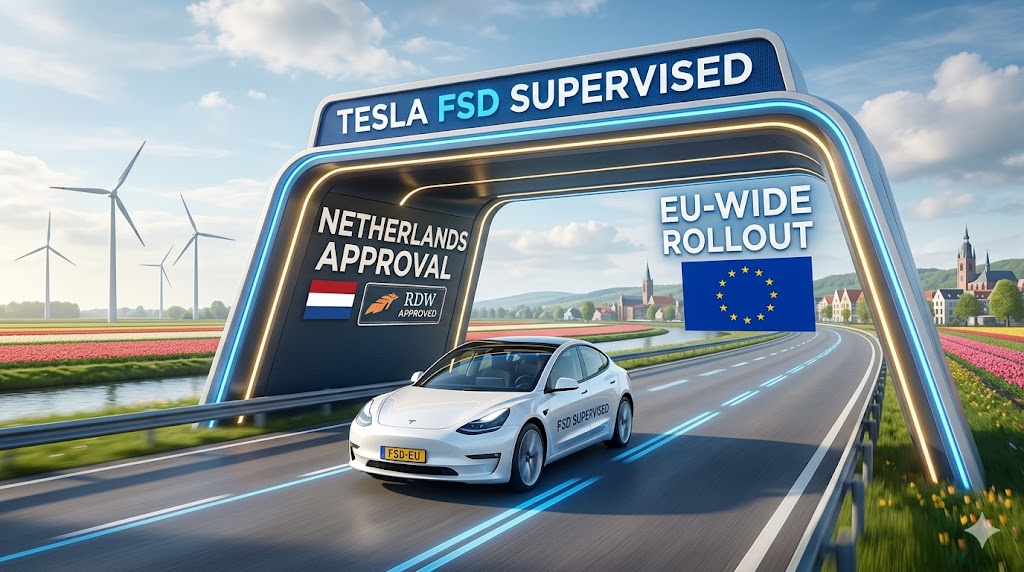
On April 10, 2026, the Dutch vehicle authority RDW (Rijksdienst voor het Wegverkeer) granted Tesla a type approval for its Full Self-Driving (Supervised) system, making the Netherlands the first European country to authorize Tesla's semi-autonomous technology for use on public roads. The approval, announced via Tesla's European X account, arrived after more than eighteen months of rigorous testing and marked a watershed moment for Tesla's European strategy. "FSD Supervised has been approved in the Netherlands & will begin rolling out in the country shortly!" Tesla declared. "No other vehicle can do this."
The significance of this milestone cannot be overstated. For years, European Tesla owners have watched their American counterparts navigate city streets hands-free while their own vehicles remained limited to basic Autopilot functionality on highways. The regulatory gap between the United States and Europe — rooted in fundamentally different vehicle approval systems — had seemed insurmountable. Now, with the RDW's decision, that barrier has been breached.
Yet the approval also raises important questions. What exactly does FSD Supervised do on European roads? How does it differ from the American version? When will it expand beyond the Netherlands? And perhaps most importantly: is it actually safe? This article examines the Dutch approval in depth, exploring the rigorous testing process, the regulatory framework that governs advanced driver assistance in Europe, the real-world experience of early adopters navigating Amsterdam's notoriously chaotic streets, and what this means for Tesla owners across the continent.
Chapter 1: The Approval — What the RDW Actually Said
The RDW's type approval for Tesla's driver assistance system represents the culmination of an exhaustive evaluation process. The agency confirmed that FSD Supervised had been "extensively examined and tested for more than one and a half years on our test track and on public roads." The testing program encompassed over 1.6 million kilometers driven on European Union roads, more than 13,000 customer ride-alongs, and over 4,500 track test scenarios. Tesla submitted documentation covering more than 400 compliance requirements under UN R-171 and Article 39 exemptions.
Crucially, the RDW's announcement emphasized what FSD Supervised is not. "A vehicle with FSD Supervised is not self-driving," the agency stated unequivocally. "It is a driver assistance system, which means that the driver remains responsible and must always remain in control." The system falls under UN R-171, the regulation governing Driver Control Assistance Systems (DCAS), which establishes strict requirements for how such systems must monitor driver attention and respond to potential misuse.
The RDW's description of driver monitoring is particularly detailed. When FSD Supervised is enabled, various sensors monitor whether the driver's eyes are on the road and whether their hands are available to take over the steering wheel. Hands do not have to rest on the steering wheel, but they must be able to take over immediately if necessary. If the system detects that the driver is insufficiently attentive, it issues escalating warnings requiring the driver to demonstrate attentiveness. It is therefore not permitted or possible to read a newspaper while driving — and if the driver remains consistently inattentive, the system will temporarily disable itself.
The RDW further noted that the FSD Supervised version approved in Europe differs materially from the version operating in the United States. "Europe imposes different and stricter requirements on safety and the environment when vehicles are admitted," the agency explained. "Another difference is that vehicles in Europe use different software versions than vehicles in the US. The software versions and functionalities of US and European cars are therefore not comparable one-to-one."
Safety was explicitly cited as the RDW's "top priority," and the agency concluded that "using driver assistance systems correctly makes a positive contribution to road safety because the driver is supported in their driving tasks; it is a supplement to the driver." This endorsement — from one of Europe's most stringent vehicle authorities — represents a significant validation of Tesla's approach to supervised autonomy.
Chapter 2: European vs. American FSD — Not the Same Software
One of the most important takeaways from the RDW's approval is that European Tesla owners are not simply receiving the same FSD software that American drivers have been using for years. The differences are substantial and stem from fundamentally different regulatory philosophies.
In the United States, vehicle approval operates through a system of self-certification. Manufacturers certify that their vehicles comply with Federal Motor Vehicle Safety Standards, and the National Highway Traffic Safety Administration (NHTSA) exercises oversight after vehicles are already on the road. Europe takes a fundamentally different approach: vehicles require pre-market type approval from designated authorities before they can be sold or, in the case of new software features, activated on public roads.
This distinction explains why FSD Supervised has been available in the United States for years while European approval required eighteen months of intensive testing. The RDW had to verify compliance with UN R-171 and other applicable regulations before issuing its approval — a process with no equivalent in the American system.
The software differences extend beyond regulatory compliance. Tesla has publicly confirmed that European FSD builds are more conservative by default, erring on the side of restraint in ambiguous situations. The European version also implements stricter driver monitoring with more frequent intervention alerts. While the American version offers multiple driving profiles including a more aggressive "Mad Max" mode, the European build adopts a more cautious approach that prioritizes predictable behavior over assertive navigation.
Hands-off driving is permitted on European highways, but drivers must keep their hands available to take over immediately. Auto-turning from stop lights — navigating intersections and handling traffic signals autonomously — is confirmed to be available in the European build, as demonstrated in Amsterdam footage showing the system handling unprotected turns and signalized intersections.
Perhaps the most significant near-term limitation concerns urban driving. Tesla has indicated that full urban FSD scope in Europe will require a separate application, targeted for 2027. The current approval covers a more limited set of urban capabilities compared to what American drivers enjoy.
Subscription pricing has also been confirmed: Tesla charges €99 per month for FSD Supervised in Europe, compared to $99 per month in the United States. The company discontinued one-time FSD purchases in February 2026, moving entirely to a subscription model globally — a shift that makes recurring software revenue increasingly important to Tesla's bottom line.
Chapter 3: The Road to Approval — 18 Months of Testing
The path to European approval was neither quick nor straightforward. The RDW's evaluation spanned more than eighteen months and involved a comprehensive testing regimen that far exceeded what American regulators required.
The testing program included over 1.6 million kilometers of real-world driving on European Union roads — a distance equivalent to circling the Earth approximately forty times. Tesla conducted more than 13,000 customer ride-alongs, gathering feedback on how the system performed in everyday European driving conditions. The company also executed over 4,500 track test scenarios, systematically evaluating the system's response to edge cases and challenging situations.
The regulatory framework governing this process was UN R-171, which establishes requirements for Driver Control Assistance Systems. This regulation mandates that manufacturers educate drivers about system capabilities and limitations to avoid potential "misunderstandings, overestimations, or operational difficulties." FSD activation tutorials must ensure that European drivers understand the system's constraints — a requirement that reflects European regulators' cautious approach to advanced driver assistance technologies.
The approval process encountered delays along the way. Tesla had originally expected Dutch approval by March 20, 2026, but the RDW pushed the timeline back by approximately three weeks. In late March, the RDW even issued a statement pushing back on Tesla's earlier announcements, clarifying that it had not yet completed its review. This episode highlighted the disconnect between Tesla's marketing timeline and the regulator's actual process — a tension that has characterized Tesla's regulatory interactions across multiple jurisdictions.
The RDW ultimately concluded that the system outperformed other driver assistance technologies available in the European market. The agency's thorough approach — evaluating compliance across more than 400 distinct requirements — set a high bar that future applicants will need to meet. The eighteen-month review period may serve as a benchmark for how long European regulators require to evaluate advanced driver assistance systems from other manufacturers.
Chapter 4: Amsterdam's First FSD Test Drives — Cyclists, Canals, and Caution
Within days of the approval, early adopters in the Netherlands began receiving over-the-air updates enabling FSD Supervised on their vehicles. Among the first was Kees Roelandschap, a Tesla enthusiast who had been waiting for this moment since Tesla's Autonomy Day in 2019.
Roelandschap invited Reuters to document one of Amsterdam's first supervised self-driving journeys, navigating the city's narrow canal-side streets amid dense flows of bicycles, trams, and pedestrians. "I've driven multiple different versions in the U.S.," Roelandschap said. "But to be able to experience it firsthand here in the Netherlands — that's unreal."
The footage revealed the system successfully navigating Amsterdam's complex urban environment, handling tram lanes and continuous bicycle traffic along the canals. Roelandschap described the experience as transformative: "I'm smiling every single time when I'm in the car." He added that the European-approved version appeared to have more stringent safeguards than the American equivalent, and he advocated for broader European approval, convinced that the technology would lead to increased road safety and ultimately fewer fatal accidents.
Not everyone shared Roelandschap's enthusiasm. Esther van Garderen, head of the Dutch Cyclists' Union, expressed significant reservations. "Cyclists are flowing through traffic, swarming around, going left and right, crossing each other," she said, emphasizing that the Netherlands presented a unique challenge for self-driving technology. "We're not fully assured that these self-driving cars will understand the road behaviour."
Van Garderen's concerns reflect the Netherlands' distinctive traffic environment. With approximately 23 million bicycles for a population of 18 million, Dutch cities feature infrastructure and traffic patterns that differ fundamentally from American road networks. Cyclists routinely navigate complex intersections, share space with motor vehicles, and follow unwritten rules of movement that human drivers learn through years of experience. Whether Tesla's neural networks — trained predominantly on American driving data — can reliably interpret and respond to Dutch cycling culture remains an open question.
Amsterdam transport alderwoman Melanie van der Horst acknowledged the city's limited role in the regulatory process, noting that Amsterdam had no say in the approval and would monitor the rollout closely. She added, however, that the supervising driver requirement meant "we don't need to panic," and she suggested the technology could ultimately improve road safety. "However, I can definitely imagine that this raises quite a few concerns and reactions," she qualified.
The safety stakes are significant. Road traffic deaths in the Netherlands increased six percent to 759 in 2025, with car-cyclist and car-pedestrian crashes driving the increase. If FSD Supervised can reduce human error in these interactions, it could make a meaningful contribution to road safety. But if the system introduces new failure modes that human drivers must then correct — what Marieke Martens, professor of automated vehicles and human interaction at Eindhoven University of Technology, described as "new errors" that "add an extra task to driving" — the net effect on safety could be ambiguous.
Chapter 5: The Regulatory Path Forward — What Comes Next
The Dutch approval is a critical first step, but it does not automatically extend FSD Supervised to the rest of the European Union. Under EU regulations, other member states can choose to recognize the Dutch type approval nationally, but each country must decide individually.
Tesla has indicated that it anticipates EU-wide recognition of the Dutch approval during summer 2026, which would extend FSD access to Germany, France, and other major markets through a mutual recognition process without each country repeating the full eighteen-month review. Germany's KBA (Kraftfahrt-Bundesamt), France's authorities, and Italy's regulators are expected to be among the first to act, potentially within four to eight weeks of the Dutch announcement.
The timeline depends heavily on regulatory processes in individual countries. Full EU-wide harmonization would require additional steps beyond national recognition. The European Union is scheduled to discuss approving the technology in May 2026, and those discussions will shape the pace of broader European adoption.
Beyond Europe, the Dutch approval could have implications for other markets. A Tesla vice president hinted that the RDW's approval could unlock rollout beyond Europe, suggesting that other countries aligned with UN regulations might accelerate their own approval processes based on the Dutch precedent.
For European Tesla owners outside the Netherlands, the waiting game continues. But the Dutch breakthrough provides a clear roadmap for how FSD Supervised can navigate Europe's complex regulatory landscape. The combination of extensive testing, documented compliance with UN R-171, and demonstrated safety performance creates a template that other European regulators can follow.
Chapter 6: What This Means for European Tesla Owners
For the approximately 100,000 Tesla Model 3 and Model Y vehicles on Dutch roads, FSD Supervised is now available via over-the-air update to eligible vehicles with Hardware 3 or newer. The rollout is expected to expand progressively as Tesla validates the software across its European fleet.
The financial implications are significant for Tesla's broader business strategy. Elon Musk's 2025 CEO compensation package includes a milestone requiring ten million active FSD subscriptions as one condition for his stock awards to vest. Tesla reached one million subscriptions during its Q4 2025 earnings call — a meaningful start but still far from the target. Opening Europe as a market for subscriptions, rather than just hardware sales, directly accelerates progress toward that goal.
European owners should understand several key points about what FSD Supervised can and cannot do. The system can steer, brake, and accelerate without hands on the wheel, navigating city streets and highways while recognizing traffic signals and managing lane changes. But driver supervision is mandatory at all times. The system may require intervention in complex scenarios, and it cannot operate in all weather conditions — notably, Tesla's Robotaxi service in the United States still shuts down during rain.
The European version includes stricter safeguards than the American version, reflecting the RDW's emphasis on safety and driver monitoring. Early users like Roelandschap report that the system performs impressively even in Amsterdam's challenging environment, but they also acknowledge that full urban functionality will require additional regulatory approvals targeted for 2027.
Conclusion
The RDW's approval of Tesla's FSD Supervised system represents a genuine breakthrough for autonomous driving technology in Europe. After years of regulatory uncertainty and waiting, European Tesla owners finally have access to the semi-autonomous capabilities that American drivers have enjoyed since 2021. The eighteen-month testing process, encompassing 1.6 million kilometers of real-world driving and more than 400 compliance requirements, establishes a rigorous benchmark for future advanced driver assistance system approvals in Europe.
For European Tesla owners, the Dutch approval is the moment they have been waiting for — real FSD functionality is finally arriving on European roads. The system's performance in Amsterdam, navigating dense bicycle traffic and narrow canal-side streets, demonstrates that Tesla's neural networks can adapt to European driving conditions. Yet the approval also underscores important limitations: FSD Supervised remains a Level 2 driver assistance system, not full autonomy, and the driver bears ultimate responsibility for safe operation.
The path to EU-wide availability remains uncertain. Mutual recognition across member states is expected during summer 2026, but the timeline depends on individual national regulators and EU-level discussions scheduled for May. Germany, France, and other major markets are likely to follow the Netherlands' lead, but each country will make its own determination.
Perhaps most significantly, the Dutch approval validates Tesla's approach to supervised autonomy under Europe's more stringent regulatory framework. The RDW's explicit finding that the system can make "a positive contribution to road safety" provides regulatory cover for other European countries considering similar approvals. As Kees Roelandschap said from behind the wheel of his Tesla navigating Amsterdam's chaotic streets: "I think this should be approved everywhere in Europe because it will lead to increased safety." The coming months will reveal whether European regulators agree.
FAQ
Q: Is FSD Supervised the same as full autonomy?
A: No. It is a Level 2 driver assistance system that requires constant driver supervision and readiness to intervene. The driver remains legally responsible for vehicle operation at all times.
Q: Which European countries will get FSD next?
A: Tesla anticipates EU-wide recognition of the Dutch approval during summer 2026. Germany, France, and Italy are expected to be among the first countries to follow the Netherlands, but no official timeline exists for each individual nation.
Q: Do I need to purchase FSD to use it?
A: Tesla moved to a subscription-only model in February 2026. European owners can subscribe for €99 per month. One-time purchases are no longer available.
Q: Will FSD work on all roads in Europe?
A: The system is designed for city streets and highways where map data and regulatory approval exist. Full urban FSD scope in Europe requires a separate application targeted for 2027. Rural roads and certain complex intersections may require driver takeover.
Q: How does European FSD differ from U.S. FSD?
A: European versions include stricter safeguards, more conservative driving behavior by default, and more frequent driver monitoring alerts. The software versions and functionalities are not comparable one-to-one, according to the RDW.
Q: Is FSD legal in the United Kingdom?
A: Not yet. The UK has its own regulatory framework separate from the EU. Tesla will need specific UK approval, which may follow EU developments.
Q: How long did the approval process take?
A: The RDW tested the system for more than eighteen months, including over 1.6 million kilometers on EU roads, 13,000 customer ride-alongs, and 4,500 track test scenarios.
Q: What hardware do I need for FSD Supervised?
A: FSD Supervised requires Hardware 3 or newer. Some older vehicles may need upgrades to support the feature.
Q: Can I use FSD Supervised without keeping my eyes on the road?
A: No. The system monitors driver attentiveness through sensors that track eye position. If the system detects inattention, it issues escalating warnings and can temporarily disable itself.
Q: Will Tesla's Robotaxi service launch in Europe soon?
A: The current approval is for supervised FSD only — a Level 2 system requiring a human driver. Full autonomous Robotaxi service (Level 4 or 5) would require separate regulatory approval that has not yet been sought or granted.