
Introduction: The Great Decoupling
For the past decade, the "Tesla Bull Case" was a simple math equation: Price x Volume = Success. However, as we stand on January 23, 2026, that equation has been discarded. Tesla’s Q4 2025 production and delivery report, released just weeks ago, confirmed a harsh reality: total vehicle deliveries for 2025 fell to 1.636 million units, an 8.6% year-over-year decline.
Yet, despite this automotive contraction, Tesla’s market valuation remains resilient. Why? Because the company is undergoing a "Great Decoupling." For the first time, Tesla’s financial health is being driven not by the number of steering wheels shipped, but by the gigawatt-hours of energy deployed and the millions of miles driven on FSD. This article provides a comprehensive post-mortem of 2025 and a strategic forecast for the "Software-First" Tesla of 2026.
Chapter 1: The Automotive Stagnation — A Two-Year Slump
1.1 Analyzing the 2025 Delivery Deficit
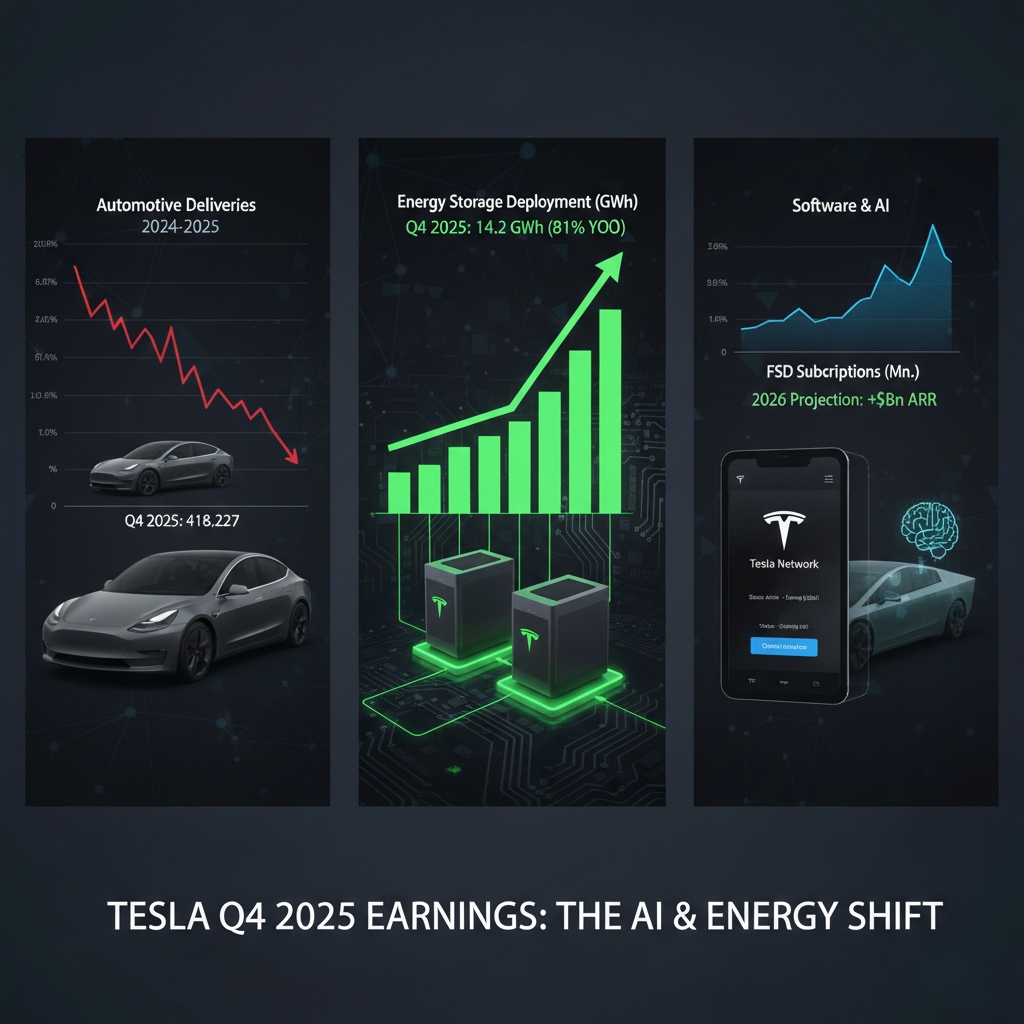
Tesla’s automotive division faced its most challenging year to date in 2025. The Q4 figures—418,227 deliveries—were not just below analyst expectations; they marked the second consecutive year of shrinking annual volume.
-
The European Challenge: Sales in Europe plummeted nearly 28% in 2025. The aging Model 3 and Model Y lineup struggled against fresh competition from European incumbents and aggressive Chinese exports.
-
The China Factor: In Greater China, Tesla has officially lost its crown as the top-selling EV brand to BYD. Market share erosion has reached a critical point where price cuts no longer trigger the same demand elasticity they did in 2023.
1.2 The "Aged Fleet" Problem
Critics argue that Tesla’s lack of new models between the Cybertruck and the upcoming "Redwood" platform created a product vacuum. While the "Juniper" Model Y refresh helped stabilize Q4 in North America, it wasn't enough to offset the global cooling of EV demand.
Chapter 2: Energy Storage — The Silent Powerhouse
2.1 The 14.2 GWh Record
While the headlines focused on cars, the Energy division quietly stole the show. In Q4 2025, Tesla deployed a staggering 14.2 GWh of energy storage—an 81% year-over-year increase.
-
Annual Scale: Total 2025 deployments reached 46.7 GWh, a 49% increase over 2024.
-
Margin Superiority: The energy segment is now operating with gross margins significantly higher than the automotive division (estimated at 25-30% vs. 15-18% for cars).
2.2 Megapack as the Primary Growth Engine
The ramp-up of the Lathrop Megafactory and the synchronization of Giga Shanghai’s energy production have allowed Tesla to dominate the utility-scale storage market. For investors, this segment is now a "financial stabilizer." When car sales drop due to high interest rates, the long-term, multi-billion dollar contracts of the Energy division provide a predictable cash flow floor.
Chapter 3: The Software Pivot — FSD as the Margin Savior
3.1 The $99 Subscription Strategy
On February 14, 2026, Tesla will officially kill the $8,000 one-time FSD purchase option, moving to a subscription-only model. This is a masterclass in SaaS (Software as a Service) economics.
-
Recurring Revenue: By shifting to $99/month, Tesla builds a "sticky" revenue stream that scales with every car ever produced.
-
Lowering the Barrier: An owner who wouldn't pay $8,000 upfront is much more likely to "try" FSD for $99 during a road trip month.
3.2 Robotaxi and the Austin Pilot
Today’s most discussed rumor in Davos and Austin is the success of the "Unsupervised" Robotaxi pilot. With 41 billion miles of data now fed into the Dojo supercomputer, Tesla is preparing to prove that its software is no longer a "feature," but a "driver." Analysts expect the Jan 28 earnings call to provide the first specific revenue breakdown for "autonomous miles driven" on the Tesla Network.
Chapter 4: Financial Mechanics — Cash Flow vs. CAPEX
4.1 The $41 Billion War Chest
Despite a 31% drop in EPS (Earnings Per Share) throughout 2025, Tesla ended the year with over $41 billion in cash and investments. This liquidity is critical. While traditional automakers are scaling back EV investments to preserve cash, Tesla is doubling down on:
-
AI Infrastructure: Massive spending on H100/H200 clusters.
-
Optimus Development: Transitioning the humanoid robot from prototype to "factory-helper" status.
4.2 Operating Margins: The 5.8% Floor?
Investors will be laser-focused on whether operating margins have finally "bottomed out." The contraction to 5.8% in Q3 was a shock. For Q4, the expectation is that record Energy deployments and lower raw material costs (Lithium) will help pull margins back toward the 8-9% range, even with lower car volumes.
Conclusion: The "AI-First" Valuation
As we head into the January 28 earnings announcement, the consensus is clear: Tesla is no longer an auto company. It is an AI and Energy conglomerate that happens to use cars as a data-collection and distribution mechanism. The 2025 delivery decline was a painful but necessary "right-sizing" that forced the company to find more profitable, scalable revenue streams in software and grid-scale batteries.
For the European and US owner, this means your car is becoming a node in a much larger energy and intelligence grid. The "Software Pivot" isn't just a corporate strategy—it's the future of the brand.
FAQ: Investor and Owner Insights
Q: Why are Tesla deliveries down when the EV market is supposedly growing? A: High interest rates and an aging product lineup (Model 3/Y) have slowed consumer demand. However, Tesla’s focus has shifted toward maximizing "profit per vehicle" through FSD rather than "volume at any cost."
Q: Is the Energy division really big enough to matter? A: Yes. At 46.7 GWh annually, the Energy division is expected to contribute nearly 15-20% of Tesla’s total profit in 2026, up from less than 5% two years ago.
Q: What should I look for in the January 28 earnings call? A: Watch for two things: 1) Guidance on "Project Redwood" (the $25k car) and 2) Updates on the take-rate of the new FSD subscription model.