
Introduction: The Unboxing of a Revolution
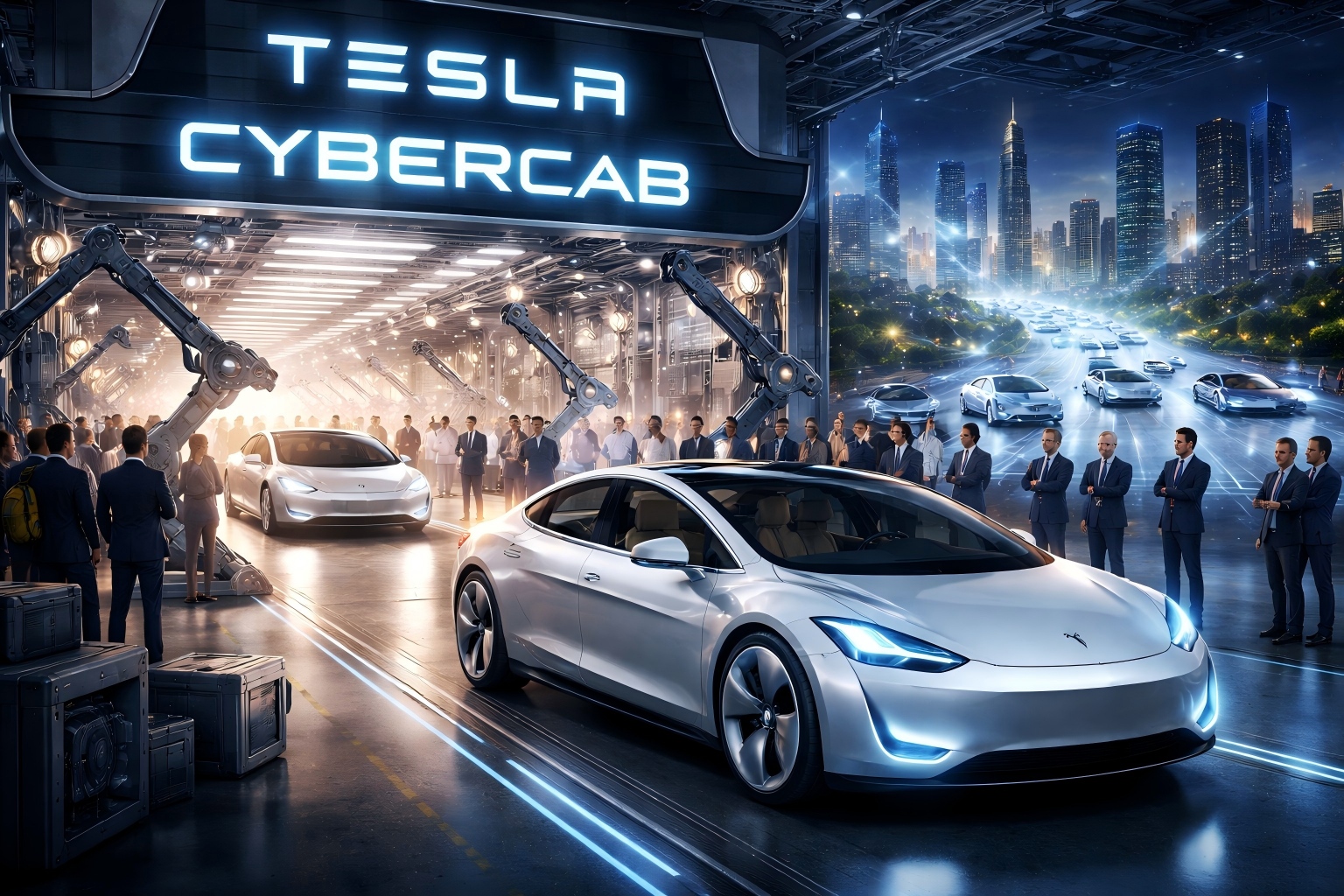
On February 18, 2026, a photograph surfaced from the depths of Gigafactory Texas. It depicted a small group of Tesla employees gathered around a vehicle unlike any that had come before it. The vehicle was low-slung, aerodynamic, and featured a distinctive two-seater silhouette. But what drew the eye was what was missing: a steering wheel. This was the first mass-produced Tesla Cybercab, a milestone that CEO Elon Musk marked with a simple post on X, congratulating his team. With that image, Tesla crossed the threshold from visionary concept to tangible reality, setting the stage for a mass production launch scheduled for April 2026. This is not merely the launch of a new car model; it is the opening salvo in a bid to fundamentally restructure the trillion-dollar transportation industry.
Chapter 1: Deconstructing the Cybercab: A Vehicle Born for Autonomy
1.1 Design Philosophy: Form Follows Function (of Autonomy)
The Cybercab is a physical manifestation of a single, uncompromising design principle: optimization for autonomy. Every line, every component, every material choice is dictated by the goal of creating the most efficient, durable, and cost-effective robotaxi possible. Its two-seater configuration is a deliberate choice based on data. Analysis of ride-hailing trips in major cities reveals that the vast majority—well over 70 percent—are for single individuals or pairs. Why build a vehicle with five seats, with all the associated weight, size, and cost, when four out of five of those seats will remain empty for most of its operational life? The Cybercab is ruthlessly efficient, designed to match the mission profile of a robotaxi perfectly.
The exterior design, with its futuristic, Cyberpunk-esque aesthetic, is not just for show. It is sculpted for maximum aerodynamic efficiency, which directly translates to extended range and lower operating costs. The interior is a study in minimalist passenger focus. Without a driver, there is no need for a traditional dashboard, instrument cluster, or center console oriented toward a driver. Instead, passengers are greeted by a spacious cabin dominated by a large central screen for entertainment, communication, and summoning vehicle information. The absence of a steering wheel and pedals is not a gimmick; it is a declaration of intent, freeing up space and fundamentally redefining the relationship between the passenger and the machine.
1.2 Technology Core: Built Around AI5
The Cybercab is the first vehicle designed from the ground up to be the physical host for Tesla's next-generation AI5 computer. While current vehicles are retrofitting autonomous capabilities onto a platform designed for a human driver, the Cybercab's every system is integrated with the AI5 at its core.
-
Sensor Fusion: The camera suite is optimized for the vehicle's operational design domain, with placements and fields of view chosen specifically for the demands of urban robotaxi service.
-
Thermal Management: A robotaxi is expected to be in near-constant operation, shuttling passengers for 12, 16, or even 20 hours a day. This generates immense heat from the batteries, motors, and especially the onboard computers. The Cybercab's thermal management system is engineered for this grueling duty cycle, ensuring consistent performance and longevity in a fleet vehicle.
-
Redundancy: True autonomy requires redundancy. The Cybercab features redundant braking, steering, and power systems, ensuring that if one component fails, another can instantly take over, allowing the vehicle to safely navigate to the side of the road or complete its journey.
1.3 The Passenger Experience
Stepping into a Cybercab is an experience designed to be both futuristic and calming. The focus is on creating a private, comfortable, and productive mobile space.
-
The Interface: Passengers will likely summon and interact with the vehicle through a dedicated Tesla Network app. Once inside, the central screen becomes the command center, allowing passengers to confirm their destination, control the climate, listen to music, watch movies, or browse the web.
-
Amenities: Rumors and patents suggest the Cybercab could be equipped with inductive smartphone charging, premium audio, and even automated cleaning systems that can disinfect the interior between rides, a feature whose importance was underscored by the global pandemic.
Chapter 2: The "Unboxed" Process: Reinventing Manufacturing for the 21st Century
2.1 Moving Beyond the Assembly Line
For over a century, car manufacturing has been dominated by the moving assembly line, a process pioneered by Henry Ford. In this linear model, a bare chassis starts at one end of the factory and moves through a long, sequential line where parts are added one by one. It is a proven system, but Tesla believes it is fundamentally inefficient and ill-suited for the age of electric, software-defined vehicles.
Enter the "unboxed" manufacturing process, a radical rethinking of vehicle assembly that Elon Musk has championed for years. The core idea is to move away from a linear sequence and toward a parallel one. Instead of a single assembly line, the factory is divided into several dedicated zones, each responsible for building a major sub-assembly of the vehicle. For the Cybercab, these zones would likely produce:
-
The front section (containing the frunk and front suspension).
-
The rear section (containing the rear motor and suspension).
-
The structural battery pack (which forms the floor of the vehicle).
-
The left and right side panels (incorporating the doors and body sides).
-
The interior cabin module (pre-assembled with seats, screen, and headliner).
2.2 The Advantages of Parallel Production
These sub-assemblies are built simultaneously in their respective zones. Only at the very end of the process are they brought together in a final, high-speed "marriage" station where the battery pack is mated to the front and rear sections, the sides are attached, and the interior module is dropped in. This approach offers profound advantages :
-
Reduced Factory Footprint: By eliminating the long, linear assembly line, the factory itself can be significantly smaller for the same output, reducing capital expenditure.
-
Increased Production Speed: Because multiple sections are built simultaneously, the overall time to produce a vehicle is dramatically reduced. Musk has hinted at the goal of a production line capable of completing a vehicle every 10 to 30 seconds, a rate that would dwarf current automotive standards.
-
Lower Labor and CapEx Costs: A smaller, more automated factory with higher throughput translates directly to lower cost per vehicle. This is critical for the Cybercab, which needs to be inexpensive to manufacture to make the economics of a robotaxi fleet work.
2.3 Synergy with Gigacasting
The "unboxed" process works in perfect synergy with Tesla's other manufacturing innovation: gigacasting. Using the world's largest casting machines, Tesla can produce large, complex sections of the vehicle—like the entire front or rear underbody—as single, massive aluminum parts. This replaces what would traditionally be dozens or even hundreds of stamped steel parts that need to be welded together. For the Cybercab, this means:
-
Reduced Parts Count: The vehicle's structural components are reportedly reduced from around 200 individual parts to just 80.
-
Lower Weight: Aluminum gigacastings are lighter than the steel assemblies they replace, contributing to improved range and efficiency.
-
Greater Structural Rigidity: A single, large casting is inherently stiffer than a welded assembly of smaller parts, improving handling and safety.
Chapter 3: Navigating the Regulatory Maze
3.1 The Federal Hurdle in the United States
The technological marvel of the Cybercab is meaningless without the regulatory approval to operate it. In the United States, the path to deployment is a two-level game involving both federal safety standards and state-level operational permits. The most immediate hurdle is federal. Current Federal Motor Vehicle Safety Standards (FMVSS) explicitly require vehicles to be equipped with manual controls, including a steering wheel and brake pedal. To deploy a vehicle that lacks these features, Tesla must petition the National Highway Traffic Safety Administration (NHTSA) for an exemption. This is a slow, painstaking process that requires Tesla to demonstrate, with copious amounts of data, that its vehicle is as safe as or safer than a conventionally equipped one.
3.2 State-Level Operations: A Patchwork of Rules
Beyond the federal exemption, Tesla must also navigate the varying regulatory landscapes of individual states where it wishes to operate a robotaxi service.
-
California: This is a key market, but also a challenging one. The California Department of Motor Vehicles (DMV) and the Public Utilities Commission (CPUC) have established frameworks for autonomous vehicle testing and deployment, currently requiring permits for both testing with a safety driver and driverless deployment. Notably, recent reporting has highlighted that while Tesla holds a permit for testing with a safety driver, it has not yet applied for the more advanced driverless deployment permit, and its reported testing mileage in the state has been minimal. This suggests that the initial commercial rollout of the Cybercab as a fully driverless service may prioritize other states.
-
Texas: As the home of Gigafactory Texas and the site of Tesla's engineering headquarters, Austin is the logical epicenter for early operations. Texas has historically taken a more permissive, "hands-off" approach to autonomous vehicle regulation, making it an ideal testing ground for the initial Cybercab fleet. Tesla is already conducting driverless testing in Austin with Model Y vehicles, laying the groundwork for the Cybercab's arrival.
3.3 The European Front: A Breakthrough on the Horizon
For Tesla owners and enthusiasts in Europe, the news is cautiously optimistic. In a recent internal interview with Berlin Gigafactory employees, Elon Musk provided a significant update on regulatory progress. He stated that authorities in the Netherlands, a key country for type approval within the European Union, have indicated that approval for Tesla's Full Self-Driving (Supervised) software could come as early as March 20, 2026 . This is a critical first step.
-
The Path to Unsupervised FSD: An initial approval would likely be for a version of FSD (Supervised), which still requires a driver to remain attentive. However, it opens the door for data collection and validation in the European market.
-
Mutual Recognition: Once approved in one EU member state, the approval benefits from a mechanism of mutual recognition, potentially allowing for a faster rollout across the entire bloc. Musk has expressed confidence that the level of sophistication offered by Tesla's system will "shock" European drivers and regulators, paving the way for the eventual approval of fully unsupervised FSD and the deployment of the Cybercab in European cities.
Chapter 4: From Pilot to Fleet: The State of Tesla's Robotaxi Operations
4.1 The Austin Beta: Learning in the Wild
Even as the Cybercab prepares for production, Tesla is already operating a small fleet of robotaxis in its own backyard. Using modified Model Y vehicles, the company has initiated driverless testing and limited rides for employees in select areas of Austin, Texas. This pilot program is not about generating revenue; it is a crucial learning laboratory. Every mile driven by these test vehicles generates data that is fed back into the neural network, refining its behavior and improving its ability to handle the complex, chaotic, and unpredictable scenarios of real-world urban driving. As of early January 2026, it was estimated that Tesla had approximately 40 vehicles operating in this capacity in Austin, alongside a small fleet in California. The key metric to watch will be the expansion of this fleet size. A rapid scale-up to hundreds or thousands of vehicles would be a powerful signal that the technology is maturing as expected.
4.2 The Economic Case for Robotaxi
The entire Cybercab project is underpinned by a compelling economic equation. By eliminating the driver, who accounts for the majority of the cost in a traditional ride-hail service (Uber, Lyft), Tesla believes it can offer transportation at a fraction of the current price. The target is to achieve an operating cost of below $0.20 per mile .
-
High Utilization: A privately owned car is parked and unused for approximately 95 percent of its life. A robotaxi, in contrast, could be in service for 50 to 60 hours per week, dramatically increasing its utilization rate .
-
Lower Manufacturing Cost: The "unboxed" process and gigacasting are designed to bring the manufacturing cost of the Cybercab down to the $25,000-$30,000 range . This low capital cost, combined with high utilization and no driver, creates a path to profitability at price points that would be impossible for human-driven services.
-
The Tesla Network: The long-term vision, often referred to as the Tesla Network, is for owners of future Teslas equipped with full autonomy to be able to add their personal vehicles to the robotaxi fleet when they are not using them . This would create a hybrid model where Tesla operates its own dedicated Cybercab fleet in dense urban cores, supplemented by a vast, distributed fleet of privately owned vehicles in the suburbs and surrounding areas.
4.3 The Road Ahead: A Timeline for 2026
Based on the latest statements from company leadership, a tentative timeline for the Cybercab rollout is beginning to emerge .
-
April 2026: Mass production of the Cybercab is scheduled to begin at Gigafactory Texas .
-
Late 2026: The initial production run will likely be used to expand Tesla's own robotaxi fleet, first in Austin and then potentially in other permissive US markets. Elon Musk has stated his expectation that the robotaxi service will become "very, very widespread" across the US by the end of the year .
-
Late 2026 / Early 2027: If European FSD approval is secured, we could see the start of validation and testing in select European cities, though a full-scale Cybercab deployment in Europe is likely a 2027 event.
Conclusion: Steering Toward an Autonomous Horizon
The first Cybercab rolling off the line at Gigafactory Texas is more than just a manufacturing milestone; it is a tangible symbol of a paradigm shift. It represents the culmination of years of work in artificial intelligence, battery technology, and manufacturing innovation, all focused on a single, audacious goal: to make transportation a utility, as accessible and affordable as turning on a tap. The challenges that remain are substantial. Regulatory approvals in the US and Europe are not guaranteed. The technology, while rapidly improving, must prove its safety and reliability across millions of miles in diverse and unpredictable conditions. The manufacturing ramp for the "unboxed" process, with its radical new approach, is fraught with the potential for the same production hell that Tesla has navigated in the past.
Yet, the direction of travel is now unmistakable. The Cybercab is not a concept car or a distant promise. It is a production vehicle, with a factory tooling up to build it. The first tentative robotaxi rides are already happening in Austin. The regulatory doors are beginning to creak open in Europe. For the first time, the driverless future has a scheduled departure time. Whether you are an investor betting on the future of mobility, a city planner preparing for a new mode of transport, or simply a driver eagerly awaiting the day you can let the car take the wheel, the Cybercab is a story you can no longer afford to ignore. The autonomous era is no longer coming; it is here, and it is being unboxed in Texas.