
Chapter 1: The Cybertruck AWD Waitlist Surge and the 2027 Bottleneck
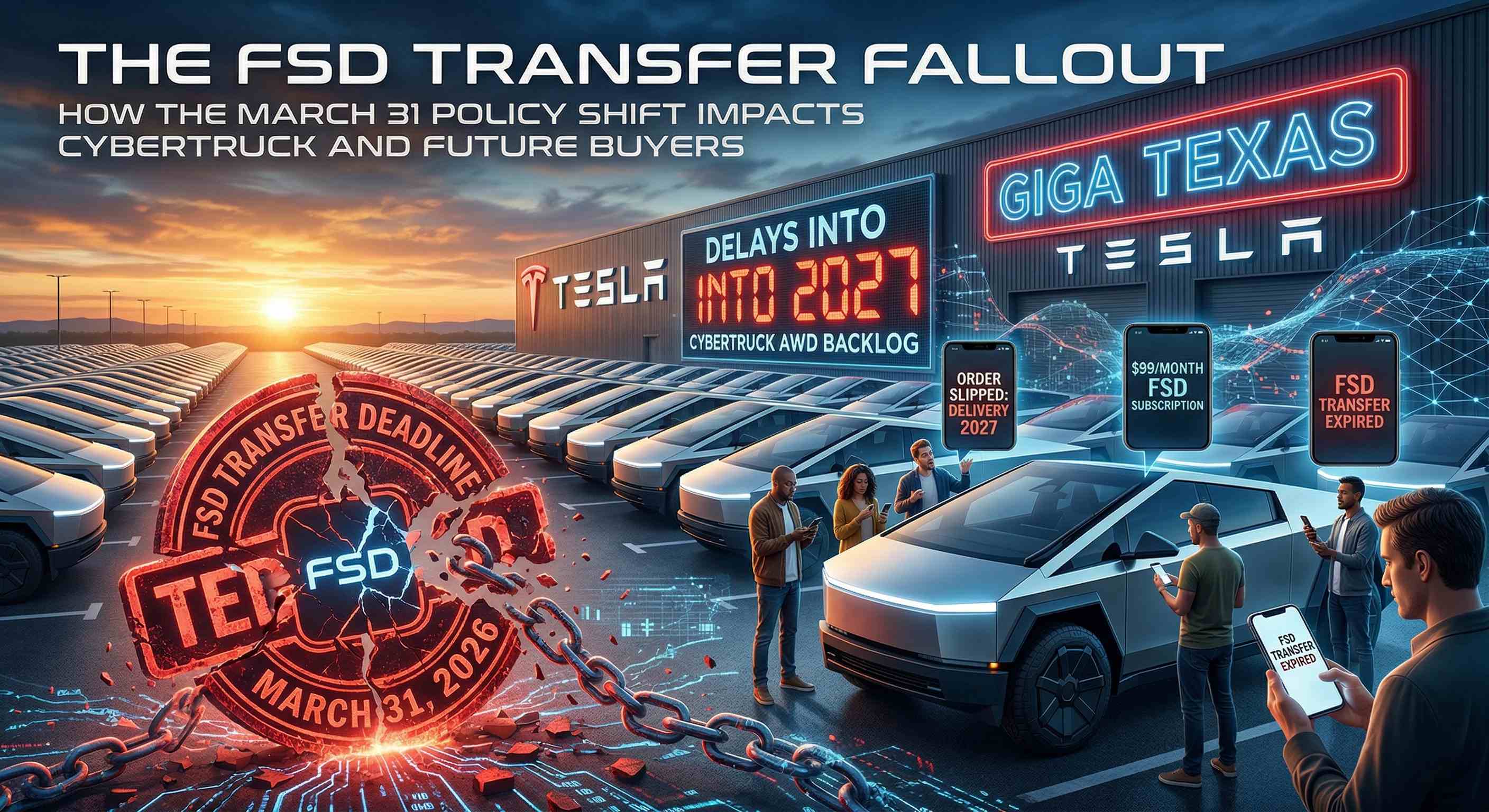
To understand the magnitude of the March 31 deadline, one must look at the vehicle that generated the most desperation: the Cybertruck. Early 2026 marked the transition period where Tesla finally began winding down the ultra-expensive "Foundation Series" Cybertrucks and began inviting early reservation holders to configure the standard All-Wheel Drive (AWD) models.
For thousands of Model 3 and Model S owners who had purchased FSD years ago, this was the moment they had been waiting for. The strategy was clear: configure the standard Cybertruck AWD and transfer the grandfathered FSD license over, saving $12,000 in the process.
When Tesla announced that the FSD transfer policy would permanently expire at the end of Q1 2026, it triggered a massive, concentrated wave of Cybertruck configurations. Buyers who were perfectly happy waiting another six months suddenly rushed to lock in their orders to beat the deadline.
The Production Reality Check The surge immediately overwhelmed the production ramp-up at Giga Texas. While the "unboxed" manufacturing process has improved efficiency, scaling the 4680 battery cell production and the massive Gigapress castings still dictates the speed of the assembly line. The influx of tens of thousands of forced orders in February and March created an insurmountable backlog.
Consequently, delivery estimates for the Cybertruck AWD, which were previously hovering around late 2026, were unceremoniously pushed back. For a significant portion of buyers who configured their trucks in the final weeks of March, their estimated delivery dates have now slipped to April 2027 or later. This massive delay is not just an inconvenience; it ties directly into the most controversial aspect of the policy shift, which we will explore in the next chapter.
Chapter 2: The Silent Fine Print Change and Customer Backlash
The core of the current consumer outrage does not stem from the expiration of the program itself, but rather how Tesla enforced it. In previous iterations of the FSD transfer promotion, Tesla operated on an "order date" basis. If a customer placed their non-refundable order deposit before the deadline, Tesla honored the transfer, regardless of how long the factory took to build and deliver the car.
In Q1 2026, the legal framework of the offer was quietly, but significantly, altered.
Delivery vs. Order The updated terms of service explicitly stated that the customer must take physical delivery of the new vehicle by March 31, 2026, to qualify for the FSD transfer.
This created a logistical nightmare and a massive conflict of interest. Buyers did their part: they placed orders in January and February, well ahead of the deadline. However, due to Tesla's own production bottlenecks, logistics issues, and the aforementioned Cybertruck surge, thousands of vehicles simply were not transported to delivery centers in time.
As March drew to a close, a palpable panic spread across Tesla forums and social media. Customers were watching their delivery apps daily, watching their delivery dates slip from "March 28-31" to "April 2-15." When April 1 arrived, those customers found that their FSD transfer eligibility had been wiped from their accounts. They were suddenly faced with a difficult choice: take delivery of the new car without FSD, pay the current market rate to add it back, or forfeit their order fee entirely.
The Fallout This enforcement mechanism severely damaged consumer goodwill. From a legal standpoint, Tesla is fully protected by the Terms and Conditions that buyers clicked to accept. However, from a customer relations standpoint, penalizing buyers for the automaker's own logistics failures is a stark departure from the user-friendly ethos Tesla championed in its early days. It signifies a maturation of the company into a traditional corporate entity, prioritizing quarterly financial boundaries over individual customer experiences.
Chapter 3: The End of "Purchased Outright" FSD and the SaaS Pivot
Why was Tesla so rigid about the March 31 deadline? The answer lies not in vehicle manufacturing, but in Wall Street valuation and software economics. Tesla is aggressively pivoting away from the model of selling FSD as a lump-sum, outright purchase. The era of buying FSD for $12,000 or $15,000 is effectively over, replaced entirely by the $99/month subscription model introduced universally.
The Economics of Recurring Revenue To understand this pivot, we have to look at how investors value software companies versus hardware companies. Hardware sales (selling cars) generate one-time revenue with fluctuating profit margins. Software-as-a-Service (SaaS) generates predictable, recurring, high-margin monthly revenue. By forcing users off the "lifetime" license model and onto a monthly subscription, Tesla vastly improves its SaaS metrics.
Let’s break down the mathematics for the consumer and the company: If an owner keeps their Tesla for 10 years, a $99 monthly subscription totals exactly $11,880. This is remarkably close to the old $12,000 outright purchase price. However, the subscription model fundamentally changes the psychology of the purchase.
-
Lower Barrier to Entry: A $12,000 upfront cost was prohibitive for a massive percentage of buyers. At $99 a month, the take-rate (the percentage of owners who opt-in) skyrockets.
-
Flexibility: Owners can subscribe for road trip months and cancel during months they only commute locally.
-
The Valuation Multiplier: For Tesla, securing millions of users paying $99 a month transforms their balance sheet, providing a stable cash flow that insulates the company against the cyclical nature of auto sales and global economic downturns.
The end of the FSD transfer was the necessary surgical cut to permanently detach the legacy "owners" of the software and force the entire ecosystem into the subscription paradigm moving forward.
Chapter 4: Market Variations: US vs. Europe & The Secondary Market
The ripple effects of this policy shift are not uniform globally; they vary wildly between the United States and the European Union, and they have caused immediate turbulence in the used EV market.
The European Equation In the United States, where FSD v14.3 is highly capable and operates with relatively few restrictions, justifying a $99/month subscription is becoming easier for the average consumer. The value proposition is clear.
In Europe, however, the dynamic is vastly different. As discussed in our previous coverage, European regulators (UNECE) currently restrict many of FSD's most advanced features. European owners are essentially paying for a heavily nerfed version of the software. When the FSD transfer program ended, European owners with grandfathered FSD on older Model 3s found themselves in a bind. Upgrading to a new Model Y means losing their FSD and being asked to pay €99/month for software that legally cannot perform at its full potential on European roads yet.
Consequently, the end of the transfer program has actively disincentivized European owners from upgrading their vehicles in Q2 2026. Many are choosing to hold onto their older cars until the UNECE DCAS regulations are finalized, waiting for the software to match the subscription price tag.
Turmoil in the Secondary Market The used Tesla market has been thrown into a state of confusion. Historically, a used Tesla sold via a private party retained its FSD license, making an older vehicle highly valuable. If you sold your car back to a third-party dealer, however, Tesla would often strip the FSD license before the car was resold.
With the definitive end of transfers, the value of FSD on the secondary market is plummeting. Because any prospective buyer of a used Tesla can simply subscribe to FSD for $99 a month, they are no longer willing to pay a $5,000 to $8,000 premium to buy a used car that has the software permanently unlocked.
Used car valuations for 2019-2022 Model 3s and Model Ys with outright FSD purchases dropped by an average of 12% in the first week of April 2026. Early adopters are realizing that the expensive software package they bought years ago is now essentially a sunk cost with near-zero resale value, further solidifying the dominance of the new subscription era.
Conclusion
The expiration of the FSD transfer program on March 31, 2026, will be remembered as a watershed moment in Tesla’s history. It was the day the company definitively severed ties with its startup-era hardware strategies and fully embraced its identity as a global software provider.
While the chaotic execution and stringent "delivery date" fine print left a bitter taste for many—particularly those caught in the Cybertruck production backlog—the strategic intent is clear. The $99 monthly subscription democratizes access to advanced autonomy, lowers the upfront cost of vehicle ownership, and provides Tesla with the massive, recurring revenue stream required to fund the next decade of AI development. For the consumer, the rules of Tesla ownership have fundamentally changed: you own the hardware, but the brain of the car is now securely on a lease.
Frequently Asked Questions (FAQs)
Q1: I ordered my Model Y in February, but Tesla couldn't deliver it until April 3rd. Is there any appeals process to get my FSD transferred? A: Officially, Tesla customer service has stated that there are no exceptions to the March 31 delivery deadline. Some owners on community forums have reported limited success escalating the issue to regional delivery managers if the delay was demonstrably due to a vehicle defect discovered during pre-delivery inspection, but these cases are exceedingly rare. Prepare to transition to the $99/month subscription.
Q2: Does the end of FSD transfers apply to Free Unlimited Supercharging as well? A: As of April 2026, Tesla has also discontinued the promotions that allowed early Model S and Model X owners to transfer their SC01 (Free Unlimited Supercharging for life) codes to new vehicle purchases. Both legacy perks have been sunsetted simultaneously to normalize the fleet's revenue metrics.
Q3: If I buy a used 2023 Tesla from a private seller that has FSD purchased outright, will Tesla remove it when the car changes accounts? A: Generally, no. If a vehicle was purchased with FSD outright, that license remains with the VIN during private party sales. Tesla typically only strips the FSD license if the vehicle passes through an official Tesla trade-in program or certain affiliated wholesale auctions. However, the premium you should pay for that feature is now heavily capped by the availability of the $99 subscription.
Q4: Will European owners get a discounted subscription rate until regulations allow full FSD features? A: Currently, Tesla has not announced regional pricing adjustments based on regulatory feature restrictions. The €99 equivalent remains the standard across major European markets, which continues to be a point of friction for EU consumer advocacy groups pushing for feature-parity pricing.
Q5: How does this affect my Cybertruck reservation if my delivery slipped to 2027? A: If you were banking on transferring FSD to offset the cost of your Cybertruck, that option is gone. You will need to factor the $99/month subscription into your long-term cost of ownership when your configuration is finally ready for delivery next year.