
Introduction
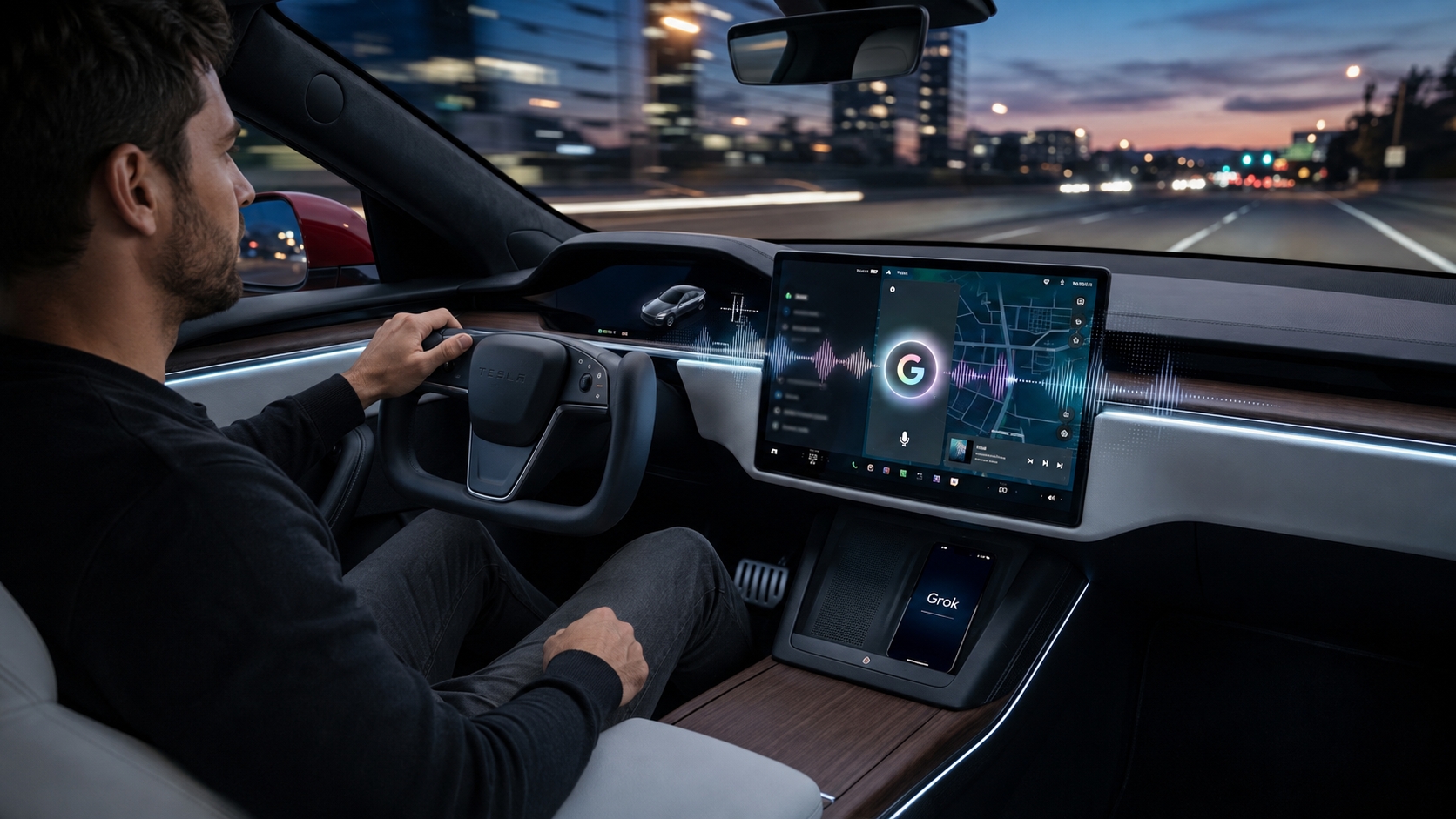
Tesla’s software ecosystem has undergone a significant architectural shift with the rollout of the 2026 vehicle firmware series. The integration of large language model intelligence through "Hey Grok" marks the end of scripted, rigid voice recognition systems, transforming the vehicle cabin into an intuitive conversational workspace. Paired with spatial routines and expanded telemetry access, Tesla's latest OS offers one of the most capable computing environments on wheels.
The Architecture of "Hey Grok"
Unlike legacy voice systems that required strict syntax matching, the Grok voice agent understands natural, conversational speech and multi-part instructions.
-
Hybrid Execution Stack: Commands affecting physical vehicle controls (e.g., climate temperature, defrosters, seat heaters, glovebox) are processed locally by the AMD Ryzen infotainment processor for zero-latency execution. Contextual queries (e.g., general knowledge, route planning summaries, business hours) route through secure cloud inference pipelines.
-
Conversational Context Memory: Drivers can issue follow-up commands without repeating context (e.g., "Navigate to the closest grocery store on our route" followed by "Find one that has an organic bakery").
-
Location-Based Task Reminders: Drivers can set spatial reminders directly through voice, such as "Remind me to grab the parcel when I arrive home". The vehicle uses geofencing to trigger notifications precisely upon arrival.
Vision and Telemetry Unlocked: The New Camera Preview Engine
Software update 2026.20+ introduced major improvements to vehicle camera access. Drivers and passengers are no longer restricted to viewing camera feeds only in reverse or within service diagnostic modes.
Privacy, Security, and Compliance
With in-cabin microphones and cameras continuously active for voice activation, data privacy is a central concern for European and North American owners:
-
GDPR and Data Isolation: For European vehicles, all conversational audio files processed in the cloud are anonymized and separated from the vehicle's unique VIN.
-
Microphone Hardware Gating: The "Hey Grok" wake-word engine operates on a local cache loop that does not stream audio to external servers until the wake-phrase is locally authenticated.
-
User Control Toggles: Owners can disable natural language voice processing or restrict Grok exclusively to local navigation commands through the vehicle safety settings.
Conclusion
By unifying conversational AI with deep vehicle telemetry, Tesla has set a new standard for in-car user experience. The 2026 OS updates prove that software capabilities remain one of the primary differentiators of the Tesla ownership experience, turning daily commutes into connected, highly automated journeys.
Frequently Asked Questions (FAQ)
Q: Does "Hey Grok" require an active Premium Connectivity subscription?
A: Basic vehicle control commands operate offline without a data plan. However, conversational web search, location business inquiries, and generative responses require an active Wi-Fi connection or Tesla Premium Connectivity.
Q: Can older Teslas with Intel Atom processors run Grok?
A: Vehicles built prior to roughly 2022 with Intel Atom (MCU2) processors have limited UI capability and do not support on-board LLM acceleration. Grok voice capabilities are exclusive to vehicles with AMD Ryzen infotainment processors.
Q: Can Grok adjust Autopilot or FSD driving speeds?
A: For safety and regulatory compliance, conversational AI cannot alter fundamental safety-critical driving inputs like steering angle or target speeds; these remain controlled via physical scroll wheels and driver input stalks.