
Introduction
In August 2026, Tesla crossed a threshold that many observers thought was years away. The company began producing its Optimus humanoid robot at the Fremont factory, repurposing the former Model S and Model X assembly lines into the first production site for a product that Elon Musk says will drive 80 percent of Tesla’s future value.
This is not a small pilot program or a laboratory experiment. Tesla is committing more than $25 billion in 2026 capital spending to robotics and AI infrastructure. The Fremont line targets 1 million robots annually, with Giga Texas slated for even larger output. The company has enlisted TSMC, Samsung, Panasonic, and Micron to build dedicated capacity, while constructing its own “Terafab” chip facility in Austin combining lithography, packaging, and testing under one roof.
But the road to mass production is fraught with challenges. Musk himself has described the manufacturing scaling effort as “the hardest product to scale manufacturing that we’ve ever made at Tesla”. Every component of the robot is new, with no existing supply chain to draw from. Initial production will be “agonizingly slow,” Musk has warned.
II. The Production Milestone
2.1 From Model S/X to Optimus
The story of Optimus production begins with the end of an era. In early May 2026, the last Model S and Model X rolled off Tesla’s Fremont line after 13 years of production. The company then spent four months converting that line for Optimus assembly. The entire transformation from the last car to the first robot took just 46 days—a testament to Tesla’s manufacturing agility.
As of mid-2026, Tesla’s Optimus program holds an estimated 1,000 to 1,200 humanoid robot units deployed across Fremont and Giga Texas. However, the company reports zero external sales and publishes no uptime figures. Musk himself described those units on the Q4 2025 earnings call as “primarily for learning and data collection rather than performing productive tasks”.
2.2 Gen 3: The Production-Ready Version
The robot entering production is the third-generation Optimus—Optimus Gen 3. Gen 3 hand production began on January 21, 2026, with full-body volume manufacturing targeted for late July or August 2026 at Fremont.
The Gen 3 represents the culmination of over three years of development. It is the “production intent” version—the configuration closest to the final mass-market product. Musk confirmed during Tesla’s Q1 2026 earnings call that Optimus production would begin in late July or August, and the company has delivered on that timeline.
2.3 The Fremont Production Line
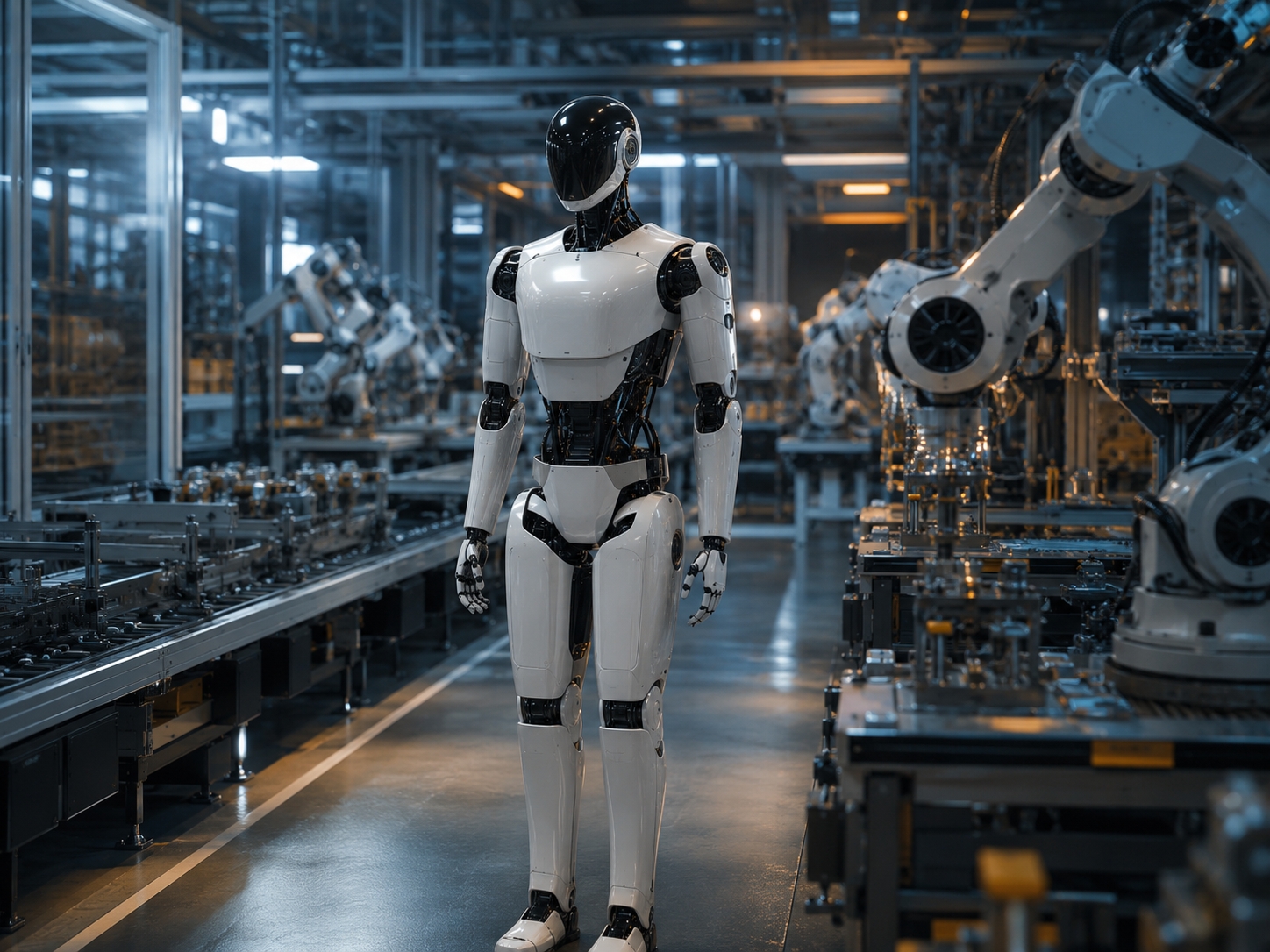
The Fremont facility, formerly used to manufacture the Model S and Model X, has been converted into a dedicated production line for humanoid robots. The line targets an annual capacity of 1 million robots, though initial output will be far lower.
Musk has been characteristically candid about the production ramp. “This is going to be the hardest product to scale manufacturing that we’ve ever made at Tesla because everything on the robot is new,” he said on the Q2 2026 earnings call. With over 10,000 unique components, the ramp “will move as fast as the least lucky, slowest, dumbest part in the entire 10,000”.
Nomura Securities has estimated that Tesla has adjusted the annual production capacity target for the Fremont line from 50,000 units to approximately 70,000 units, reflecting a more realistic assessment of the initial ramp.
III. The Technology: What Makes Optimus Tick
3.1 The AI and Compute Architecture
Optimus is not just a mechanical robot—it is an AI platform. The robot runs on Tesla’s FSD (Full Self-Driving) computer, adapted for humanoid form. The AI training happens on Tesla’s Dojo supercomputer, which provides the massive compute power needed to train the neural networks that control the robot’s movements and decision-making.
To support this compute-intensive workload, Tesla has enlisted TSMC to build a new fab in Arizona and Samsung to build a new fab in Texas, with both companies committing tens of billions of dollars to expand AI compute chip capacity. Panasonic has poured additional billions into battery cell production, and Micron has set aside large memory allocations for Tesla on favorable terms.
3.2 The Terafab: Tesla’s In-House Chip Facility
Tesla is not relying solely on outside partners. Musk disclosed a new in-house chip facility—referred to internally as “Terafab”—under construction in Austin, combining lithography, logic and memory production, packaging, and chip testing under one roof.
He called it a necessary investment, warning that without it Tesla “will be constrained in our ability to scale Optimus production because we simply won’t have enough AI chips”. The Terafab represents a staggering commitment to vertical integration, putting Tesla in the same league as the world’s largest semiconductor manufacturers.
3.3 Actuators and Motors
Each Optimus robot requires approximately 3.5 kg of neodymium-iron-boron (NdFeB) magnets across 40-plus servo actuators. These magnets are critical to the robot’s precision and power, enabling the fine motor control required for tasks like battery cell sorting and parts handling.
The supply of these magnets has become a significant concern. China imposed export controls in April 2025 on seven medium and heavy rare earth elements, including terbium and dysprosium used in NdFeB servo magnets. The International Energy Agency reports that China controls 94 percent of global sintered permanent magnet production. After those April 2025 controls, European rare earth magnet prices reached up to six times Chinese levels.
Tesla has responded by reducing the use of rare earth magnets in Optimus and forming a team in China to work with suppliers for sensors, motors, and other components. The company has also been negotiating with Chinese suppliers to order enough sensors and coreless motor parts for thousands of robots.
3.4 Battery and Power
The Optimus robot carries a 2.3 kilowatt-hour battery rated for approximately eight or more hours of light-to-medium factory work. This battery capacity is modest compared to an EV, but it is sufficient for a full shift of industrial tasks—and it can be swapped or recharged during breaks.
IV. Real-World Deployment: From Lab to Factory Floor
4.1 Berlin: The First European Deployment
While Fremont focuses on building robots, Giga Berlin is proving how they can be used. In August 2026, Tesla’s Berlin-Brandenburg factory confirmed that second-generation Optimus robots have begun real production testing in the battery production and internal logistics areas.
The robots are performing 4680 battery cell transport, visual quality inspection, and material shelving tasks. They are not yet entering the Model Y final assembly line, as German industrial safety regulations require physical separation between robots and human workers for now.
The significance of the Berlin deployment cannot be overstated. Less than nine months after Optimus was making popcorn at a Berlin shopping mall, it is now moving battery cells on a factory floor. The transition from “mall mascot” to “factory intern” happened remarkably quickly.
4.2 The “Human Demonstrates, Robot Learns” Pipeline
Tesla has established a rapid learning pipeline at the Berlin factory. In early August 2026, Tesla had Berlin factory employees wear backpack-like devices with cameras to record their movements—grabbing tools, moving parts, completing assembly tasks. Within two weeks, Optimus robots were performing real tasks in the same battery production area.
The path from “human demonstration” to “robot learning” to “production line work” has been validated. This is a critical breakthrough for humanoid robotics, demonstrating that the robots can learn from human demonstrations and generalize to real industrial tasks.
4.3 Confirmed Tasks and Capabilities
Tesla has confirmed that Optimus can perform the following tasks:
-
Sorting 4680 battery cells
-
Moving parts between stations
-
Kitting (assembling sets of parts for production)
-
Quality inspection
-
Pick-and-place operations
However, Tesla has not published cycle times, error rates, or throughput for any of these tasks. The company is clearly in the early stages of validating the robot’s industrial capabilities.
4.4 The Optimus Academy
Early Fremont builds go to the “Optimus Academy,” an internal program where robots learn simple factory skills before advancing to productive tasks. This structured learning approach mirrors how Tesla trains its FSD neural networks—starting with basic tasks and progressively increasing complexity.
The distinction is important: as of mid-2026, more than 1,000 Gen 3 Optimus units deployed across Fremont and Giga Texas are collecting training data rather than performing productive tasks. These robots are learning, not working—at least not yet.
V. The Supply Chain Challenge
5.1 10,000 Unique Components
Musk has emphasized repeatedly that Optimus is a manufacturing challenge unlike anything Tesla has faced. “Everything on the robot is new,” he said. With over 10,000 unique components, there is no existing supply chain to draw from.
Tesla is building that supply chain from scratch. The company has enlisted TSMC, Samsung, Panasonic, and Micron to build dedicated capacity. It is constructing its own Terafab chip facility. It is forming teams in China to work with local suppliers for sensors and motors.
5.2 Rare Earth Constraints
The rare earth magnet supply is perhaps the most significant constraint. Each humanoid robot requires approximately 3.5 kg of NdFeB magnets. At a production rate of 1 million robots per year, that would require 3,500 metric tons of NdFeB magnets annually—a staggering quantity that would strain global supply.
China’s export controls on rare earth elements have made the situation more acute. Tesla has responded by reducing rare earth magnet usage in Optimus and diversifying its supplier base. But the underlying supply concentration—China controls 94 percent of global sintered permanent magnet production—remains unresolved.
5.3 The China Factor
Tesla is heavily dependent on Chinese suppliers for Optimus components. The Wall Street Journal has reported that Tesla and other American companies are relying on Chinese suppliers to provide key components for humanoid robot development and production.
Tesla employees are visiting Chinese parts makers for sensors, motors, and other components as part of preparations for mass production. Some suppliers are working to avoid U.S. tariffs on Chinese goods. This dependence on Chinese supply chains creates both operational and geopolitical risks for the Optimus program.
VI. The Competitive Landscape
6.1 Chinese Manufacturers Dominate Shipments
Tesla is far from alone in chasing the humanoid opportunity. Chinese manufacturers took the top six positions in Omdia’s ranking of global humanoid robot shipments in 2025, with Tesla and Figure AI the only two U.S. companies to crack the top ten.
Unitree, a Chinese company, shipped more than 5,500 humanoid units in 2025 across all models combined and is targeting 20,000 units in 2026. This volume dwarfs Tesla’s current production, though it is important to note that Unitree’s robots are generally less sophisticated and less capable than Optimus.
6.2 Figure AI: The Closest American Rival
Figure AI, widely viewed as Optimus’s closest American rival, has been running a paid commercial pilot at BMW’s Spartanburg, South Carolina plant. The company has raised more than $1 billion in a September 2025 funding round that valued it at $39 billion.
Figure AI’s Figure 02 robot has documented over 1,250 operating hours at BMW, processing more than 90,000 sheet-metal parts with over 99 percent placement accuracy. This is a significant advantage over Tesla: Figure has external customers, documented operating hours, and verified output data.
The company has said it aims to manufacture and deploy roughly 100,000 units within four years.
6.3 Agility Robotics: The Other Competitor
Agility Robotics, with its Digit robot, has deployed across nine facilities with customers including GXO, Schaeffler, Toyota Canada, and Mercado Libre. The company has accumulated over 65,000 operating hours across these facilities.
Like Figure, Agility has the advantage of real-world commercial data—something Tesla cannot yet claim.
6.4 The Market Forecasts
Wall Street’s long-range estimates for the humanoid robot market diverge sharply depending on the time horizon. Goldman Sachs Research puts the addressable market for humanoid robots at $38 billion by 2035—more than six times its earlier $6 billion estimate—with a base case of over 250,000 unit shipments in 2030, almost all of them industrial.
Morgan Stanley Research projects the market could reach $5 trillion by 2050, with more than 1 billion humanoids in use worldwide and roughly 90 percent deployed in industrial and commercial settings. Morgan Stanley also estimates a single humanoid costs about $200,000 in 2024, falling to around $150,000 by 2028 and roughly $50,000 by 2050.
Musk has said Optimus will eventually reach a price of $20,000 to $30,000—far below Morgan Stanley’s 2050 estimate. If Tesla can achieve that price point, it would completely reshape the economics of humanoid robotics.
VII. What This Means for Tesla Owners and Investors
7.1 The 80 Percent Valuation Claim
Musk has stated that Optimus will drive 80 percent of Tesla’s value. This is an extraordinary claim for a product that, as of mid-2026, has zero external sales and no verified performance data.
Investors are pricing in this potential. The $25 billion in 2026 capital spending on robotics and AI infrastructure reflects Tesla’s conviction that Optimus is the future of the company. For Tesla owners, this means that the company’s long-term health—and the value of their vehicles—is increasingly tied to the success of the robotics program.
7.2 The Timeline to Commercial Sales
Tesla has not announced when Optimus will be available for commercial sale. The current plan appears to be: internal use and learning throughout 2026, with external deployment beginning in 2027.
The robots are not yet ready for customers. They are learning, collecting data, and performing basic factory tasks. But the trajectory is clear: Tesla is building the production capacity for 1 million robots per year, and eventually 10 million per year at Giga Texas.
7.3 The Industrial vs. Consumer Question
The initial market for Optimus will be industrial—factories, warehouses, and logistics centers. The robots are being trained on factory tasks: battery cell sorting, parts handling, quality inspection.
The consumer market—a robot that can fold laundry, cook dinner, or care for elderly relatives—is much farther away. Musk has talked about these applications, but they require levels of dexterity, safety, and general intelligence that the current generation of robots does not possess.
7.4 The Brand Implications
For Tesla owners, the success of Optimus matters beyond stock prices. If Tesla becomes the dominant player in humanoid robotics, it will cement the company’s reputation as an AI company first and an automaker second. That brand evolution could affect everything from resale values to the company’s ability to attract top talent.
Conclusion
Tesla has begun producing the Optimus humanoid robot at Fremont, marking one of the most significant milestones in the company’s history. The $25 billion bet on robotics and AI infrastructure, the 1 million-unit annual production target, and the Terafab chip facility all point to a company that sees humanoid robotics as its future.
But the challenges are immense. The supply chain for 10,000 unique components must be built from scratch. Rare earth magnet supplies are constrained by Chinese export controls. Competitors like Figure AI and Agility Robotics have real-world commercial deployments and verified performance data. And the production ramp will be “agonizingly slow”.
Yet Tesla has a track record of overcoming manufacturing challenges that others deemed impossible. The Model 3 production ramp, the Gigafactory builds, the Supercharger network expansion—all were dismissed as impossible until Tesla did them.
Optimus is Tesla’s next great test. If the company can scale production to 1 million units per year and achieve the $20,000-to-$30,000 price point Musk has promised, it will not just transform Tesla—it will transform the global economy. If it cannot, the $25 billion bet will be one of the most expensive failures in corporate history.
For now, the robots are learning. The factories are being built. The supply chain is being assembled. And the world is watching.
FAQ
Q: When can I buy an Optimus robot?
A: Tesla has not announced a commercial sales date. The current timeline appears to be internal use in 2026, with external deployment beginning in 2027.
Q: How much will Optimus cost?
A: Elon Musk has said Optimus will eventually reach a price of $20,000 to $30,000. Current humanoid robots cost approximately $150,000 to $200,000.
Q: What tasks can Optimus actually do?
A: Confirmed tasks include sorting 4680 battery cells, moving parts between stations, kitting, quality inspection, and pick-and-place operations. Tesla has not published performance data for these tasks.
Q: How does Optimus compare to competitors like Figure AI?
A: Figure AI has documented over 1,250 operating hours at BMW with verified output data. Tesla has zero external sales and no verified performance data. However, Tesla’s planned production capacity—1 million units per year—far exceeds any competitor’s plans.
Q: What is the Terafab?
A: The Terafab is Tesla’s in-house chip facility under construction in Austin, combining lithography, logic and memory production, packaging, and chip testing under one roof. It is designed to ensure Tesla has enough AI chips to scale Optimus production.
Q: Is Optimus affected by China’s rare earth export controls?
A: Yes. China controls 94 percent of global sintered permanent magnet production and imposed export controls on rare earth elements in April 2025. Tesla has responded by reducing rare earth magnet usage and diversifying its supplier base.
Q: Will Optimus replace human workers?
A: The initial deployment is focused on repetitive, dangerous, or physically demanding tasks in industrial settings. The long-term impact on employment is a subject of significant debate among economists and policymakers.