
For years, the promise of a truly autonomous vehicle has been the shimmering horizon for the automotive industry, a goal pursued with immense investment and intellectual fervor. At the forefront of this pursuit has been Tesla, whose Full Self-Driving (FSD) program has captivated, impressed, and occasionally courted controversy. For Tesla owners and enthusiasts, the incremental updates to the FSD Beta software have been akin to episodes in a long-running saga. With the recent global rollout of FSD V13, we stand at a pivotal moment. The removal of the "Beta" tag in its marketing, a subtle yet profound shift, signals a new level of confidence from Austin's engineers. But what does this mean for the person behind the wheel?
The journey from early Autopilot to the sophisticated neural networks of today has been one of relentless iteration. Each update has been built upon the trillions of data points collected from Tesla’s global fleet, a real-world testing ground of unparalleled scale. FSD V13 represents the latest and most significant leap in this evolutionary process. It promises a driving experience that is not only safer and more convenient but also more intuitive and human-like than ever before.
This article will serve as your comprehensive guide to understanding FSD V13. We will move beyond the hype and the headlines to conduct a deep dive into its core architecture, analyzing what has fundamentally changed. We will then take it on the road, virtually, to assess its real-world performance in the diverse and demanding driving environments of the United States and Europe. From the chaotic, grid-like streets of New York City to the ancient, winding roads of Rome, and from the wide-open highways of Texas to the speed-unrestricted sections of the German Autobahn, we will scrutinize V13’s capabilities. Finally, we will explore the crucial human-machine interface, discussing the driver's role, the system's impact on driver confidence, and what it’s truly like to live with this cutting-edge technology. For current owners considering the upgrade and potential buyers weighing the FSD option, this analysis will provide the detailed insights you need.
Chapter 1: The Architecture of Intelligence: What's New Under the Hood in V13?
To truly appreciate the advancements in FSD V13, one must look beyond the surface-level performance and understand the foundational architectural shifts that power it. Tesla has progressively moved away from a system heavily reliant on manually coded rules and heuristics towards one that more closely mimics a biological brain: a complex, interconnected web of neural networks. V13 marks the most significant stride in this direction yet.
End-to-End AI: From Photons to Control
The headline feature of FSD V13 is its expanded use of "end-to-end AI." In layman's terms, this means the system is learning to go directly from raw sensor input to driving controls (steering, acceleration, braking) with minimal intermediate steps that are hand-coded by engineers. Imagine the previous system as a cautious student who first identifies an object ("that is a pedestrian"), then consults a rulebook ("the rulebook says I must slow down for pedestrians"), and then acts. The end-to-end approach is more like an experienced driver who, in a single, fluid process of perception and intuition, sees the pedestrian and instinctively eases off the accelerator.
In V13, the photons captured by the car’s eight cameras are fed into a powerful neural network. This network, trained on millions of video clips of expert human driving, learns the correlation between visual data and appropriate driving actions. It’s not just identifying objects; it's understanding the entire scene in context—the flow of traffic, the subtle body language of a cyclist, the implications of a partially obscured sign. This holistic understanding allows for smoother, more nuanced, and ultimately more human-like driving behavior. It reduces the jerky, robotic movements that were sometimes characteristic of earlier versions, replacing them with a more confident and fluid grace on the road.
Occupancy Networks 2.0: Painting a 3D World
A critical component underpinning this new AI architecture is the second generation of Tesla’s "Occupancy Networks." Think of this as the car’s high-fidelity 3D map of its immediate surroundings, updated in real-time. Where earlier systems primarily focused on identifying and tracking specific, recognized objects (cars, trucks, people), Occupancy Networks take a more comprehensive approach. They voxelize the space around the vehicle—breaking it down into a dense, 3D grid—and predict whether each tiny cube (voxel) is occupied by an object, regardless of what that object is.
V13 significantly enhances the resolution and predictive power of this network. It can now better represent the volume and predict the future position of amorphous or unusual obstacles—a pile of construction debris, an oddly shaped piece of fallen cargo on the highway, or a flock of pigeons. This is a game-changer for handling unpredictable, real-world clutter. For a driver in a US city, this means the car is less likely to be spooked by a discarded mattress on the side of the road. For a European driver navigating a street market, it means the system can better comprehend the space occupied by vendor stalls and crowds, maneuvering through them with greater assurance.
Improved Decision-Making Logic: Assertiveness Meets Safety
With a better understanding of the world around it, FSD V13 can make more sophisticated driving decisions. This is most apparent in scenarios that require a delicate balance of assertiveness and safety.
For US drivers, the infamous "unprotected left turn" has long been a benchmark for autonomous systems. V13 demonstrates a marked improvement here. It is better at judging gaps in oncoming traffic, inching forward more confidently to signal its intent, and then executing the turn decisively when the window of opportunity arises. This reduces the frustrating hesitation that could sometimes annoy other drivers.
For European drivers, the primary test is the roundabout. V13 brings a new level of mastery to this common traffic feature. It shows improved lane discipline on multi-lane roundabouts, better anticipation of other drivers' exit intentions, and a smoother blending of speed and steering to navigate the circle. This is a direct result of being trained on vast quantities of European driving data, where roundabout navigation is a daily necessity.
Furthermore, the system’s ability to handle adverse weather has been refined. By learning from countless hours of driving in rain, fog, and snow, the neural networks are better at filtering out noise from the sensors and understanding the reduced traction limits, leading to more cautious and appropriate speed and following distance adjustments.
The Unseen Engine: The Power of Fleet Data
None of these advancements would be possible without the foundational asset that sets Tesla apart: its fleet. Every mile driven by a Tesla with FSD engaged is a potential lesson. When a driver has to intervene, that data is flagged and can be used by Tesla's engineers to create a simulation of the scenario. This "shadow mode" testing and data-driven refinement create a continuous learning loop. FSD V13 is the product of this exponential cycle of learning, a system that gets smarter every single day, thanks to the collective experience of millions of drivers around the globe.
Chapter 2: On the Road: FSD V13 Performance in Urban and Highway Environments
Theory and architecture are fascinating, but the ultimate measure of any driving system is its real-world performance. FSD V13, for all its backend sophistication, must prove its mettle on the unpredictable and chaotic tarmac of our cities and highways. We’ll dissect its performance, focusing on the distinct challenges presented by American and European driving environments.
Urban Driving Analysis (US Focus): Taming the Concrete Jungle
American cities, often characterized by their grid-like layouts, wide lanes, and complex intersections, present a unique set of challenges.
-
Complex Intersections: V13’s handling of four-way stops and unprotected left turns is arguably its most noticeable improvement for US drivers. In a dense urban environment like downtown San Francisco, the system now exhibits a more patient yet aware behavior at four-way stops. It correctly identifies the arrival order of other vehicles and proceeds without the excessive hesitation of past iterations. For unprotected lefts, the "creeping" motion is more purposeful, and the system's gap selection in fast-moving traffic on boulevards in Los Angeles feels significantly more confident. It's a move from tentative calculation to what feels like situational judgment.
-
Pedestrian and Cyclist Interaction: In bustling centers like New York’s Manhattan, where pedestrians and cyclists often operate with a fluid interpretation of traffic laws, V13's enhanced Occupancy Networks shine. The system is less prone to sudden, jarring stops for pedestrians who are safely on the sidewalk but close to the curb. It creates a virtual "force field" around vulnerable road users that feels more dynamic and predictive. It anticipates the path of a delivery cyclist weaving through traffic, providing a wider, safer berth without unnecessarily disrupting the flow of traffic behind the Tesla.
-
Parking and Summon: While not a core driving task, urban convenience is key. The latest Autopark functions in V13 demonstrate better recognition of tight parallel and perpendicular spots. More importantly, the pathing logic is improved, resulting in fewer adjustments and a quicker, more successful parking maneuver. Smart Summon, while still best used in less crowded parking lots, shows a better ability to navigate around pillars and other common obstacles in underground parking garages, a welcome improvement for apartment dwellers.
Urban Driving Analysis (European Focus): Precision in Ancient Spaces
European cities are a stark contrast to their American counterparts. Streets are often narrow, winding, and shared with a variety of transport modes unseen in the US.
-
Navigating Historic City Centers: This is where FSD has historically struggled and where V13 makes its most impressive European-centric gains. Driving through the narrow streets of Rome’s Trastevere district or Paris’s Le Marais requires millimeter precision. V13 shows a much-improved ability to stay centered in lanes that barely accommodate the vehicle's width. It skillfully navigates around double-parked cars, a ubiquitous feature of European city life, making a judgment call on whether to wait or to carefully squeeze through a gap that would make a human driver pause.
-
Roundabout Mastery: This is the make-or-break test for any autonomous system in Europe. In the UK, navigating a complex multi-lane roundabout like the Magic Roundabout in Swindon (an extreme example) is still beyond its scope, but for the vast majority of standard and multi-lane roundabouts across the continent, V13 is a revelation. It correctly selects the appropriate entry lane based on the intended exit, yields correctly to circulating traffic, and signals its exit with newfound reliability. The driving experience through a series of French "ronds-points" is smoother and requires far fewer interventions than before.
-
Tram and Public Transport Interaction: A common sight from Amsterdam to Zurich is the shared road space with trams. FSD V13 demonstrates a specific understanding of tram lines. It avoids driving on them where prohibited and shows a clear awareness that trams have the right of way, holding position patiently rather than attempting to dart around them. This specialized training is crucial for building trust with European drivers.
Highway and Motorway Performance: The High-Speed Commute
On major highways, the differences between Autopilot and FSD become more nuanced but are still significant.
-
Enhanced Autopilot vs. FSD: On a straight highway, both systems excel. However, FSD V13's primary advantage is "Navigate on Autopilot," which automatically handles interchanges and exits. With V13, these maneuvers are executed more smoothly. The system now signals its intent to change lanes earlier, finds its gap more efficiently, and tracks through the interchange ramp with less of the "ping-pong" effect between lane lines.
-
Lane Changes and Overtaking: The system’s assertiveness can be tuned, but even in its standard mode, V13 is more decisive. On a multi-lane US interstate, it will more readily move out to overtake a slower truck. On the German Autobahn, where speed differentials are enormous, V13 shows a better ability to check its blind spots for rapidly approaching vehicles before initiating a lane change. It won't move into the left lane if it detects a Porsche approaching at 200 km/h, a critical safety improvement. The automatic speed adjustments for curves are also more subtle and human-like.
-
Ghost Phantom Braking: A persistent issue for Tesla owners has been "phantom braking"—sudden, unexpected braking events on the highway. While not entirely eliminated, the incidence of these events is drastically reduced in V13. The improved Occupancy Networks and better data processing seem to allow the system to differentiate better between a genuine threat (like debris) and a harmless shadow from an overpass, leading to a much more relaxing long-distance driving experience.
Chapter 3: The Human-Machine Interface: Living with FSD V13
The world’s most advanced autonomous system is useless if the driver doesn’t trust it or understand how to interact with it. The relationship between human and machine is paramount. FSD V13 brings not just technical improvements but also refinements to this critical interface.
The Driver's Role: Still the Captain of the Ship
Tesla has made it unequivocally clear, despite the "Full Self-Driving" name, that the driver must remain fully attentive and ready to take control at any moment. FSD V13 is a Level 2 driver-assistance system, a classification that legally and ethically places the ultimate responsibility on the human in the driver's seat.
The in-cabin camera-based driver monitoring system is more sophisticated in V13. It is better at detecting driver inattentiveness, such as prolonged phone use or looking away from the road. The system's "nags"—audible and visual alerts to apply torque to the steering wheel—remain, serving as a constant reminder of this shared responsibility. It's a crucial safety feature that, while sometimes annoying to the user, is non-negotiable for the safe deployment of this technology. Living with V13 means accepting this role as an active supervisor, not a passive passenger.
Visualizations and Confidence: Seeing What the Car Sees
A core pillar of driver trust is understanding what the car is perceiving. The on-screen visualizations on the Tesla's center display are the window into the car's digital mind. With V13, these visualizations are more detailed and less abstract than ever before.
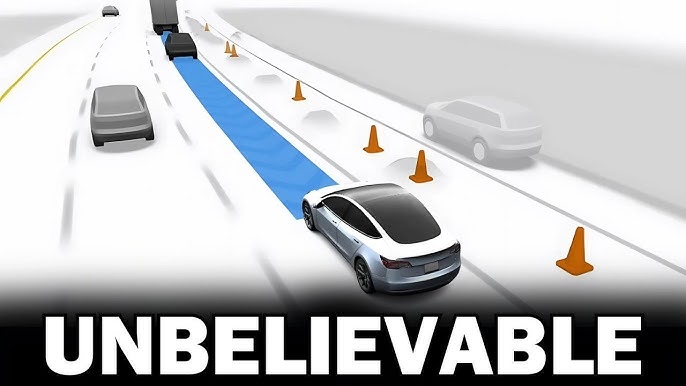
The abstract, multi-colored "occupancy" grid is now rendered with more clarity, showing not just that an object is there, but giving a better sense of its shape and trajectory. Turn signals, brake lights, and even the open doors of parked cars are now more reliably rendered on the screen. When the car's visualization perfectly mirrors the complex scene outside the windshield, it builds an immense amount of confidence in the system's capabilities. You see that it sees the cyclist preparing to cross the road, and you trust that it will react accordingly. This detailed, real-time feedback loop is perhaps the most powerful tool for turning a skeptical user into a confident one.
Disengagements: Learning the Limits
No system is perfect, and building trust also means being honest about its limitations. FSD V13 will still disengage or require driver intervention in certain scenarios. Understanding these limitations is key to using the system safely and effectively.
-
Extreme Weather: While improved, heavy snow that covers lane markings or dense, "pea soup" fog will still challenge the vision-only system and likely prompt a request for the driver to take over.
-
Unusual Road Markings or Construction: Complex, poorly marked construction zones with human flaggers are a known challenge area. The system may become confused by contradictory signals and lane paths.
-
Aggressive or Erratic Human Drivers: FSD is programmed to be a safe, law-abiding driver. It can sometimes be "too polite" and may struggle to navigate situations where aggressive human drivers are not following conventional rules.
By being aware of these edge cases, the driver can anticipate when the system might need help, further cementing the human-machine team dynamic.
Customization and Driver Profiles: Tailoring the Experience
Recognizing that not everyone has the same driving style, Tesla has expanded the customization options within the FSD profiles. The "Chill," "Average," and "Assertive" modes are more distinct in V13.
-
Chill: Follows at a greater distance, accelerates more gently, and prefers to stay in its lane rather than make frequent overtakes. Ideal for relaxed cruising.
-
Average: A well-balanced mode that mimics typical, competent driving behavior.
-
Assertive: Follows more closely (while maintaining a safe distance), performs lane changes more briskly, and will not linger behind a vehicle traveling significantly below the speed limit.
This ability to tailor the car's "personality" is a subtle but important aspect of long-term ownership. It allows the FSD experience to align more closely with the driver's own preferences, making the system feel less like a tool and more like a true co-pilot.
Conclusion
FSD V13 is, without question, a landmark achievement in the journey towards autonomous driving. It represents the tangible result of Tesla's unwavering commitment to a vision-based, neural network-driven approach. The move to an end-to-end AI architecture, coupled with the precision of Occupancy Networks 2.0, has yielded a system that is demonstrably smoother, smarter, and more capable in a wider variety of real-world scenarios. For drivers in both the US and Europe, the targeted improvements for their specific environments—from mastering unprotected left turns to navigating complex roundabouts—make V13 the most compelling version of FSD to date.
However, it is crucial to temper excitement with a dose of reality. FSD V13 is not true, Level 4 or 5 "mind-off" autonomy. It is a highly advanced Level 2 driver-assistance system that demands the driver's full and undivided attention. The "captain of the ship" analogy has never been more appropriate. The system is an incredibly talented first mate, but the ultimate responsibility for the vessel's safety remains with the human at the helm. The reduction in phantom braking and the increase in overall driving fluidity significantly boost confidence, but the need for vigilance is absolute.
Looking ahead, the hurdles are as much regulatory as they are technical. Proving the system's safety to governments and standards bodies around the world will be the next great challenge. Perfecting performance in the most extreme weather and handling the infinite unpredictability of human behavior remain on the engineering roadmap.
So, is the FSD subscription or purchase worth it with the V13 update? For the technology enthusiast who wants to be on the bleeding edge of automotive innovation and is willing to accept the role of an active supervisor, the answer is a resounding yes. The system reduces the cognitive load of driving, especially on long commutes and road trips, to an extent that is hard to appreciate until you've experienced it. It offers a tangible, fascinating glimpse into the future of transportation. For the more cautious consumer, V13 may be the tipping point that makes the investment justifiable, offering a level of convenience and safety that is finally beginning to align with its ambitious name. It is not yet the final destination, but it is a profoundly significant and impressive milestone on the journey.
FAQ Section
-
Is FSD V13 officially out of "Beta"? While Tesla has removed the "Beta" moniker from much of its marketing and user interface for V13, it is functionally still a system that requires full driver supervision. From a legal and regulatory standpoint, it remains a Level 2 driver-assistance system, not a fully autonomous one. The name change reflects Tesla's increased confidence in the system's capabilities and reliability.
-
How do I get the FSD V13 update on my Tesla? The update is being rolled out over-the-air (OTA) to Tesla vehicles that have purchased or subscribed to the Full Self-Driving Capability package and have the necessary hardware (HW3 or HW4). The rollout is typically staggered, so it may take some days or weeks to reach all eligible vehicles. Ensure your car is connected to Wi-Fi to download the update when it becomes available.
-
Does FSD V13 work in all weather conditions? FSD V13 has shown significant improvements in handling adverse weather like rain and fog. However, its performance can still be degraded in extreme conditions. Heavy snow that obscures lane markings, extremely dense fog, or torrential rain can limit the cameras' visibility, and the system may disengage and require the driver to take full control.
-
Can I use FSD V13 on any road? Yes, FSD V13 is designed to work on virtually all roads, including city streets, country lanes, and highways. However, its performance is best on well-marked roads with predictable traffic flow. It may struggle in complex, poorly marked construction zones or on unmapped private roads. The driver must always be ready to intervene, especially in unfamiliar or challenging environments.
-
What is the legal status of FSD in the US vs. Europe? In both the US and Europe, FSD is classified as a SAE Level 2 system. This means the driver is legally responsible for the vehicle at all times and must keep their hands on the wheel (or be ready to take over instantly) and their eyes on the road. Specific regulations can vary by US state and European country, but the core principle of driver responsibility is universal for Level 2 systems. Full "hands-off" driving is not yet legally permitted on public roads with this system.
-
How does FSD V13's performance compare to competitors like Waymo or Cruise? This is a comparison of two different approaches. Waymo and Cruise operate Level 4 autonomous services, meaning they can drive completely on their own without a human driver, but only within a limited, heavily pre-mapped geographical area (a "geofence"). Tesla's FSD is a Level 2 system that works on almost any road but requires driver supervision. FSD V13's strength is its scalability and versatility, while Waymo's strength is its current level of full autonomy within its operational domain. They are solving the problem of self-driving from different ends of the spectrum.