
I. Introduction
Tesla's Full Self-Driving (FSD) system has always been at the nexus of technological aspiration and intense scrutiny. The latest iteration, FSD Beta V12, marks a definitive break from previous architectures. Moving from a traditional, explicit code-based system—where engineers manually programmed rules for every traffic sign and maneuver—to an end-to-end neural network, V12 fundamentally changes how the vehicle "thinks." This system learns directly from massive video data streams, taking in raw visuals and outputting driving actions, effectively mirroring how a human learns to drive.
This technological leap is transforming the driving experience in the United States, where V12 deployment is proceeding rapidly under a "Supervised" model, demonstrating unprecedented improvements in handling complex, unpredictable urban environments. However, V12's global journey is bifurcated. Its advanced capabilities are meeting a formidable barrier in Europe, where the continent’s traditionally cautious regulatory bodies, primarily operating under the UNECE (United Nations Economic Commission for Europe) DCAS (Driving Control Assistance Systems) framework, demand a phased, highly constrained rollout.
The core argument of this article is that while FSD V12 represents a profound, singular technological advance in the realm of autonomy, its future scalability and mass adoption are entirely dependent on navigating the complex, often conflicting, regulatory requirements of two distinct continents, forcing Tesla into a "two-tier" deployment strategy.
II. FSD V12 Technological Leap in the US
The end-to-end neural network architecture of FSD V12 is arguably the most significant shift in Tesla’s autonomy program since its inception. It redefines the relationship between perception, planning, and control.
End-to-End AI and Learning by Observation:
In V12, the entire decision-making stack is consolidated into a single, vast neural network. Instead of dedicated modules for "object detection," "path planning," and "command execution," the system is trained on petabytes of real-world video footage captured by the Tesla fleet, paired with the corresponding human driver inputs.
-
Mimicking Intuition: This approach allows the system to develop an intuitive understanding of driving—learning subtle, unspoken rules of the road (e.g., yielding in complex four-way stops, predicting pedestrian behavior, negotiating lane merges) that are virtually impossible to program explicitly through millions of lines of code.
-
Performance Metrics and Intervention Reduction: Early performance data and user reports from the U.S. Beta fleet confirm the efficacy of this approach. Specific releases, such as V12.5.2, have reportedly demonstrated a significant reduction in the miles between necessary interventions—a critical safety metric. Improvements in spatial awareness, smoothness of maneuvers, and the ability to handle previously tricky scenarios (like complex, unmarked parking lot navigation) are frequently cited.
-
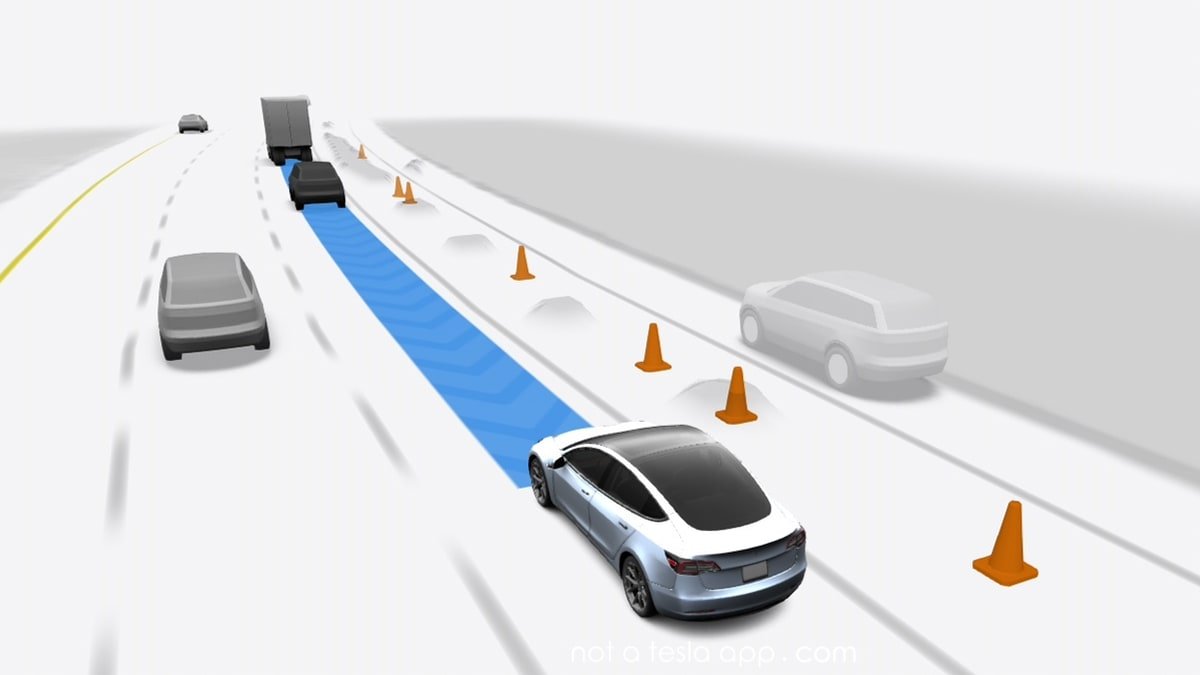
Dynamic Obstacle Interaction: The system shows a robust ability to interact with dynamic, unpredictable elements, such as navigating safely around road construction, dealing with jaywalkers, and maneuvering with millimeter precision around forklifts and other vehicles in high-density areas (e.g., observed at Giga factories).
Hardware Unification and Next-Generation Processing:
V12 is optimized for deployment across different generations of Tesla hardware, including the newer AI4 computer and the existing AI3 platform. This hardware unification simplifies the software development cycle and ensures that the maximum number of existing vehicles are capable of running the latest, most compute-intensive neural network models. This universal deployment strategy is key to rapidly scaling the data collection feedback loop in the U.S.
III. The European Regulatory Maze (UNECE DCAS)
While the U.S. deployment operates under relatively permissive "Beta" terms requiring constant driver supervision, Europe imposes a vastly more restrictive framework rooted in international standards.
UNECE DCAS Phase 1 & 2:
The UNECE Driving Control Assistance Systems (DCAS) regulation provides the blueprint for advanced driver assistance and automation in Europe. The phased approach dictates what technologies can be legally enabled:
-
Level 2 Constraints: Current European regulations largely constrain Autopilot and FSD features to SAE Level 2—meaning the human driver must remain fully engaged, responsible, and ready to intervene at any moment.
-
The Supervised Mandate: European regulators are highly focused on mandatory Driver Monitoring Systems (DMS). This requires eye-tracking technology to ensure the driver is watching the road. This mandate is non-negotiable for enabling FSD on European roads, necessitating sophisticated in-cabin cameras capable of tracking the driver's gaze, even if they are wearing sunglasses—a technological hurdle in itself.
The Feature Parity Issue and Sensor Constraints:
Due to a combination of legacy regulations and Tesla’s recent architectural choices, European FSD users experience significant feature parity gaps compared to their U.S. counterparts.
-
Missing Core Features: European FSD systems still lack many key functions considered standard in the U.S. (e.g., full Smart Summon, sophisticated Autopark). The removal of ultrasonic sensors (USS) from newer Tesla vehicles (circa late 2022 onwards) has further complicated the deployment of low-speed, precise maneuvering features, which regulators require to be perfectly reliable.
-
"Meek" Performance: User feedback from the UK and continental Europe suggests that the current Autopilot functionality is often excessively cautious, slow to execute lane changes, and frequently requires confirmation for even simple maneuvers, making it a convenience feature rather than a true automated assistant. This performance gap is a direct result of the system operating within the tight legal constraints.
The Road to True Autonomy in Europe:
The path to deploying a V12-level system with Autosteer on City Streets in Europe is excruciatingly slow. It requires Tesla to not only prove the system’s safety statistically (through billions of simulated and real-world miles) but also to integrate complex local road rules and traffic behaviors into a generalized neural network—all while satisfying local Type Approval authorities. The process is expected to occur in stages, with the most complex city-street functionality likely delayed well into 2026 or beyond.
IV. Tesla's FSD Roadmap and Future Outlook
Tesla’s stated long-term strategy for FSD is a unified, global platform, utilizing the overwhelming advantage of its data collection.
The Unified Data Loop:
The vast dataset gathered from the U.S. Beta fleet, combined with data from Europe and Asia, is crucial. Every intervention, every successful maneuver, and every edge case is fed back into the training algorithms. This rapid data-feedback loop allows Tesla to train millions of hours of simulated and real-world scenarios, a volume that traditional competitors cannot match. This data-driven approach is the primary lever Tesla expects to use to eventually overcome regulatory resistance by demonstrating unparalleled safety statistics.
Integration with Grok/AI:
Elon Musk's vision extends FSD beyond mere driving. The long-term plan involves integrating the underlying generalized AI capabilities of FSD with broader intelligence systems (such as the Grok AI currently being developed). This aims to create a highly context-aware vehicle that can not only drive but also understand the intent of its occupants and the environment—for instance, understanding complex conversational commands or navigating based on external factors like calendar appointments. While highly futuristic, this generalized AI approach is what underpins the belief that V12 is a foundational technology, not just an automotive feature.
V. Conclusion
FSD V12 is a technological marvel that has cemented Tesla's lead in the self-driving race, showcasing the profound power of end-to-end neural network architectures in the U.S. market. The system’s ability to "learn" driving intuition from observation is a game-changer for the industry.
However, the chasm between the U.S. and European deployment highlights the critical role of regulation in shaping the future of mobility. Europe’s adherence to Level 2 constraints, its emphasis on robust driver monitoring, and the complex process of UNECE Type Approval will force Tesla to continue its dual-strategy: rapid, cutting-edge development in the U.S. to gather data, and a cautious, compliant, and often feature-restricted rollout in Europe.
For European owners, the promise of true, unsupervised FSD remains a distant horizon. The near-term reality is a sophisticated, supervised Level 2 system that, while technically superior, is functionally constrained by regulations demanding a human in the loop. The ultimate success of FSD V12 globally will not be measured solely by its technological prowess, but by its ability to secure the trust and approval of the world’s most demanding regulatory bodies.