
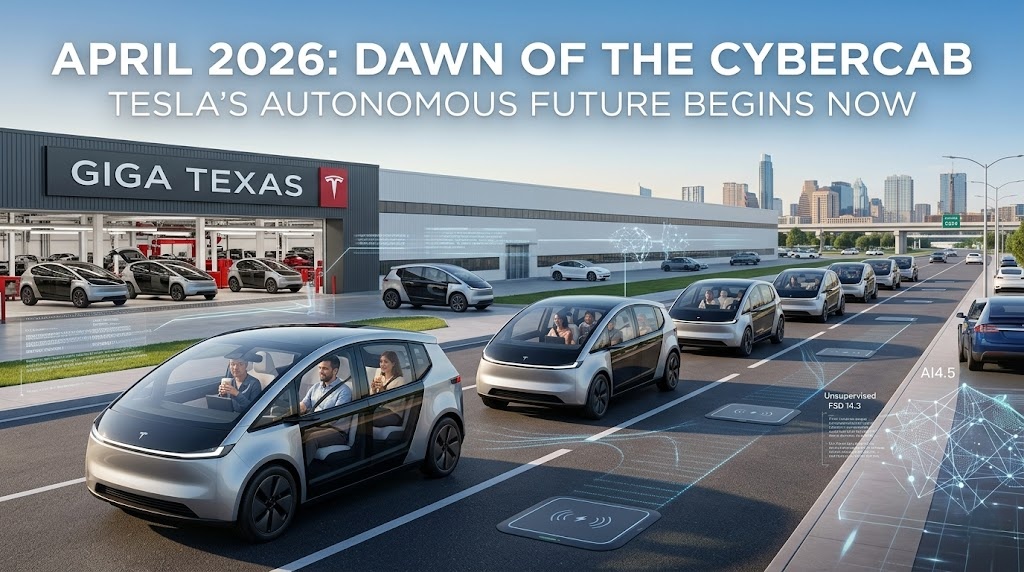
Introduction: The End of an Era, The Beginning of an Ecosystem
If we look back at the timeline of automotive history, there are a few distinct moments that fundamentally shifted how humanity moves. The rolling out of the first mass-produced Ford Model T was one; the introduction of the Tesla Model S in 2012, proving that electric vehicles could be highly desirable, was another. However, as the calendar turns to April 2026, we are witnessing a milestone that eclipses both. At Gigafactory Texas, the assembly lines have officially begun churning out the first production units of the highly anticipated Tesla Cybercab.
For years, skeptics dismissed the concept of a dedicated, steering-wheel-less robotaxi as Elon Musk’s ultimate piece of vaporware—a futuristic fantasy designed to pump stock prices rather than transport real human beings. Yet, today, the Cybercab is a physical, manufactured reality. This month marks a definitive pivot for Tesla. The company is actively transitioning away from its identity as purely an electric vehicle manufacturer. Instead, it is firmly establishing itself as a global artificial intelligence and robotics network.
For you, the Tesla owner and enthusiast in the United States or Europe, the arrival of the Cybercab is not just a novelty. It represents a total reimagining of personal transport, urban infrastructure, and even vehicle ownership economics. It validates years of data collection from the global Tesla fleet, proving that the billions of miles driven on Autopilot and Full Self-Driving (FSD) were building toward a singular, autonomous zenith. This comprehensive deep-dive explores the engineering marvel of the Cybercab, the profound implications of its sub-$30,000 consumer variant, the revolutionary Unsupervised FSD ecosystem that powers it, and what this all means for the future of the roads we share.
Inside the Cybercab: A Radical Rethink of Automotive Design
To understand the Cybercab, you must first forget everything you know about what a "car" is supposed to look and feel like. From its inception, traditional automotive design has been dictated by the necessity of a human driver. The placement of the seats, the dashboard, the mirrors, the glass house—every element has been engineered around human sightlines and physical reach. By eliminating the driver, Tesla’s engineering and design teams were given a blank canvas.
The Eradication of Traditional Controls
The most striking feature of the Cybercab's interior is what is missing. There is no steering wheel. There is no steering column. There are no accelerator or brake pedals, no gear stalks, and no traditional rear-view mirrors.
The manufacturing implications of removing these components are staggering. Without a steering column to route through the firewall, without a brake booster, and without the associated wiring harnesses and physical linkages, Tesla has slashed thousands of dollars off the Bill of Materials (BOM). This radical simplification significantly reduces the vehicle's weight, drastically improves aerodynamic efficiency, and practically eliminates the mechanical failure points associated with traditional driving controls.
The Passenger-Centric Lounge
With the driver out of the equation, the interior of the Cybercab is heavily optimized for passenger comfort and digital immersion. The cabin resembles a minimalist, high-end lounge rather than a vehicular cockpit. The front row—if it can even be called that—offers massive legroom. The seating arrangement is designed to facilitate conversation or productivity, enveloped by a wraparound acoustic glass canopy that provides an expansive view of the city while heavily isolating passengers from outside road noise.
At the center of the experience is an oversized, ultra-high-definition infotainment screen. Because the occupants are no longer required to watch the road, this screen serves as the primary hub for the journey. It seamlessly integrates with passenger profiles via the Tesla app. When you hail a Cybercab, the vehicle instantly adjusts the cabin temperature, customizes the ambient lighting, and loads your Spotify or Netflix profile before you even open the door. It is personalized transit on demand.
Exterior Design and "Unboxed" Manufacturing
Externally, the Cybercab borrows the brutalist, aerodynamic efficiency seen in the Cybertruck and the ultra-sleek drag coefficient of the Model 3 Highland, but it is distinctly its own silhouette. It is compact, designed to easily navigate dense urban environments and tight alleyways.
More importantly, the Cybercab is the first vehicle fully realized through Tesla's revolutionary "unboxed" manufacturing process. Instead of assembling the car linearly down a traditional line, the vehicle is built in discrete, massive sub-assemblies (front, rear, battery/floor, and sides) that are worked on simultaneously by high-density robotic arms before being brought together in one final, rapid marriage step. This method vastly reduces the factory footprint and capital expenditure required to scale production, directly enabling the vehicle's aggressive pricing model.
The Unsupervised FSD Ecosystem: Brains and Brawn
A steering-wheel-less car is nothing more than a highly stylized brick without the software and hardware to guide it safely. The launch of the Cybercab coincides directly with the rollout of the FSD 14.3 architecture and the maturation of Tesla’s next-generation silicon.
AI4.5: The Computational Powerhouse
The Cybercab is powered entirely by what Tesla now officially calls the "AI Computer" (formerly the FSD Computer). Specifically, it utilizes the hardware suite internally designated as HW4.5 or AI4.5. This system relies on a robust three-System-on-a-Chip (SoC) architecture. It processes gigabytes of visual data per second, offering redundancy and computational headroom that vastly exceeds the capabilities of earlier HW3 and even initial HW4 iterations.
True to Elon Musk's long-standing philosophy, the Cybercab relies entirely on a "pure vision" approach. There are no expensive, fragile LiDAR units protruding from the roof, no ultrasonic sensors on the bumpers, and no radar. It navigates the world using high-resolution, high-dynamic-range cameras strategically positioned around the vehicle to provide a flawless 360-degree, 3D vector-space understanding of its environment.
The Leap to Unsupervised FSD
The critical distinction between the Tesla you currently drive and the Cybercab is the leap from Supervised FSD to Unsupervised FSD. In a Cybercab, there is no human to take over if the system encounters a corner case.
To achieve this, FSD v14.3 utilizes end-to-end neural networks. The system is no longer relying on hundreds of thousands of lines of C++ code dictating "if this, then do that." Instead, the vehicle's AI absorbs video data from its cameras and outputs steering and acceleration commands directly, having learned how to drive by analyzing billions of miles of high-quality human driving data collected from the global Tesla fleet over the last decade.
The Zero-Intervention Infrastructure
The ecosystem extends beyond just driving. A true robotaxi fleet must operate without human intervention for days at a time. The Cybercab is equipped with wireless induction charging capabilities. When the battery runs low, the vehicle navigates itself to a dedicated Tesla charging depot, parks over a wireless induction pad, and charges automatically—no human required to plug in a heavy cable.
Furthermore, Tesla has developed automated servicing hubs for the fleet. Between rides, if the interior cameras detect a mess left by a passenger, the vehicle routes itself to a facility where automated robotic arms utilize UV-C light for rapid sanitization and vacuum systems to clean the cabin, ensuring the vehicle is pristine for the next user.
The Sub-$30k Consumer Version: Democratizing Autonomy
While the initial run of April 2026 Cybercabs is earmarked for Tesla’s internal, corporate-owned ride-hailing fleet (competing directly with Uber and Waymo), Elon Musk confirmed earlier this year that a consumer-purchasable version will hit the market next year. This is arguably the most disruptive economic development in automotive history.
The Ghost of the "Model 2"
For years, the market awaited the "Model 2"—a traditional, $25,000 compact EV with a steering wheel. Tesla ultimately scrapped that traditional concept. Instead, the affordable car promise is being fulfilled by the consumer-purchasable Cybercab, projected to be priced under $30,000 before any tax incentives.
By utilizing the unboxed manufacturing method, the cheaper structural LFP (Lithium Iron Phosphate) battery packs, and the removal of physical driving controls, Tesla has driven the cost of production down to levels legacy automakers cannot fathom.
The Economics of Private Robotaxi Ownership
Buying a consumer Cybercab fundamentally flips the economic model of vehicle ownership. Currently, a private car sits parked and depreciating for roughly 90% to 95% of its life. It is a massive capital sink.
When you purchase a consumer Cybercab, you are not just buying transportation; you are purchasing a revenue-generating robotic asset. The vision is clear: you use the vehicle to commute to your office. When you arrive, instead of paying $20 a day for parking, you open your Tesla app and deploy your vehicle onto the "Tesla Network." While you sit at your desk, your Cybercab spends the next eight hours giving rides to other people, generating passive income directly into your digital wallet. When it’s time to go home, you summon your car, it stops taking fares, and it picks you up.
This model effectively subsidizes the cost of the vehicle. A sub-$30,000 car that can generate a conservative $10,000 to $15,000 a year in ride-hailing revenue pays for itself incredibly quickly, democratizing vehicle ownership and mobility for a massive segment of the global population.
The Regulatory Landscape and Global Rollout Realities
As with any paradigm-shifting technology, the technology itself is only half the battle. The other half is navigating the labyrinth of global government regulations. For the Cybercab, the rollout will be highly fractured based on regional legal frameworks.
The US Vanguard: Texas, Nevada, and California
The initial deployment of the Unsupervised Cybercab fleet is heavily focused on the United States, specifically in states with forward-thinking autonomous vehicle legislation. Texas and Nevada are the primary launchpads. The wide, gridded streets of Austin and the predictable urban sprawl of Las Vegas serve as the perfect geofenced operational design domains (ODDs) for the initial fleet.
California, despite its stringent DMV regulations and recent legal battles over the naming of "Autopilot," is also a critical target. Tesla's vast amounts of shadow-mode data gathered from California owners over the years mean the neural nets are exceptionally well-trained for Los Angeles and San Francisco traffic patterns. Regulators in these states are already accustomed to commercial autonomous operations (thanks to Waymo and Cruise), making the legal pathway for the Cybercab relatively clear, provided Tesla can demonstrably prove its safety metrics surpass human drivers.
The European Hurdle: A Test of Patience
For European Tesla owners and enthusiasts, the reality of the Cybercab is much further away. The regulatory environment in the EU is governed by the United Nations Economic Commission for Europe (UNECE). European regulators are notoriously cautious, heavily favoring prescriptive, rules-based testing over the empirical, data-driven "prove it's safer" approach favored in parts of the US.
The current DCAS (Driver Control Assistance Systems) guidelines in Europe require strict driver monitoring and a human in the loop. A vehicle with no steering wheel is currently illegal to homologate for general public use in the EU. Tesla is actively lobbying European regulatory bodies, using the data generated by the US Cybercab fleet to prove the system's efficacy. However, industry analysts realistically project that a widespread, Unsupervised Cybercab rollout in Europe will not occur until 2028 or 2029 at the earliest.
The Insurance Revolution
A steering-wheel-less car answers one of the most complex legal questions of the 21st century: If an autonomous car crashes, who is at fault? In a Cybercab, the passenger cannot possibly be held liable.
This necessitates a total overhaul of automotive insurance. Tesla Insurance is uniquely positioned to handle this. Because Tesla operates the vehicle, owns the software, and manages the network, they will assume the liability for the fleet. For the consumer purchasing a private Cybercab, commercial insurance policies will be bundled directly into the Tesla Network revenue-sharing agreement, simplifying ownership and protecting the consumer from liability during unsupervised operation.
Conclusion: Transforming into an AI Robotics Network
April 2026 will be recorded as the month the future arrived on four wheels. The commencement of Cybercab production at Giga Texas is the culmination of Elon Musk’s long-standing master plan. It proves that the relentless, sometimes controversial pursuit of vision-only autonomous driving was not a fool's errand, but a calculated climb toward a monumental technological peak.
Tesla has ceased to be a traditional automaker. By removing the steering wheel, they have removed the human bottleneck from transportation. The Cybercab represents a shift toward a world where traffic accidents are drastically reduced, urban parking lots are reclaimed for green space, and mobility is rendered as a cheap, accessible, and automated utility.
While regulatory hurdles remain—particularly for our European readers—the hardware is now real. The software is scaling. The AI Computer is online. The dawn of the autonomous age isn't a promise of tomorrow; as of today, it is rolling off the assembly line.
Frequently Asked Questions (FAQs)
1. When can the general public actually request a ride in a Cybercab? While production started in April 2026, these initial units are undergoing massive internal validation and localized geo-fenced mapping. Tesla plans to launch the public beta of its ride-hailing app in select, regulation-friendly US cities (likely Austin and Las Vegas) by late Q3 or early Q4 of 2026. Users will be able to summon a Cybercab just as they would an Uber or Lyft.
2. Is it legal to operate a vehicle with no steering wheel or pedals on public roads? In specific jurisdictions, yes. Several US states, including Texas, Nevada, Arizona, and California, have established legislative frameworks that allow for the commercial deployment of purpose-built autonomous vehicles without traditional human controls, provided the manufacturer meets rigorous safety and reporting standards. However, it is not currently legal on a federal level across all 50 states, nor is it legal in Europe.
3. If I buy the consumer version of the Cybercab next year, will I need a driver's license to use it? No. Because the vehicle does not have physical controls and operates entirely unsupervised, you are legally a passenger, not a driver. However, state and local laws regarding the ownership and registration of autonomous robotic assets will apply, and you will likely need to meet specific age or liability requirements to deploy the vehicle on the Tesla Network.
4. Why is the Cybercab rollout in Europe delayed compared to the United States? The delay is purely regulatory, not technological. The European Union follows UNECE vehicle homologation standards, which currently mandate the presence of human controls and strict driver monitoring systems for passenger vehicles. A massive legislative overhaul is required in Europe to allow a vehicle without a steering wheel to operate on public roads. Tesla is utilizing its US safety data to lobby for these changes, but a European rollout is realistically slated for 2028 or later.
5. How are these vehicles cleaned and maintained if there is no human driver to take care of them? Tesla is building dedicated, automated maintenance depots. If the Cybercab's interior cameras detect spills, trash, or a mess left by a passenger, the vehicle will temporarily take itself offline and route to a depot. There, automated robotic systems will utilize high-power vacuums and UV-C sanitization lights to clean the cabin. Similarly, charging is handled automatically via wireless induction pads, requiring zero human intervention.