
Introduction
Twelve months ago, Tesla’s European business looked like a crisis. Sales had been declining for over a year. Customer backlash against Elon Musk‘s political involvement was tangible. Chinese rival BYD was gaining share, and legacy automakers were finally launching competitive EVs at scale. The narrative was clear: Tesla had lost Europe.
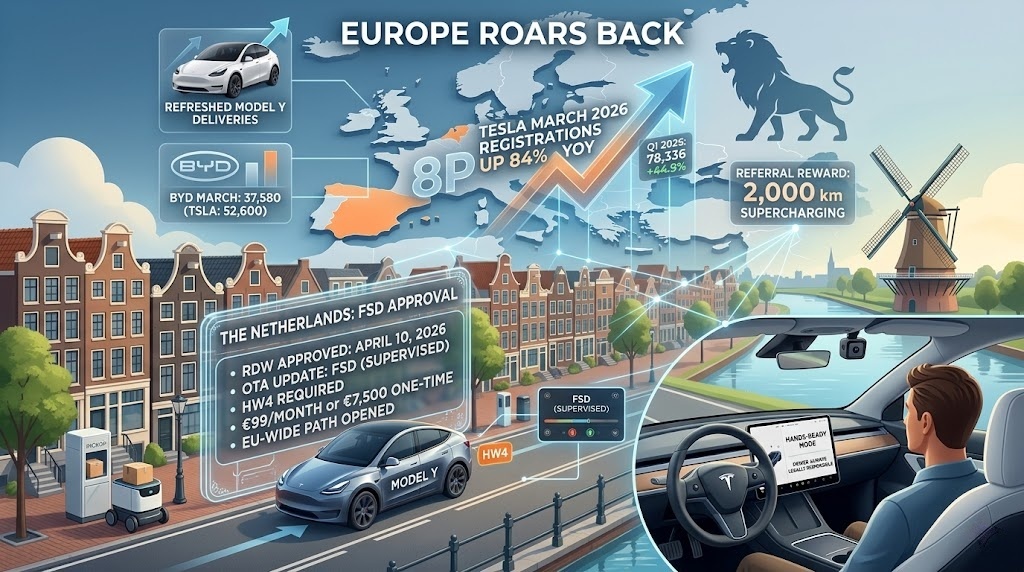
Then March 2026 happened. On April 23, ACEA released data that stunned even bullish analysts. Tesla‘s new‑car registrations across the European Union, the UK, Iceland, Liechtenstein, Norway, and Switzerland grew more than 84% year‑over‑year to 52,600 units. Within the EU alone, sales more than doubled from a year earlier to 36,868 vehicles. The overall European car market grew 11.1% in March — the best year‑on‑year gain in 23 months — but Tesla’s growth far outpaced the market average.
Two weeks before the ACEA release, the Netherlands provided another piece of good news. On April 10, 2026, the Dutch vehicle authority RDW granted Tesla regulatory approval for Full Self‑Driving (Supervised), making the Netherlands the first country in Europe where drivers can legally activate the system on public roads. The over‑the‑air rollout began the next day.
Together, these two developments — a dramatic sales rebound and a long‑awaited regulatory breakthrough — have fundamentally reset the conversation about Tesla‘s European trajectory.
Chapter 1: The Numbers That Changed the Narrative
The March sales figures are not just strong; they are historically significant for the European market.
According to ACEA data released on April 23, overall car registrations in the EU, Britain, and the EFTA region rose 11.1% to 1,581,169 vehicles in March — the largest year‑on‑year percentage increase since April 2024. Battery electric vehicle registrations jumped approximately 42% in March after rising about 15% in both January and February. The trend was particularly pronounced in Germany (EV registrations up 66%), France (up 69%), and Italy (up 72%).
Within that surging EV market, Tesla outperformed nearly every competitor. The 84.3% year‑on‑year increase came after Tesla resumed growth in February for the first time in more than a year — up nearly 12% across Europe — and then accelerated sharply in March. Quarterly volumes rose 45% to 78,300 units.
For context, Tesla’s 2025 European performance had been genuinely concerning. A combination of product line aging, Musk’s political statements regarding the Trump administration (where he oversaw the Department of Government Efficiency), and intense competition from BYD drove market share down from 2.4% to 1.8%. Multiple months saw year‑over‑year declines. The February 2026 uptick was the first monthly growth in 15 months. The March surge, therefore, represents not a blip but a potential turning point — a signal that Tesla may have bottomed out and is now rebuilding momentum.
What drove the rebound? Several factors appear to be at work. The refreshed Model Y — which began reaching European showrooms in early 2026 — has injected new energy into Tesla‘s best‑selling nameplate. Persistent high oil prices, driven in part by the Iran war and broader geopolitical tensions in the Strait of Hormuz, have made the running cost advantage of EVs far more compelling. And Tesla’s decision to double its referral reward in Europe — offering 2,000 km (approximately 1,300 miles) of free Supercharging to both buyer and referrer, up from 1,000 km previously — has clearly stimulated word‑of‑mouth demand.
Notably, Tesla has responded to the rebounding demand by actually increasing Model Y prices across several European markets — an unusual move for a company often associated with aggressive price cuts. The price increases suggest that supply and demand are now in a healthier balance than at any point in the past 18 months.
Chapter 2: The BYD Challenge — Closing Fast but Not There Yet
No analysis of Tesla‘s European performance is complete without accounting for BYD, the Shenzhen‑based automaker that has become Tesla’s most formidable global competitor.
ACEA data shows that BYD‘s new‑car registrations in Europe more than doubled in March 2026, reaching 37,580 units. That represents 147.6% year‑over‑year growth — an even higher percentage increase than Tesla’s 84.3% — but from a smaller base. In absolute terms, Tesla outsold BYD by roughly 15,000 units in March.
The competitive dynamic is evolving rapidly. BYD has gained share every month since ACEA began including the company in its data in summer 2025, and its lineup of affordable EVs — including the Atto 3, Seal, and Dolphin — continues to expand across European markets. BYD‘s European strategy has focused heavily on fleet sales and partnerships with rental car companies, allowing it to scale volumes quickly even as brand recognition lags Tesla’s.
For Tesla owners, the BYD challenge has two edges. On one hand, increased competition will likely drive innovation and potentially put downward pressure on prices. On the other hand, as BYD and other Chinese EV makers gain traction, Supercharger congestion could increase if networks are not expanded quickly enough. Tesla has thus far maintained a lead in charging infrastructure in Europe, but that advantage is not guaranteed to persist.
Legacy automakers are also showing signs of life in the EV space, though their growth rates lag well behind Tesla and BYD. Volkswagen‘s registrations grew 4.8% in March, Stellantis grew 6%, Renault grew 3.4%, and BMW climbed 15.4%. None of these come close to Tesla’s 84% surge. The electrification of legacy fleets is proceeding, but Tesla remains the pace‑setter in pure‑EV volume in Europe.
Chapter 3: Dutch FSD Approval — The Regulatory Breakthrough Europe Needed
While the March sales figures grabbed headlines for their magnitude, the regulatory news from the Netherlands may prove more consequential over the long term.
On April 10, 2026, the Dutch vehicle authority RDW granted Tesla regulatory approval for Full Self‑Driving (Supervised), making the Netherlands the first country in Europe where drivers can legally activate the system on public roads. The system was rolled out via over‑the‑air software update the following day.
The approval was not granted lightly. According to RDW, the system was extensively researched and tested for more than one and a half years on the agency‘s test track and on public roads. Tesla submitted thousands of pages of compliance documentation, and the approval was based on over 1.6 million kilometers of real‑world testing and more than 13,000 customer ride‑along experiences, according to Chinese media reports citing regulatory filings. The RDW explicitly stated that proper use of the system can make “a positive contribution to road safety,” while cautioning that vehicles equipped with FSD Supervised are not self‑driving — drivers must remain fully responsible and maintain control at all times.
Crucially, the European version of FSD Supervised differs from the US version in several key respects. While US drivers are allowed to enable a hands‑off mode on approved roads, European drivers must always be in what is called Hands‑Ready Mode, ready to take back control immediately. The driver remains legally responsible at all times, and the system continuously monitors attentiveness via a cabin‑facing eye‑tracking camera, issuing visual, audio, and haptic alerts if it detects inattention. If warnings are ignored, the system temporarily disables itself. The EU version‘s speed and behavioral settings are also notably more conservative than the US version. As RDW itself notes, both versions are “not comparable one‑on‑one”.
For owners, the practical implications are clear: European FSD Supervised is a driver assistance system, not an autonomy system. It handles steering, braking, and navigation across a wide range of scenarios, but the human driver must remain attentive and ready to intervene at all times. This is not the unsupervised self‑driving that Musk has promised for the future; it is a highly capable supervised system that shifts the driving burden without removing driver responsibility.
Chapter 4: Pricing, Hardware Requirements, and the Path to EU‑Wide Adoption
The Dutch approval comes with specific commercial terms that European owners need to understand.
FSD Supervised is available in the Netherlands as a monthly subscription for €99 or as a one‑time purchase for €7,500. Those who previously purchased the Enhanced Autopilot package are eligible for a lower subscription rate. The subscription pricing is roughly comparable to the US $99 monthly fee, though the one‑time purchase is higher in Europe than the US price (which Tesla eliminated in February 2026 in favor of subscription‑only access).
The hardware requirements are even more important. FSD Supervised is compatible only with Tesla vehicles equipped with Hardware 4 (HW4) — the computing platform introduced from early 2023. Vehicles with earlier HW3 cannot activate the system approved by RDW. For these vehicles, Tesla is targeting the release of an FSD Lite before the middle of 2026, though that version will lack the full feature set of the HW4‑compatible system. This hardware cutoff has already triggered a Europe‑wide collective legal action by HW3 owners who say they were promised that their vehicles had the necessary hardware for self‑driving capabilities.
What about the rest of Europe? The Dutch approval creates a regulatory shortcut for introduction in other EU member states. Tesla is actively pursuing rapid approvals in Germany, France, Belgium, Spain, and Italy, and is targeting EU‑wide availability by summer 2026. RDW has said it will submit an application to the European Commission, after which EU members will vote on whether to allow the system across the bloc. A spokesperson for the European Commission indicated that if the evidence from test results is satisfactory and there is support from a majority of member states, the Commission would prepare legislation authorizing the Netherlands to grant an approval that would pave the way for an EU‑wide rollout.
The timeline is ambitious but plausible. Belgium and Ireland have already indicated a willingness to recognize RDW‘s certification, though Germany and France — with their powerful domestic automotive industries — remain less certain. For owners outside the Netherlands, the expectation should be that FSD Supervised will be available on a country‑by‑country basis starting in mid‑2026, with full EU coverage potentially taking until late 2026 or early 2027.
Chapter 5: What Dutch and European Owners Should Do Now
If you are a Tesla owner in the Netherlands with an HW4‑equipped vehicle, you can subscribe to FSD Supervised today. The system is available through the Tesla app and can be activated as a monthly subscription without a long‑term commitment. Owners should be aware that the European version requires Hands‑Ready Mode and is monitored by eye‑tracking — it is not possible to drive hands‑off the way US owners can on approved highways.
For owners elsewhere in Europe, patience is required. The summer 2026 target for EU‑wide availability is aspirational, but Germany, France, Belgium, Spain, and Italy are the next most likely approvals. Owners in those countries should monitor Tesla‘s official communications and local regulatory announcements.
HW3 owners face a more difficult situation. FSD Supervised will not be available on HW3 vehicles in Europe. The promised FSD Lite update — expected before mid‑2026 — will bring some but not all FSD features to older hardware. Owners who paid for FSD packages on HW3 vehicles may have legal recourse; collective actions are already underway in multiple European jurisdictions. For now, HW3 owners should manage expectations: unsupervised driving is not coming to those vehicles, and the best that can be expected is a reduced version of supervised FSD.
Beyond the Netherlands, European owners can also take advantage of the doubled referral program, which offers 2,000 km of free Supercharging for both the buyer and the referrer. Tesla has not announced an end date for this promotion, so potential buyers should act quickly if they intend to use it.
Finally, owners across Europe should be aware of the long‑term roadmap. Tesla‘s energy business is also growing rapidly in Europe, and Virtual Power Plant programs using Powerwalls are expanding. While not directly related to FSD, the financial health of Tesla’s European operations — supported by strong vehicle sales — helps fund continued investment in Supercharger networks and service infrastructure.
Chapter 6: Implications for North American Owners
What does Tesla‘s European resurrection mean for US and Canadian owners? Several lessons and considerations emerge.
First, the European rebound demonstrates that demand for Tesla vehicles is more resilient than many feared. The combination of refreshed products, improved incentives, and high oil prices proved sufficient to overcome political backlash and competitive pressure. North American owners facing similar headwinds — aging product perception, political polarization around Musk, and increased competition — can take heart that a product‑led recovery is possible.
Second, the Dutch FSD approval provides a template for regulatory expansion in other jurisdictions. While the US already has FSD Supervised available in most states, the European approval process — especially the use of the EU‘s reciprocal recognition mechanism — could inform Tesla’s approach to other regulated markets such as Japan, South Korea, and Brazil. The key takeaway is that once one major regulator approves the system, others often follow.
Third, the hardware cutoff in Europe — restricting FSD Supervised to HW4 vehicles — reinforces a message that North American owners should already have absorbed: hardware generations matter, and HW3 vehicles are now excluded from the most advanced FSD features. North American owners with HW3 vehicles who have been waiting for unsupervised FSD need to accept that it will not arrive on their current hardware. The discounted trade‑in path Tesla has proposed is the only realistic way to access unsupervised capabilities.
Fourth, the European transition to subscription‑only FSD — the US eliminated the one‑time purchase option in February 2026 — suggests that Tesla is committed to recurring revenue models across all major markets. Owners who prefer ownership to subscription have missed that window in North America and will likely face the same choice in Europe as FSD spreads.
Finally, the price increases Tesla implemented in Europe on rebounding demand could foreshadow similar moves in North America if the market tightens. For prospective buyers, the lesson is not to wait indefinitely for lower prices. Tesla has shown that when demand returns, pricing power returns with it.
Conclusion
March 2026 will likely be remembered as the month Tesla proved its critics wrong about Europe. An 84% sales surge, more than double the overall market growth, signals that the combination of refreshed products, strong EV tailwinds, and strategic incentives can overcome brand headwinds and competitive pressure. The Dutch FSD approval — the first in Europe — adds a long‑term growth driver that goes beyond vehicle sales into software subscription revenue.
For European owners, the message is clear: HW4 is the baseline for advanced FSD; HW3 owners should explore trade‑in options or accept reduced features; and the subscription model is now the only path forward. The doubled referral bonus makes this an unusually favorable time to buy, but the window may close without warning.
For North American owners, the European story offers cause for cautious optimism. If Tesla can turn around a market that looked genuinely troubled just 12 months ago, the same product‑led recovery could play out in the US. The hardware lessons — especially the cutoff of older generations from new features — apply globally. Pay attention to what is happening in Europe, because the forces shaping that market will shape your market soon enough.
Tesla‘s comeback in Europe is real. Whether it is sustainable depends on how quickly FSD approvals spread, how effectively BYD is contained, and whether the refreshed Model Y can carry momentum through the rest of 2026. For now, owners and investors alike have reason to be encouraged — but not complacent.
FAQ
1. Can I use FSD Supervised in Germany if I have a Dutch‑registered car?
No. FSD Supervised is geofenced to approved jurisdictions. A Dutch‑registered car will have FSD active only while operating within the Netherlands. Driving into Germany will disable the feature until German approval is granted.
2. Is the €99 subscription cheaper or more expensive than the US price?
The €99 monthly fee is approximately $106 USD at current exchange rates, slightly higher than the US $99 monthly fee. The price difference reflects European regulatory costs and VAT structures.
3. Do I need HW4 for FSD Supervised in Europe?
Yes. The Dutch approval explicitly requires Hardware 4. HW3 vehicles cannot activate the approved system and will receive only the reduced FSD Lite update.
4. When will FSD come to my EU country if I do not live in the Netherlands?
Tesla is targeting EU‑wide availability by summer 2026, with active approval processes underway in Germany, France, Belgium, Spain, and Italy. Owners should expect a country‑by‑country rollout rather than a simultaneous bloc‑wide launch.
5. How long will the double referral bonus (2,000 km free Supercharging) last?
Tesla has not announced an end date. The promotion is active in multiple European markets for new Model 3 and Model Y purchases. It may end without notice.
6. Is Tesla losing ground to BYD in Europe?
Tesla outsold BYD by about 15,000 units in March 2026, but BYD‘s 147.6% year‑over‑year growth is growing from a smaller base. The gap is narrowing, but Tesla remains the European EV sales leader for now.
7. What is the difference between the European and US versions of FSD Supervised?
The European version requires Hands‑Ready Mode (hands on the wheel or ready to take control), while the US version allows hands‑off driving on approved roads. The European version also has more conservative speed and behavior settings and uses cabin eye‑tracking more aggressively. Driver responsibility remains with the human in both versions.
8. I have a HW3 vehicle and paid for FSD. What are my options?
Tesla has proposed a discounted trade‑in path to HW4 vehicles for owners who purchased FSD on HW3. No details on pricing or timing have been released. European HW3 owners have initiated collective legal actions seeking compensation or free upgrades.