
I. Introduction: The End of an Era
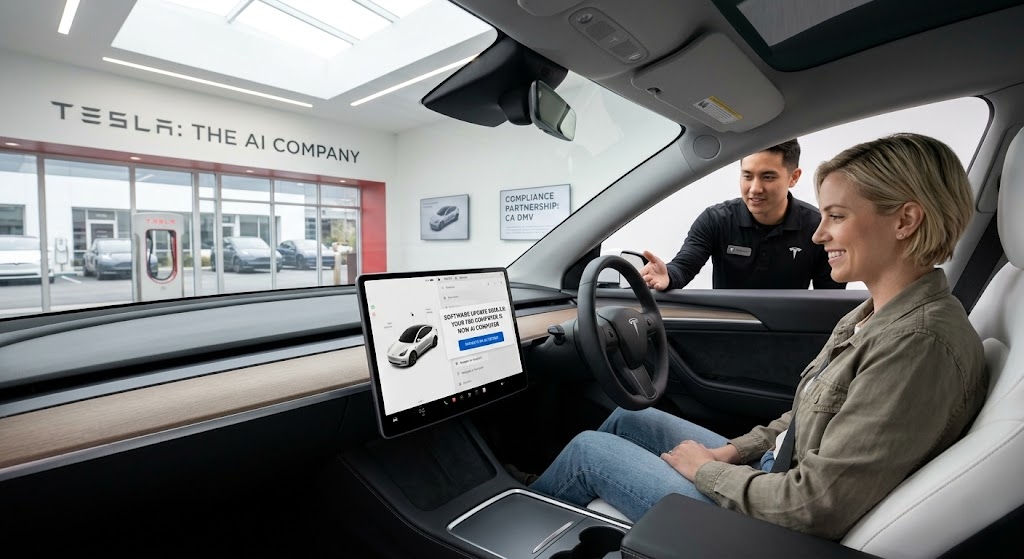
For years, the "FSD Computer" was the heart of the Tesla dream. It promised a future where the driver was a passenger, and the car was a robot. But as of March 2026, the term is being scrubbed from the UI. Software Update 2026.2.9 has arrived with a simple yet profound message: "FSD Computer" is now "AI Computer." Simultaneously, "Navigate on Autopilot"—the feature that defined Tesla’s highway dominance—has been rebranded to "Navigate on Autosteer."
To the casual observer, this might look like a mere word change. To the seasoned Tesla enthusiast and the legal teams in Palo Alto, it is a strategic retreat and a rebranding masterstroke. This article dives deep into the regulatory, technical, and marketing implications of this shift, exploring how Tesla is navigating the fine line between innovation and litigation.
II. The Legal Catalyst: The California DMV Showdown
The primary driver behind this sudden nomenclature shift isn’t a change in technology, but a change in the law.
1. The 30-Day Threat
In late 2025, the California Department of Motor Vehicles (DMV) issued a "deceptive marketing" complaint against Tesla. The agency argued that the terms "Autopilot" and "Full Self-Driving" inherently misled consumers into believing the cars were fully autonomous. By February 2026, the situation escalated. The DMV threatened to suspend Tesla’s manufacturer and dealer licenses in its home state for 30 days—a move that would have halted thousands of deliveries in America's largest EV market.
2. The Corrective Action
To avoid the suspension, Tesla entered a "corrective action" phase. The result is the Software Update 2026.2.9. By removing "Autopilot" and "Self-Driving" from the hardware and feature titles, Tesla is stripping away the linguistic "triggers" that regulators used to claim deception.
3. The Counter-Suit
True to form, Tesla isn't just complying; it’s fighting back. In February 2026, Tesla filed a lawsuit against the California DMV to overturn the "false advertising" ruling. Tesla’s argument is that its disclaimers—which drivers must agree to every time they engage the system—provide sufficient clarity that "Supervised" operation is required.
III. Technical Analysis: What’s in a Name?
Does the "AI Computer" drive differently than the "FSD Computer"?
1. Same Silicon, Different Label
Under the hood, the hardware remains unchanged. Whether your car is equipped with Hardware 3 (HW3) or the newer AI4 (formerly HW4), the renaming is purely cosmetic. The "AI Computer" still utilizes the same neural network weights and processing pipelines.
2. "Navigate on Autosteer" (NoA) Explained
The rebranding of "Navigate on Autopilot" to "Navigate on Autosteer" is perhaps the most significant change for the user experience. By calling it "Autosteer," Tesla is aligning the feature name with its SAE Level 2 reality. Autosteer implies a driver-assist function (helping you steer), whereas Autopilot implies a system that is in total control.
3. FSD (Supervised) v14 Integration
Coinciding with the rebrand is the rollout of FSD (Supervised) v14.2.2.5. This version introduces "Robotaxi-style" arrival options, allowing the AI Computer to intelligently select a parking spot (curbside, driveway, or garage) upon reaching a destination. This demonstrates that while the name is more "conservative," the capability is becoming more "aggressive."
IV. The Strategic Shift: Tesla as an AI Company
Why choose the name "AI Computer"? This is a calculated move by Elon Musk to shift the company's valuation framework.
1. Decoupling from the Car
By labeling the hardware an "AI Computer," Tesla is signaling that this silicon is not just for driving. It is the same architectural foundation used for Optimus (the humanoid robot). In 2026, Tesla wants investors to see the car as a "shell" for their AI, rather than a vehicle with some smart features.
2. The Subscription Pivot
As of February 2026, Tesla has largely moved away from the $12,000+ upfront FSD purchase in favor of a $99/month subscription model. The "AI Computer" branding makes the car feel like a platform for a software service (SaaS), encouraging owners to think of their monthly payment as a "compute fee" rather than a "driving fee."
V. Regional Impact: USA vs. Europe
1. United States
In the US, the rebrand is primarily about legal compliance and managing the expectations of a consumer base that has become increasingly litigious regarding ADAS (Advanced Driver Assistance Systems).
2. Europe and the UNECE
In Europe, the rebrand may actually accelerate the rollout of FSD features. European regulators (under the UNECE) have historically been much stricter about "Autopilot" terminology. By adopting "Navigate on Autosteer" globally, Tesla is removing a major diplomatic hurdle for the "FSD" (or rather, "AI-Supervised") launch in the EU, expected later in 2026.
VI. Conclusion: A Masterclass in Regulatory Navigation
Tesla’s transition from "FSD" to "AI Computer" is a defensive move that has been turned into an offensive marketing strategy. By complying with the DMV, Tesla keeps its sales channels open. By rebranding to "AI," it reinforces its identity as a technology leader.
For the owner, the car is as capable as ever—perhaps more so with the v14 update. But the era of "Full Self-Driving" as a marketing term is over, replaced by the more accurate, yet arguably more ambitious, era of the "AI Computer."
VII. FAQ (Frequently Asked Questions)
Q: Does the "AI Computer" rebrand mean my car is less capable? A: No. The change is strictly a naming and UI update to comply with California regulations. The underlying software (FSD v14) and hardware performance remain the same.
Q: Why was "Navigate on Autopilot" renamed to "Navigate on Autosteer"? A: Regulators argued "Autopilot" was misleading. "Autosteer" more accurately describes the system's function as a Level 2 driver-assist tool that requires your active supervision.
Q: Will this change affect my insurance or resale value? A: Likely not. Most insurance providers and valuation tools (like KBB) already categorize Tesla based on the hardware generation (HW3/AI4) rather than the marketing names in the UI.
Q: Is this rebrand happening in Europe too? A: Yes. Tesla is rolling out Software Update 2026.2.9 globally to ensure a consistent brand identity and to prepare for more expansive feature releases in the EU under new regulatory frameworks.