
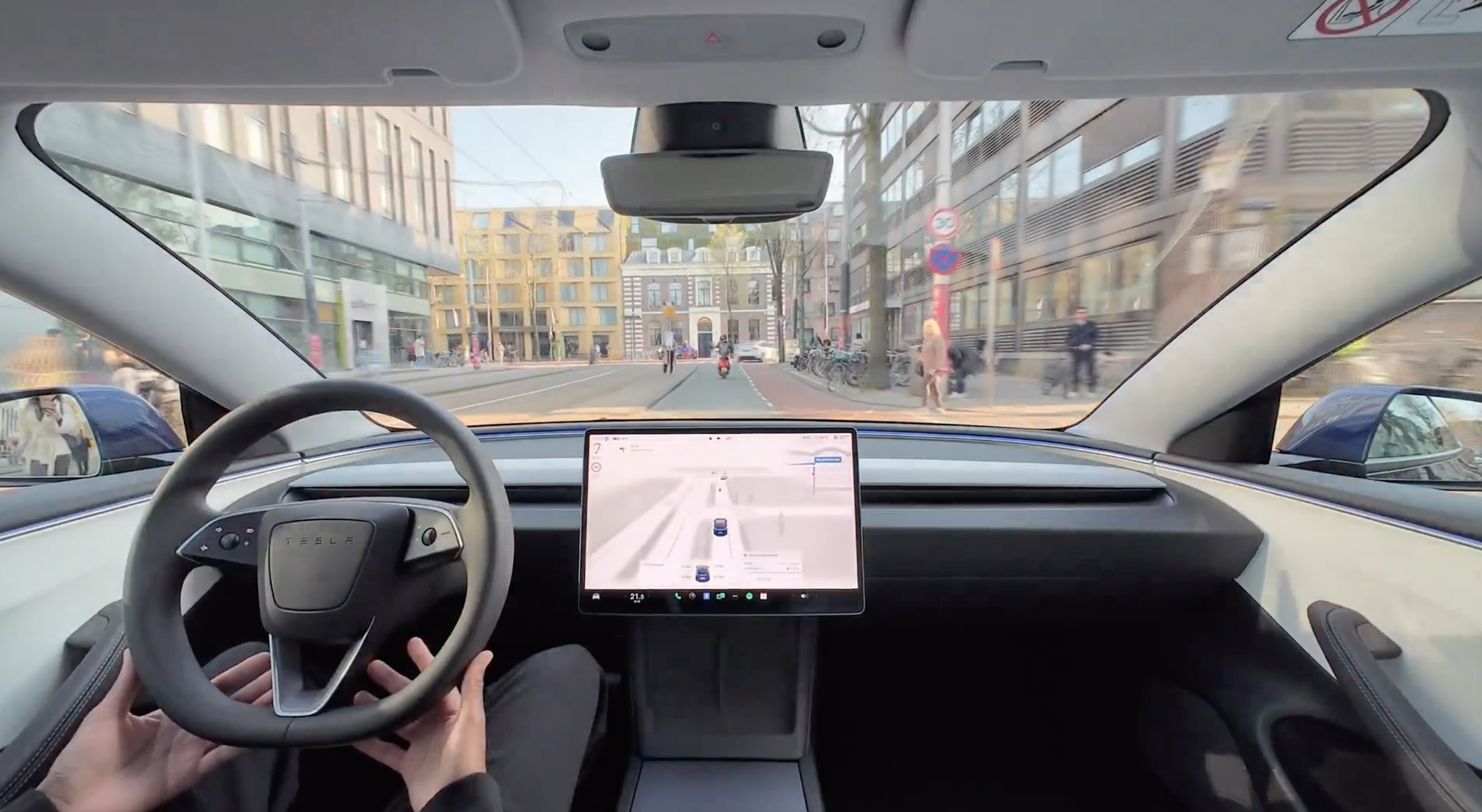
Imagine this: you are gliding through the chaotic symphony of the Place de l'Étoile in Paris, the twelve avenues converging on the Arc de Triomphe a testament to organized pandemonium. Your hands, however, are resting comfortably in your lap. Your Tesla, running Full Self-Driving (FSD) Version 13, is not just following lines on a map but is actively negotiating, predicting, and maneuvering through the intricate dance of Parisian traffic. It yields to an assertive Peugeot, anticipates a scooter zipping through a gap, and seamlessly finds its exit. Now, picture another scene: navigating the breathtaking but perilously narrow hairpin turns of Italy's Amalfi Coast, where the road is a mere suggestion carved into a cliffside. The car handles it with a confidence that borders on supernatural.
This vision, for years the stuff of science fiction and Elon Musk's most audacious tweets, is now technologically closer than ever. The release of FSD V13, with its revolutionary end-to-end artificial intelligence architecture, represents a monumental leap from a system that follows rules to one that exhibits genuine driving intelligence. It promises a future of unparalleled safety and convenience.
Yet, there is a profound paradox at the heart of this story. Europe, a continent that is home to the inventors of the automobile and some of the world's most advanced automotive engineering, presents the most formidable fortress of challenges to Tesla's ambitions. The very ground that birthed the Autobahn and the precision of German engineering is now the final frontier for FSD. Its successful deployment here is not a matter of a simple over-the-air software update; it is a complex and arduous negotiation between raw AI capability, a deeply entrenched and cautious regulatory framework, a mosaic of diverse and often unwritten driving cultures, and the world's most stringent data privacy laws.
This article will serve as your comprehensive guide to the multifaceted European debut of FSD V13. We will deconstruct the technological marvel that is V13, explaining why its neural network-driven approach is a game-changer. We will then journey into the intricate labyrinth of United Nations and European Union regulations that act as both a safety net and a gatekeeper. We will explore the fascinating, and for an AI, maddening, challenge of adapting to Europe's diverse cultural driving styles. Finally, we will analyze the critical battleground of data privacy under the GDPR, a uniquely European concern that could make or break Tesla's entire data-driven learning model. The arrival of FSD V13 in Europe is more than a product launch; it is a landmark confrontation between Silicon Valley's disruptive innovation and the Old World's cherished principles of order, safety, and privacy.
Chapter 1: Deconstructing the V13 Leap: More Than Just an Update
For years, Tesla owners have experienced the evolution of FSD through a series of incremental "beta" updates. Each version improved, but the underlying logic felt, at times, like a sophisticated but still recognizably robotic system. It was a complex stack of functions: one module for detecting lanes, another for identifying traffic lights, a separate one for predicting pedestrian paths, all stitched together with hundreds of thousands of lines of C++ code. FSD V13 is not merely an improvement on that model; it is a fundamental paradigm shift. It marks the transition from a system guided by human-written rules to one driven by a holistic, learned intelligence.
The most significant architectural change in V13 is the deep integration of an "end-to-end" neural network. This is the practical realization of the "photon-in, control-out" philosophy that Tesla's AI team has been championing. In layman's terms, this means the system takes raw video input from the car's eight cameras (the "photons") and, through a single, vast neural network, directly outputs the vehicle controls—steering, acceleration, and braking (the "controls"). This minimizes the need for intermediate steps and hard-coded human logic. The car is no longer just identifying a "pedestrian" from a library of images and then running a pre-programmed "if-pedestrian-then-brake" command. Instead, the network has learned from billions of miles of real-world driving data what the appropriate and nuanced driving behavior is in countless situations involving pedestrians, without ever being explicitly told the rules.
This approach yields a driving quality that is demonstrably smoother and more "human-like." Where previous versions might exhibit a slight jerkiness or hesitation in complex scenarios, V13 demonstrates a fluid confidence. It can, for instance, perform a "vehicle-in-front-of-vehicle" creep at an unsignaled intersection, subtly inching forward to signal its intent to other drivers—a deeply human behavior that is nearly impossible to program with explicit rules.
This new architecture is powered by several key technological advancements. The first is a vastly enhanced "World Model." This isn't just about identifying objects; it's about creating a high-fidelity, four-dimensional (3D space + time) understanding of the environment. V13 can now predict not just the path of a cyclist but their likely intent with greater accuracy. It understands that a cyclist looking over their shoulder is likely to change lanes, or that a group of pedestrians gathered at a corner might cross the street. This predictive power is absolutely essential for surviving the dense, unpredictable urban environments of cities like Rome or Amsterdam, where cars, bikes, trams, and people coexist in a tightly woven, chaotic ballet.
Furthermore, features that were previously weaknesses have been completely overhauled. The "Smart Summon" feature, which often proved clumsy and unreliable in the tight, irregular parking lots common in Europe, has been rebuilt using the new AI engine. The result is a much higher-fidelity system capable of navigating complex multi-level garages and finding a specific spot with precision. Similarly, the low-speed maneuvering for parking, a constant source of frustration, has been refined to handle the challenge of fitting a wide Model S into a narrow Parisian underground parking space that was designed in the 1970s.
This vision-only, AI-driven approach stands in stark contrast to the strategy of legacy European automakers. Competitors like Mercedes-Benz, with their Level 3 certified Drive Pilot, have opted for a "belt-and-braces" method, relying on a suite of expensive sensors including LiDAR, high-definition maps, and radar, in addition to cameras. While this provides a degree of redundancy, it also confines the system's operational design domain. Mercedes' system only works on pre-mapped, geofenced highways under specific conditions. Tesla's approach is infinitely more scalable. Because it learns from vision like a human, it is designed to eventually drive anywhere, on any road. FSD V13 is the most potent expression of this ambitious philosophy, but its ability to operate freely is now entirely dependent on its ability to convince Europe's regulators that its learned intelligence is as safe as, or safer than, a system bound by redundant hardware and rigid rules.
Chapter 2: The Great Wall of Regulation: Navigating UNECE and EU Law
If FSD V13's technology represents a powerful offensive charge, Europe's regulatory framework is an equally formidable defense. Unlike the United States, where autonomous vehicle regulation is a fragmented patchwork of state-level laws, Europe operates under a multi-layered, harmonized, and deeply cautious system. For Tesla, this means there is no single "approval" to be won; instead, it must navigate a complex web of rules set by the United Nations Economic Commission for Europe (UNECE) and the European Union, which are then interpreted and enforced by national authorities.
The single most important piece of legislation governing the future of FSD in Europe is UNECE Regulation No. 157 (UN R157). This is the world's first binding international regulation on Level 3 vehicle automation, and it is the gatekeeper through which any true self-driving system must pass. Initially adopted in 2021, its scope was specifically for "Automated Lane Keeping Systems" (ALKS). The regulation's core philosophy is built on a "safety cage" principle, defining a very narrow set of conditions under which a car can drive itself.
The initial limitations of UN R157 were severe. It permitted Level 3 operation only on motorways (roads with a physical separation from opposing traffic and no pedestrians or cyclists), at speeds below 60 km/h (37 mph), and required the driver to be able to take back control within 10 seconds. Furthermore, the system could only be activated in clear weather and good traffic conditions. While a 2022 amendment raised the speed limit to 130 km/h (81 mph) and allowed for automated lane changes, the fundamental principle remains: the system is designed for traffic jam assistance and highway cruising, not for general-purpose driving.
Herein lies the fundamental mismatch with Tesla's FSD. FSD V13 is architected as a holistic system, designed to handle everything from complex city intersections to rural backroads. It does not fit neatly into the narrow ALKS box defined by UN R157. For regulators, a system that can operate in a city is far more complex to certify than one that is technically prohibited from doing so by its design. Tesla's challenge is to either prove that its all-encompassing system can be safely constrained to meet ALKS rules or, more ambitiously, to convince regulators to create an entirely new category of certification for AI-driven systems.
Compounding this challenge is the EU's recently implemented General Safety Regulation 2 (GSR2). This sweeping legislation mandates a host of new safety technologies for all new vehicles sold in the EU. For automated systems, the most critical components are the requirements for a robust Driver Monitoring System (DMS), enhanced cybersecurity protocols to prevent hacking, and a mandatory "black box" style Event Data Recorder (EDR). The EDR must perpetually record parameters like speed, steering input, system status, and sensor readings, specifically to determine liability in the event of a crash. While Tesla cars already have a DMS and an EDR, they must now ensure these systems are fully compliant with the stringent specifications of GSR2, a process that requires reams of documentation and third-party certification.
Finally, even with UNECE and EU approval, Tesla must contend with the national level. Individual member states are responsible for the final "type approval" of vehicles. Countries like Germany, with its "Act on Autonomous Driving (StVG)," have been proactive in creating a legal framework for Level 3 and even Level 4 systems, but they are also known for their meticulous and demanding technical service agencies like the TÜV. France's legal framework is evolving, while the United Kingdom, post-Brexit, is developing its own parallel but distinct regulatory pathway. This means Tesla cannot pursue a single "Europe strategy." It must engage in a painstaking, country-by-country process of testing, validation, and certification, each with its own bureaucratic hurdles. This regulatory labyrinth, designed for safety and incremental progress, is the single greatest obstacle standing between the technical capability of FSD V13 and its widespread activation on European roads.
Chapter 3: The Unwritten Rules of the Road: FSD vs. European Driving Culture
Passing the legal tests set by regulators is one thing; passing the unwritten social tests of Europe's diverse roadways is an entirely different and arguably more complex challenge. For an AI that learns from observation, mastering the subtle, chaotic, and deeply ingrained cultural norms of driving across two dozen countries is a monumental task. An American-trained AI will quickly discover that what constitutes "normal" driving behavior can change dramatically with each border crossing.
The first major challenge is the spectrum of assertiveness. In Germany, the Autobahn is a masterclass in high-speed, disciplined driving. The "zipper merge" (Reißverschlusssystem) is not just a suggestion; it's a social contract executed with precision. An FSD system must learn to be assertive, taking its turn at the last possible moment without hesitation, an action that might be considered dangerously aggressive in the UK. Conversely, navigating a roundabout in Naples requires a different kind of assertive chaos, a game of vehicular chicken where eye contact and subtle nudges mean more than painted lines. A system trained for the orderly four-way stops of suburban California could be paralyzed by indecision. In London, a driver flashing their headlights might be signaling "after you," while in other countries, it's a warning to "get out of my way."
This leads to the second major hurdle: reading human intent. FSD V13's enhanced world model is designed to predict behavior, but much of European driving is a non-verbal conversation. A driver in a rural French village might acknowledge a yielding car with a slight wave of the hand. A pedestrian in Spain might make eye contact and give a slight nod to indicate they are waiting for you to pass. These are subtle cues an AI, lacking cultural context, cannot easily interpret. Can FSD distinguish between an angry gesticulation and a friendly wave? Can it understand the implicit communication that allows two drivers to negotiate a single-lane road on a Scottish Highland pass? This is the deep, nuanced level of social intelligence that currently separates human drivers from even the most advanced AI.
Finally, the sheer diversity of infrastructure presents a staggering challenge. The United States road network is relatively modern and standardized. Europe is a tapestry of ancient and modern. FSD must be able to navigate the labyrinthine, GPS-denied medieval streets of Siena, where roads are barely wider than the car itself. It must master the dreaded "priority to the right" (priorité à droite) rule common at unmarked intersections in France, which requires yielding to traffic from the right, a concept almost entirely alien to American drivers and AI training data.
Roundabouts are a particular point of contention. While present in the US, they are an art form in Europe, ranging from simple single-lane circles to the multi-lane, multi-exit behemoths like the Magic Roundabout in Swindon, UK, which is essentially five roundabouts arranged in a circle. Lane markings can be faded or non-existent, and local driving customs often supersede official rules. An AI must learn the specific "flow" of each one. A case study in contrast would be the high-speed, perfectly marked lanes of the Autobahn versus the chaotic free-for-all of the traffic circle around Rome's Colosseum. For FSD V13 to succeed, it needs not just a single driving license, but a full passport stamped with the unique driving dialect of every region it hopes to operate in. Tesla's fleet learning is a powerful tool, but it will need an immense amount of local European driving data to even begin to grasp this level of cultural and infrastructural complexity.
Chapter 4: Data is the New Oil, and Europe Has Strict Drilling Rights
Tesla's entire AI development strategy is built on a simple, powerful feedback loop: the global fleet of millions of vehicles acts as a distributed data-gathering network. Every complex intersection navigated, every disengagement, every tricky weather condition encountered provides valuable "training data" that is used to improve the neural networks. This data is the lifeblood of FSD. However, in Europe, this data-centric model collides head-on with the world's most formidable data privacy regulation: the General Data Protection Regulation (GDPR).
The GDPR is not just a law; it's an expression of a fundamental European belief in an individual's right to privacy. It is built on several core principles that pose direct challenges to Tesla's methodology. The first is data minimization, the principle that one should only collect and process data that is absolutely necessary for a specific purpose. Tesla's approach, which often involves collecting vast amounts of video data from its eight cameras for general network training, could be seen by regulators as excessive.
The second and more critical principle is user consent and transparency. Under GDPR, companies must obtain explicit, unambiguous consent from users before processing their personal data. Furthermore, they must be transparent about what data is being collected and for what purpose. For Tesla, this is a minefield. The video streams captured by a Tesla's cameras can inadvertently record faces of pedestrians, license plates of other cars, and even views into private homes. All of this can be classified as personal data under the GDPR. The question then becomes: can the car owner give consent on behalf of the thousands of other people the car might record in a single day's driving?
This is the core conflict: Tesla's AI requires a massive, continuous stream of real-world visual data to learn and improve, but GDPR demands that the collection of that data be strictly controlled, justified, and respectful of individual privacy. A "shadow mode" that collects data even when FSD is not active would face immense scrutiny from European data protection authorities.
To operate legally and ethically in this environment, Tesla has had to invest heavily in "Privacy by Design." This means engineering its systems from the ground up to protect privacy. One of the primary solutions is robust, real-time anonymization. This involves on-board processing within the car to automatically and irreversibly blur faces and license plates before the video clips are ever uploaded to Tesla's servers. The challenge is ensuring this anonymization is flawless; even a small percentage of failures could result in a major GDPR violation, carrying fines of up to 4% of a company's global annual turnover.
Another key strategy is data localization. In response to these concerns, Tesla has established a data center in Germany. By processing and storing data collected from European cars within the EU's borders, Tesla can better comply with GDPR's rules on cross-border data transfers and demonstrate a commitment to European legal standards. However, questions remain about access to this data by Tesla's primary AI development teams based in Palo Alto. Regulators will want clear and legally binding assurances about how this data is handled, who can access it, and under what circumstances it might leave the EU.
Ultimately, the data privacy issue may force a compromise in Tesla's development model for the European market. It may need to rely more heavily on simulation, or on a smaller, more carefully curated set of data from drivers who have explicitly opted into a more intensive data-sharing program. The "collect everything" approach that worked in the more lenient US regulatory environment will not fly in Europe. Navigating the GDPR is not a technical problem to be solved by engineers alone; it is a legal and ethical challenge that will require a fundamental adaptation of Tesla's core business model.
Chapter 5: The Road Ahead: A Tale of Two Timelines
The activation of FSD V13 across Europe will not be a singular, continent-wide event. The "flip the switch" moment that American owners have become accustomed to is a logistical and legal impossibility in the EU. Instead, Tesla will be forced to adopt a patient, phased, and country-by-country rollout strategy, creating a tale of two timelines: what owners can expect in the short term, and the much longer, more arduous path toward true, unrestricted self-driving.
In the short term, over the next 6 to 12 months, European owners will likely see a rollout that could be described as "Enhanced Autopilot Plus." Tesla will unlock the features of the V13 stack that are clearly permissible under existing Level 2 driver-assist regulations. This would include a vastly superior Autosteer and Traffic-Aware Cruise Control, capable of handling lane changes, interchanges, and traffic lights with unprecedented smoothness. The new neural network's ability to navigate complex junctions and roundabouts might be enabled, but still require constant driver supervision and hands on the wheel, legally classifying it as a support system, not an autonomous one. The improved Park Assist and Smart Summon features would also fall into this category. This initial phase is about delivering tangible improvements to the driving experience without crossing the regulatory red line into Level 3 autonomy.
The second phase, likely playing out over the next 1 to 3 years, will be the pursuit of Geofenced Level 3 Approval. This is where Tesla will take on the UN R157 (ALKS) regulation directly. The company will likely partner with a national authority, probably Germany's Kraftfahrt-Bundesamt (KBA), to certify FSD for hands-free operation on specific, pre-approved stretches of the Autobahn. This will be a long and data-intensive process, requiring Tesla to submit terabytes of safety data and conduct extensive real-world validation trials. If successful, a German Tesla owner could, for the first time, legally take their hands off the wheel in a traffic jam or during a long-distance cruise on the A9 between Munich and Berlin. This approval would then serve as a blueprint to be replicated in other countries like France and the UK that accept the UNECE framework.
The final phase is The Long Game: the pursuit of regulations that recognize the full capability of an AI-driven system beyond the narrow confines of ALKS. This is a multi-year effort, potentially taking 5 years or more, and involves not just engineering but extensive lobbying and public education. Tesla, along with other industry players, will need to convince UNECE and EU lawmakers to create a new regulatory category for systems that can operate in a wider domain, including city streets. They will need to prove, with billions of miles of data, that their system is statistically safer than a human driver in all conditions. This phase will involve pilot programs, "robotaxi" demonstrations in controlled urban areas, and a slow, deliberate process of building trust with both regulators and the public.
This phased approach will also be influenced by the competitive landscape. Mercedes-Benz already has its Level 3 Drive Pilot certified and on the road, albeit within the tight ALKS constraints. While technologically less ambitious than FSD, its regulatory approval puts pressure on Tesla to get its own certified system to market. At the same time, Tesla's vastly more capable (even if legally restricted) system will pressure regulators to modernize their rules, lest they be seen as stifling innovation. For the European Tesla owner, this means patience is key. The revolutionary promise of FSD V13 is real, but its delivery will be piecemeal, a gradual unlocking of capabilities as the technology proves itself not just on the road, but in the halls of power in Brussels and Geneva.
Conclusion
The arrival of FSD V13 on the global stage is an undeniable technological triumph. It represents the maturation of an idea—that a car can learn to drive using only vision, much like a human—from a bold concept into a tangible, high-performing reality. Yet, its journey into the heart of Europe underscores a critical lesson for the age of AI: groundbreaking technology alone is not enough.
We have seen that the path to deployment is not a highway but a dense, intricate cityscape of obstacles. The regulatory framework, built with the laudable goals of supreme safety and incremental progress, acts as a formidable gatekeeper, its narrow definitions struggling to classify a system as fluid and all-encompassing as FSD. Beyond the written laws are the unwritten rules of the road, a rich and complex tapestry of European driving cultures that will demand an unprecedented level of adaptability and social intelligence from the AI. And underpinning it all is the continent's unwavering commitment to data privacy, a foundational principle that challenges the very data-gathering model that makes Tesla's rapid learning possible.
FSD V13's European story is therefore a marathon, not a sprint. The eventual outcome will be a system profoundly shaped by its environment. The FSD that ultimately achieves widespread use in Europe may be more cautious, more privacy-aware, and more attuned to regional nuances than its American counterpart. This is not necessarily a bad thing. The continent's rigorous demands for safety, privacy, and reliability will serve as a crucible, forging a more robust and trustworthy system for the entire world.
This saga is more than just about one company or one product. It is a landmark case study in the global deployment of advanced artificial intelligence. It is a dialogue between the disruptive, fast-moving ethos of Silicon Valley and the deliberative, tradition-valuing spirit of Europe. The question is no longer if a car can teach itself to navigate the complexities of our world, but rather, how we, in turn, teach it to respect our diverse laws, cultures, and values. The road ahead for FSD in Europe is long and winding, but navigating it successfully will set the precedent for the future of autonomous technology for decades to come.
FAQ Section
1. What is the key difference between FSD V13 and the Autopilot my European Tesla has now? Autopilot in Europe is a Level 2 driver-assist system, primarily for highway use (lane-keeping and adaptive cruise control). It requires your constant attention and hands on the wheel. FSD V13 is architecturally a Level 4/5 capable system built on an end-to-end AI. This means it's designed to handle all aspects of driving, including complex city streets, intersections, and roundabouts. While it will be legally restricted in Europe initially, its underlying intelligence and smoothness are light-years ahead of standard Autopilot.
2. Is FSD V13 legal to use in Europe today? No, not in its full, hands-free capacity. Upon release, its features will be limited to what is permissible under existing Level 2 regulations, meaning it will function as a very advanced driver-assist system requiring full driver supervision. Achieving legal, hands-free Level 3 operation will require specific certification under UNECE Regulation 157, which will be a lengthy, country-by-country process limited to approved highways.
3. Why can Mercedes sell a Level 3 system in Europe but Tesla can't offer full FSD yet? Mercedes designed its Drive Pilot system specifically to fit inside the narrow box of the UNECE's ALKS regulation. It only works on certain highways, below 130 km/h, and uses expensive hardware like LiDAR and HD Maps. Tesla's FSD is a far more ambitious, vision-based system designed to work everywhere. This makes it much more difficult to certify under the current, limited regulations. In essence, Mercedes built a system to pass the test; Tesla built a system to solve the entire problem of driving, and now must figure out how to make it fit the test's rigid criteria.
4. How does the "end-to-end AI" in V13 actually work? Instead of using multiple different programs for detecting objects, planning a path, and controlling the car, an "end-to-end" system uses a single, large neural network. It takes the video from the cameras as input and directly outputs the steering, acceleration, and braking commands. It learns driving behavior holistically from watching billions of miles of human driving, allowing it to be much more fluid and "human-like" than a system based on rigid, pre-programmed rules.
5. Will my car's data be sent to the US if I use FSD in Europe? How does GDPR affect this? This is a major regulatory concern. To comply with GDPR, Tesla is increasingly processing and storing European data at its data center within the EU (in Germany). The company employs strong anonymization techniques, like blurring faces and license plates, before any data is used for training its networks. While some data may still need to be accessed by AI teams in the US, it is done under strict data protection agreements designed to be GDPR-compliant. User privacy is a non-negotiable legal requirement in the EU.
6. What is the most realistic timeline for seeing full city-street self-driving in a major European city? This is the long-term goal and is likely at least 5-10 years away. It requires not just perfected technology, but entirely new regulations to be written and adopted at both the EU and national levels. Before we see a Tesla legally navigating Paris or Rome on its own, there will be years of geofenced highway approval, pilot programs, and public-trust-building initiatives.