
Introduction
For the discerning Tesla owner—whether you are behind the wheel of a Cybertruck in Texas or a Model Y in the UK—the company’s trajectory is of more than just academic interest. It affects resale values, Supercharger network expansion, software updates, and the long-term viability of the ecosystem you have invested in. As we navigate through March 2026, Tesla is at a pivotal inflection point, transitioning from a period of stagnation to what could be a record-breaking year.
After a challenging 2024 that saw the company’s first annual decline in deliveries—1.79 million units—and a sluggish start to 2025, the pieces are now aligning for a significant rebound . The core question for owners and investors alike is whether Tesla can translate its expanding factory base, new product catalysts, and burgeoning energy business into sustained growth.
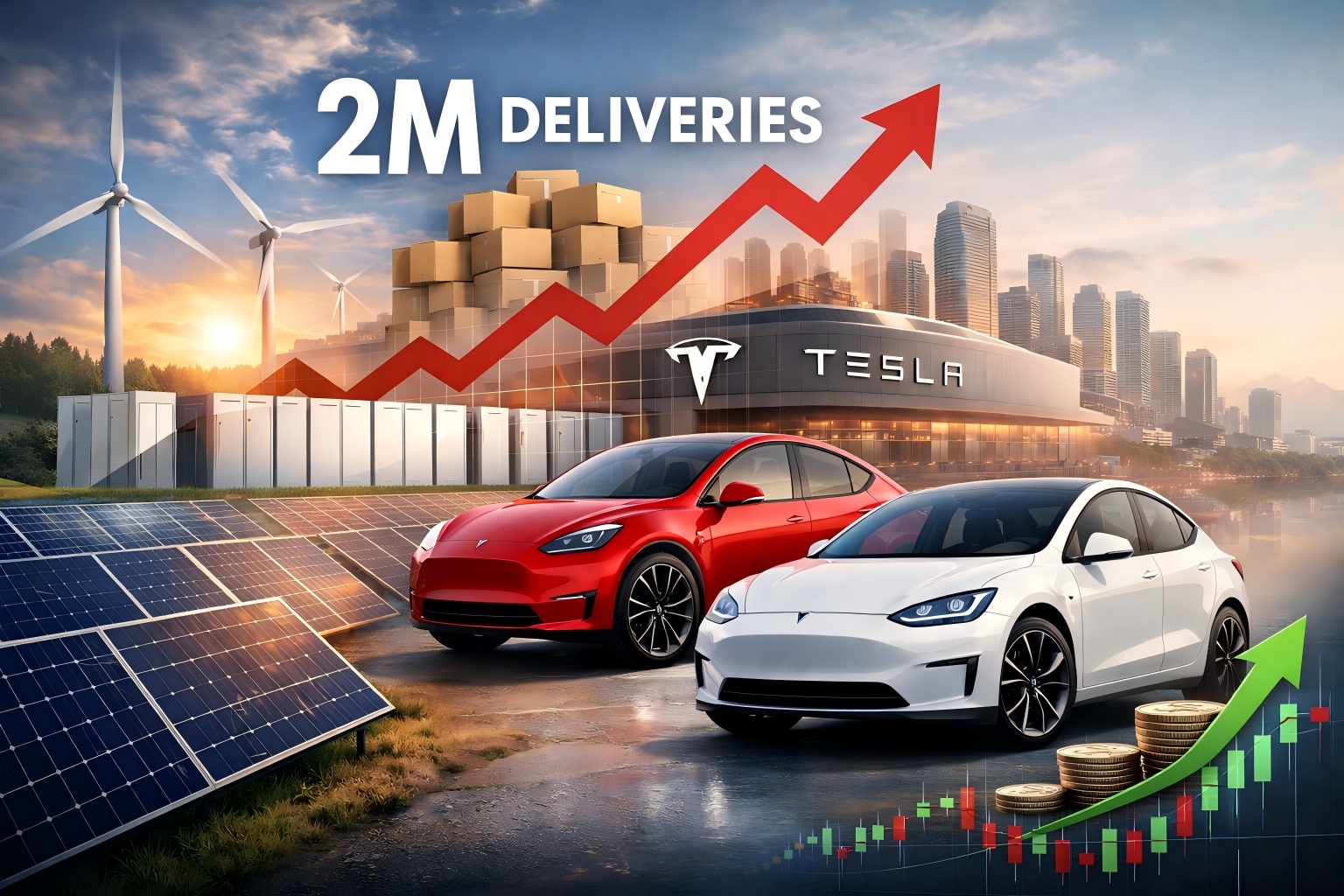
Chapter 1: The Capacity Math-How 2 Million Deliveries Becomes Reality
The foundation of any automaker’s success is manufacturing capacity. Tesla’s installed annual capacity now tops roughly 2.35 million vehicles, a figure that serves as the theoretical ceiling for production . Breaking this down geographically provides a clear picture of the company’s global footprint:
-
California (Fremont): Over 550,000 units (Model 3, Model Y, Model S, Model X).
-
Shanghai (Giga): Over 950,000 units (Model 3, Model Y) — the export hub for Europe and Asia.
-
Berlin (Giga): Over 375,000 units (Model Y) — serving the European market.
-
Texas (Giga): 250,000 for Model Y and 125,000 for Cybertruck .
Utilization is the Lever
The installed capacity is not the current production rate. The first half of 2025 saw production line changeovers for the refreshed Model Y (Juniper), which temporarily constrained output. However, the step-up from Q1 to Q2 deliveries suggests a pathway back to higher run rates as these new configurations stabilize.
To surpass 2 million deliveries in 2026, Tesla needs to achieve approximately 85% utilization of its current installed capacity. This is a realistic target, given that Shanghai has consistently operated at high efficiency, and the Berlin and Texas factories are ramping up with the refreshed Model Y and the new affordable vehicle . For European owners, a high-utilization Berlin factory means shorter wait times for vehicles and better parts availability. For US owners, the Texas factory’s output is critical for meeting demand for the Cybertruck and the upcoming affordable model.
Chapter 2: Product Catalysts-The Affordable Model and the Juniper Effect
Capacity alone is meaningless without demand. Tesla’s product lineup has been aging, and the revitalization is now underway with two major catalysts.
The 2026 Model Y Juniper
The refreshed Model Y, codenamed Juniper, is already rolling off production lines in all four global factories. February 2026 registration data from Europe showed Tesla’s overall registrations jumped 10% year-over-year across 15 major markets—the first meaningful growth in over a year. France saw a 55% increase, Spain 74%, and Norway 32%.
For owners, the Juniper refresh is more than cosmetic. It delivers up to 5% more range through aerodynamic tweaks, a quieter cabin with 22% less road noise, ventilated seats, and an entry-level Standard trim that starts at approximately $39,990 in the US. This is the vehicle that is directly combating competition from the Hyundai Ioniq 5, VW ID.4, and BYD Atto 3 in Europe.
The Affordable Model (Model 2 / Model Q)
Perhaps the most significant catalyst for 2026 is the “more affordable model.” Management confirmed that the first builds of this vehicle occurred in June 2025, with volume production planned for the second half of 2025 . While details remain scarce, this vehicle—rumored to be priced around $25,000–$30,000—is designed to expand Tesla’s addressable market dramatically.
For the European market, where smaller, more affordable vehicles dominate sales charts, this model is critical. It allows Tesla to compete directly with mass-market leaders like the Volkswagen Golf or the Renault Megane E-Tech. For US owners, this vehicle represents the democratization of the Tesla ecosystem, potentially bringing millions of new users into the Supercharger network and software ecosystem.
Chapter 3: Energy-The Silent Profit Center
While vehicles dominate headlines, Tesla’s energy division is increasingly becoming a pillar of the company’s financial health. The strategic synergy between the Energy business and the EV business is often overlooked but is crucial for long-term stability.
Megapack Deployment and Grid Stability
In early 2026, Tesla began rolling out Megapack-backed Supercharger sites in Europe, particularly in Sweden and Germany. These sites use giant batteries to store energy during off-peak hours and discharge at 500 kW during peak travel times, bypassing grid limitations. This is a direct application of the Energy division’s products to enhance the EV ownership experience.
Supercharger for Business (SfB)
In Europe, the SfB program allows Tesla to act as a hardware supplier and software provider to third-party hosts. This is an “asset-light” expansion model that generates revenue from the sale of V4 cabinets and stalls without the full capital expenditure of land acquisition. For Tesla, it turns the charging network from a cost center into a profit center.
Profit Margins
The energy business typically carries healthier margins than the automotive sector. In Q4 2025, Tesla’s automotive (ex-credits) gross margin surprised positively at 17.2%, supported by favorable regional mix and pricing. As the energy business scales, it provides a buffer against the cyclical downturns and competitive pressures in the automotive market .
Chapter 4: The Software and Autonomy Angle-FSD as a Revenue Stream
Tesla’s long-term valuation has always been tied to autonomy. In 2026, we are seeing a transition from promise to execution, albeit with careful steps.
Full Self-Driving (FSD) Subscription Model
Tesla has initiated a full transition of FSD to a subscription model, moving away from the high upfront purchase price. This strategy aims to convert the 1.8 million vehicle deliveries expected in 2026 into recurring high-margin software revenue . For owners, this lowers the barrier to entry for experiencing FSD, while for Tesla, it creates a predictable revenue stream.
Cybercab and Robotaxi
The Cybercab—a dedicated autonomous vehicle—is targeted for volume production in 2026. While the initial robotaxi service launched in Austin with safety riders, the scale deployment of Cybercab will be a massive test of Tesla’s autonomy claims. The success or failure of this initiative will have profound implications for the brand’s perception in both the US and European markets, where regulatory scrutiny on autonomy is intense.
Chapter 5: The Execution Risks-Navigating a Complex Landscape
Despite the bullish catalysts, Tesla’s path to 2 million deliveries is fraught with execution risks that owners and investors must acknowledge.
Intensifying Competition
The competitive landscape has changed dramatically since Tesla’s early dominance. In Europe, legacy automakers like Volkswagen and BMW are finally delivering competitive EVs. In the global market, Chinese OEMs like BYD are demonstrating impressive EV sales growth and are expanding into European markets . This competition puts pressure on Tesla’s pricing power and margins.
Regional Market Dynamics
-
United States: The market is characterized by high interest rates and the rising popularity of hybrid powertrains. Tesla has responded by introducing more accessible trims like the Model Y Base AWD at $41,990 to maintain volume without resorting to aggressive discounting that would erode margins .
-
Europe: The European market faces unique challenges, including aging grid infrastructure, diverse regulatory environments across countries, and high energy costs. Tesla’s strategy of Megapack-backed sites and SfB program is a direct response to these hurdles.
The Valuation Conundrum
Tesla’s market capitalization sits at approximately $1.4 trillion against trailing-12-month revenue and profit of about $93 billion and $5.9 billion, respectively. This implies extraordinarily high growth expectations. Any missteps in execution—whether a delayed Cybercab launch, a slower-than-expected ramp of the affordable model, or a margin squeeze from competition—could cause a sharp sell-off.
Chapter 6: What This Means for Owners
For Tesla owners in the US and Europe, the business strategy outlined above directly impacts the ownership experience in several ways:
-
Resale Value Stability: A successful delivery rebound (2 million units) and the introduction of new models like the affordable vehicle will help stabilize the used market by demonstrating strong brand momentum.
-
Supercharger Network Growth: The capital generated from the Energy division and the SfB program is reinvested into network expansion. More revenue means more stalls, faster.
-
Software Ecosystem: The shift to FSD subscription ensures that the software you use will continue to receive updates and improvements, as it becomes a primary revenue driver for the company.
-
Service and Parts Availability: High utilization of factories in Berlin and Texas translates to better parts availability and shorter service wait times for European and North American owners.
Conclusion
As of March 2026, Tesla is standing at the threshold of a transformative year. The capacity is in place, the product catalysts—namely the Juniper refresh and the affordable model—are arriving, and the energy business is evolving into a robust profit center. The goal of surpassing 2 million deliveries is ambitious but achievable if the company executes effectively on its manufacturing ramp-up and demand generation.
For owners, this is a moment of cautious optimism. The ecosystem you are part of is growing, diversifying, and becoming more financially resilient. However, the challenges of intensifying competition and macroeconomic headwinds remain real. Whether Tesla can navigate these hurdles while maintaining its innovative edge will determine not only its stock price but also the long-term value and experience of owning one of its vehicles. The next 12 months will be a defining chapter in the Tesla story.
FAQ
Q: Will the new affordable model be available in Europe?
A: Yes. The affordable model is expected to be produced at Giga Berlin for the European market, leveraging the factory’s existing capacity to meet local demand.
Q: How does the Energy business help Tesla owners?
A: The Energy business provides direct benefits through Megapack-backed Supercharger sites, which ensure stable, high-speed charging even when the local grid is strained. It also generates revenue that supports network expansion.
Q: Is the FSD subscription available in Europe?
A: Availability varies by country due to regulatory differences. Tesla is working to expand FSD capabilities and subscription access across Europe, but the rollout is contingent on local approvals.
Q: What is the current delivery outlook for 2026?
A: Consensus expectations project auto volumes to recover to approximately 1.8 million units in 2026, representing 8.2% year-over-year growth. With strong execution, deliveries could surpass 2 million.
Q: How is Tesla dealing with competition from Chinese EVs in Europe?
A: Tesla is leveraging its brand strength, the Supercharger network advantage, and localized production at Giga Berlin to maintain competitiveness. The affordable model is a direct response to lower-priced competitors.