
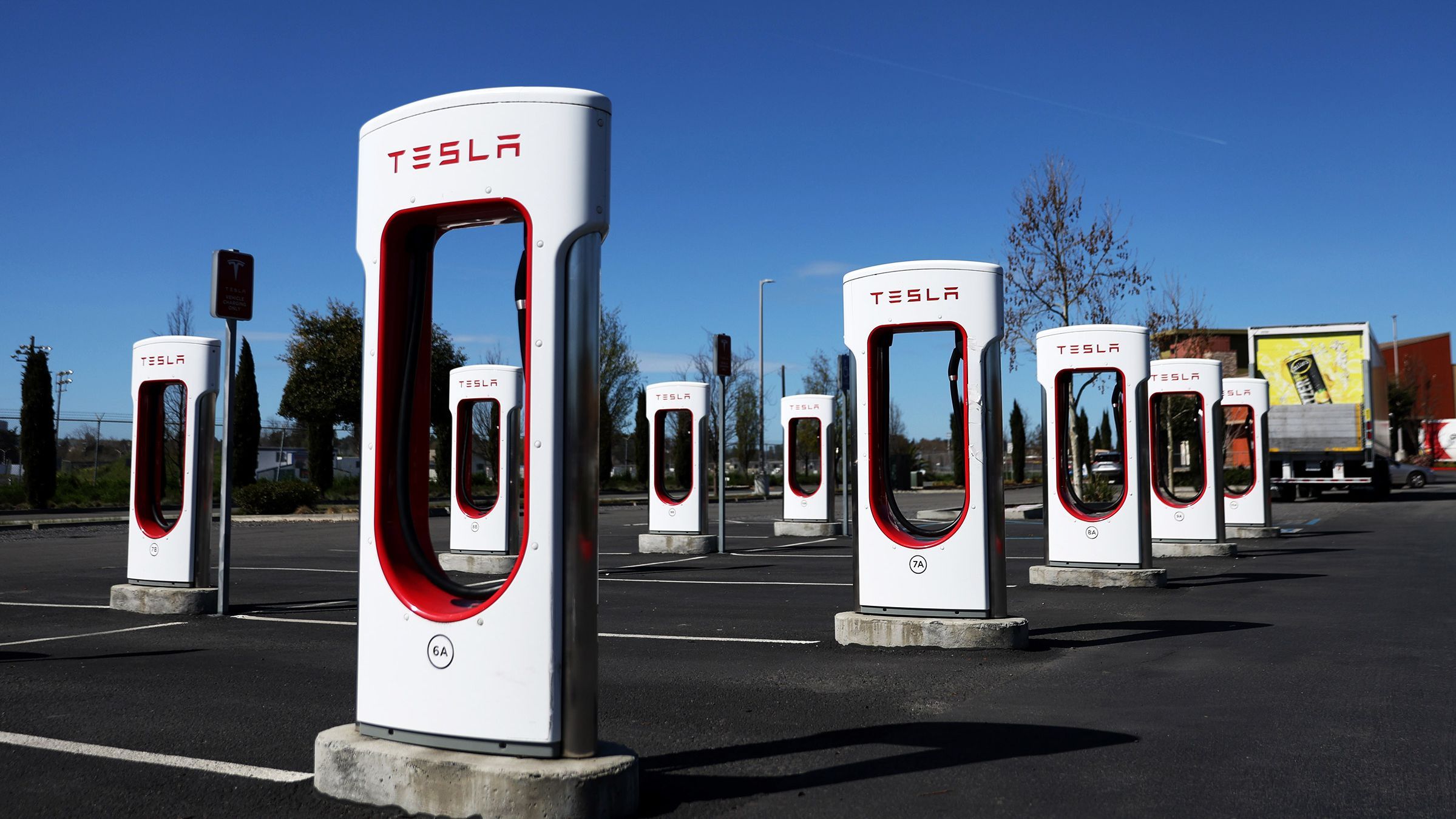
Tesla’s Supercharger network — long a competitive advantage — is undergoing a significant transformation in 2025. Not only is Tesla accelerating its deployment of higher-power stalls (including next-generation V4 hardware), but the company is also opening up its network to non-Tesla EVs and non-Tesla apps. Key developments include:
-
Live availability data integration: Tesla now shares real-time Supercharger stall availability with Google Maps, enabling better routing and planning for all EV drivers.
-
MultiPass rollout in Europe: Tesla’s MultiPass feature allows Tesla owners to charge at supported third-party networks using their Tesla app or keycard — simplifying billing and reducing app fragmentation.
-
Growing non-Tesla access: Through adapter and native NACS (North American Charging Standard) adoption, brands like Mercedes-Benz, Volvo, and Polestar are integrating with Tesla’s Supercharger network.
-
Faster hardware deployment: Tesla is expanding its high-power V3 and V4 Superchargers, improving power delivery, adding CCS connectors, and increasing capacity to serve both Tesla and non-Tesla EVs.
This article dives deep into Tesla’s evolving Supercharger strategy: the technical and infrastructure upgrades, the strategic shift toward open charging, the user experience implications, and how this plays into Tesla’s longer-term vision of charging as a platform (not just a proprietary network).
1. The State of the Supercharger Network in 2025
1.1 Scale and Growth Metrics
-
According to recent community-reported data, Tesla’s global Supercharger network grew significantly in Q3 2025: there were 7,753 Supercharger stations and 73,817 total stalls, representing ~18% year-over-year growth. Average new stations added ~376 in that quarter, and connectors increased by ~3,589.
-
Throughput also climbed: the same report suggests ~1.8 TWh of energy was delivered in that quarter — showing strong utilization.
1.2 Hardware Evolution: V3 / V4
-
Tesla has already deployed V3 Superchargers (250 kW+), but more importantly, it's building V4 Superchargers, which promise power up to 500 kW for passenger EVs and even 1.2 MW for its Semi trucks.
-
V4 cabinets also bring design improvements: longer cables, CCS connectors (enabling native or adapter-based access), and more efficient electronics — helping Tesla scale its network more rapidly and support a broader range of EVs.
1.3 Strategic Significance
Tesla’s aggressive buildout of Superchargers demonstrates that charging infrastructure is not just cost center — it's a strategic asset. By scaling both quantity (stations) and quality (higher-power hardware), Tesla is doubling down on its infrastructure moat. This also supports its broader vision of being not just a carmaker, but a charging-platform provider.
2. Google Maps Integration: Real-Time Supercharger Availability
One of the biggest user-experience leaps Tesla has made recently is sharing live Supercharger stall availability with Google Maps.
2.1 What’s New
-
As of November 2025, Tesla has enabled live stall availability (number of free vs total stalls) for its Superchargers in Google Maps.
-
The Tesla Charging account announced it on X: “Live availability of Superchargers now in Google Maps.”
-
The integration shows per-station occupancy (e.g., “6/8 stalls available”), and sometimes maximum charging power of the station (e.g., 250 kW) on the map interface.
2.2 Geographic Scope
-
The feature covers both North America and Europe, per EVXL’s reporting.
-
It works in Google Maps on mobile (iOS/Android), and for some users even via in-car systems (Android Auto / Google Maps–based navigation), depending on vehicle integration.
2.3 Why This Matters
-
Reduced Range Anxiety: Real-time availability helps drivers avoid arriving at full Superchargers — one of the most anxiety-inducing EV moments.
-
Better Route Planning: Users can pick stations with free stalls, or decide to detour to lower-occupancy chargers.
-
Inclusion for Non-Tesla Drivers: As Tesla opens its network to other brands, this data gives non-Tesla EV owners better planning tools, not tied to Tesla’s app. EVXL notes this as a strategic step in democratizing Tesla’s charging intelligence.
-
Traffic Management: From Tesla’s side, exposing occupancy data can help distribute load more evenly; drivers may self-balance to less busy stations.
2.4 Limitations & Remaining Challenges
-
Currently, Google Maps does not support automatic route planning that dynamically picks Superchargers based on predicted occupancy or wait times: users must manually add waypoints.
-
The data is “live,” but there’s no clear public evidence yet of predictive forecasting (e.g., expected wait times) or virtual queuing being integrated into Maps. EVXL notes Tesla’s interest in future features like trip re-routing based on expected demand.
-
Some users report incomplete behavior: in Reddit, non-Tesla drivers with adapters say they must manually enable NACS plug compatibility in Google Maps settings (“Compatible plugs -> NACS”) for Supercharger stations to appear.
3. MultiPass: Tesla’s Bridge to Third-Party Charging in Europe
Tesla’s MultiPass feature is a key pillar in its strategy to unify charging under a single Tesla-managed experience, even for non-Supercharger networks.
3.1 What Is MultiPass?
-
MultiPass lets Tesla owners charge at supported third-party EV networks using their Tesla account (app or key card).
-
Drivers can pay via their Tesla account — no need to register separately with each charging network or manage multiple apps/cards.
-
The Tesla app consolidates both Supercharger and supported third-party charging stations in its map interface, simplifying access and billing.
3.2 Geographic Expansion
-
Originally launched in the Netherlands in September 2025, Tesla has now extended MultiPass to Sweden, Germany, UK, France, and Belgium.
-
Tesla announced more partner networks, including large European providers such as Fastned and Allego, as part of the rollout.
3.3 How It Works in Practice
-
To enable MultiPass, Tesla users need to go to the Tesla app, accept the MultiPass invitation (if available), and optionally activate “Display third-party charging stations” in the navigation settings.
-
The Tesla key card (if supported) can also be used to initiate charging at third-party sites — but you must first activate it as a “charging card” within the Tesla app.
-
Charging cost depends on the third-party operator: Tesla doesn’t set the per-kWh price, so Tesla customers should check the station in the app or in-car before starting a session
3.4 Benefits to Users
-
Simplified Ecosystem: Instead of carrying many cards or apps, Tesla users can use a single account.
-
Integrated Payment & Billing: Users get a monthly invoice for all their charging sessions, including third-party ones.
-
Improved Accessibility: MultiPass widens the effective charging network for Tesla drivers, especially where Supercharger infrastructure is sparse or congested.
3.5 Challenges and Limitations
-
Some caveats remain: not all third-party stations support Supercharger-like capabilities (e.g., preconditioning, virtual queuing). Tesla notes that at some third-party sites, keycard-based or app-based “magic dock”-style features don’t apply.
-
In some regions, activation is still being rolled out slowly; not all Tesla users can yet see or enable MultiPass in their app. A test in Germany found some users still saw only Supercharger pricing even with the latest software.
-
Price transparency is mixed: because operators set prices individually, Tesla customers must remain alert about rate changes, idle fees, or blocking fees on non-Tesla networks.
4. Non-Tesla EV Access: Opening the Supercharger Network
Tesla is no longer keeping its Superchargers as a Tesla-only fortress. Instead, it's gradually opening the network to other EV brands through adapters, NACS standardization, and partnerships.
4.1 Adapter and NACS Adoption
-
Many automakers are now adopting NACS (North American Charging Standard), allowing their EVs to plug into Tesla Superchargers. For example, Mercedes-Benz BEVs in the U.S. gained access to Tesla superchargers starting February 2025 via NACS/CCS-to-NACS adapters, and future models will have native NACS ports.
-
Volvo and Polestar EVs are also integrating with Tesla’s Supercharger network. These brands are providing adapters (or moving to NACS in future models) for existing and future cars.
4.2 Third-Party Payment & Plug-and-Charge Integration
-
Some EV brands will use Tesla’s billing or authentication mechanisms to plug into Superchargers. For example, Mercedes’ integration with Tesla’s network will leverage “Plug & Charge” via the “Mercedes me Charge” system.
-
For non-Tesla drivers, having NACS-compatible adapters + real-time station data (via Google Maps) makes route planning and charging more seamless.
4.3 Benefits & Strategic Rationale
-
Network Utilization: Opening the Supercharger network to more brands helps Tesla increase utilization, improve ROI on its infrastructure investments, and amortize costs more efficiently.
-
Platform Play: By positioning the Supercharger network as a platform (not just for Tesla cars), Tesla can monetize infrastructure more broadly and become a central player in the wider EV ecosystem.
-
Customer Acquisition & Branding: As non-Tesla EV drivers use Tesla Superchargers, the network’s stickiness may create upsell or brand-awareness opportunities; Tesla strengthens its brand as not just a carmaker but an EV infrastructure leader.
4.4 Risks and Challenges
-
Adapter Logistics and Compatibility: Not all Superchargers are compatible with third-party cars yet. Reddit users report that some V2 Superchargers still lack the necessary communication protocols for non-Tesla EVs.
-
Billing Complexity: Supporting payments from non-Tesla accounts or systems introduces complexity — Tesla must manage different payment flows, authentication systems, and billing reconciliation.
-
Infrastructure Strain: More vehicles using Superchargers could increase urban congestion. Without effective demand forecasting and load management, peak utilization could degrade the charging experience for all.
5. User Experience: What Tesla Owners & Non-Tesla Drivers Should Know
5.1 For Tesla Owners
-
Use Google Maps to plan trips more efficiently: with real-time stall availability, you can choose less congested Superchargers.
-
Enable MultiPass: If you drive in Europe, activating MultiPass in the Tesla App gives you access to more charging stations, consolidating your experience.
-
Monitor session costs: When charging via MultiPass at third-party sites, check pricing in the app or in-car UI before starting — rates may vary per network.
5.2 For Non-Tesla EV Drivers
-
Make sure you have a NACS-compatible adapter (or a vehicle with NACS built-in) if you want to use Tesla Superchargers where open access is granted.
-
In Google Maps, you may need to explicitly set your vehicle to show NACS-compatible plugs: go to Maps settings → My Vehicle → toggle the NACS plug type.
-
Even if you can navigate to a Supercharger, confirm via your app (Tesla or your OEM’s) that billing is set up or that “Plug & Charge” (if supported) is enabled.
5.3 Potential Issues & Workarounds
-
Some users (especially on Reddit) report that certain Supercharger stations don’t appear in their in-car maps or phone apps, either due to adapter issues or because not all Superchargers communicate occupancy in the same way.
-
If a station appears “full” in Maps, consider rerouting to a nearby charger, or waiting a few minutes — with real-time data, you can often plan dynamically.
-
For long road trips, combine Tesla’s own trip planner (if in-car) with Google Maps to get both predictive routing and occupancy insights.
6. Strategic Implications for Tesla & the EV Industry
6.1 Tesla’s Charging Vision
Tesla is evolving from a closed Supercharger network toward a charging-as-a-platform business. By integrating third-party charging (via MultiPass), sharing real-time data, and enabling non-Tesla access, Tesla stands to gain significantly:
-
Monetization: More vehicles, more sessions, more revenue per station.
-
Data Advantage: With more usage, Tesla can collect richer charging data (utilization patterns, peak demand, geographical insights), which helps optimize infrastructure planning.
-
Network Effect: As more EVs use Tesla’s infrastructure, its value proposition as a “go-to” charging network strengthens, potentially influencing OEMs, fleets, and new EV entrants.
6.2 Challenges & Competitive Risks
-
Regulation & Market Risk: Tesla must navigate different regulations, especially in Europe, where interoperability rules, price caps, and roaming policies may apply.
-
Load Management: More users could overload popular Superchargers unless Tesla invests in smart load balancing, demand forecasting, or queuing.
-
Capital Intensity: Building out V4 infrastructure is expensive. ROI depends on utilization, which in turn depends on how well Tesla can monetize non-Tesla usage.
6.3 Future Opportunities
-
Predictive Queuing / Virtual Waiting: Tesla may introduce virtual queuing, where drivers can reserve or join a waitlist for busy Superchargers via app — reducing physical congestion.
-
Dynamic Pricing: As part of more open platform play, Tesla could test variable pricing at Superchargers depending on demand, time of day, or occupancy.
-
Partnerships: Tesla can partner with OEMs, municipal fleets, and ride-sharing companies to scale infrastructure usage, possibly offering tiered access or subscription models.
Conclusion
Tesla’s Supercharger strategy in 2025 is about more than just scaling up; it’s about opening up. By sharing real-time stall data via Google Maps, offering MultiPass for third-party charging, and enabling non-Tesla access through adapters and NACS, Tesla is transforming its Supercharger network into a central pillar of the broader EV ecosystem.
For Tesla owners, these changes mean smarter charging decisions, less waiting, and access to more stations. For non-Tesla drivers, they signal the growing reality that Tesla’s charging network is no longer off-limits. For Tesla itself, it's a bet on charging infrastructure not just as a cost center, but as a strategic growth engine.
The challenge will be managing growing demand, load balancing, and preserving the Supercharger experience as more players tap into it. But if Tesla executes well, its Supercharger network may become not just the best place to charge a Tesla — but one of the most reliable and intelligent charging networks for any EV driver.
FAQ
-
Can non-Tesla EVs use Tesla Superchargers?
Yes, but only at certain Supercharger stations and depending on whether your vehicle supports NACS or you have a suitable adapter. Mercedes, Volvo, Polestar, and other brands are integrating via adapters or native NACS. -
How do I enable Tesla’s live Supercharger occupancy in Google Maps?
The live-availability data is now published by Tesla and appears in Google Maps for many stations; users may need to enable certain “plug type” settings (such as NACS) in Maps for compatibility. -
What is Tesla MultiPass, and how do I activate it?
MultiPass lets Tesla drivers charge at third-party networks using their Tesla account. You activate it in the Tesla app (Manage Payments → Tesla MultiPass) or by enabling “Display third-party charging stations” in navigation settings. -
Are charging rates the same on MultiPass as on Superchargers?
No — rates depend on the third-party network. Tesla users should check pricing in the app or vehicle UI before starting a session, as third-party operators set their own per-kWh price and may also charge idle or blocking fees. -
Will my car always be able to use Tesla Superchargers?
It depends. If your vehicle has a NACS port or a compatible adapter and the Supercharger station supports non-Tesla EVs, you may be able to use it. Also, some older Superchargers (V2) might not support all communication protocols, limiting compatibility. -
Does Google Maps show estimated wait times or queuing for Superchargers?
As of now, only live occupancy (current free/total stalls) is shown. Predictive wait times or virtual queuing features are not yet publicly integrated in Maps, though Tesla has expressed interest in future features like demand forecasting. -
Will more Tesla Supercharger stations be upgraded to V4?
Yes — Tesla is building V4 Superchargers, which support higher power (up to 500 kW) and include CCS connectors, which helps with non-Tesla vehicle access. -
How does this affect Tesla’s business model?
Tesla is shifting toward treating its Supercharger network as a platform, not just as proprietary infrastructure. Opening to other brands and networks can drive higher utilization, more data, and potential recurring revenue.