
Introduction: When an Automaker Stops Talking About Next Quarter's Deliveries
In January 2026, Tesla released its Q4 2025 earnings report.
By conventional standards, this should have been a post-mortem on "the second consecutive year of declining deliveries." Tesla's global deliveries in 2025 fell 9% year-over-year, with a 16% decline in Q4 alone—the largest drop since going public.
Yet during the earnings call, Musk spent less than 10 minutes discussing automobiles.
The remainder of his time was devoted to Cybercab, Optimus, Dojo 2.0, xAI, and a $20 billion capital expenditure plan.
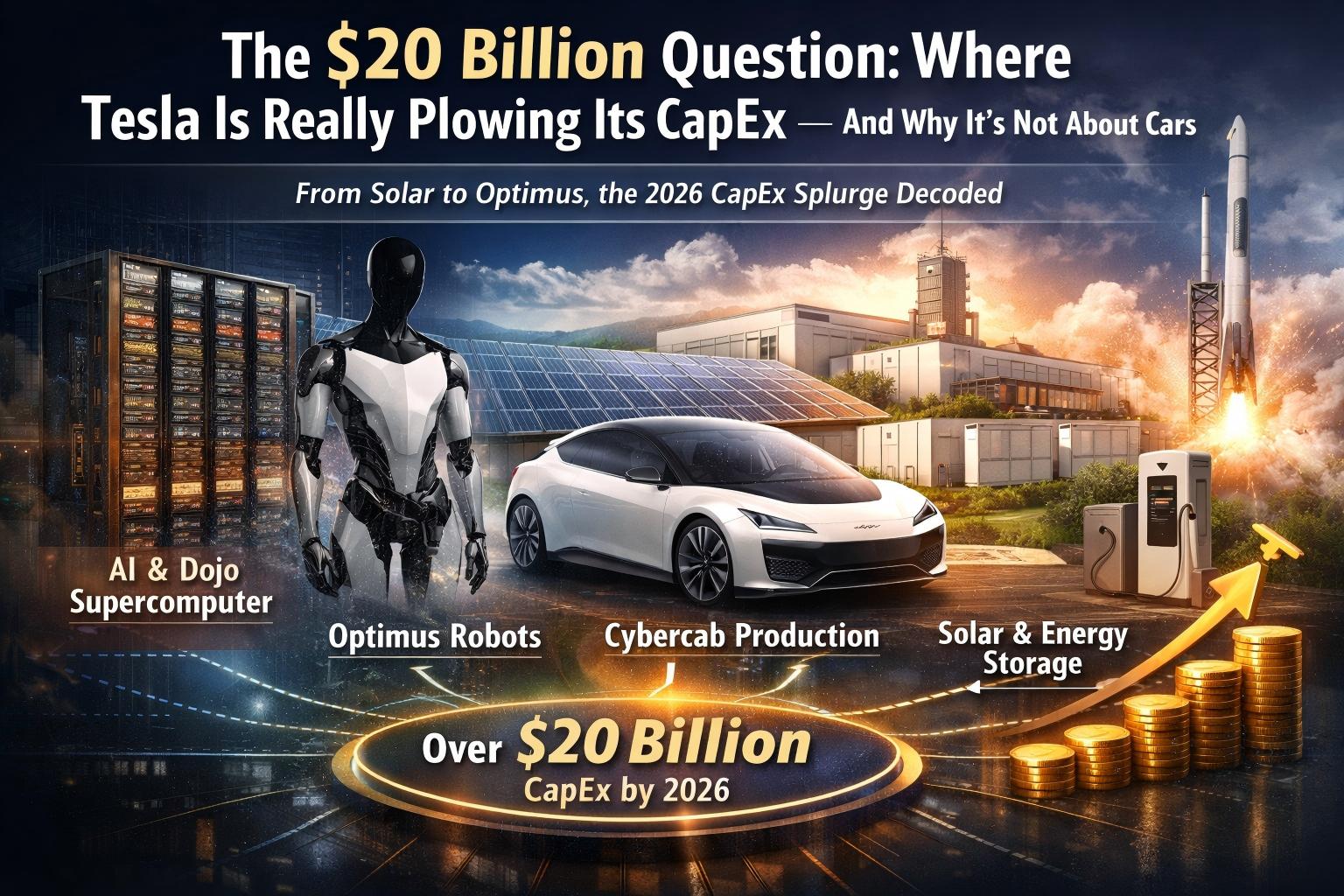
Two days later, Tesla Vice President Tao Lin detailed the allocation of this $20 billion in a presentation: Cybercab mass production, AI compute centers, robotics factories, energy storage expansion, global manufacturing upgrades, and charging networks.
That same week, Tesla initiated the retooling of its Model S/X production lines. These two vehicles—the first that made Tesla profitable, the first that shattered the notion that EVs "had to be cheap economy cars"—entered their official production phase-out.
This is not a routine automaker product cycle.
This is a publicly traded company dismantling its own past to make physical space for a future without steering wheels or pedals.
Chapter 1: Where $20 Billion Goes—It's Not Just Money, It's Direction
To understand the true meaning of $20 billion, we must first establish a coordinate system.
2024: Tesla capital expenditure: $11.3 billion. That year: Texas Gigafactory expansion, Berlin factory ramp-up, 4680 production line tackle.
2025: Capital expenditure reduced to approximately $8.5 billion. Management actively controlled spending, preparing for the upcoming investment peak.
2026: Over $20 billion.
This figure is nearly double Wall Street's expectations. Goldman Sachs urgently revised its CapEx forecast upward to $20 billion post-earnings, while simultaneously lowering its price target—a combination that rarely occurs simultaneously.
Where is the money going?
According to Tao Lin's public statements in early February 2026, the six major investment directions are:
First, Cybercab Mass Production Ramp (USA).
The core production line construction will have largely completed its initial investment phase by 2025. Additional investments will continue in 2026 to ensure the full-scale realization of production capacity. Cybercab is a two-seater vehicle designed for autonomous ride-hailing networks, featuring no steering wheel or pedals. It is not the Model 2 (an affordable mass-market vehicle), but rather Tesla's direct alternative to the very concept of vehicle ownership itself.
Second, AI Compute Center (Texas).
This is the most core investment direction. Cumulative investment in the Texas training center has already exceeded $10 billion, with substantial additional investment planned for 2026. This center will underpin all of Tesla's AI applications—FSD, Optimus, and a "unified world model" Musk repeatedly references but has not yet fully defined. This model is intended to serve global markets, including China.
Third, Robotics Factory Retooling and Upgrades.
This is the most aggressive investment direction. Tesla has already commenced physical retooling of the Model S/X production lines. 2026 will see larger-scale engineering efforts, with the goal of achieving mass production capability for Optimus robots by the end of 2026. Annual production capacity of millions of humanoid robots—this is the direction that part of Fremont's production lines are transforming towards.
Fourth, Energy Storage Business Expansion.
Continued increase in investment in energy storage manufacturing, scaling up overall Megapack and Powerwall production capacity. In Q4 2025, the energy business achieved 28.6% gross margin, far exceeding the automotive business, making it Tesla's most profitable segment.
Fifth, Global Manufacturing System Upgrades.
The core focus is simultaneous improvement of hardware automation levels and software capabilities. In plain terms, Tesla aims to "copy and paste" the efficiency of Gigafactory Shanghai globally, and to imbue this manufacturing system with rapid iteration and self-optimization capabilities.
Sixth, Continued Expansion and Opening of the Charging Network.
Continued expansion of Supercharger network coverage and further opening access to other automakers. This is Tesla's most mature, least controversial business line, yet it continues to receive new investment.
Chapter 2: The Sacrificed and The Bet On—Why Did Model S/X Have to Die?
Any discussion of Tesla's $20 billion capital expenditure cannot avoid one concrete question:
Why the Model S and Model X?
These two vehicles are not Tesla's sales pillars. In 2025, combined S/X deliveries accounted for less than 3% of total volume. But emotionally, they are Tesla's "moon landing vehicles."
In 2008, Tesla launched the Roadster, proving EVs could be fast. In 2012, the Model S proved EVs could be great. It earned the highest score in Consumer Reports' history and was rated the top luxury car for four consecutive years. It was the status symbol for Silicon Valley's newly wealthy, replacing the Mercedes S-Class.
But the technological generation gap is closing its scissors.
The Model S/X platform was born in 2012. It has undergone numerous electrical architecture upgrades and battery pack refreshes, but its body-in-white structure, electronic/electrical architecture, and 4680 battery compatibility have all reached the boundary where further modification is no longer viable or economical.
Tesla confirmed in its earnings report that the decision to end Model S/X production was made to free up physical space for Optimus production lines.
This is not a tragic story. This is an efficiency of capacity allocation problem.
Fremont Factory's capacity is finite. One production line capable of producing 50,000 Model S/X vehicles annually, if retooled for Optimus production, can achieve an annual capacity of one million humanoid robots within the same physical footprint.
From a financial perspective, this choice required zero hesitation.
Chapter 3: xAI's $200 Million—Left-Hand-Right-Hand Compute Positioning
Within the $20 billion capital expenditure plan, one $200 million investment stands out.
Tesla agreed to purchase preferred shares of xAI (Musk's independent AI startup), simultaneously signing a "framework agreement" aimed at "strengthening Tesla's capabilities in developing and deploying physical world AI products and services."
This transaction faced shareholder resistance in November 2025. Due to a significant number of abstentions, the non-binding proposal did not pass. Tesla's statement at the time was: "Will continue to explore investment possibilities."
Two months later, the investment materialized.
Market interpretation splits into two camps.
Optimists: xAI's Grok model is already integrated into certain Tesla vehicles. xAI has told investors its long-term goal is to develop AI "ultimately capable of driving humanoid robots." Deep integration between Tesla and xAI could accelerate Optimus's intelligence roadmap. The two entities already have commercial relationships: Tesla sells Megapack energy storage systems to xAI. This is technological synergy.
Skeptics: As of 2025, Tesla's cash and cash equivalents stood at $44.1 billion. $200 million represents merely 0.45% of its cash reserves and does not impact solvency. However, this precedent opens the door to continued capital infusion from Tesla into Musk's private ventures. How much next time? $2 billion or $20 billion?
Regardless of position, one fact is crystallizing: Tesla's AI strategy is becoming deeply entwined with Musk's private AI empire. Whether this is a blessing or a risk for shareholders depends entirely on whether you believe Musk is Tesla's greatest asset or its greatest liability.
Chapter 4: Robotaxis—From Austin to Seven Cities
Within the $20 billion CapEx narrative, Cybercab and Robotaxi occupy prominent positions.
By the end of 2025, Tesla's Robotaxi fleet size exceeded 500 vehicles, operating in Austin and the San Francisco Bay Area. Critically, part of Austin's operations has removed safety drivers, achieving genuine driverless operations.
This represents one of the few globally operational, publicly accessible L4 commercial services.
H1 2026 target: Expand service to Dallas, Houston, Phoenix, Miami, Orlando, Tampa, and Las Vegas.
These cities share common characteristics: abundant sunshine, grid-pattern roads, and regulator-friendly environments.
But the expansion bottleneck isn't regulatory; it's production capacity. Cybercab must achieve scaled production in 2026. This is precisely the core mission of the $20 billion capital expenditure.
A subtle but crucial detail: Tesla management explicitly stated on the earnings call that it will no longer provide 2026 delivery guidance.
This means Tesla has formally abandoned "vehicle sales volume" as the core metric communicated to markets. Replacing it will be FSD subscription numbers, Robotaxi fleet size, and Optimus shipment volumes.
These are the measures of the post-automotive era.
Chapter 5: Energy's Silent Growth and Solar's Billion-Dollar Imagination
Within the $20 billion CapEx narrative, energy storage receives less attention than Cybercab and Optimus, yet it may be the most financially solid component.
Q4 2025: Tesla Energy revenue: $3.8 billion, up 25% year-over-year. Gross margin: 28.6%.
For comparison: Automotive gross margin (excluding regulatory credits) during the same period: 17.9%.
Energy storage is now Tesla's highest-margin segment.
In February 2026, Morgan Stanley published a report isolating Tesla's solar business for standalone valuation. Summary conclusion:
Assuming Tesla's solar capacity operates at full utilization, this business could contribute $20-50 billion in incremental equity value to Tesla's Energy segment (approximately $6-14 per share).
Morgan Stanley simultaneously warned: Without this investment, Tesla may face energy bottlenecks constraining other business development.
This statement requires unpacking. What "energy bottlenecks constraining other businesses"?
It refers to the insatiable electricity demand of AI data centers.
xAI is constructing what may become the world's largest supercomputer cluster. The electrical load of Tesla's Texas compute center already rivals that of a small-to-medium city. Amazon, Microsoft, and Google are competing nationwide for grid interconnection capacity. Musk's long-term vision reportedly includes space-based solar-powered data centers—which sounds like science fiction, but the logic is consistent: Future compute competition is fundamentally electricity competition.
Tesla's solar + storage combination is the only vertically integrated, scaled deliverable technology energy solution controlled by a single company.
The 2025 global photovoltaic inverter shipment leader, Huawei, achieved approximately 60GW annual capacity. Musk's stated goal: Achieve 100GW annual solar capacity within three years.
This is not catching up. This is leapfrogging.
Conclusion: $20 Billion Isn't a Cost—It's the Price of Admission
The message Tesla transmitted to capital markets in early 2026 is exceptionally clear:
Electrification was the last war. AI and energy are the next war. Tesla chooses to fight on two fronts.
The $20 billion capital expenditure is not an annual budget; it is the financing cost of a strategic transformation. The $44.1 billion cash pile is the ammunition depot. Model S/X discontinuation is a tactical sacrifice. The xAI investment is in technological outsourcing.
Wall Street's reaction is complex. Morgan Stanley and Goldman Sachs both lowered price targets post-earnings, while simultaneously acknowledging Tesla's leadership in "physical AI."
This is normal. Capital markets abhor uncertainty. And Tesla is deliberately transforming itself into uncertainty itself.
But for owners, the answer may be simpler:
You didn't purchase a depreciating vehicle. You purchased an access node to an enormous, appreciating energy and intelligence network. A portion of what you paid for your Model Y is now becoming GPU clusters in Texas, robot production lines in Fremont, and energy storage factories in Nevada.
Your car depreciated. But the network you plugged into is appreciating.
Frequently Asked Questions (FAQ)
Q: Will the $20 billion capital expenditure cause Tesla to raise prices?
A: Not in the short term. Capital expenditure is investment cash flow and is not allocated to per-vehicle cost. However, long-term, Tesla is reallocating resources from "volume vehicles" to "AI and energy assets." This inevitably impacts pricing strategy—premiumization, servitization, and subscription are clear directional vectors.
Q: My Model S/X is discontinued. What about after-sales service?
A: Tesla commits to a minimum 10-year parts supply cycle. Discontinuation does not mean the end of service. However, clarification is necessary: inventory of high-wear items like headlights and bumpers is sufficient, but the repairability of theAll-aluminum body after severe collisions will become progressively more difficult over time.
Q: What does Optimus robot mass production have to do with me?
A: Short term: nothing. Long term: Optimus's sensors, chips, and battery management technology will flow back into automotive products. Tesla's "technology trickle-down" logic has always operated this way.
Q: Is it worth installing solar panels now?
A: If you reside in states with high electricity rates and stable net metering policies (e.g., California, Texas), this is effectively a physical call option on Tesla's long-term strategy. The Powerwall you purchase today may eventually connect to a virtual power plant network, generating ongoing returns.