
Introduction: More Than Just a Facelift
In the automotive world, a "refresh" usually implies new bumpers, a slightly larger screen, and perhaps a new set of wheels. But at Tesla, "Refresh" is often a euphemism for a total industrial re-engineering. As of January 30, 2026, the world's best-selling vehicle—the Tesla Model Y—is undergoing its most radical transformation since its 2020 debut.
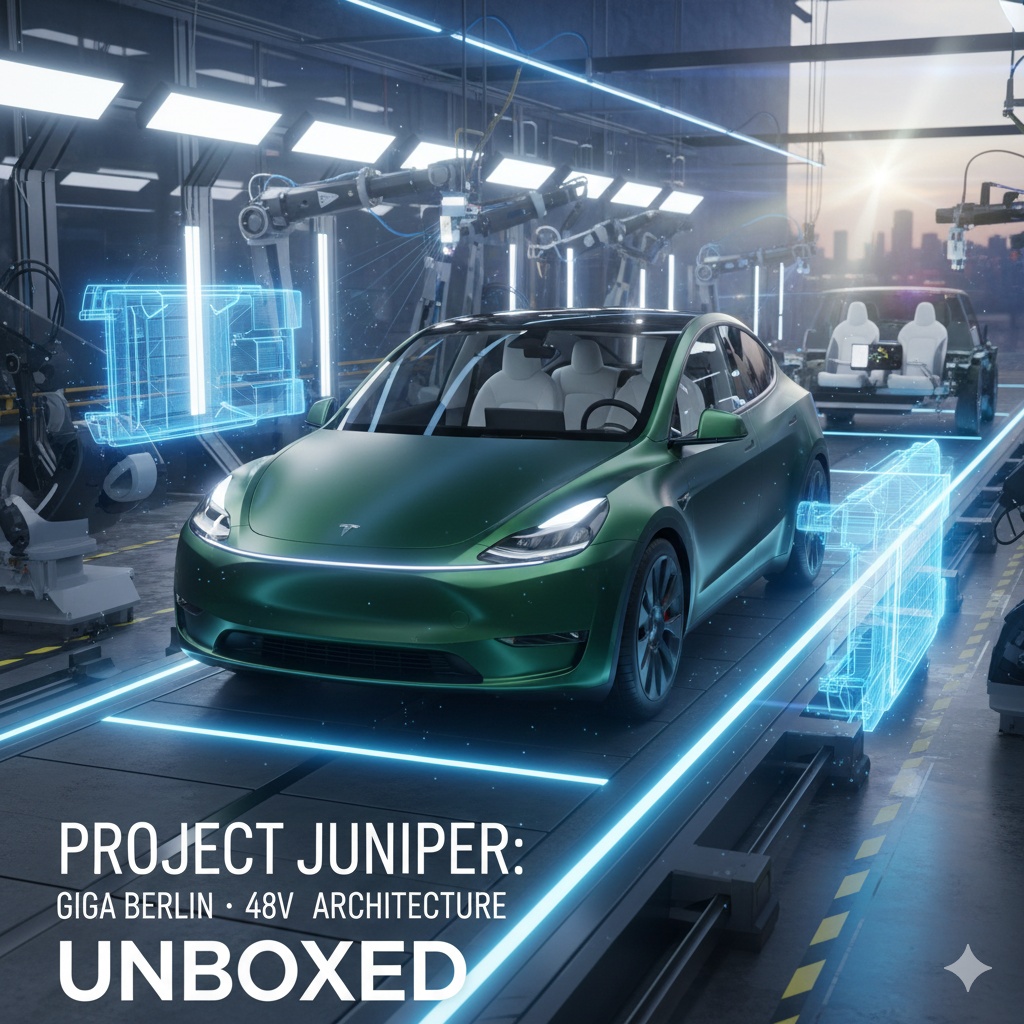
Codenamed Project Juniper, this 2026 update is the culmination of Tesla’s latest manufacturing breakthroughs. It isn't just about making the Model Y look like the Model 3 "Highland"; it is about proving a new way to build cars. For the first time, we are seeing the "Unboxed" manufacturing process—originally designed for the upcoming $25,000 "Model 2"—being "back-ported" into the Model Y assembly lines in Giga Berlin and Giga Shanghai.
This article explores the design language of the 2026 Model Y, the technical shift to 48V architecture, and how the synergy with the Model 2 platform is set to decimate the competition in the European and American SUV markets.
I. Design Language: The Cyber-Influenced Aesthetic
Exterior: A Sharper, Sleeker Silhouette
The 2026 Model Y "Juniper" finally sheds its "duck-lip" front hood in favor of a much sharper, more aerodynamic fascia.
-
The "Cyber-Light" Bar: Taking a cue from the Cybertruck and the Cybercab, the new Model Y features a thin, continuous LED light bar stretching across the front. This isn't just aesthetic; the integration of Matrix LED technology allows the car to "mask" oncoming traffic with surgical precision, a feature highly coveted by European drivers who frequent unlit rural roads.
-
Aerodynamic Mastery: Leaked data suggests a drag coefficient ($C_d$) of 0.22, down from 0.23. While 0.01 might seem negligible, at highway speeds (120 km/h or 75 mph), this translates to a real-world range increase of approximately 5-7% without adding a single gram of battery weight.
Interior: The "Highland" Treatment and Beyond
European and North American owners have long complained about the Model Y’s interior feeling "unfinished" compared to luxury rivals. Juniper changes that:
-
The Death of Stalks: Following the Model 3 and Model S/X, the turn signal and gear selector stalks are gone. Steering wheel buttons and the touchscreen now handle these functions. While controversial, this simplifies the wiring harness significantly.
-
Acoustic Sanctuary: Tesla has introduced 360-degree acoustic glass and improved suspension bushings. Tests from early production units in China indicate a noise reduction of 20% to 25% at high speeds—addressing the #1 complaint of existing Model Y owners.
-
Rear Passenger Empowerment: An 8-inch rear touchscreen (standard on all trims) now controls climate and entertainment, a feature that turns the Model Y from a "commuter car" into a genuine family tourer for long European road trips.
II. The "Unboxed" Connection: Sharing DNA with the Model 2
What is the Unboxed Process?
Traditionally, cars are built on a long conveyor belt (the Ford model). A steel "skeleton" moves along, and workers struggle to install interiors and wiring through narrow doors and window openings.
Tesla’s Unboxed Process (Global Automotive Modular Evolution) breaks the car into separate sub-assemblies:
-
The Front Casting (Gigapressed)
-
The Rear Casting (Gigapressed)
-
The Structural Battery Pack (The Floor)
-
The Interior Module (Seats and consoles bolted directly to the battery)
In Giga Berlin and Giga Shanghai, Project Juniper is the "test bed" for this modularity. By building the interior on top of the battery before the sides of the car are even attached, Tesla has reduced factory footprint by 40% and increased production speed by 25%.
The Platform Synergy
The most exciting "insider" news today is that the 2026 Model Y Juniper and the Model 2 share over 60% of their non-structural components. From the drive units (4th Generation) to the thermal management system (Octovalve 2.0), the high-volume production of the Model Y is subsidizing the low cost of the Model 2. For the consumer, this means the Model Y is getting "overbuilt" components designed to last for a million-mile Robotaxi lifespan.
III. Engineering the Future: 48V Architecture and EtherLoop
Moving Beyond the 12V Legacy
Most cars today—including most EVs—still use a 12V electrical system for lights, windows, and computers. This requires thick, heavy copper wires. The 2026 Model Y Juniper has officially made the jump to 48V architecture.
-
Weight Savings: By quadrupling the voltage, the current (amps) required to power components is reduced by 75%. This allows Tesla to use much thinner wiring, saving roughly 20kg (44 lbs) of copper per vehicle.
-
The "EtherLoop" Data Bus: Juniper replaces miles of traditional wiring with a single "data ring" called EtherLoop. This system allows the car's various computers to communicate at gigabit speeds with far less physical complexity.
IV. Production Timeline: Giga Berlin vs. Giga Shanghai
European Rollout (Giga Berlin)
For our European readers, Giga Berlin has already begun "pre-production" of the Juniper refresh.
-
Q1 2026: Final testing of the new paint colors (expected: Deep Forest Green and Stealth Grey).
-
Q2 2026: First customer deliveries in Germany, Norway, and the Netherlands.
Giga Berlin’s units will feature the BYD Blade (LFP) cells for the RWD version and the 4680 Structural Pack for the Performance models, offering some of the fastest charging curves in the industry.
North American Rollout (Giga Texas/Fremont)
Expect a slight delay compared to the European and Chinese markets. Fremont is currently prioritizing the "AI4.5" hardware integration. North American owners should expect orders to open in March 2026, with volume deliveries beginning by summer.
V. Conclusion: Is Juniper the Smartest Buy of 2026?
The 2026 Model Y Juniper is not just an update; it is a declaration of industrial dominance. By merging the design of the Model 3, the ruggedness of the Cybertruck, and the manufacturing efficiency of the upcoming Model 2, Tesla has created a vehicle that is cheaper to build yet more premium to own.
If you are currently driving a 2021 or 2022 Model Y, the leap in NVH (Noise, Vibration, Harshness), Efficiency, and Tech (48V) makes the 2026 model a compelling upgrade. It is the car that will likely keep Tesla at the top of the charts for the remainder of the decade.
FAQ: The Juniper Cheat Sheet
Q: Will the price increase?
A: Surprisingly, no. Thanks to the "Unboxed" process and 48V savings, Tesla is aiming to keep the MSRP stable, with the RWD starting around €44,990 / $42,990.
Q: Does it have Steer-by-Wire?
A: Current leaks from Giga Shanghai suggest a traditional steering column for now, though the hardware is "SBW-ready" for a potential mid-year 2027 update.
Q: What about the 7-seater option?
A: Project Juniper maintains the 7-seater layout, but with improved 2nd-row sliding mechanisms to make third-row access easier—a specific request from the North American market.
Q: Is the battery bigger?
A: The capacity remains similar (approx. 75-82 kWh for Long Range), but a 5% increase in efficiency means you get more "miles per kWh."