
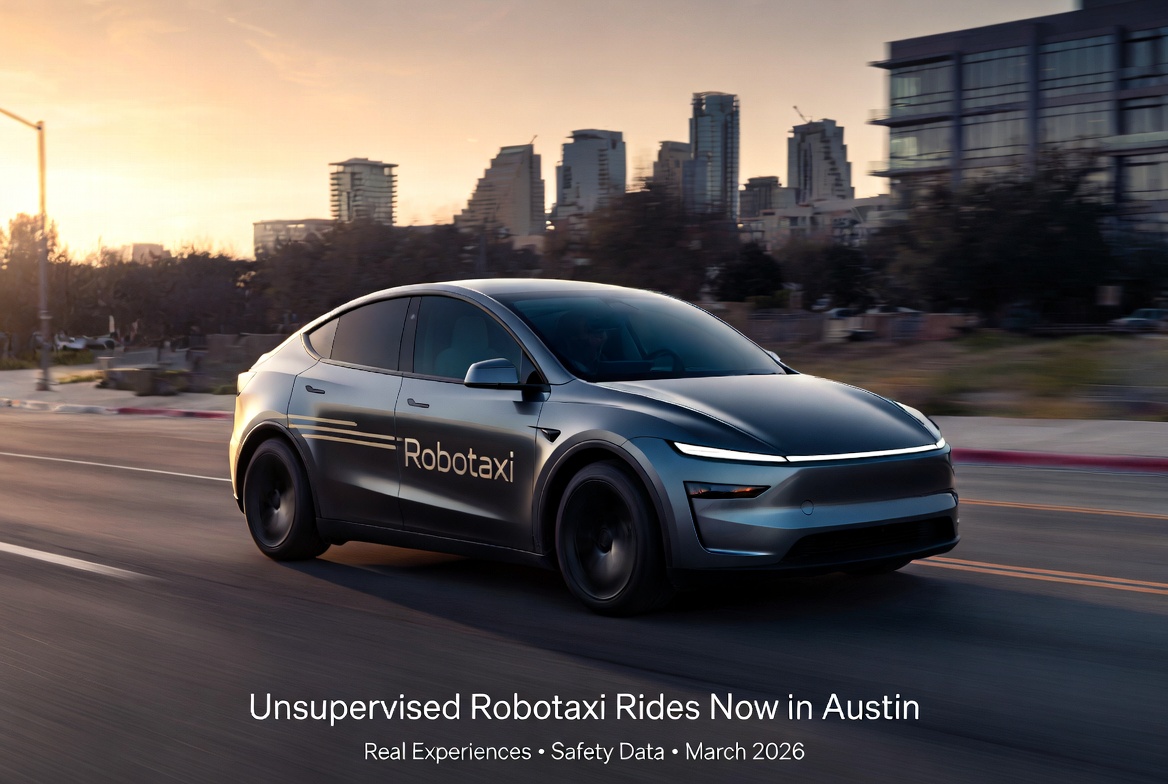
As of March 29, 2026, Tesla’s Robotaxi service in Austin, Texas, has crossed a pivotal threshold that many Tesla owners worldwide have been anticipating for years. What began as a supervised pilot program in June 2025 using a small fleet of Model Y vehicles has now evolved into a growing number of truly unsupervised rides—vehicles operating with no safety monitor inside the car, no chase vehicle in some cases, and no human intervention required for the entire journey. Elon Musk first announced the shift on January 22, 2026, stating that Tesla had begun offering Robotaxi drives in Austin “with no safety monitor in the car.” Within hours, rider videos flooded social platforms, confirming the milestone: passengers stepping into empty Model Ys that navigated city streets, highways, and complex intersections entirely on their own.
For Tesla owners in the United States and Europe, this is more than a headline—it is living proof that the Full Self-Driving (FSD) technology you already have (or are considering) in your personal vehicle is ready for prime time. Early unsupervised operations remain limited to a handful of vehicles mixed into the broader supervised fleet, yet the pace is accelerating. Recent fleet tracking data shows a new unsupervised Model Y added to the Austin roster as recently as the past week, marking the first expansion in over a month. Riders report seamless pickups, confident lane changes, and smooth merges onto freeways—experiences that feel less like an experiment and more like the future of personal transportation finally arriving.
This article dives deep into the current operational reality of unsupervised Robotaxi rides in Austin. We will examine the latest fleet status and safety metrics pulled from public NHTSA reports and independent trackers, share detailed first-hand user accounts (including video-backed examples from March 2026 rides), explore the practical implications for everyday American Tesla owners, and look ahead to how this technology could scale to Europe. Whether you drive a Model 3, Model Y, or are eyeing a future Cybercab, these unsupervised rides validate the software updates rolling out to your own car right now. The data, the stories, and the technical foundation all point to one conclusion: autonomy is no longer a promise—it is happening on public roads today.
Chapter 1: Operational Status and Safety Data
Tesla’s Robotaxi fleet in Austin currently consists of modified Model Y vehicles equipped with the latest FSD hardware and software stack. The service launched in June 2025 with approximately 10–20 vehicles operating in a limited geographic area during daylight hours and favorable weather. Every early ride included a safety monitor in the front passenger seat. By late 2025, Tesla began testing empty vehicles on public roads, and the public unsupervised rollout officially commenced in January 2026.
As of late March 2026, independent trackers such as Robotaxi Tracker report roughly eight to nine vehicles capable of unsupervised operation at any given time, though the exact number fluctuates daily. These unsupervised units are deliberately mixed into the larger supervised fleet of around 70–80 vehicles total. The rollout follows a “graduation” process: vehicles first accumulate supervised miles, then transition to unsupervised status once performance thresholds are met. Fleet growth paused for over 30 days earlier in March before resuming with the addition of at least one new unsupervised Model Y.
Safety data remains the most scrutinized aspect of any autonomy program, and Tesla’s Robotaxi operation is no exception. Since the June 2025 launch, NHTSA filings indicate 14 reported collisions involving the fleet. The majority occurred during the supervised phase. The calculated crash rate stands at approximately one incident per 57,000 miles—significantly better than the U.S. national average for human-driven vehicles in urban environments when adjusted for comparable conditions. Critically, none of the incidents resulted in serious injuries or fatalities, and most were minor low-speed events such as minor fender-benders in construction zones or parking-lot maneuvers.
Independent analysts note that the unsupervised subset of the fleet has logged thousands of miles with zero reported crashes to date. Tesla does not publicly release exact mileage figures for unsupervised rides, but cross-referencing app-based ride data and fleet sightings suggests the unsupervised vehicles are accumulating data at a steady pace. Remote teleoperation—where an off-site operator may briefly assist via software—occurs in an estimated 1–3% of rides, typically for edge cases like ambiguous construction signage or unusual pedestrian behavior. This hybrid supervision layer keeps the system safe while the AI continues to learn.
Compared to competitors like Waymo, which has operated in Austin for years with its own safety record, Tesla’s vision-only approach (no lidar or radar) demonstrates rapid improvement. The absence of hardware redundancy is offset by massive real-world training data from millions of customer FSD miles. For Tesla owners, this translates directly: the same neural nets powering your personal vehicle’s FSD Supervised updates are being battle-tested daily in Robotaxi service. Every unsupervised mile logged in Austin improves the software that will soon roll out to your garage.
Chapter 2: Real Ride Experience Analysis
Nothing captures the reality of unsupervised Robotaxi rides better than the voices and videos of actual passengers. In the past two months, dozens of riders have shared their experiences through the Tesla app, X posts, and YouTube. Pricing remains straightforward and competitive: early rides carried a flat $4.20 fee during the initial pilot, but current dynamic pricing typically ranges from $6–$12 for short urban trips (2–5 miles), still well below traditional ride-hail services during peak hours. Wait times vary by demand and location within the service area—downtown Austin and airport-adjacent zones see 3–8 minute arrivals on average, while suburban edges can stretch to 15 minutes during evenings.
A standout example comes from rider Jesse Richards, who in early March 2026 took his parents on their first unsupervised ride. The vehicle arrived empty, greeted them politely via the in-car screen, and executed a flawless route that included freeway merging and neighborhood navigation. “They weren’t sure about it at first but were very impressed by the end of the ride,” Richards posted alongside video footage showing smooth acceleration and precise turns. Another enthusiast, Joe Tegtmeyer, captured one of the earliest unsupervised journeys on January 22, 2026. His video shows the Model Y pulling away from the curb, handling traffic lights, and even performing a confident lane change while a black chase car (used for initial validation) followed at a distance. Tegtmeyer noted the ride felt “buttery smooth” compared to earlier supervised attempts.
David Moss, a persistent tester, documented taking 58 rides before securing his first fully unsupervised experience in late January. His footage reveals the car navigating airport-area traffic, construction zones, and even a brief rain shower without hesitation. In one memorable clip from February, a rider described the vehicle confidently threading through a complex construction site that would challenge many human drivers. The passenger interacted naturally with the in-car voice assistant, requesting music changes and route adjustments mid-trip—all handled autonomously.
User feedback consistently highlights three strengths: comfort, predictability, and the absence of human driver quirks. No more awkward small talk, no phone distractions, and no last-minute route changes. The interface is intuitive—riders open the Tesla app, select Robotaxi, input pickup and drop-off, and watch the car arrive empty. Upon entry, the doors close automatically, the screen displays the route and estimated time, and the journey begins. Disembarkation is equally seamless: the vehicle pulls over safely, doors unlock, and a polite “Thank you for riding” message appears.
Of course, the system is still maturing. Occasional hesitations at novel construction zones or heavy pedestrian areas have been reported, sometimes resolved via brief remote assistance. Yet these moments are rare and decreasing weekly. Riders describe the experience as “future-forward” and far less stressful than driving themselves in Austin’s notoriously congested traffic. For Tesla owners who already use FSD Supervised on their personal cars, the Robotaxi rides feel like a natural extension—proof that the software you trust daily is scaling to commercial service.
Chapter 3: Impact on American Car Owners and Future European Expansion
For the hundreds of thousands of Tesla owners in the United States, the Austin Robotaxi program is a direct confidence booster. Every unsupervised ride validates the investment you made in FSD capability. Owners with FSD subscriptions or purchases now see their vehicles as future revenue generators: Tesla has hinted at an owner-operated Robotaxi network where personal cars can earn money when not in use. The same hardware and software running in Austin fleets is already deployed across the 8+ million Tesla vehicles on the road. Software version 14, for instance, ships robotaxi-grade code to all FSD-equipped cars, blurring the line between personal and commercial autonomy.
Resale values stand to benefit as well. Buyers shopping for used Model Ys or Model 3s increasingly view FSD as a must-have feature because it unlocks Robotaxi potential. Insurance companies are already beginning to recognize the safety data from fleet operations, which could translate into lower premiums for FSD-equipped vehicles. Daily commuters in cities like Los Angeles, New York, or Chicago watch Austin’s progress and imagine the day when similar service arrives locally—potentially reducing the need for a second family car or eliminating parking headaches entirely.
Looking across the Atlantic, European Tesla owners have even more reason to pay attention. While regulatory hurdles remain (the EU’s UN R-157 framework and country-specific approvals), the Austin success provides crucial real-world validation data that Tesla is already sharing with regulators. The same FSD stack undergoing unsupervised testing in Texas is designed for global scalability. Early signals suggest limited European pilots could begin in 2027 in countries with progressive autonomy rules, such as the Netherlands or Germany. For owners in the UK, France, or Germany, the Austin program demonstrates that Tesla’s vision-only approach can meet stringent safety standards without expensive additional sensors. This accelerates the timeline for FSD Supervised to evolve into unsupervised capability on European roads, potentially transforming urban mobility and boosting the residual value of European Tesla fleets.
Chapter 4: FSD Supervised Technical Foundation in Robotaxi Operations
At the core of every unsupervised Robotaxi ride is the same FSD technology available to personal owners—now refined through massive fleet learning. Tesla’s end-to-end neural network processes camera feeds in real time, making decisions on steering, acceleration, and braking without modular hand-offs. The unsupervised variant benefits from additional training on commercial edge cases: high-density urban intersections, airport traffic, and unpredictable construction zones that private owners rarely encounter daily.
Version 14 and subsequent updates incorporate lessons from both supervised and unsupervised miles. Rear camera washers, spotted on recent prototypes and rolling out to fleets, ensure clear vision in adverse weather—a critical upgrade for reliability. The system’s ability to handle complex scenarios (merging onto freeways, yielding to emergency vehicles, or navigating temporary lane shifts) stems from billions of miles of aggregate training data. Remote assistance, when needed, serves as a safety net rather than a crutch, allowing the AI to learn from each intervention and improve autonomously.
For owners, this means your next FSD software update carries genuine robotaxi DNA. The transition from Supervised to unsupervised on personal vehicles will be regulatory rather than technical—Tesla has stated the hardware is already capable. Watching Austin operations provides a preview of how your own car will behave once local approvals arrive.
Conclusion
Unsupervised Robotaxi rides in Austin represent a genuine inflection point in autonomous mobility. From the first empty Model Ys rolling out in January 2026 to the incremental fleet expansions still happening this month, Tesla has demonstrated that safe, scalable, driverless transportation is no longer science fiction. The safety data, while still maturing, shows a clear path toward industry-leading reliability. Real rider experiences—from parents taking their inaugural trip to enthusiasts stress-testing the system—paint a picture of convenience, comfort, and confidence that traditional ride-hailing cannot match.
For Tesla owners in the United States and Europe, these rides are personal validation. Your FSD investment is powering the future today. As the Austin fleet grows and the technology spreads, the benefits will compound: lower ownership costs, new income opportunities, safer roads, and ultimately a transformed daily commute. The journey from supervised pilot to unsupervised reality has taken time, but the destination is now visible on Austin streets—and soon, on roads near you. The future of driving is here, and it is electric, autonomous, and remarkably human-centered.
FAQ
- How do I book an unsupervised Robotaxi ride in Austin? Open the Tesla app, select the Robotaxi tab (available only within the service area), enter your pickup and drop-off locations, and request a ride. The app will indicate if an unsupervised vehicle is dispatched.
- What is the current pricing structure? Pricing is dynamic but generally $6–$12 for typical 2–5 mile trips. Early pilot rides used a flat $4.20 fee; check the app for real-time rates.
- How long are typical wait times? Waits average 3–8 minutes in core Austin zones during operating hours (roughly 6 a.m. to midnight), though availability is still limited and demand can cause longer delays in suburban areas.
- Is the ride truly unsupervised? Yes—no safety monitor sits inside the vehicle. Some early unsupervised rides used distant chase cars for validation, but current operations increasingly rely on the vehicle’s own systems with occasional remote assistance.
- What safety measures are in place? The vehicle maintains constant connection to Tesla’s operations center. Remote operators can intervene if needed. All rides are recorded for continuous AI improvement, and the fleet’s crash rate remains competitive with human drivers.
- Can I use Robotaxi if I don’t own a Tesla? Yes—the service is open to the public via the Tesla app in the Austin service area. No Tesla ownership is required.
- When will unsupervised Robotaxi expand beyond Austin? Tesla has indicated additional U.S. cities (including potential Bay Area rollout) later in 2026. European expansion depends on regulatory approvals but is actively under discussion.
- Does riding Robotaxi affect my personal FSD experience? Indirectly yes—every fleet mile improves the shared neural network that powers FSD updates for all owners.
- What happens if I feel uncomfortable during a ride? The vehicle can be instructed to pull over safely at any time via the touchscreen or voice command. A support team is available through the app.
- Are there any restrictions on where Robotaxi can take me? The service operates within a defined Austin geo-fence that continues to expand. Airport terminals and certain private lots may have drop-off limitations.