
Introduction
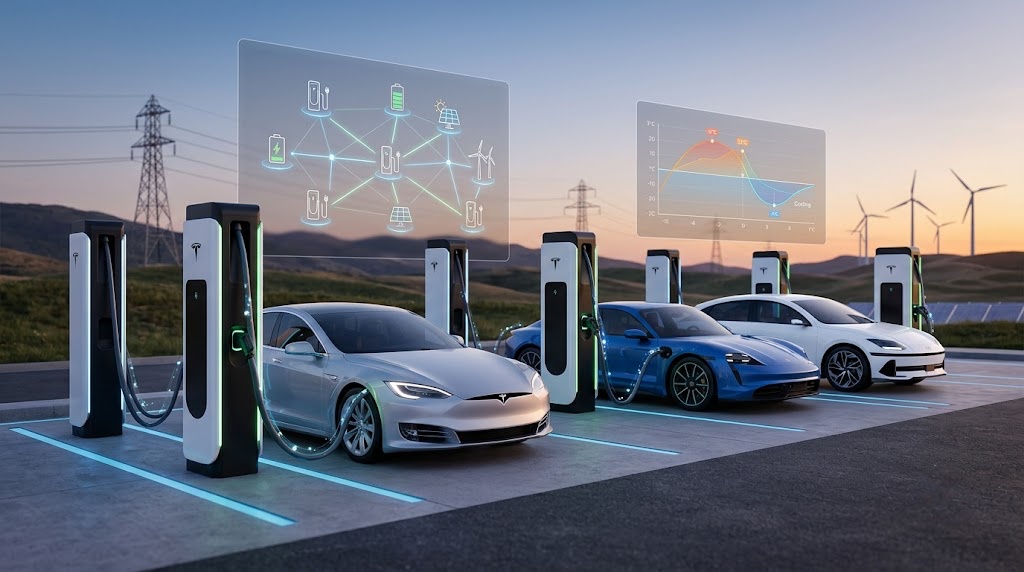
Tesla's Supercharger network remains the gold standard for electric vehicle charging infrastructure across North America and Europe. With the continued expansion of V4 Supercharger architecture throughout 2026, Tesla is addressing two main challenges: supporting non-Tesla EVs with varying battery architectures, and managing high peak power loads on local energy grids. Supported by updated software pre-conditioning routines, V4 hardware acts as a flexible energy hub for all electric vehicles.
Chapter 1: Dynamic Voltage Distribution in V4 Cabinets
Unlike legacy V3 stations limited to 500V peak output, V4 Supercharging post architectures support operating voltages up to 1000V alongside charging currents up to 615A.
Technical Highlights:
-
800V Architecture Support: Allows high-voltage EVs to charge at peak rates without needing onboard step-up converters.
-
Dynamic Load Allocation: Power is dynamically routed across charging stalls based on real-time vehicle demand, preventing localized thermal throttling.
-
Extended Reach and Display: Longer charging cables and integrated payment terminals ensure easy access for all EV models, regardless of port location.
Chapter 2: Predictive Battery Pre-Conditioning Algorithms
Charging speeds depend heavily on internal battery cell temperatures. Tesla's 2026 software updates optimize this pre-conditioning process using real-time route telemetry.
Optimization Innovations:
-
Targeted Heat Management: The vehicle dynamically adjusts coolant loops and heat pump cycles to bring the battery pack to its ideal thermal window right as it arrives at the stall.
-
Arrival Energy Targets: Users can set target SoC parameters via the mobile app, allowing the route planner to calculate exact pre-conditioning times and minimize stall occupancy.
Chapter 3: Grid Support and Distributed Energy Ecosystems
V4 Supercharging hubs are increasingly deployed alongside Megapack battery storage and solar installations.
Grid Benefits:
-
Peak Shaving: Megapack units buffer grid power during off-peak hours, supplying high-current fast charging during busy times without stressing local power grids.
-
Virtual Power Plant (VPP) Integration: Supercharging hubs can feed stored energy back into local grids during grid stress events, generating ancillary revenue for the network.
Conclusion
The rollout of V4 Supercharging hubs showcases Tesla's comprehensive approach to EV infrastructure. By combining high-voltage hardware, adaptive software pre-conditioning, and energy storage integration, Tesla continues to build a robust, future-proof charging network for all EV drivers.
Frequently Asked Questions (FAQ)
Q1: Can 400V Tesla vehicles like the Model Y charge faster on a V4 Supercharger compared to a V3 stall?
A1: Peak charging power for 400V vehicles remains similar, but V4 stalls maintain peak rates longer due to improved thermal management and cable cooling.
Q2: How does setting an Arrival State of Charge (SoC) affect battery pre-conditioning?
A2: Lower arrival SoC targets prompt earlier pre-conditioning to prepare the battery for high initial power intake, whereas higher arrival SoC targets adjust thermal ramp-up times accordingly.