
Introduction: The Five-Year Wait Is Over
There is a scene in the 2020 documentary Tesla: Battery Day that has aged remarkably poorly. On stage, Elon Musk stands beside Drew Baglino, the Senior Vice President of Powertrain and Energy Engineering. They are unveiling the 4680 battery cell—a giant cylindrical cell, 46 millimeters by 80 millimeters, that they claim will unlock a $25,000 electric vehicle. The key, they explain, is the "dry battery electrode" process. It will reduce capital expenditure, shrink factory footprints, cut energy consumption, and slash costs.
It was, in retrospect, a promise that would take five years to even partially fulfill.
The intervening years were filled with headlines about "production hell," supplier contract collapses, and skepticism from industry veterans. In late 2025, the situation looked dire. LG Energy Solution, a key partner, was reportedly struggling with yields. Then, in November 2025, the Korean supplier L&F disclosed that a supply contract with Tesla, originally valued at nearly $2.9 billion, had been reduced to essentially zero—a 99.99% collapse that suggested the 4680 program was on life support.
And then, in late January 2026, the narrative flipped. Tesla released its Q4 2025 earnings update. Buried in the shareholder deck was a line that sent shockwaves through the battery industry: "We have started production of 4680 cells using dry cathode and anode electrode processes at Giga Texas, and have begun producing battery packs for some Model Y vehicles".
Elon Musk took to X, his platform of choice, to celebrate: "Achieving scale with the dry cathode process is extremely difficult. This is a major accomplishment by Tesla engineering, production, and supply chain teams, along with our supplier partners".
Chapter 1: The Technical Deep Dive—Why Dry Electrode Mattered
The Wet Process: A Fifty-Year Standard
To understand why Tesla's achievement is significant, one must first understand how nearly every other lithium-ion battery in the world is made.
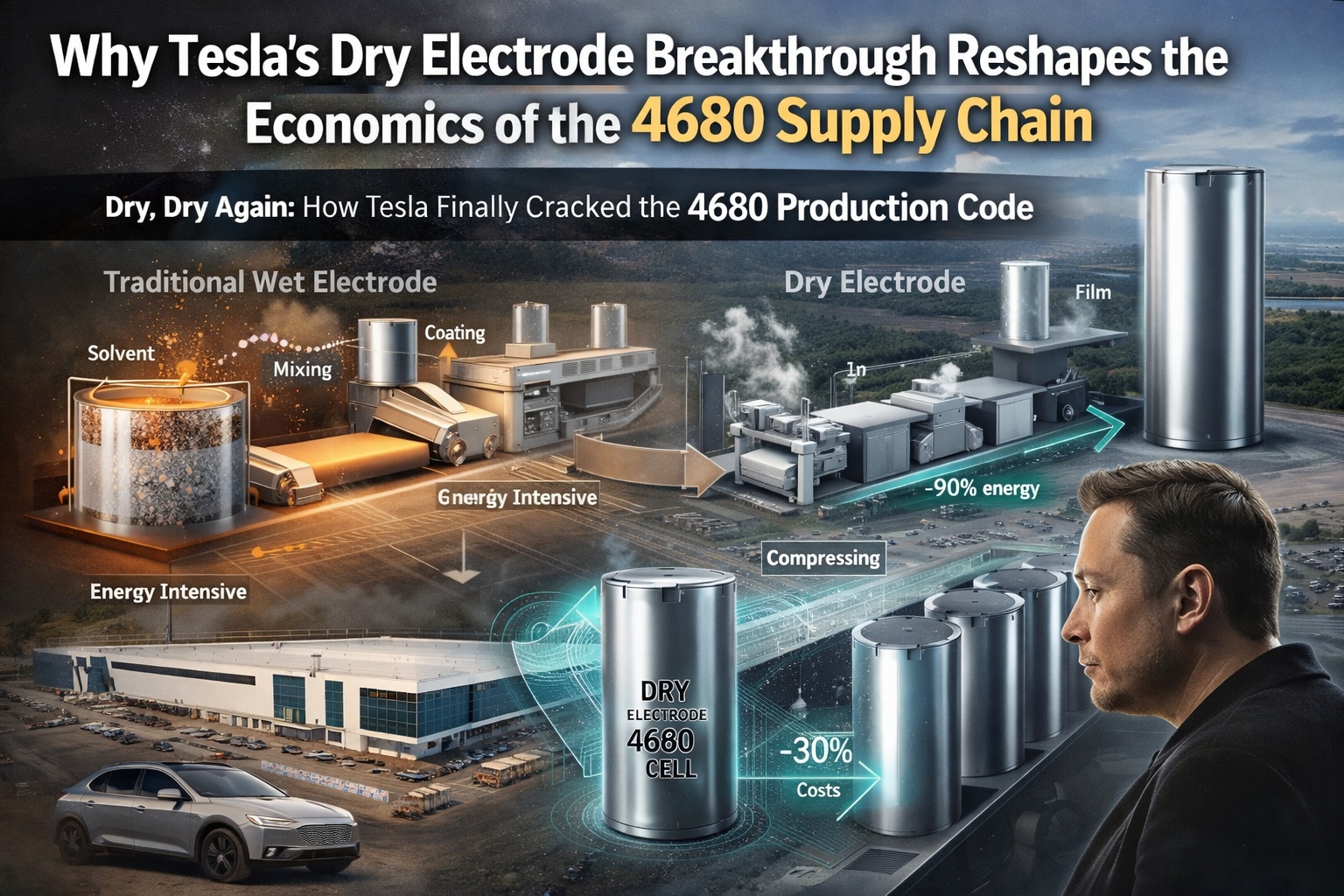
The conventional "wet" electrode process is a testament to the chemical engineering achievements of the late 20th century. It works like this: active materials (the lithium compounds that store energy), conductive additives, and polymer binders are mixed with a toxic solvent—typically N-Methyl-2-pyrrolidone (NMP)—to create a slurry. This slurry is coated onto a metal foil (copper for the anode, aluminum for the cathode). The coated foil then passes through massive drying ovens, sometimes stretching dozens of meters in length, where heat evaporates the solvent. The solvent is captured, recovered, and recycled.
This process works. It produces high-quality electrodes. But it has profound drawbacks. The drying ovens consume enormous amounts of energy—accounting for nearly 30% of total battery production energy consumption. The solvent recovery systems add capital cost and complexity. The ovens themselves occupy vast factory floor space. And the high temperatures required for drying can damage the microscopic structure of the electrode materials, potentially impacting battery cycle life.
The Dry Process: The Theoretical Ideal
The dry electrode process eliminates the solvent entirely. Instead of mixing a slurry, the active materials and binders are mixed as dry powders. This mixture is then compressed under high pressure and temperature to form a solid film, which is laminated directly onto the current collector foil.
The theoretical advantages are transformative:
Energy Reduction: Eliminating the drying step cuts production energy consumption by an estimated 40-50%.
Capital Efficiency: Removing the drying ovens and solvent recovery systems reduces factory footprint by up to 50% and lowers capital expenditure.
Cost Reduction: The combination of energy and capital savings can reduce overall cell production costs by approximately 30%.
Environmental Impact: Eliminating toxic solvents removes a significant environmental and worker safety concern.
The Cathode Problem: Why It Took Five Years
The anode, which stores lithium ions during charging, is relatively simple. Its primary active material is graphite, which is mechanically robust and chemically stable. Tesla was able to implement dry electrode processing for the anode relatively early.
The cathode is the nightmare. It is a complex composite of lithium, nickel, manganese, cobalt, and aluminum—depending on the specific chemistry. These materials are hard, brittle, and chemically reactive. Getting them to form a uniform, flexible film without cracking or delaminating is extraordinarily difficult.
The challenge is the binder. In the wet process, the binder (typically PVDF) is dissolved in the solvent and uniformly distributed as the slurry dries. In the dry process, the binder must be mixed as a powder and then activated under pressure and heat to "glue" the active particles together. Too little binder, and the film falls apart. Too much binder, and the binder blocks the paths lithium ions need to travel, reducing performance.
For years, Tesla's 4680 cells used a hybrid approach: dry-processed anode, wet-processed cathode. This was better than nothing, but it didn't deliver the full cost and energy savings the company needed to hit its targets.
Chapter 2: The Patent—How Tesla Finally Cracked the Code
US 2025/0364562: A New Approach
On January 29, 2026, the US Patent and Trademark Office published Tesla's patent application number US 2025/0364562. The title was unassuming: "Electrode Manufacturing Process." The content was revolutionary.
The patent describes a fundamental shift in how Tesla approaches dry electrode fabrication. Rather than focusing on the machinery (the rollers, the presses, the calenders), Tesla's breakthrough lies in the material formulation and processing sequence.
The key innovations are:
1. Particle Size Optimization
Traditional electrode manufacturing, whether wet or dry, tends to favor small particles. Smaller particles pack more densely and have shorter ion diffusion paths. But small particles also have more surface area, which requires more binder to hold them together.
Tesla's patent describes a different approach: using active material particles larger than 10 micrometers in diameter. By keeping the particles larger, the total surface area is reduced, which dramatically cuts the amount of binder required. The patent claims binder content below 2% by weight, a level previously thought impossible for dry-processed cathodes.
2. The Composite Binder System
The binder itself is not simple PTFE (Teflon), which has been used in dry electrode experiments for decades. Instead, Tesla developed a composite binder system combining PTFE with a high-stability polymer such as PVDF or polyethylene. This composite creates what the patent describes as a "spider web" microstructure that mechanically locks the active particles together while maintaining flexibility.
3. High-Shear Jet Milling
The mixing process is critical. Tesla's patent describes a high-shear jet milling process that fibrillizes the binder—stretching it into microscopic fibers that entangle the active particles. This creates a self-supporting film with mechanical integrity far exceeding previous dry-processed electrodes.
4. Reduced Roll Passes
In the dry process, the electrode film is created by passing the powder through a series of rollers, each applying more pressure until the desired thickness and density are achieved. Tesla's new formulation and process reduce the number of roll passes from ten or more to just three. This is not an incremental improvement; it is a 3x increase in line throughput.
The Numbers Behind the Breakthrough
The patent quantifies the improvements:
Irreversible Capacity Loss (ICL): Reduced to 30-50 mAh/g, equivalent to mature wet-processed electrodes.
Binder Content: Below 2% by weight.
Roll Passes: Reduced from 10+ to 3.
Factory Footprint: Reduced by up to 50%.
Energy Consumption: Reduced by up to 90% for the drying-eliminated portion of the process.
Chapter 3: The Supply Chain Implication—Independence from the Incumbents
The L&F Collapse: A Near-Death Experience
The timing of Tesla's announcement, coming just weeks after the L&F contract collapse, is not coincidental.
The L&F contract, signed in 2023, was supposed to secure a massive supply of high-nickel cathode materials for the 4680 program. The fact that it was reduced to effectively zero in late 2025 signaled to the industry that Tesla's 4680 ambitions were in serious trouble. Suppliers do not cancel multi-billion dollar contracts unless they have been told, explicitly, that demand is not materializing.
What the market did not know at the time was that Tesla was on the verge of a breakthrough that would fundamentally alter its relationship with material suppliers. The dry electrode process, particularly the cathode process, changes the game.
The New Supply Chain Math
Traditional battery manufacturing requires a complex, global supply chain. Lithium comes from Australia or South America. Nickel comes from Indonesia or Russia. Cobalt comes from the DRC. These materials are processed into precursor chemicals in China, then synthesized into cathode active materials in China or Korea, then shipped to battery cell factories in the US or Europe.
Each step adds cost, time, and geopolitical risk. The Inflation Reduction Act in the US and similar legislation in Europe are designed to force this supply chain to localize, but building out that infrastructure takes years and billions of dollars.
Dry electrode technology changes the calculus. Reducing the complexity and capital intensity of electrode production enables a more localized, vertically integrated supply chain. Tesla can potentially source raw materials directly, process them in-house at its Texas and Nevada lithium refining facilities, and manufacture electrodes and cells in the same facility without relying on intermediate suppliers like L&F or even Panasonic.
This is the context for Musk's comment about "supply chain complexity" and "trade barriers". The 4680 program, with its dry electrode breakthrough, is as much about supply chain resilience as it is about cost reduction.
The "Tariff Hedge" Strategy
In the Q4 2025 earnings materials, Tesla explicitly framed the 4680 ramp as a response to "trade barriers and tariff risk". This is a direct acknowledgment that the global trade environment is becoming more hostile to the cross-border supply chains that have defined the automotive industry for decades.
By producing cells in Texas, using materials processed in Texas, Tesla immunizes itself against future tariffs on Chinese imports or disruptions to maritime shipping lanes. The dry electrode breakthrough makes this local production economically viable. Without it, the cost of fully localized production might be prohibitive.
Chapter 4: The Product Implications—What Gets Built With These Cells
Model Y: The First Beneficiary
Tesla's announcement explicitly stated that "some Model Y vehicles" are now being produced with 4680 battery packs at Giga Texas.
This is significant for two reasons. First, it proves the technology is real and scalable. Model Y is Tesla's highest-volume, most important product. If Tesla is willing to put 4680 cells into Model Y, the cells have passed rigorous internal validation for performance, safety, and durability.
Second, it signals a shift in strategy. Earlier, 4680 production was almost exclusively funneled into the Cybertruck. The Cybertruck, with its lower production volumes and unique structural requirements, was a safe testing ground. Moving 4680 into Model Y production means Tesla believes the technology is ready for prime time.
But what does the 4680-equipped Model Y offer the consumer? On paper, perhaps not much. Early reviews suggest the performance differences between 4680 Model Ys and 2170 Model Ys are subtle—slightly different charging curves, perhaps slightly different thermal behavior. The real benefit accrues to Tesla: lower cost, higher margin, and reduced supply chain risk.
Cybertruck: Unlocking the Original Promise
The Cybertruck was always the product most dependent on 4680 cells. Its structural battery pack, with cells bonded directly into the vehicle structure, requires the specific form factor and mechanical properties of the 4680. The Cybertruck's promised range and performance metrics assume the energy density and cost structure of 4680 cells.
With the dry electrode breakthrough, Tesla can now scale 4680 production to meet Cybertruck demand. The recent delivery date slippage for new Cybertruck orders—now pushed to April 2027—suggests demand is strong and production is ramping, but not yet at full capacity. The dry electrode process is the key to unlocking that capacity.
The $25,000 Tesla (Model 2 / Redwood)
This is the ultimate prize. Musk stated explicitly at Battery Day 2020 that a $25,000 Tesla was impossible without a fundamental breakthrough in battery cost.
The dry electrode process, combined with the 4680 form factor and structural pack design, delivers that breakthrough. The 30% cost reduction from the dry electrode is not additive to other improvements; it is multiplicative. When combined with the simplified manufacturing of the "unboxed" process (the next-generation assembly line Tesla is developing), the economics of a $25,000 vehicle finally work.
Supply chain rumors about the "Redwood" project (the internal code name for Tesla's next-generation compact vehicle) have circulated for months. The dry electrode breakthrough makes that vehicle real. It is now a question of when, not if.
Chapter 5: The Competitive Landscape—What This Means for Rivals
The Pressure on Panasonic and LG
Tesla's 4680 breakthrough is not necessarily bad news for its long-time battery partners, Panasonic and LG Energy Solution. Both companies are also ramping up 4680 production, and both will likely supply cells for Tesla vehicles for years to come.
But the balance of power has shifted. Previously, Tesla was dependent on Panasonic and LG for its highest-volume cells (2170 for Model 3/Y). Now, Tesla has an internal alternative. This gives Tesla leverage in price negotiations and protects it against supply disruptions from any single partner.
The Challenge to CATL and BYD
CATL and BYD dominate the global battery market, particularly in China. Their cost advantages, built on scale and vertical integration, have been nearly insurmountable.
Tesla's dry electrode breakthrough challenges that dominance. If Tesla can achieve its targeted 30% cost reduction, the gap between Tesla's internal cell cost and the cost of cells from Chinese suppliers narrows dramatically. For vehicles sold in North America and Europe, where tariffs and logistics costs already disadvantage Chinese cells, Tesla's internal cells could become the lowest-cost option.
The Response from Legacy Automakers
Legacy automakers are watching this closely. Ford, GM, and Volkswagen all have joint ventures with battery manufacturers (SK On, LG, Northvolt, etc.). None of them has a dry electrode capability approaching Tesla's newly demonstrated level.
The danger for them is not that they cannot buy dry electrode equipment—the equipment suppliers (like Germany's Manz or China's Wuxi Lead) will sell to anyone. The danger is that Tesla has spent five years learning how to make the process work at scale. The knowledge is in the processes, the recipes, the thousands of small adjustments that turn a laboratory concept into a high-yield production line. That knowledge cannot be bought; it must be earned through experience.
Chapter 6: The Skeptics' Corner—What Could Still Go Wrong
Scaling Is Not Solved
Tesla has demonstrated that it can produce dry cathode cells at pilot scale. It has demonstrated that it can put them into some Model Y vehicles. What it has not yet demonstrated is that it can produce them at the scale required to supply millions of vehicles per year.
The history of Tesla is littered with technologies that worked in the lab but struggled on the production line. The original 2170 cell ramp at Gigafactory Nevada was painful. The 4680 ramp has been even more painful. The dry electrode breakthrough removes a major obstacle, but it does not guarantee smooth sailing from here.
Yield and Reliability
The patent describes a process that reduces roll passes and improves uniformity. But until Tesla releases data on production yields—the percentage of cells that meet specification coming off the line—the true economic impact remains unknown. If yields are low, the cost advantage evaporates.
The "So What?" Factor for Consumers
As Electrek noted in its coverage, Tesla's announcement was framed almost entirely in terms of supply chain risk, not customer benefit. This is telling. For the average Model Y buyer, the fact that their car has a 4680 pack with dry electrode cells is irrelevant. They care about range, charging speed, and price.
The danger for Tesla is that it spends billions perfecting a technology that delivers no discernible customer benefit. The benefit accrues to Tesla's bottom line, which is good for shareholders, but it does not create a competitive advantage in the showroom unless it enables lower prices.
Conclusion: The Foundation for the Next Decade
The dry electrode breakthrough is not a product launch. It is not a new vehicle. It is not a software update with flashy new features. It is something more fundamental: a manufacturing innovation that rewrites the cost curve of the most expensive component in an electric vehicle.
For the past five years, the 4680 program has been a source of skepticism, doubt, and occasional ridicule. Industry veterans, including CATL's Robin Zeng, publicly predicted it would fail. The L&F contract collapse in late 2025 seemed to confirm those predictions.
The January 2026 announcement changes the narrative. Tesla has not just solved the dry cathode problem; it has solved it in a way that appears scalable, repeatable, and economically transformative. The patent describes a process that reduces factory footprint by half, cuts energy consumption by up to 90%, and increases line throughput by 3x.
For Tesla, this means the $25,000 vehicle is finally within reach. For the broader industry, it means the cost gap between Tesla and its competitors is about to widen. For the global battery supply chain, it means the center of gravity may begin to shift away from Asia and toward North America.
The five-year wait is over. The hard part is done. Now comes the even harder part: scaling it to millions of vehicles.
Frequently Asked Questions
Q: What is dry electrode technology?
A: It is a method of manufacturing battery electrodes without using liquid solvents. Instead of mixing active materials into a wet slurry and drying it in long ovens, dry electrode technology mixes dry powders and presses them directly into films.
Q: Why is this breakthrough important?
A: It reduces battery production costs by approximately 30%, cuts energy consumption by up to 50%, shrinks factory footprint by up to 50%, and eliminates toxic solvents from the manufacturing process.
Q: Has Tesla really solved the problem?
A: According to Tesla's Q4 2025 earnings report and subsequent statements from Elon Musk, yes. The company is now producing 4680 cells with dry cathode and anode processes at Giga Texas and installing them in some Model Y vehicles.
Q: What does this mean for the $25,000 Tesla?
A: The $25,000 Tesla (often called "Model 2" or "Redwood") was always contingent on a battery cost breakthrough. The dry electrode process is that breakthrough. It makes the economic math work for a low-cost vehicle.
Q: Will this affect the Cybertruck?
A: Yes. The Cybertruck's structural battery pack is designed around the 4680 cell. Scaling dry electrode production will enable Tesla to increase Cybertruck production volumes.
Q: What about existing Tesla owners? Will my car get a 4680 retrofit?
A: No. The 4680 cells are physically larger than the 2170 cells in most existing Teslas. They are not interchangeable. The benefits of this breakthrough will flow to new vehicles, not retrofitted ones.
Q: Is this technology exclusive to Tesla?
A: Other companies are working on dry electrode processes, including some of Tesla's suppliers and competitors. However, Tesla appears to have a significant lead in scaling the technology for automotive production.