
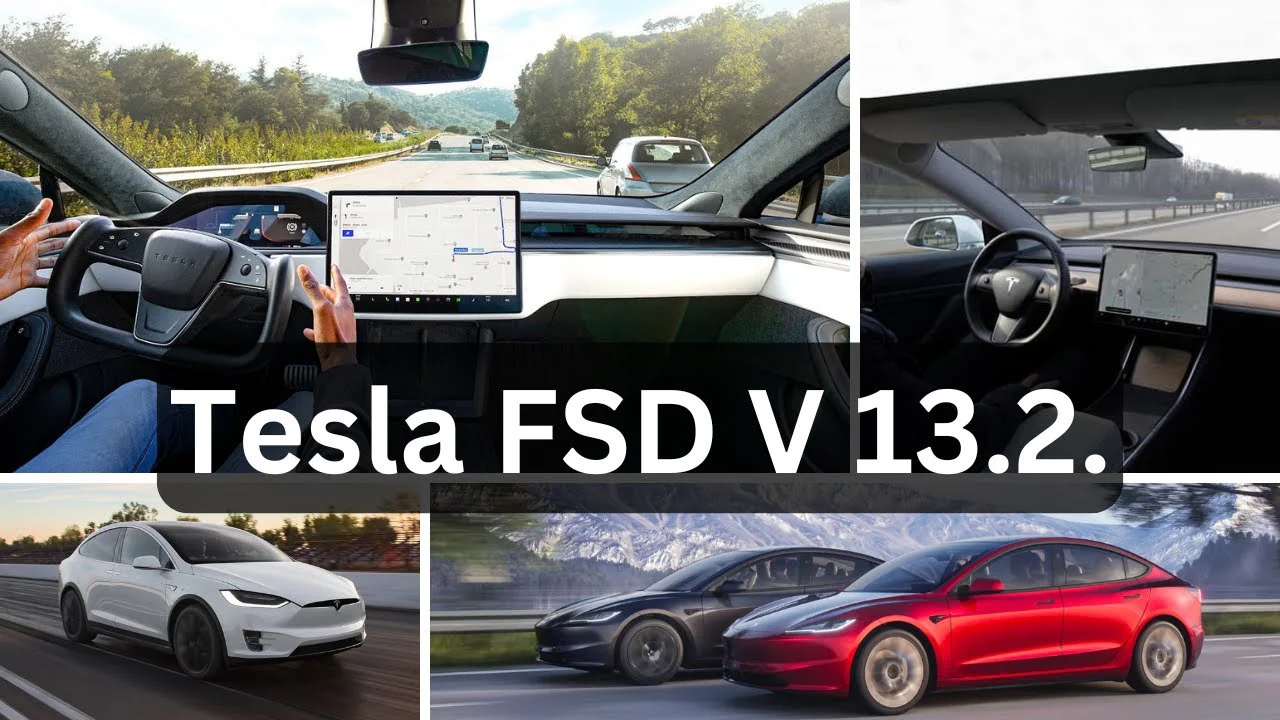
Imagine this: you are navigating the chaotic, rain-slicked streets of downtown Boston during rush hour. A symphony of honking horns, jaywalking pedestrians, and aggressive lane changes plays out before you. Yet, your hands are resting gently in your lap. Your Tesla, with a quiet confidence, smoothly negotiates an unprotected left turn, patiently waiting for a gap in oncoming traffic that you might have missed. It perfectly anticipates a cyclist swerving unexpectedly from behind a double-parked delivery truck and applies a gentle, measured brake response. This isn't a scene from a science fiction film. For a growing number of Tesla owners across North America, this is the reality of Full Self-Driving (FSD) Version 13.
For years, Tesla's FSD has existed in a state of "beta," a tantalizing glimpse into the future that was often brilliant but occasionally flawed, requiring constant human supervision. With each iteration, it improved, but the underlying feeling was one of incremental progress. FSD V13, rolled out to the fleet in the summer of 2025, represents something fundamentally different. It is not just another step on the ladder; it is the revealing of an entirely new staircase. This update marks a significant architectural shift away from a collection of siloed neural networks stitched together with human-written code, towards a more unified, end-to-end artificial intelligence. This evolution is moving Tesla demonstrably closer to its goal of Level 4 autonomy, and in doing so, it is profoundly altering the definition of car ownership. This article will deconstruct the core technology that makes V13 so revolutionary, provide a comparative analysis of its real-world performance in the varied environments of North America and Europe, explore the rapidly shifting regulatory landscape that will determine its future, and ultimately analyze what this leap forward means for the financial and practical value of owning a Tesla today.
Chapter 1: Deconstructing the V13 Update: What's Under the Hood?
To truly appreciate the magnitude of the FSD V13 update, one must look beyond the surface-level driving improvements and understand the foundational changes in its AI architecture. Tesla has been on a multi-year journey to reduce its reliance on manually written code and heuristics, instead allowing the neural network to learn the complex art of driving from raw data. V13 is the most significant public-facing product of this philosophy to date.
From Occupancy Networks to End-to-End AI
Previous advanced versions of FSD relied heavily on a concept called Occupancy Networks. This was a revolutionary step in itself, allowing the car to create a 3D volumetric representation of the space around it, predicting which "voxels" (3D pixels) were or would be occupied by an object, regardless of what that object was. This was excellent for avoiding collisions and understanding the physical world. However, the car’s subsequent actions—steering, accelerating, braking—were still largely determined by a separate set of networks and a significant amount of C++ code written by human engineers. This code had to contain rules for countless scenarios: how to approach a stop sign, how to merge, when to be assertive, when to be cautious. The problem is that the real world has an almost infinite number of edge cases, and it's impossible to code for them all.
FSD V13 introduces what Tesla calls an "end-to-end" AI model. While not yet fully end-to-end (some legacy code still exists for safety-critical functions), it dramatically expands the neural network's control over the vehicle's actions. The system now takes the raw video input from the eight cameras and directly outputs vehicle control commands (steering angle, acceleration, braking). It learns the "how" of driving, not just the "what to avoid." By training the AI on millions of video clips of exemplary human driving, the network learns the nuanced, almost intuitive, behaviors that are so difficult to program. This includes subtle steering adjustments when passing a large truck, the slight "creep" forward at a busy intersection to signal intent, or the gentle deceleration when approaching a stale green light. This shift reduces brittle, rule-based behavior and replaces it with a more fluid, human-like driving style. Owners have reported a palpable decrease in "hesitation" and "robotic" movements, replaced by a newfound confidence in complex situations.
The "World Model" Concept
A crucial component of this end-to-end approach is the simultaneous development of what Tesla engineers refer to as a "World Model." An AI that only reacts to its immediate surroundings is inherently limited. To drive safely and effectively, you must predict the future actions of others. The World Model is an internal simulation within the FSD computer that attempts to predict the likely behavior of all surrounding road users over the next few seconds. It’s a simulation of plausible futures.
With V13, the fidelity of this model has visibly improved. For example, when approaching a crosswalk, the system doesn't just see a pedestrian. It sees a pedestrian who is looking at their phone and walking briskly toward the curb. The World Model, trained on vast datasets, predicts a high probability that this person will step into the street without looking. The car then proactively slows down more than it would for a pedestrian who is standing still and has made eye contact. Similarly, it can identify a car in an adjacent lane that is repeatedly moving towards the lane line and predict a higher likelihood of an imminent, possibly unsignaled, lane change. This predictive power is the key to unlocking smoother, safer, and more efficient driving. It allows the car to act proactively rather than reactively, which is a cornerstone of advanced driving skill.
Vision-Only System Enhancements
Since Tesla's controversial decision to remove radar from its vehicles, the performance of the vision-only system has been under intense scrutiny. Every FSD update is, in essence, a testament to the viability of this approach. V13 brings substantial enhancements, particularly in handling "corner cases" where cameras can struggle. The neural networks responsible for image processing have been retrained with a much larger and more diverse dataset of adverse weather conditions. This includes terabytes of data from vehicles driving in heavy rain, dense fog, and even moderate snow.
The result is a system that is far less likely to degrade or disengage in inclement weather. The visualizations on the screen now more accurately render the environment even when visibility is poor, showing that the car is still tracking lane lines and other vehicles through the downpour. Furthermore, low-light and nighttime performance has improved. The system has become better at interpreting faint or worn lane markings and distinguishing between the headlights of distant cars and other light sources. This is achieved through better AI-powered image enhancement, effectively allowing the car to "see in the dark" with greater clarity than the human eye, improving both the reliability and safety envelope of the system after sunset.
User Interface (UI) and Visualization Changes
Building trust between the human driver and the autonomous system is paramount. If the driver doesn't understand what the car is doing or why, they will be hesitant to use it. FSD V13 introduces a new set of visualizations designed to open a window into the AI's "mind." The on-screen display now renders the predicted paths of other vehicles and pedestrians as translucent "ribbons" extending into the future. The driver can see the car's intended path highlighted in blue, and can also see how that path subtly shifts in response to the predicted movements of others.
When the car decides to wait at an intersection, it might display a subtle visual cue indicating why it's waiting—perhaps highlighting a fast-approaching car from a cross-street that is still outside the driver's primary field of view. This "show your work" approach is critical. It transforms the experience from a black box of mysterious decisions into a collaborative process, where the driver can understand the car's reasoning. This not only builds confidence but also serves as a powerful tool for teaching the driver what the system is capable of, encouraging safer and more appropriate use.
Chapter 2: The Atlantic Divide: FSD Performance in North America vs. Europe
An AI's performance is a direct reflection of the data it was trained on. Given that Tesla's FSD development has been overwhelmingly concentrated in North America, a significant performance gap has always existed between its capabilities on US highways and European city streets. FSD V13 begins to narrow this gap, but the core challenges and regulatory environments of the two continents ensure that the FSD experience remains distinct.
North America - The Proving Ground
The United States, with its relatively uniform road infrastructure, wide lanes, and car-centric culture, has been the ideal sandbox for FSD. V13 shines here, demonstrating a mastery of uniquely American driving challenges. On multi-lane interstates, it now performs high-speed lane changes and merges with a new level of assertiveness, confidently slotting into gaps in traffic that previous versions would have hesitated to take. The infamous unprotected left turn, a source of anxiety for human and machine drivers alike, is now handled with remarkable poise. The system accurately judges the speed of multiple lanes of oncoming traffic, creeps forward to claim its space, and executes the turn smoothly.
In dense urban environments like San Francisco or New York, V13 shows a new resilience to chaos. It navigates around double-parked cars, gives a wide berth to unpredictable pedestrians, and correctly interprets the complex, often unwritten, rules of four-way stops. The massive volume of data from the millions of miles driven by the US fleet has allowed Tesla to train the AI on nearly every conceivable scenario, from navigating sprawling shopping mall parking lots to dealing with the sudden appearance of emergency vehicles. For American owners, FSD V13 feels less like a beta test and more like a deeply competent, if still learning, co-pilot.
Europe - A Unique Set of Challenges
Europe presents a far more complex and fragmented operational design domain for any autonomous system. FSD V13 is making inroads, but the challenges are immense. Firstly, the road infrastructure is ancient and varied. The narrow, winding streets of a historic Italian village, with no lane markings and buildings flush with the road, are a world away from a German Autobahn. V13's path-planning abilities are stretched to their limits in these environments.
Secondly, roundabouts are a particularly European problem. Unlike the simple, single-lane roundabouts common in some parts of the US, Europe features multi-lane, spiral, and "magic" roundabouts (like the one in Swindon, UK) with complex priority rules that vary by country. While V13 shows marked improvement, correctly yielding to traffic already in the roundabout, it can still display hesitation or non-optimal lane choice in the most complex scenarios. This is a direct result of a relative lack of training data for these specific situations.
Thirdly, the diversity of road signage and markings is a significant hurdle. Each country has its own subtle variations in sign shape, color, and language. While the vision system is adept at reading standardized signs, it can be confused by regional oddities. Tesla is actively using the data from its growing European fleet to address these issues, and with each software update, European owners report tangible improvements. The system is getting better at navigating the tight corners of Paris and the bicycle-filled lanes of Amsterdam, but it still lacks the seemingly effortless confidence it displays on the wide-open roads of Arizona.
Regulatory Headwinds and Tailwinds
The biggest differentiator between the US and EU experience is not technology, but regulation. The US operates under a self-certification model, where Tesla is largely free to deploy new features as long as they can internally validate their safety, with the National Highway Traffic Safety Administration (NHTSA) intervening only after issues arise. This has allowed for rapid iteration and the release of "beta" software to the public.
In contrast, the European Union operates under a much stricter, top-down type-approval system managed by bodies like the UNECE (United Nations Economic Commission for Europe). Before a feature like FSD can be fully enabled, it must meet stringent, pre-defined performance and safety criteria. This includes regulations on automatic lane changing (which must be driver-initiated) and steering input limitations. Consequently, the version of FSD available in Europe, even with the V13 software, is often feature-limited compared to its North American counterpart. For example, "Summon" may have a shorter operational range, and "Navigate on Autopilot" might require more frequent driver confirmation for lane changes. While these regulations are designed to maximize safety, they also stifle the pace of innovation and data collection, creating a catch-22 where the system needs more data to get approved, but can't get that data without wider deployment.
Chapter 3: The Road to True Autonomy: What V13 Means for Tesla Owners
The release of FSD V13 is more than just a technical milestone; it has profound implications for the ownership experience, the financial value of the vehicle, and the long-term vision of the company.
Redefining "Driver Assistance"
With V13, the line between a Level 2 "driver assistance" system and a Level 3 "conditional automation" system becomes increasingly blurry. Under SAE definitions, a Level 2 system requires the driver to be constantly supervising, while a Level 3 system allows the driver to be "eyes off" in certain conditions. While Tesla still insists that FSD requires full driver attention, the sheer competence of V13 in many situations tempts the definition. The system's ability to handle entire journeys, from driveway to destination, with zero to minimal interventions, challenges the "assistance" label.
This raises new questions about driver responsibility. As the system becomes more capable, the risk of human complacency increases. The industry and regulators are grappling with this "handoff" problem: how to ensure a human who has been passively monitoring for an hour can instantly and correctly resume control in a critical situation. FSD V13's release will undoubtedly accelerate these conversations, pushing the entire automotive world to define a new legal and practical framework for semi-autonomous driving.
Impact on Vehicle Value
For years, Tesla CEO Elon Musk has framed the FSD package, currently a costly upfront purchase or a monthly subscription, as an investment in a future asset. The thesis is that once the software is "solved" and robotaxis are approved, any FSD-capable Tesla will be worth significantly more, as it can be used to generate revenue. This claim has been met with both enthusiasm and skepticism.
FSD V13 is the strongest evidence yet to support this thesis. For owners who have purchased the package, the dramatic improvement in capability and usability provides a tangible return on their investment in the form of a more relaxed and safer driving experience. For the resale market, a vehicle with FSD V13 is now demonstrably more capable than one without, which could begin to create a clearer price separation. While the robotaxi future is not yet here, V13 makes that future feel less like a distant dream and more like an approaching reality. This will likely bolster consumer confidence in purchasing the FSD package and could support higher residual values for equipped vehicles.
The Future of Robotaxis
The ultimate goal of FSD has always been the creation of the Tesla Network, a decentralized ride-hailing service of owner-operated autonomous vehicles. FSD V13, with its end-to-end AI, is the architectural foundation upon which a robotaxi service could be built. The human-like driving behavior it enables is crucial for passenger comfort and acceptance.
However, several key hurdles remain. The system's reliability needs to improve by several orders of magnitude, moving from "one intervention every hundred miles" to "one intervention every million miles." This requires an astronomical amount of training data and processing power. Furthermore, the regulatory framework for operating driverless commercial vehicles is still in its infancy globally. What V13 does is provide a clear technological path. The challenge is no longer "is this possible?" but rather "how do we refine and validate this to a superhuman level of safety?" The progress seen in V13 suggests that the focus at Tesla is shifting from core capability development to massive-scale validation and a push for regulatory approval.
Conclusion
FSD V13 is a landmark achievement in the quest for autonomous driving. By embracing a more holistic, end-to-end AI approach, Tesla has unshackled the system from the limitations of human-coded rules, resulting in a driving experience that is smoother, more predictive, and profoundly more capable. The update solidifies FSD's lead in the North American market and, while still facing the unique challenges of European roads and regulations, shows a clear path to global improvement.
This leap forward transforms the FSD package from a promising but flawed experiment into a genuinely useful and often astounding co-pilot. It redefines the daily commute, reduces the stress of long road trips, and provides a compelling, if not yet fully realized, argument for the car as a future appreciating asset. While the final destination of true Level 5 autonomy—a car that can drive anyone, anywhere, anytime—remains on the horizon, FSD V13 proves that Tesla is not just on the right road; it has its foot firmly on the accelerator. It marks the end of the beginning for autonomous driving, and for Tesla owners, it has made the future of driving a tangible part of their present.
FAQ Section
Is FSD V13 available for all Tesla models? FSD V13 is a software update. It is available for all Tesla vehicles that have purchased or subscribed to the Full Self-Driving capability package and are equipped with the necessary hardware (typically Hardware 3.0 or newer). The rollout is often staggered, so it may take several weeks for all eligible cars in a region to receive the update.
How do I know if my car has the latest FSD version? You can check your car's current software version by navigating to the 'Software' tab on your Tesla's main touchscreen. The FSD version number (e.g., V13.x.x) will be displayed alongside the main vehicle software version. You will also receive a notification in your Tesla app and on the car's screen when a new update is ready to be installed.
Will the price of the FSD package increase after this update? Historically, Tesla has increased the price of the FSD package following major improvements in capability. While there has been no official announcement as of the release of V13, the company has stated that the price will continue to rise as the system gets closer to full autonomy. It is reasonable to anticipate a price adjustment in the near future.
What are the key legal limitations I should be aware of when using FSD in Europe? In Europe, the use of FSD is governed by UNECE regulations, which are generally more restrictive than in the US. Drivers must keep their hands on the wheel and be prepared to take over at all times. Features like automatic lane changing typically require driver confirmation. The system's operational speed may also be limited. It is crucial to be aware of the specific laws in the country you are driving in, as the "beta" label does not absolve the driver of legal responsibility.
Can I transfer my FSD package to a new Tesla? Historically, the FSD package has been tied to the vehicle, not the owner. However, Tesla has occasionally offered limited-time promotions allowing owners to transfer their FSD package to a new Tesla purchase as a loyalty incentive. As of August 2025, this is not a standard policy. You should check with Tesla directly at the time of purchase for any current offers.