
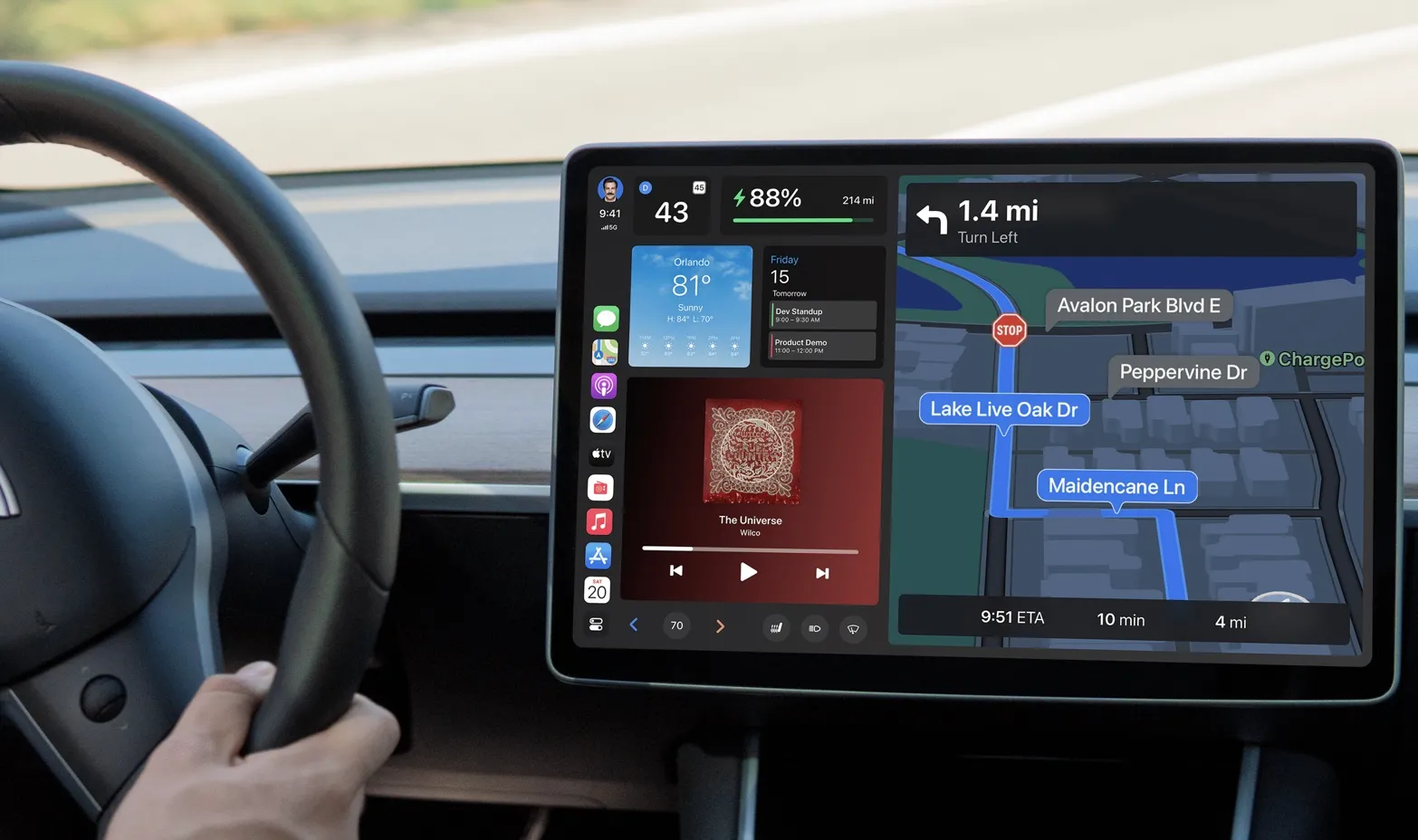
Tesla, the electric vehicle (EV) giant long known for its bold software-first approach, may be on the verge of a massive change: internal sources suggest the company is working on integrating Apple CarPlay into its vehicles. This marks a potential paradigm shift for Tesla’s infotainment philosophy, which for years has leaned entirely on its proprietary system — eschewing third-party integrations like CarPlay or Android Auto.
According to a Bloomberg report, Tesla is now testing CarPlay internally, and while a public rollout may come soon, things aren’t finalized. This development could significantly improve the iPhone-user experience in Tesla cars, offering access to iPhone-native apps for music, navigation, and messaging — all optimized for in-car use.
In this article, we will explore Tesla’s transformation with CarPlay, why it matters, the technical trade-offs, the business and strategic implications, the risks, and how Tesla owners may react. This is a big moment — one that could redefine the Tesla in-car experience, its relationship with Apple, and even its broader market competitiveness.
1. Background: Tesla’s Infotainment Philosophy
1.1 Tesla Proprietary System from the Start
From its earliest models, Tesla has prioritized its own full-stack software for the car’s infotainment system. The large center screen, built-in Tesla apps, in-car web browser, Atari-era games — all that is part of Tesla's unique in-house user experience. Rather than relying on phone mirroring, Tesla has offered its own navigation, media, messaging, and even voice features.
1.2 Elon Musk’s Longstanding Skepticism
Elon Musk has historically resisted integrating CarPlay and Android Auto. In past earnings calls and public comments, he expressed that Tesla’s own UI is designed specifically for the car, and considered third-party mirroring systems to be a “crutch.” Back in 2017, he reportedly said Tesla would not support CarPlay — a strong statement that established Tesla’s differentiation.
1.3 The Current Landscape of Infotainment in EVs
In contrast to Tesla, many automakers have long embraced CarPlay (and Android Auto). Brands like Ford, General Motors, Hyundai, and more widely support Apple’s system, giving drivers a familiar and seamless way to connect their iPhones to the car’s screen.
Meanwhile, Tesla’s integrated ecosystem — while innovative — has sometimes drawn criticism from users who want tighter iPhone integration, especially for apps like Apple Maps, iMessage, or third-party navigation like Waze.
2. What the Latest Reports Actually Say
2.1 The Bloomberg & Reuters Report
The turning point came on November 13, 2025, when Bloomberg reported — via unnamed but “people familiar with the matter” — that Tesla is developing support for Apple CarPlay. According to the report, internal testing is already underway.
This isn’t just speculative: multiple sources confirm that Tesla has discussed a potential rollout in the “coming months,” though no final decision has been made. Tesla could still delay or even cancel, as has happened with other ambitious software features in the past.
2.2 Integration Style: Windowed CarPlay
Importantly, Tesla’s proposed implementation is not a full takeover of the touchscreen. Rather than replacing Tesla’s interface entirely, CarPlay may run in a window inside Tesla’s existing system. This suggests Tesla wants to maintain control and preserve its own UI experience, while giving users access to a subset of iPhone functionality.
2.3 Which Version of CarPlay?
The report clarifies that Tesla is testing the standard version of CarPlay — not CarPlay Ultra (the more advanced version that can control instrument clusters, climate, etc.). Moreover, the integration is expected to support wireless CarPlay, so iPhone users may be able to connect without a cable.
2.4 Why Tesla Might Do This Now
According to insiders, this effort isn’t purely technical — it's strategic. Tesla reportedly sees CarPlay integration as one of the most requested features by customers. There is speculation within the company that enabling CarPlay could help reverse softening demand or improve satisfaction among iPhone-using buyers.
3. Strategic & Business Implications
3.1 Responding to Customer Demand
Tesla’s move could be seen as a direct response to repeated customer feedback. Apple CarPlay is, for many users, a must-have feature — particularly for iPhone users who want continuity, familiar apps, and seamless mobile integration.
By adopting CarPlay, Tesla may make its cars more attractive to a subset of buyers who previously rejected Tesla due to its lack of mirroring.
3.2 Boosting Sales & Retention
Sources suggest that part of Tesla’s motivation may be to boost vehicle sales by addressing a common friction point. If a significant portion of potential buyers consider CarPlay or Android Auto a deal-breaker, then integrating CarPlay could help Tesla close that gap.
3.3 Balancing Control vs Openness
Tesla has always treasured its control over the software stack: its own navigation, software updates, and in-car interface are part of the brand identity. With a windowed CarPlay, Tesla is striking a balance — letting in Apple’s ecosystem without ceding full control. This way, Tesla can preserve its user experience while acknowledging customer demand.
3.4 Competitive Pressure
Rival automakers increasingly promote CarPlay or Android Auto as key features. By moving in the same direction, Tesla may be responding to competitive pressure. According to market watchers, being the only major EV brand without smartphone mirroring could risk Tesla’s appeal to certain buyers.
Also, given Tesla’s software-first image, integrating CarPlay may help reassure more traditional buyers (used to legacy automakers) and capture more mainstream EV shoppers.
3.5 The Apple Relationship
If Tesla integrates CarPlay, its relationship with Apple could subtly shift. Tesla and Apple have had a complex history: Musk and Tesla have criticized Apple’s policies, and there were reports of Apple hiring Tesla engineers.
This move may signal a more pragmatic collaboration: Tesla recognizing Apple as a key partner in certain areas, even if not as a full-blown rival.
4. Technical & UX Trade‑offs
4.1 Coexistence of CarPlay and Tesla UI
Running CarPlay in a window rather than full screen is a clever design to coexist with Tesla’s native UI. Users may be able to switch between or overlay functions: for example, running Apple Maps in one window while still using Tesla’s system for settings, climate, or vehicle-specific controls.
4.2 Performance & Latency Considerations
Implementing CarPlay could introduce performance challenges: Tesla will need to ensure that rendering the CarPlay interface doesn’t degrade responsiveness or introduce lag. Wireless CarPlay, in particular, demands reliable bandwidth and low latency to deliver a smooth experience.
Tesla’s hardware (various generation MCU units) could matter: older vehicles may struggle more than recent ones.
4.3 Safety & Regulatory Concerns
By not giving CarPlay full control (i.e., running in a window), Tesla may mitigate safety risks: critical vehicle functions remain under Tesla’s own interface. This reduces the risk that CarPlay could interfere with driving-critical controls.
However, regulatory bodies could still scrutinize how much screen real estate CarPlay occupies and how it interacts with Tesla’s built-in systems — especially around driving distractions.
4.4 Over-the-Air (OTA) Deployment
If Tesla rolls this feature out, it’s likely to be via an over-the-air software update. That’s consistent with Tesla’s model for deploying new features. But OTA rollout brings its own challenges: ensuring compatibility across vehicle models, screen sizes, MCU versions, and avoiding bugs in early versions.
Tesla may need to restrict initial rollout to certain regions, car models, or software channels (e.g., early access, public beta) to manage risk.
4.5 Backward Compatibility
A key question is: will all Teslas get this? It’s not yet clear whether older models (with older MCU or hardware) will support CarPlay smoothly. Tesla will need to decide whether it supports only newer cars or backports to older ones — balancing user satisfaction against engineering cost.
5. User and Owner Reactions
5.1 Enthusiasm Among iPhone Users
Many Tesla owners — especially those who use iPhones — have long requested CarPlay. For them, integration would bring major benefits: access to Apple Maps, easier messaging via iMessage, and familiar music apps in a more integrated way than Bluetooth audio.
Reddit threads already reflect this excitement: one user said, “I drive with my phone in my pocket … but more options are always nice.”
Some are particularly looking forward to using third-party navigation like Waze through CarPlay.
5.2 Skepticism and Caution
Not all reactions are purely positive. Some Tesla users doubt the feature will ever materialize, citing past promises that were delayed or canceled.
Others worry that CarPlay running in a window may come with limitations: for example, CarPlay may not interact with Tesla’s Autopilot / Full Self-Driving (FSD) systems, climate control, or other vehicle-specific functions.
There are also concerns about performance, especially in older vehicles, and whether Tesla will support all models.
5.3 Impact on Resale Value and Buyer Sentiment
If Tesla does integrate CarPlay, it could make its cars more attractive on the used market, particularly to buyers who value smartphone integration.
Prospective buyers may also see this as a signal that Tesla is paying attention to customer feedback and maturing in its software approach, potentially increasing purchase confidence.
On the flip side, if Tesla launches a glitchy or poorly integrated version, it could spark frustration and reputational risk.
6. Risks, Challenges & Potential Pitfalls
6.1 Feature Cancellation or Delay
Although reports say Tesla is testing CarPlay, the project isn’t finalized, and rollout could be delayed or scrapped. Tesla has a history of killing or postponing features, especially ambitious software projects.
Investing heavily in CarPlay, only to pause or cancel, could disappoint users who were counting on the feature — and potentially hurt Tesla’s credibility.
6.2 Quality and Usability Issues
Delivering CarPlay in a windowed format may pose usability issues: small screen size, poor scaling, or subpar touch responsiveness could limit its usefulness. If CarPlay feels “tacked on” or clunky, adoption may suffer.
Wireless CarPlay introduces additional risk: connection drops, lag, or degraded performance may frustrate users.
6.3 Regulatory Hurdles
Regulators in some regions may push back if CarPlay’s UI interferes with critical car controls, or if it is deemed a distraction. Tesla will need to navigate safety, legal, and compliance scrutiny — particularly in Europe or other markets with stricter automotive UI regulations.
6.4 Strategic Brand Risk
Tesla’s brand is tightly linked to its software identity. By embracing CarPlay, Tesla risks diluting its “unique user experience.” Some purist fans may view this as a backward move: abandoning total UI control in favor of a more conventional setup.
Additionally, misalignment in how Tesla balances CarPlay vs its own interface could confuse users: will Tesla subsidize or promote its own apps less once CarPlay is available? How will future updates handle both systems?
6.5 Fragmentation Across Models
Tesla’s vehicle fleet spans multiple hardware generations: older cars have different CPUs, RAM, screen specs, and MCU architectures. Not all vehicles may support CarPlay equally. If Tesla restricts CarPlay to newer cars, older owners might feel left out, possibly affecting customer satisfaction.
7. Strategic Scenarios: What Could Happen Next
Let’s examine a few likely scenarios for how Tesla might roll out Apple CarPlay, and what each means:
Scenario A: Smooth Rollout & Wide Adoption
-
Tesla launches CarPlay via OTA to most recent models (or all compatible ones).
-
CarPlay runs well in a window, integrates cleanly with Tesla software.
-
iPhone owners embrace it; Tesla sees a boost in customer satisfaction.
-
Tesla markets this as a key new feature, perhaps helping to reverse sales softness or attract new buyers.
Scenario B: Limited Beta / Pilot Phase
-
Tesla releases CarPlay to a subset of vehicles (e.g., those with newer MCU) as a beta.
-
Initial feedback is mixed: some performance issues, but enthusiasm from iPhone users.
-
Tesla refines the UI, addresses latency, and iterates over several software updates.
-
Full rollout is delayed, but eventually broadens once the system is stable.
Scenario C: Delayed or Canceled Project
-
Internal testing reveals too many performance or safety issues.
-
Tesla decides to scrap or pause CarPlay integration.
-
Users are disappointed; some potential buyers who waited may look elsewhere.
-
Tesla reverts to improving its own native apps instead.
Scenario D: Hybrid Integration with Limited Features
-
CarPlay integration is partial: e.g., only media and messaging, not navigation or vehicle controls.
-
Tesla positions CarPlay as an “option” rather than a core UI replacement.
-
Some users adopt, but others find limited value; demand is mixed.
-
Tesla uses this as a way to offer flexibility without abandoning its in-house experience.
8. Implications for Tesla’s Market Position
8.1 Strengthening Appeal to iPhone Users
With CarPlay, Tesla could significantly increase its appeal among iPhone-centric buyers. For those who rely heavily on Apple Maps, Siri, iMessage, or third-party navigation, CarPlay could close a usability gap that prevented them from choosing Tesla.
8.2 Differentiating from EV Rivals
While many EV makers already ship with CarPlay or Android Auto, Tesla’s selective, windowed integration could offer a unique hybrid experience. By maintaining its UI while offering CarPlay, Tesla may strike a differentiated balance: the best of both worlds.
8.3 Response to Weakening Sales (Speculative)
Some insider commentary links this move to Tesla's broader sales strategy: integrating CarPlay might help reverse or slow down softening demand. Considering Tesla has faced increasing competition in recent years — both from established automakers and emerging EV startups — this could be part of a customer retention and attraction play.
8.4 Risk Management in Software Strategy
Tesla’s software-first strategy has always been a competitive advantage, enabling OTA updates, frequent features, and high integration. But introducing a third-party system like CarPlay changes the dynamic: Tesla must carefully manage how much control it yields, how it updates, and how it supports different UI systems without fragmenting its user base.
8.5 Strengthening/Altering Apple Relations
By enabling CarPlay, Tesla could be signaling a more cooperative stance toward Apple. If done well, this may open further opportunities for collaboration — perhaps in AI (xAI), app integrations, or even future in-car services. But it also entails a public acknowledgment that Tesla needs Apple’s ecosystem to serve a portion of its customer base.
9. Recommendations for Tesla Owners & Potential Buyers
9.1 For Current Tesla Owners
-
Check for Software Updates: If Tesla releases CarPlay, it may come as a newer version of its software. Stay on top of release notes.
-
Evaluate Your Use Case: Do you rely on Apple Maps / iMessage / certain iOS-only apps? CarPlay could be a big win.
-
Consider Hardware Limitations: If you have an older MCU, test early (if possible) in beta to see how well it works.
-
Provide Feedback: If Tesla opens up a beta program, participating can help shape the final product and prioritize fixes you care about.
9.2 For Prospective Tesla Buyers
-
Ask About CarPlay: When buying a Tesla (new or used), ask the dealer or in listings whether CarPlay integration is available / supported.
-
Factor in iPhone Integration: If being able to seamlessly mirror your iPhone is important, this feature may influence which Tesla you choose, or whether you wait.
-
Resale Considerations: A Tesla with CarPlay may have stronger appeal to future buyers, particularly iPhone users.
9.3 For Tesla as a Company (Strategic Advice)
-
Roll Out Gradually: Start with a pilot or beta to test different vehicle models, get real-world feedback, and iterate.
-
Optimize UX: Ensure CarPlay’s windowed mode is ergonomic, responsive, and safe — avoid making it feel like a second-class feature.
-
Communicate Transparently: Tesla should clearly communicate which vehicles are compatible, the timeline, and the support plan to manage customer expectations.
-
Use Analytics & Feedback: Monitor how many users actually use CarPlay, in which contexts, and adapt future UI / update priorities accordingly.
-
Leverage Marketing: Use CarPlay integration as a selling point to attract iPhone users who previously rejected Tesla for lack of mirroring support.
Conclusion
Tesla’s potential integration of Apple CarPlay is a significant moment — one that could reshape the in-car experience for iPhone users and signal a strategic shift in Tesla’s software philosophy. By offering CarPlay in a windowed mode rather than fully replacing its system, Tesla is navigating a delicate balance: preserving its identity while meeting customer demand.
If successful, this move could boost satisfaction among existing Tesla owners, attract new buyers who have long seen CarPlay as essential, and strengthen Tesla’s competitiveness against rivals. Yet, risks remain: technical challenges, performance, user experience, and the possibility that the project might be delayed or canceled.
For Tesla, CarPlay could be more than just a feature — it could be a statement: that even a pioneer of in-house software is willing to adapt, and that the next era of EV user experience might be more open and flexible than ever.
FAQ
Q1: Will CarPlay fully replace Tesla’s native interface?
A: No — based on current reports, Tesla plans to run CarPlay in a window within its existing interface, rather than letting it take over the full screen.
Q2: When will Tesla release CarPlay to customers?
A: There is no confirmed timeline yet. While Bloomberg reports that Tesla has discussed a rollout in the “coming months,” the plan is not finalized and could be delayed.
Q3: Will the CarPlay in Tesla be the “Ultra” version?
A: According to the reports, Tesla is testing the standard version of CarPlay — not CarPlay Ultra.
Q4: Will it require a cable, or is it wireless?
A: Tesla reportedly plans to support wireless CarPlay, so iPhone users may be able to connect without plugging in.
Q5: Will all Tesla models support CarPlay, including older ones?
A: That remains unclear. Tesla hasn’t publicly stated which vehicle generations or hardware configurations will be compatible. There may be limitations based on MCU, screen, or other factors.
Q6: Does this integration affect driver safety?
A: Because Tesla is likely to restrict CarPlay to a windowed mode (rather than full takeover), critical driving functions will remain under Tesla’s control. However, regulatory scrutiny and safety testing will be important to ensure the feature doesn’t become a distraction.
Q7: How can I find out when CarPlay becomes available for my Tesla?
A: Monitor Tesla’s software release notes, check your Tesla app for update listings, and participate in any beta or early-access programs if Tesla offers them. Also, engage with Tesla owner communities — they often share early reports and experiences.