
Part I: The Marque Feature—Comfort Braking (The "Soft Stop" Engineering)
1.1 The Physics of the Nodding Car
For years, one of the most persistent criticisms of electric vehicles, including Teslas, has been the "nodding" or "dive" that occurs during the final milliseconds of a braking event. Even with one-pedal driving, as regenerative braking brings the car to a complete stop, there is a moment where the hydraulic brakes must engage to hold the vehicle stationary. The transition from regen to friction brakes, and the final clamping of the calipers, often results in a subtle but perceptible jolt.
Tesla's 2026.8 update introduces Comfort Braking (also referred to in release notes as "Soft Stop") to address this exact phenomenon. This feature is currently listed as compatible with the "new" Model Y (Juniper) and is gradually being rolled out to other models.
The engineering behind it is more complex than it sounds. Comfort Braking utilizes the vehicle's real-time inertial measurement unit and pressure sensors to execute a "torque ramp-down" algorithm. As the vehicle approaches 0 mph, the system does not simply release the brake motors; it precisely modulates the hydraulic pressure in the calipers to counteract the natural pitch of the chassis. The goal is to replicate the feel of a professional driver executing a "limousine stop"—where the deceleration is so linear that the occupants are unaware of the exact moment the vehicle ceases to move.
1.2 The One-Pedal Debate: Is It Necessary?
The release of Comfort Braking has sparked a lively debate in the Tesla community, particularly on forums like Tesla Motors Club . Veteran drivers who have mastered the art of one-pedal driving argue that they can already achieve a perfectly smooth stop by gently feathering the accelerator pedal. For them, the feature may seem redundant.
However, this perspective misses the mark on two fronts. First, not all drivers have the same level of skill or sensitivity. For the vast majority of owners, and especially for passengers who are prone to motion sickness, the automatic smoothing of the stop is a significant quality-of-life improvement. Second, and more importantly, Comfort Braking is not just for the driver; it is for the passenger. It addresses the "head toss" that occurs when a driver (like a rideshare operator or a parent distracted by children) fails to modulate the stop manually.
As one UK-based owner on the Tesla Motors Club forum noted, "I've always found letting the regen braking come to a full stop to be extremely smooth with no jarring sudden halt," while another countered, "I think the difference is for those who don't feather, or in situations where the car is doing the final stop under TACC or FSD". Indeed, for those who rely on Traffic-Aware Cruise Control, the automated stop has historically been less refined. Comfort Braking bridges that gap.
1.3 Regional Implications: The European "Blended Braking" Void
The discussion around Comfort Braking takes on a different nuance in Europe. European regulations have historically limited the effectiveness of regenerative braking at higher states of charge or in cold weather, as the system must comply with braking standards that prioritize hydraulic systems. Some owners in the UK have expressed frustration that Tesla has not yet implemented a "blended braking" system that seamlessly integrates regen and friction brakes to simulate a consistent deceleration feel regardless of battery temperature .
While Comfort Braking solves the end of the braking event, it does not yet solve the middle. As one forum user lamented, "I still don't understand why us Brits don't get blended braking for when regen is unavailable... I approach a junction, come off the accelerator expecting strong regen braking, but the brakes 'fail' and I am then manually braking later and harder than normal" . This highlights that while 2026.8 is a step forward, the European market is still waiting for a full-suite braking solution that accounts for local regulatory quirks.
Part II: The Safety Leap—Anti-Dooring Protection Arrives on Cybertruck
2.1 What is "Anti-Dooring"?
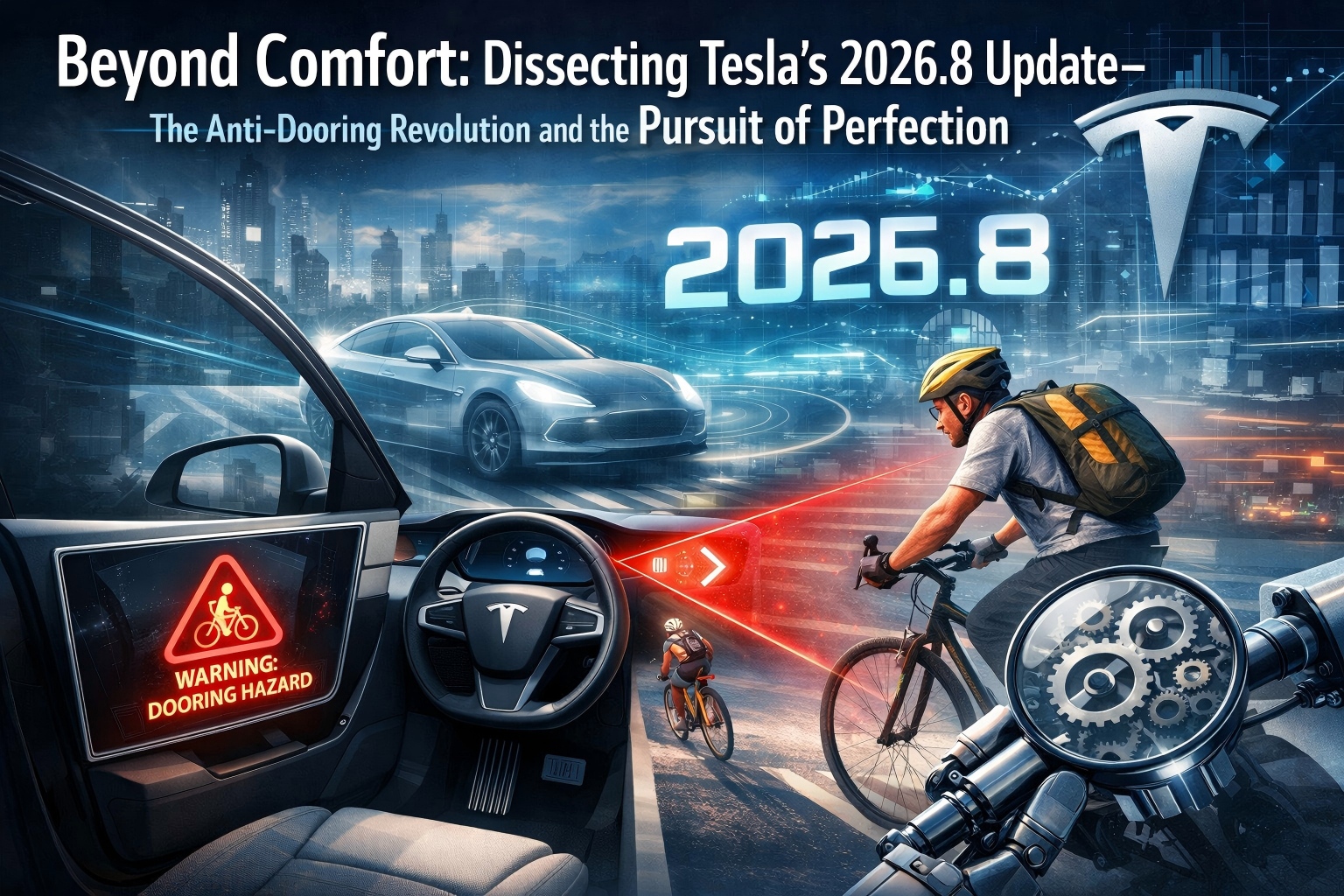
If Comfort Braking is about refinement, Anti-Dooring Protection is about genuine safety innovation. On March 17, 2026, just days after the initial 2026.8 rollout, Tesla confirmed that the feature was being extended to the Cybertruck via this very update .
"Dooring" is the act of opening a car door into the path of an oncoming cyclist, pedestrian, or vehicle. It is a pervasive urban hazard. According to data cited by Teslarati, in major cities like Chicago, dooring incidents can account for nearly 20% of all bicycle crashes . Nationally, emergency departments in the U.S. have treated over 17,000 dooring-related injuries over a decade, with victims often suffering fractures and head trauma .
Tesla's solution, which is standard on new Model 3 and Model Y vehicles, leverages the vehicle's existing side-repeater and pillar cameras. When the vehicle is parked and an occupant attempts to open a door, the system performs a rapid vision-based scan of the blind spot.
2.2 How It Works: The Three-Stage Intervention
The feature operates in a layered, failsafe manner designed to prevent accidents without being overly intrusive:
-
Detection: The cameras detect an object (cyclist, scooter, car) approaching at speed in the door's swing path.
-
Warning: The blind spot indicator light on the side mirror flashes rapidly, accompanied by an audible chime .
-
Intervention: Crucially, the door will not open on the initial button press. The electronic latch remains engaged. The driver or passenger must wait a beat and press the button again to override the system .
This "hold and override" mechanism provides a critical delay—perhaps just one or two seconds—that can mean the difference between a close call and a catastrophic collision. For Cybertruck owners, whose vehicle's stainless steel panels and sharp lines could pose a particular danger to cyclists, this feature is a welcome addition.
2.3 The "Sentry Mode" for Pedestrians
The community response to the Anti-Dooring feature has been overwhelmingly positive, with many calling it a "Sentry Mode for pedestrians" . It shifts the safety paradigm from passive protection (airbags, crumple zones) to active, preventative intervention. It also highlights a key differentiator for Tesla: the ability to add safety features to existing vehicles without a trip to the dealership.
For owners of older Model S and X vehicles, the rollout has sparked a desire for retroactive compatibility. While Tesla has not confirmed if the legacy hardware (HW3 or earlier) supports the latency requirements for this feature, the discussion underscores the community's appetite for continuous safety improvement.
Part III: Infotainment and Quality of Life Improvements
Beyond the headline features, the 2026.8 update is packed with a series of minor tweaks that, collectively, significantly polish the user interface.
3.1 Spotify and Media Usability
One of the most practical updates is the improvement to the Spotify player. For users with extensive playlists or long-form podcasts (common among European commuters), scrolling from the top to the bottom of a list was a tedious distraction. The 2026.8 update introduces a down arrow shortcut that allows users to jump instantly to the bottom of a playlist or the latest episode of a podcast . It is a small change, but it speaks to Tesla's attention to user interface friction points.
3.2 Grok Gets a British Accent
In a move that delighted UK and Commonwealth owners, Tesla's in-car voice assistant, Grok, received a new voice option: Leo, the British accent . While seemingly cosmetic, this update is part of a broader localization effort. Voice assistants are inherently more comfortable to use when they speak in a familiar dialect. Alongside Leo, the 2026.8 update also added full Slovakian language support, expanding the vehicle's menus and voice recognition to serve the Central European market .
3.3 Navigation and Display Refinements
Tesla also addressed user feedback regarding screen clutter. A new toggle in the settings menu (Controls > Navigation > Destinations) allows drivers to hide recommended destinations . For those who do not want the navigation system suggesting their "Home" or "Work" locations every time they swipe down, this simple toggle cleans up the visual field, allowing the map to take center stage.
Part IV: The Owner Experience—Real-World Feedback and Issues (Days 1-8)
No software rollout is without its quirks. As the 2026.8 update propagated through the fleet in the US and Europe over the past week, owner forums have become a rich source of real-world data.
4.1 The "Factory Reset" Anomaly
A small subset of owners, particularly those with 2020 Model Y and 2018 Model 3 vehicles, reported a startling issue post-update: the car appeared to have lost all its driving dynamics settings . One user described the screen as looking like it "went back a few software updates," with FSD behaving erratically, hunting side-to-side within the lane.
The consensus among the forum community is that this is likely a profile corruption issue during the update installation. Recommended fixes included the standard "two-thumb scroll wheel reset" and a deeper "power off" cycle where the car is left undisturbed for 3-5 minutes . For most, these steps resolved the issue, but it serves as a reminder that OTA updates, while magical, are complex surgical procedures on a vehicle's central nervous system.
4.2 The FSD Quirk: Almaden Expressway
Beyond the initial glitches, long-term observations of FSD on 2026.8 remain mixed. One veteran owner noted a persistent problem on Almaden Expressway in California, where the vehicle incorrectly moves into a far-right lane that is designated for a southbound on-ramp, despite the navigation requiring a northbound merge onto Highway 85 . The fact that this issue has persisted through multiple updates (the user noted it had been happening for "over two years") highlights the challenge of solving long-tail edge cases in autonomous driving.
4.3 European Sentiment: "Where is the Range?"
In Europe, where efficiency is often prized over sheer speed, the reception to 2026.8 has been muted but positive. The lack of major features like the long-awaited "Blended Braking" has left some owners wanting more, but the stability of the update has been praised . The focus remains on the subtlety of the "soft stop" and the improved media controls, which are seen as signs that Tesla is maturing its product for a more discerning, luxury-oriented European audience.
Part V: The Strategic View—Why 2026.8 Matters
5.1 Polishing the FSD Foundation
As Tesla barrels toward the launch of its unsupervised Robotaxi network (slated for later this year in Austin), the refinement of the base vehicle controls is non-negotiable . A Robotaxi cannot have a jerky stop; it cannot open its doors into cyclists. The 2026.8 update essentially takes two critical elements of the Robo-ride experience—the "stop" and the "exit"—and automates them to a level of human-like competency.
5.2 The Cost of Acquisition vs. The Value of Retention
For automakers, selling the car is only half the battle. Retaining the customer through software engagement is the new frontier. Updates like 2026.8 keep owners talking about their vehicles long after the purchase. They generate positive sentiment, reduce the desire to switch brands (high switching costs), and reinforce the idea that a Tesla is a depreciating asset that paradoxically gains new features over time.
Conclusion
The Tesla 2026.8 software update is a masterclass in incremental innovation. It lacks the fireworks of a V4 Supercharger or a new vehicle launch, but it possesses the quiet confidence of a company that understands the devil is in the details. From the physics-defying smoothness of Comfort Braking to the life-saving potential of Anti-Dooring Protection, this update makes the fleet smarter, safer, and more pleasant to use.
For the owner in San Francisco, it means a more refined daily commute. For the owner in Berlin, it offers a more intuitive interface and a voice that speaks their language. And for the cyclist in London, it represents a digital guardian angel watching out for them when a driver is distracted. As Tesla navigates the complex regulatory and technological waters of 2026, updates like 2026.8 serve as the bedrock upon which its autonomous future is being built.
FAQ: Software Update 2026.8
Q: I have a 2022 Model 3 in Germany. Will I get Comfort Braking?
A: As of the initial rollout, Tesla has indicated Comfort Braking is primarily for the "new" Model Y. However, Tesla frequently expands feature compatibility in subsequent point releases (e.g., 2026.8.1) based on hardware validation. Keep your app notifications on .
Q: The Anti-Dooring feature saved me from a cyclist! Is it on my older Model S?
A: Anti-Dooring Protection is currently confirmed for Cybertruck, and is standard on new Model 3 and Y. For older S and X, the hardware (door latches and camera suite) may differ. Watch for future updates, but do not rely on it if you have not seen it in your release notes .
Q: The update reset all my settings. What happened?
A: This is a known but rare bug. Perform a two-finger scroll wheel reset on the steering wheel. If that fails, go to Safety & Security and hit "Power Off." Wait 3-5 minutes, then press the brake to wake the car. Your profile should restore.
Q: I hate the new voice. How do I switch Grok back to the American accent?
A: Go to the "Display" or "Language" settings menu (depending on your region). Look for "Voice Assistant Voice" or "Assistant Accent." You can toggle between available options, including the new British "Leo" and the standard American voice.
Q: I'm in the UK. Will this update fix the inconsistent regen in winter?
A: No. The 2026.8 update does not introduce blended braking, which is the feature that would simulate regen when the battery is cold. That remains a frequently requested feature for the European market .