
Introduction
On February 26, 2026, a photograph emerged from Giga Texas that sent ripples through the Tesla community. Standing on the factory floor, surrounded by a large team of workers, was the first production-spec Cybercab—a vehicle without a steering wheel, without pedals, designed from the ground up to operate as a fully autonomous robotaxi. The milestone was significant, marking the first time Tesla had assembled a purpose-built autonomous vehicle at scale. But beneath the celebration lurked a question that has haunted Tesla owners for years: What does this mean for the car sitting in my garage?
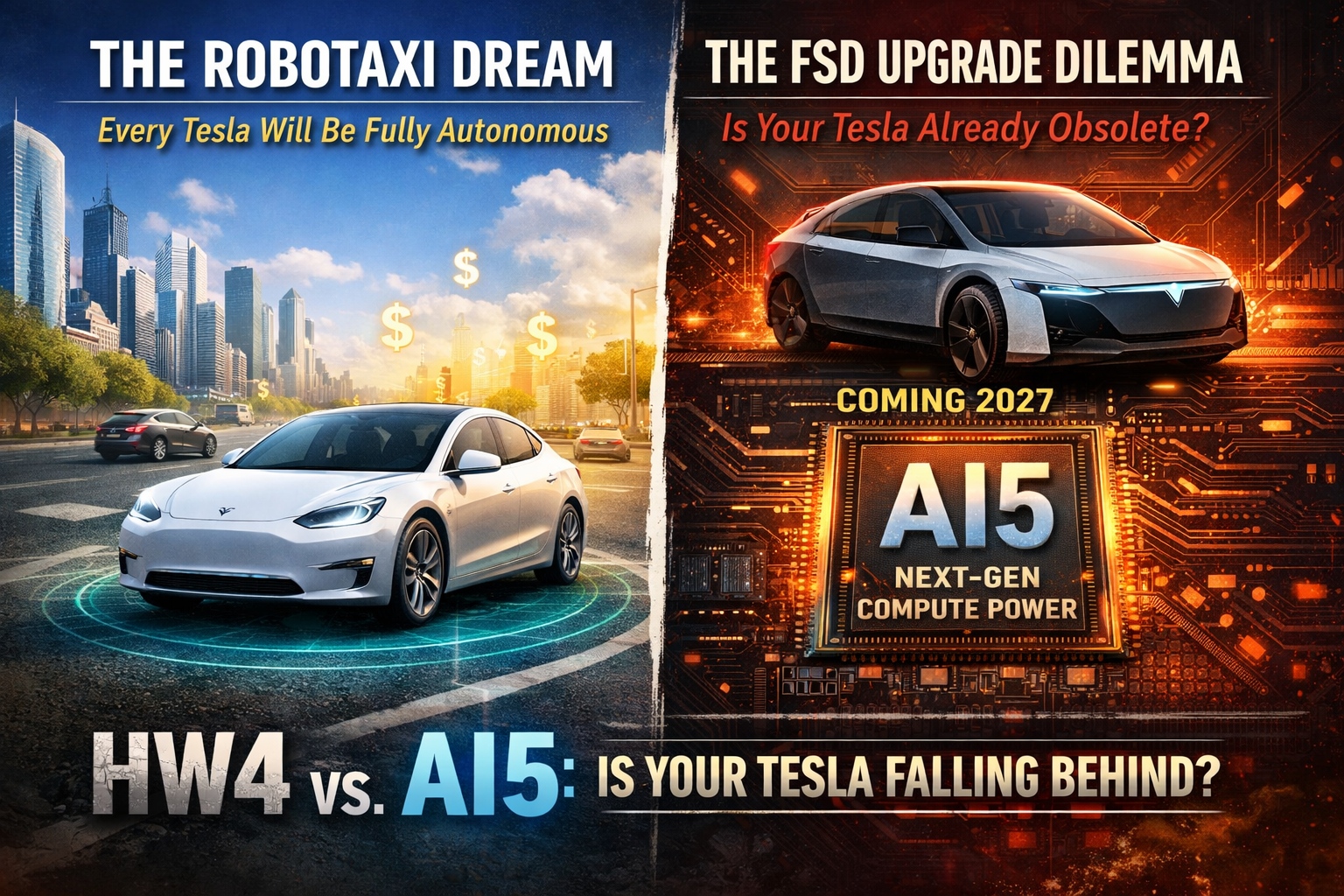
For the approximately three million Tesla owners who have purchased vehicles equipped with Hardware 4 (HW4)—the current-generation autonomy computer—the stakes could not be higher. Elon Musk has long promised that every Tesla produced today is a "fully autonomous vehicle" that will appreciate in value as a robotaxi asset. Yet the Cybercab's production timeline reveals an uncomfortable truth: mass production won't begin until at least April 2026, and the vehicle is slated to receive Tesla's next-generation AI5 chip, which isn't scheduled for volume production until 2027.
This timing gap has created a perfect storm of speculation and anxiety within the Tesla community. Will HW4 vehicles ever achieve true, unsupervised autonomy? Or will they be relegated to the same fate as Hardware 3 (HW3) cars, which Tesla has admitted may require retrofits to reach full self-driving capability? The answer lies not just in silicon specifications, but in a deeper understanding of how Tesla's autonomy strategy has evolved—and what recent developments reveal about the company's true roadmap.
Section 1: The Hardware Generations — A Technical Foundation
To understand the debate surrounding HW4 and AI5, one must first understand the evolutionary path of Tesla's autonomy hardware. Each generation has represented a significant leap in computational capability, but the relationship between hardware capability and software capability has proven far from linear.
The HW3 Era (2019-2023): The First Promise
When Tesla began shipping Hardware 3 in 2019, it represented a radical departure from the industry norm. Rather than purchasing off-the-shelf chips from Nvidia or Intel, Tesla had designed its own neural network accelerator. The HW3 computer, developed by a team led by Pete Bannon, delivered 144 trillion operations per second (TOPS) of inference performance—sufficient, Musk claimed at the time, for full self-driving.
Today, that claim looks increasingly optimistic. Tesla has quietly acknowledged that HW3 vehicles may not be capable of achieving unsupervised Full Self-Driving. In public statements, the company has maintained that HW3 owners will need to upgrade their hardware to access unsupervised FSD once it becomes publicly available. For these owners, Tesla has promised a retrofit path, though the logistics and cost of upgrading millions of vehicles remain unclear.
The HW3 situation serves as a cautionary tale for current owners. It demonstrates that Tesla's autonomy timeline has consistently proven optimistic, and that hardware capabilities that seem sufficient at launch may prove inadequate as software complexity grows.
Hardware 4 (2023-Present): The Current Standard
Hardware 4 began shipping with the Model S and X in early 2023, later expanding to Model Y and Model 3. While Tesla has never published official specifications, teardowns and analyses by industry experts have revealed a significant upgrade over HW3:
Computational Throughput: HW4 delivers approximately 3-5 times the raw computational performance of HW3. Early estimates suggest performance in the range of 300-500 TOPS, though exact figures remain speculative.
Camera Suite: The camera hardware received a substantial upgrade. HW4 features higher-resolution cameras with improved dynamic range and low-light performance. The number of cameras increased, and their placement was optimized for a better field of view.
Memory Bandwidth: Perhaps most critically for neural network inference, HW4 features significantly increased memory bandwidth. This allows the system to process more visual information per second and run larger, more sophisticated neural networks.
Redundancy Architecture: HW4 introduced improved redundancy for critical systems, including dual power supplies and redundant processing paths—features essential for safety-critical autonomous operation.
For current owners, the key question has always been whether HW4 represents a "final" autonomy platform or simply another stepping stone. Until recently, the conventional wisdom suggested that true unsupervised autonomy would require the next leap: AI5.
AI5: The 2027 Leap
According to recent statements from Elon Musk, the AI5 chip represents a generational leap in capability. In social media posts, Musk has revealed that the AI5 chip design is nearing completion and has passed design review.
The specifications, while preliminary, are staggering:
Performance Target: AI5 is expected to deliver between 2,000 and 2,500 TOPS using int8 precision—approximately five times the performance of HW4.
Power Consumption: The chip is designed to operate at a peak power consumption of 800 watts, requiring significant thermal management that current vehicles may not be equipped to handle.
Architecture: AI5 features an advanced matrix multiplication engine optimized for transformer-based neural networks. It supports mixed precision computing (FP16, BFLOAT16, INT8) and employs a unified cache hierarchy specifically designed for FSD workloads.
Manufacturing: Interestingly, Tesla has adopted a dual-sourcing strategy. AI5 chips will be manufactured by both TSMC and Samsung Electronics, with slightly different versions produced for each foundry. Tesla's software team is tasked with ensuring identical performance across both variants.
Timeline: Samples are expected in late 2026, with mass production ramping through 2027. This timeline aligns with the Cybercab's production schedule—the vehicle is expected to ship with AI5 from the factory.
The gap between HW4 and AI5 is not merely incremental. It represents a fundamental shift in capability—the difference between a system that can run current neural networks efficiently and one that can run the massive, transformer-based architectures that may be required for true unsupervised driving in all conditions.
Section 2: The Great Debate — Can HW4 Achieve Unsupervised FSD?
The central question facing Tesla owners and investors is whether HW4's capabilities will prove sufficient for unsupervised autonomy, or whether AI5 represents a minimum requirement. The answer, based on recent developments, is more nuanced than either side of the debate suggests.
The Case for HW4 Sufficiency
On January 20, 2026, Tesla owners received what appeared to be definitive news. In response to online speculation about whether HW4 vehicles might require upgrades, Elon Musk offered a simple, unambiguous confirmation: "Yup"—HW4 vehicles would be capable of achieving Full Self-Driving (Unsupervised) without hardware upgrades.
This statement aligned with technical developments that have emerged from Tesla's AI team. According to internal validation reports, Tesla has successfully deployed a technique called "Model Distillation" to compress the unsupervised FSD neural network stack to run efficiently on HW4 hardware.
Model Distillation is a machine learning technique where a large, complex "teacher" model is used to train a smaller, more efficient "student" model. The student model learns to mimic the teacher's behavior while requiring significantly less computational resources. In Tesla's case, the full unsupervised stack—presumably trained on the massive DOJO supercomputer cluster—has been distilled into a version that runs within HW4's constraints.
The results, according to validation data, are impressive:
Inference Speed: HW4 inference speed improved by approximately 40 percent following the distillation optimization.
Latency: End-to-end processing latency dropped to sub-10 milliseconds, matching the reaction time targets for the AI5 chip.
Visual Processing: Cameras now process at full resolution without frame dropping, ensuring that the neural network receives the complete visual context required for safe decision-making.
This development fundamentally changes the narrative around hardware requirements. It demonstrates that algorithmic efficiency can, to some extent, compensate for raw computational power. As one Tesla engineer reportedly noted, "You don't need a bigger TV to watch a 4K movie if the streaming algorithm gets smarter." Similarly, HW4 doesn't need to match AI5's raw TOPS if the software can achieve the same results with greater efficiency.
The Case for AI5 Necessity
Despite Musk's confirmation and the distillation breakthrough, significant questions remain about HW4's long-term viability for unsupervised autonomy. These concerns center on several factors:
Thermal and Power Constraints: HW4 was designed within the thermal and power envelope of current production vehicles. AI5, with its 800-watt peak power consumption, represents a different class of system entirely. The cooling systems, power delivery electronics, and thermal management in current vehicles may not be capable of supporting AI5-level performance. This suggests that AI5 may be reserved for future vehicles (Cybercab, next-generation models) while HW4 handles the legacy fleet.
Safety Margins and Redundancy: Unsupervised autonomy requires not just capability, but also substantial safety margins. The neural network must handle edge cases, sensor failures, and unexpected scenarios with sufficient computational headroom. HW4, running a distilled model at near-peak capacity, may lack the headroom required for the safety-critical redundancy that regulators will demand.
Future-Proofing and OTA Growth: One of Tesla's competitive advantages has been over-the-air updates that continuously improve vehicle capability. However, a system running at the edge of its performance envelope has limited capacity for future growth. As neural networks become more sophisticated, HW4 may struggle to keep pace, while AI5's substantial headroom provides room for years of software evolution.
The Waymo Comparison: Waymo's fully driverless vehicles operate at SAE Level 4 automation within geofenced areas. These vehicles rely on multiple sensor modalities (lidar, radar, cameras) and substantial onboard compute capacity. Tesla's camera-only approach places greater demands on neural network sophistication and computational throughput. If Tesla is to match Waymo's demonstrated capability, the computational requirements may prove higher than currently anticipated.
The Middle Ground: A Hybrid Future
The most likely outcome is neither a clean victory for HW4 nor a mandatory upgrade path. Instead, Tesla may pursue a hybrid strategy where HW4 vehicles achieve unsupervised autonomy within defined operational domains—perhaps geofenced urban areas or highway conditions—while AI5 vehicles handle the full spectrum of driving scenarios.
This approach would align with Tesla's stated goal of deploying robotaxi services initially in limited geographies. The Austin robotaxi fleet, which began operations in June 2025, operates within defined boundaries and reportedly relies on remote operator oversight for edge cases. For consumer-owned vehicles, unsupervised autonomy may similarly begin with geofenced operation before expanding to full capability.
For HW4 owners, this means their vehicles may indeed become robotaxi-capable, but perhaps not with the universal capability that Musk's most optimistic projections suggest. The vehicle may earn money while you sleep, but only within designated areas where Tesla has validated performance and obtained regulatory approval.
Section 3: The Robotaxi Reality — Where Tesla Stands Today
To understand the hardware question, one must examine the current state of Tesla's robotaxi operations. The gap between promise and reality provides crucial context for evaluating future claims.
The Austin and San Francisco Deployments
Tesla began its first robotaxi service in Austin in June 2025, later expanding to the San Francisco Bay Area. The current fleet consists primarily of modified Model Y vehicles, equipped with the same Hardware 4 systems available to consumers.
The operational data reveals a technology still in its infancy:
Scale: Tesla has reported nearly 700,000 paid miles logged by the robotaxi fleet. For context, Waymo is logging over 450,000 paid rides per week in the United States—a difference of several orders of magnitude in activity level.
Safety: Since launch, Tesla's Austin robotaxis have been involved in 14 reported crashes. While crash rates must be normalized for exposure, early analysis suggests the robotaxis may be involved in accidents nearly four times more frequently than human-driven Teslas.
Supervision: Perhaps most tellingly, the supposedly "autonomous" robotaxis often operate with remote operator oversight. According to reports, during operation, the vehicles are accompanied by other Tesla vehicles equipped with special safety equipment, suggesting that true driverless operation remains limited in scope.
Expansion Delays: Tesla had planned to expand robotaxi operations to seven additional cities in the first half of 2026, including Dallas, Houston, Phoenix, Miami, Orlando, Tampa, and Las Vegas. As of late February 2026, no new locations have launched, suggesting regulatory or technical hurdles remain.
The Regulatory Reality
The regulatory landscape for autonomous vehicles in the United States remains fragmented. California, in particular, has proven challenging for Tesla. Despite Elon Musk's public statements suggesting readiness, Tesla has taken zero steps to obtain the necessary robotaxi permits from California regulators. The company has logged no autonomous test miles in the state in 2025 and holds only the most basic testing permit.
This regulatory gap is not merely bureaucratic. California's autonomous vehicle permitting process requires demonstration of capability, safety protocols, and financial responsibility. Waymo, by contrast, holds seven distinct permits and has logged over 13 million miles of autonomous testing in the state. The contrast could not be starker.
For HW4 owners, the regulatory reality means that even if their vehicles are technically capable of unsupervised operation, they may be years away from actually being permitted to operate as robotaxis in their home cities.
The Safety Data Question
Newly submitted crash data to the National Highway Traffic Safety Administration (NHTSA) has raised additional questions about Tesla's autonomous readiness. According to recent filings, Tesla's robotaxis may be less safe than human drivers based on reported crash statistics.
This data must be interpreted with caution—early deployments often have higher incident rates as systems encounter novel scenarios. However, it underscores the gap between technical capability and safety validation. Unsupervised autonomy requires not just the ability to drive, but the ability to drive more safely than humans across millions of miles of exposure.
Section 4: Implications for Current Owners
For the millions of HW4 owners who have purchased Tesla vehicles in the last two years, the debate over hardware capability translates directly into financial and practical implications.
Resale Value and Asset Protection
One of Musk's most provocative claims has been that Tesla vehicles will appreciate in value once they become robotaxi-capable. The logic is straightforward: if your car can earn money while you sleep, its value as an income-generating asset exceeds its value as mere transportation.
The HW4 validation, if it holds, protects current owners from the worst-case scenario: sudden obsolescence. If HW4 had proven inadequate, 2024 and 2025 Model Y vehicles would have faced catastrophic depreciation as buyers anticipated the need for expensive retrofits. The distillation breakthrough and Musk's confirmation have, at minimum, stabilized the resale value proposition.
However, owners should maintain realistic expectations. The robotaxi network, even if HW4 vehicles are technically capable, will not launch overnight. Regulatory approval, safety validation, and geographic expansion will occur gradually. The "dormant asset" in your garage may remain dormant for years before generating meaningful income.
The FSD Purchase Decision
For owners considering whether to purchase Full Self-Driving capability, the hardware question adds complexity. FSD currently costs $8,000 in the United States—a significant investment that purchases access to Tesla's evolving autonomous software.
The HW4 validation suggests that the FSD purchased today will not become obsolete due to hardware limitations. The software will continue to improve via over-the-air updates, and the vehicle should remain capable of running future versions of the FSD stack.
However, owners should distinguish between "capable of running the software" and "capable of unsupervised operation." The former is now assured; the latter depends on regulatory approval and Tesla's willingness to deploy unsupervised features to consumer vehicles.
The Upgrade Path Question
For owners who want maximum future capability—including the ability to operate as robotaxis in all conditions, anywhere—the AI5 generation may eventually prove necessary. Tesla has not announced upgrade pricing or availability for HW4 to AI5 retrofits, and the significant thermal and power differences between the platforms suggest that such retrofits may be technically challenging.
The more likely path is that HW4 vehicles achieve unsupervised autonomy within defined operational domains, while AI5 vehicles handle edge cases and more challenging environments. For most owners, this distinction may prove irrelevant. If your daily driving occurs within areas where unsupervised operation is permitted, HW4 may be entirely sufficient.
Section 5: The Competitive Landscape
Tesla's autonomy ambitions cannot be evaluated in isolation. The competitive landscape, particularly Waymo's progress, provides crucial context for assessing Tesla's hardware strategy.
Waymo's Lead
Waymo, a subsidiary of Alphabet, has established itself as the clear leader in fully driverless technology. The company's vehicles operate at SAE Level 4 automation within geofenced areas in multiple cities, including San Francisco, Phoenix, Los Angeles, and Austin.
Key metrics illustrate the gap:
Scale: Waymo is logging over 450,000 paid rides per week in the United States.
Experience: The company has accumulated over 13 million miles of fully driverless operation and billions of miles of simulation testing.
Regulatory Standing: Waymo holds permits in multiple states and has established relationships with regulators that facilitate expansion.
Technology: Waymo's sensor suite includes lidar, radar, and cameras, providing redundant sensing modalities that enhance safety and reliability.
Tesla's Differentiation
Tesla's approach differs fundamentally from Waymo's. By relying exclusively on cameras and neural networks, Tesla avoids the cost and complexity of lidar and high-definition mapping. This approach, if successful, would enable faster scaling and lower vehicle costs.
However, the camera-only approach places greater demands on computational capability and neural network sophistication. The neural network must infer depth, detect obstacles, and predict behavior from visual data alone—tasks that lidar simplifies significantly.
This architectural difference explains why Tesla's hardware requirements may differ from Waymo's. A camera-only system may require substantially more computational throughput to achieve the same level of safety as a sensor-fusion system with lidar redundancy.
The European Context
While the robotaxi debate focuses primarily on the United States, European Tesla owners face a different reality. European regulations have proven even more challenging for autonomous deployment than American rules. No Tesla vehicles currently operate autonomously in Europe, and the timeline for regulatory approval remains uncertain.
For European owners, the HW4 vs. AI5 debate may prove largely academic. Even if their vehicles are technically capable, they may never be permitted to operate as robotaxis within their home countries. The value proposition for FSD in Europe, therefore, remains focused on supervised driver assistance rather than future autonomy.
Section 6: The Technical Future — AI5 and Beyond
Looking beyond the current debate, Tesla's hardware roadmap reveals the company's long-term thinking about autonomy.
AI5 Specifications and Capabilities
The AI5 chip, as currently described, represents a fundamental architectural advance. Beyond raw TOPS, the chip incorporates several features specifically designed for autonomous driving:
Transformer Optimization: Modern neural networks for autonomous driving increasingly rely on transformer architectures, which excel at understanding relationships between objects in a scene. AI5's matrix multiplication engine is optimized specifically for transformer inference.
Sparse Computation: AI5 supports sparse computation techniques that skip unnecessary operations, effectively increasing throughput without increasing power consumption.
Unified Memory Architecture: The chip features a unified cache hierarchy that minimizes data movement—one of the largest sources of power consumption in neural network inference.
Safety Features: AI5 includes hardware-level safety features, including lockstep processing cores and error-correcting code memory, that enhance reliability for safety-critical applications.
AI6: The 2028 Horizon
Even as AI5 nears production, Tesla is already planning its successor. According to Musk, AI6 is in early development and is expected to deliver approximately twice the performance of AI5. Production is targeted for 2028.
Significantly, Tesla has signed a long-term agreement with Samsung Electronics valued at approximately $165 billion for AI6 production at Samsung's Texas facility. This agreement, extending through 2033, demonstrates Tesla's commitment to vertical integration and domestic semiconductor production.
The AI6 chip will first appear in the Cybercab and Optimus humanoid robot before expanding to other applications. Musk has suggested that combining AI5 and AI6 chips could form the foundation for a "Dojo 3" supercomputer system, highlighting the interconnection between Tesla's vehicle and training infrastructure.
The Diminishing Returns Question
As hardware generations advance, the relationship between raw performance and real-world capability may become less linear. The distillation breakthrough with HW4 demonstrates that software optimization can partially compensate for hardware limitations. Similarly, future algorithmic advances may reduce the performance required for given capability levels.
The long-term trajectory, however, suggests that autonomous driving will continue to demand increasing computational resources. As neural networks grow more sophisticated and training data expands, the inference requirements for achieving human-level performance may continue to grow.
Conclusion
The question of whether Hardware 4 vehicles can achieve true unsupervised autonomy has received what appears to be a definitive answer: yes. Elon Musk's confirmation, combined with technical advances in model distillation, suggests that current Tesla vehicles have the computational capability to run the full unsupervised FSD stack.
However, capability does not equal deployment. The gap between "can drive itself" and "is permitted to drive itself" remains vast. Tesla's robotaxi fleet operates at minimal scale, with safety drivers still present in many vehicles. Regulatory approvals remain elusive in key markets. Crash data raises questions about safety readiness.
For current HW4 owners, the implications are cautiously optimistic. Your vehicle will not become obsolete due to hardware limitations. The FSD software you purchase today will continue to improve and will remain compatible with your car's systems. The robotaxi future, when it arrives, may include your vehicle as a participant.
But the timeline remains uncertain. The Cybercab, with its AI5 computer, will enter production this year. AI5 vehicles will begin shipping in 2027. By the time unsupervised autonomy is widely available and regulated, the HW4 fleet may be approaching the end of its design life.
The prudent approach, for both owners and investors, is to evaluate Tesla based on what it delivers today rather than what it promises for tomorrow. The Model Y Juniper is an excellent electric vehicle. FSD (Supervised) provides impressive driver assistance capabilities. These are real, tangible benefits that justify the purchase price.
The robotaxi future, when it arrives, will be a bonus—not a guarantee. And for the millions of HW4 owners wondering about their vehicles' fate, the evidence suggests they will be along for the ride, not left behind at the station.
Frequently Asked Questions (FAQ)
Q: Does my current Tesla with Hardware 4 need an upgrade to achieve unsupervised Full Self-Driving?
A: According to Elon Musk, no. In January 2026, Musk confirmed that HW4 vehicles are capable of achieving Full Self-Driving (Unsupervised) without any hardware upgrades. This confirmation has been supported by technical developments in model distillation that allow the full unsupervised stack to run efficiently on HW4 hardware.
Q: What is the difference between Hardware 4 and AI5?
A: AI5 represents a generational leap in computational capability, delivering an estimated 2,000-2,500 TOPS compared to HW4's 300-500 TOPS. AI5 is designed for 800-watt power consumption and includes architecture optimized for transformer-based neural networks. Production is scheduled for 2027, with the Cybercab expected to be the first vehicle to receive the chip.
Q: When will Tesla's robotaxi service be available to the public?
A: Tesla currently operates limited robotaxi services in Austin and the San Francisco Bay Area, using modified Model Y vehicles. The company has announced plans to expand to seven additional cities in the first half of 2026, though no new locations have launched as of late February. Expansion depends on regulatory approval and validation of the technology's safety.
Q: How does Tesla's autonomous technology compare to Waymo's?
A: Waymo currently leads in fully driverless deployment, with over 450,000 paid rides per week across multiple cities. Waymo vehicles operate at SAE Level 4 automation within geofenced areas and use lidar, radar, and cameras. Tesla's approach relies exclusively on cameras and neural networks, with the goal of achieving autonomy without high-definition maps or lidar. Tesla's robotaxi fleet has logged approximately 700,000 paid miles since launch, a significantly smaller scale than Waymo's operations.
Q: Will Tesla offer retrofits for older vehicles to achieve unsupervised FSD?
A: Tesla has committed to offering retrofits for Hardware 3 vehicles to enable unsupervised FSD when it becomes available. For HW4 vehicles, retrofits are not expected to be necessary, as the hardware is already considered capable. No information has been released about potential retrofits from HW4 to AI5, and the significant thermal and power differences between the platforms suggest such upgrades may be technically challenging.
Q: Is Full Self-Driving worth purchasing for my current Tesla?
A: The answer depends on your expectations. FSD (Supervised) currently provides impressive driver assistance capabilities, including highway navigation, city street driving, and traffic light recognition. For owners who value cutting-edge technology and want to participate in Tesla's autonomy development, FSD may be worthwhile. However, the "robotaxi" future that would make FSD an income-generating asset remains years away and depends on factors beyond Tesla's control, including regulation and safety validation. Purchase FSD for what it does today, not for what it might become tomorrow.