
Introduction: The Dawn of a New Era
For the better part of a decade, European Tesla owners have lived in a state of "autonomy envy." While their North American counterparts were filming FSD Beta (now FSD Supervised) navigating complex intersections in San Francisco and Toronto, European drivers were restricted to a neutered version of Autopilot—hamstrung by strict UNECE R79 regulations that limited steering torque and prohibited system-initiated lane changes on local roads.
However, as of today, January 30, 2026, we are standing on the precipice of the most significant software shift in European automotive history. The Dutch vehicle authority (RDW), the primary gatekeeper for Tesla’s type approval in the European Union, has confirmed a critical demonstration window for February 2026. This isn't just another "Elon time" promise; it is a coordinated regulatory dance involving the new DCAS (Driver Control Assistance Systems) framework and specific national exemptions.
In this deep dive, we will explore the technical "Border Crossing" breakthrough, the regulatory "Article 39" loophole, the impending subscription price hike, and what this means for the millions of Teslas currently roaming the streets from Oslo to Athens.
I. The Regulatory Architecture: How Tesla Cracked the European Code
The Failure of UN-R79 and the Rise of DCAS
The primary villain in the story of Tesla FSD in Europe has long been UN Regulation 79. Originally designed for basic lane-keeping, R79 imposed physical limits on how much a car could turn its wheels automatically (lateral acceleration) and required a "hands-on" confirmation for almost every maneuver.
By 2024, it became clear that R79 was incompatible with "End-to-End" neural networks. Tesla’s AI doesn't follow rigid rules; it mimics human smoothness. In response, regulators developed DCAS (UN-R171).
-
Phase 1 & 2: Focused on highway assistance and hands-on maneuvers.
-
Phase 3 (Accepted January 2026): This is the breakthrough. Phase 3 allows for System-Initiated Maneuvers (SIM) on local roads. This means for the first time, a car in Europe can legally decide to turn a corner or navigate a roundabout without the driver "nudging" the wheel to confirm the intent.
The "Netherlands Gateway": The Article 39 Strategy
Waiting for all 27 EU member states to agree on a single standard is a recipe for multi-year delays. To bypass this, Tesla is utilizing EU Article 39 of Regulation 2018/858.
The Strategy: Obtain a "National Small Series" or "New Technology Exemption" in the Netherlands via the RDW.
Once the RDW grants this exemption in February 2026, Tesla can legally deploy the software in the Netherlands. Under EU law, other member states (like Germany, France, and Italy) can then "mutually recognize" this approval almost instantly, rather than starting their own three-year testing cycle.
II. Technical Deep Dive: The 2026.4.1 "Border" Firmware
Adapting to the Mosaic of Europe
In the United States, traffic laws are largely homogeneous across state lines. In Europe, a 30-minute drive can take you through three countries with different speed limit logic, right-of-way traditions, and signage styles.
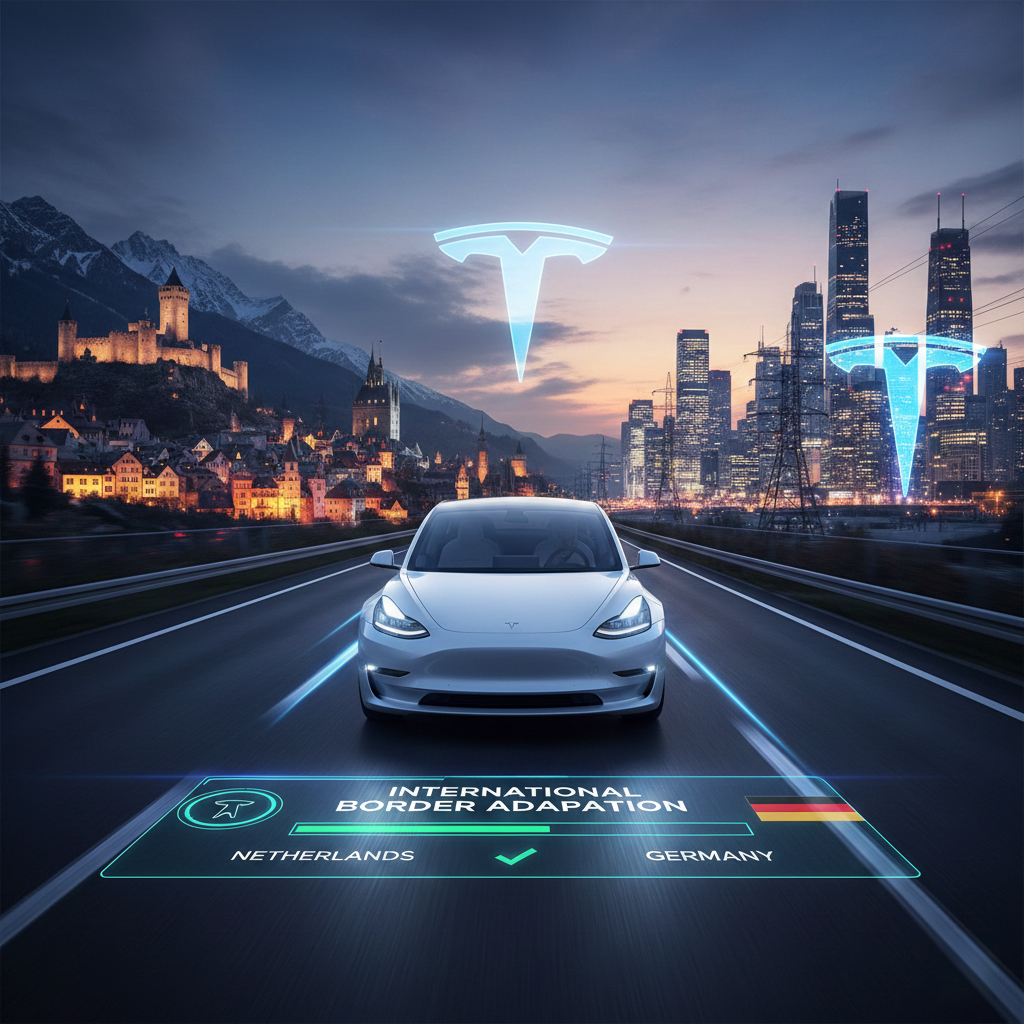
The latest firmware identified this week (2026.4.1) contains a groundbreaking module: International Border Adaptation.
-
The "Handshake" Protocol: When the GPS detects a border crossing (e.g., crossing from the Netherlands into Belgium), the car’s "World Model" adjusts its confidence scores for specific behaviors.
-
Dynamic Compliance: If FSD is approved in Country A but only "Basic Autopilot" is allowed in Country B, the car now provides a seamless transition UI, informing the driver: "FSD restricted to Autosteer in 500m due to local regulations."
Vision-Based Monitoring: The "Gaze" Requirement
European regulators are significantly stricter regarding driver attentiveness than the NHTSA in the US. To satisfy the RDW, Tesla has overhauled its internal cabin camera software. The 2026 FSD build for Europe uses High-Fidelity Gaze Tracking.
-
Infrared Support: It can now track eye movement through polarized sunglasses even in pitch-black conditions.
-
The "Zero-Tolerance" Strike System: Sources suggest the European version will be less forgiving than the US version, with "forced disengagements" occurring if the driver’s eyes leave the road for more than 3 consecutive seconds in urban environments.
III. The Economic Shift: From Ownership to Subscription
The Death of the $8,000 / €7,500 Buy-In
For years, Tesla sold FSD as a "future-proof" one-time purchase. As of mid-February 2026, coinciding with the European launch, Elon Musk has announced that the option to buy FSD outright will be phased out in favor of a Subscription-Only model.
Projected Pricing in Europe
Currently, FSD Supervised in the US is priced at $99/month. However, Musk’s recent Davos interview confirmed that "as capabilities improve, the price will rise."
-
Estimated EU Launch Price: €120 - €150 per month.
-
The "Basic to Supervised" Ladder: Tesla is expected to retire the "Enhanced Autopilot" (EAP) tier, simplifying the offering to:
-
Basic Autopilot: Included (TACC + Lane Keep).
-
FSD Supervised: Full city-street and highway navigation.
-
For European owners, this is a double-edged sword. It lowers the barrier to entry for those wanting to try FSD on a summer road trip through the Alps, but it removes the ability to "lock in" the value of the software for the life of the vehicle.
IV. The HW3 vs. HW4/AI4 Divide in Europe
A critical point for your blog audience: Hardware matters more in Europe. Because the RDW requires a higher "Safety Buffer" (often 2x safer than a human) compared to the US, the processing power of the onboard computer is under the microscope.
-
AI4/HW4 Advantage: With higher-resolution cameras and more compute, HW4 vehicles are expected to receive the "Full" version of the European FSD stack immediately.
-
The HW3 "Shadow Mode" Risk: There is growing concern that HW3 vehicles in Europe may initially be limited to a "Shadow Mode" or a restricted version of FSD while Tesla optimizes the neural nets to meet the RDW’s strict latency requirements.
V. Conclusion: The Summer of Autonomy
The February 2026 RDW decision is the "Big Bang" for Tesla in Europe. If the "Green Light" is given, we will see a rapid rollout across the continent by June 2026. Tesla is no longer just selling a car; they are selling a Digital Chauffeur that understands the nuances of the Arc de Triomphe and the Autobahn.
For the blogger and the owner, the message is clear: The wait is over. The "Red Tape" is finally being cut by the very AI that was once deemed "illegal" on European soil.
FAQ: Everything You Need to Know
Q: Will FSD work in the UK since it’s not in the EU? A: Yes, but through a separate track. The UK’s Automated Vehicles Act (2024/2025) provides a pathway that is actually more flexible than the EU's. Tesla is already testing RHD (Right-Hand Drive) FSD in London.
Q: Can I use FSD to go through a roundabout in Europe? A: With the Phase 3 DCAS approval expected in February, yes. The car will be allowed to initiate the steering and lane-positioning required for roundabouts without driver confirmation.
Q: If I already bought EAP (Enhanced Autopilot), will I get a discount on the FSD subscription? A: Historically, Tesla has offered a reduced "Upgrade" price. Expect a "top-up" subscription of roughly €49-€69 for existing EAP owners.
Q: What happens if the RDW denies the application in February? A: Tesla would likely have to "roll back" the neural net complexity to a more rule-based system, which would delay a meaningful rollout until late 2026 or 2027. However, given the "commitment" language used by Tesla Europe this week, a denial is considered unlikely.