
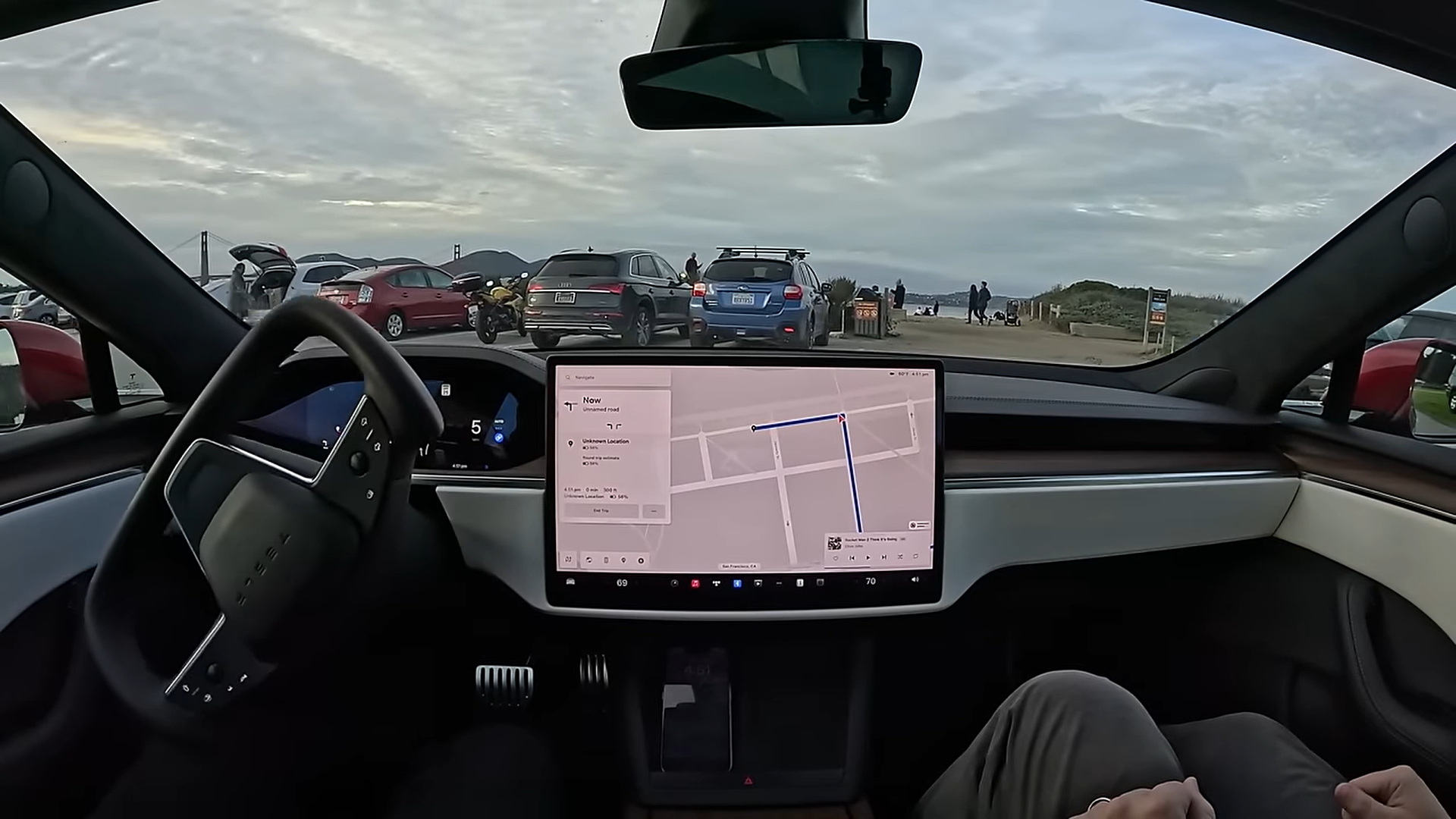
The promise of true self-driving has been a tantalizing fixture on the horizon of automotive technology for years, a sci-fi concept slowly crystallizing into reality. For Tesla owners, this promise has a name: Full Self-Driving (FSD). With each software update, the dream inches closer, but no single update has carried more weight, more anticipation, and more revolutionary potential than Version 12. This isn't just another incremental improvement; it's a fundamental reimagining of how a car perceives and navigates the world.
At its core, FSD V12 abandons the rigid, painstakingly coded logic of its predecessors in favor of a holistic, artificial intelligence-driven approach. It learns to drive by watching, much like a human does. While this paradigm shift has been rolling out to beta testers in North America, leaving many in awe of its capabilities, for the millions of Tesla owners and enthusiasts across Europe, the excitement is tempered by a crucial and complex question: When will it be our turn?
This article provides a deep dive into that very question. We will explore the technological leap that makes FSD V12 so transformative, but more importantly, we will dissect the specific challenges and potential timeline for its full-scale rollout in the uniquely complex European market. While FSD V12 represents a monumental leap in engineering, its deployment across the Atlantic is not a simple matter of flipping a switch. It is a complex puzzle of stringent regulatory hurdles, massive data adaptation, and shifting public perception that will unfold on a timeline and in a manner entirely distinct from the United States.
Part 1: What Makes FSD Version 12 a "Game Changer"?
To understand the regulatory and practical challenges in Europe, one must first grasp why FSD V12 is not merely an update but a revolution in automotive AI. The difference between V11 and V12 is as significant as the difference between a detailed instruction manual and innate intuition.
From Coded Logic to AI Learning
Previous versions of Tesla's FSD software, while remarkably complex, were built on a traditional programming foundation. Engineers wrote millions of lines of C++ code to define specific rules for countless driving scenarios. An engineer would have to explicitly code instructions like: "IF a traffic light is red, THEN apply brakes," or "IF a pedestrian is detected within X meters of the crosswalk and moving at Y speed, THEN reduce vehicle speed and prepare to stop." This approach is powerful but brittle. The system's performance is limited by the engineers' ability to anticipate and write code for every possible edge case on the road—an infinite and impossible task. If the system encountered a novel situation it wasn't explicitly programmed for, it would often hesitate or behave unpredictably.
FSD Version 12 throws that entire playbook out the window. It replaces the millions of lines of explicit code with a single, end-to-end neural network. This network is not programmed; it is trained. Tesla feeds it millions of hours of video footage from its global fleet of vehicles, showing it examples of expert human driving. The AI learns the subtle connections between what it sees and what the driver does—how a human seamlessly merges into traffic, navigates a chaotic intersection, or yields to an assertive cyclist.
"Photon In, Controls Out"
You'll often hear Tesla and its proponents use the phrase "photon in, controls out" to describe V12. This elegantly captures the essence of the new architecture. The system takes raw visual information from the car's eight cameras—the photons hitting the sensors—and processes it through the neural network. The direct output from this network is the physical controls for the car: steering wheel angle, accelerator pedal position, and brake force.
There are no intermediate steps where the system identifies "this is a car," "that is a lane line," and then consults a rulebook. Instead, it develops a holistic understanding of the scene and drives based on that integrated perception. This is profoundly similar to how the human brain works. When you drive, you don't consciously calculate the trajectory of every object. You see the whole picture and intuitively react, your brain sending signals directly to your hands and feet. This is why V12's driving behavior is often described as more "human-like" and "confident"—it's operating on a similar principle of learned intuition rather than rigid logic.
Early Impressions from North America
The rollout of FSD V12 (Supervised) to beta testers in the US and Canada has provided a fascinating glimpse into this future. The feedback has been overwhelmingly positive, with users noting a dramatic reduction in "disengagements," the moments when the human driver has to take over. The system's performance in complex, previously challenging urban environments has been a standout feature.
Users have posted countless videos showcasing V12 navigating dense city streets in San Francisco, handling unprotected left turns into fast-moving traffic, and smoothly maneuvering around double-parked cars and construction zones with a level of fluidity that prior versions lacked. The notorious "hesitation" at stop signs or in busy roundabouts has been significantly reduced. The car appears to have a better grasp of the "vibe" of the traffic, making decisions that feel less robotic and more attuned to the flow of other vehicles. These are the "wow" moments that demonstrate the profound potential of a trained AI over a coded system. It is this potential that European owners are so eager to experience.
Part 2: The Great Wall of Regulation: Why Europe is Different
If the technology is so advanced, why can't Tesla simply push the update to its European fleet? The answer lies in a dense and fundamentally different regulatory landscape, one that was not designed for the kind of technology FSD V12 represents.
The UNECE Framework
Vehicle laws in the United States are largely set at the federal level by the National Highway Traffic Safety Administration (NHTSA), with additional layers from individual states. In Europe, the situation is more unified and stringent. The United Nations Economic Commission for Europe (UNECE) sets vehicle regulations through its World Forum for Harmonization of Vehicle Regulations (WP.29). These are not mere guidelines; they are legally binding standards for the 56 member countries, which include the entire European Union, the United Kingdom, and others. If a car is to be sold in Europe, it must comply with these UN Regulations.
Level 3 vs. Tesla's "Supervised" FSD
Herein lies the central conflict. The most advanced European regulations governing automation, such as UN Regulation No. 157, are specifically designed for Level 3 "conditional automation." Level 3 is defined as a system where the car is in complete control of the driving task, and the driver is legally permitted to take their eyes off the road and engage in other activities. However, this is only allowed under very specific, pre-approved conditions—an Operational Design Domain (ODD). For example, Mercedes-Benz's Drive Pilot, the first certified Level 3 system in Europe, can only be activated on certain pre-mapped German highways, in dense traffic, and at speeds below 60 km/h (37 mph). If any of these conditions are not met, the system prompts the driver to take back control with ample warning.
Tesla's FSD Beta, by its very design and philosophy, is a Level 2 system. Despite its name, "Full Self-Driving" is, in its current form, a "hands-on, eyes-on" driver assistance feature. The driver is always legally responsible for the vehicle's operation and must be prepared to intervene at any moment. The trade-off is that FSD is designed to work almost anywhere—on highways, in cities, on rural roads—vastly exceeding the geofenced ODD of a Level 3 system.
European regulators are faced with a paradox: a Level 2 system that is, in practice, far more capable and versatile than their legally defined Level 3 systems. They have no existing framework to certify a "supervised" system that operates everywhere. Their rules are built on the idea that if the car is driving itself, it must be verifiably safe to the point that the driver is no longer liable within its ODD. Tesla's approach, which places liability on the driver at all times, doesn't fit into this neat box.
The Certification Bottleneck
Getting a system like FSD V12 approved in Europe is a bureaucratic marathon. National type-approval authorities, such as Germany's Kraftfahrt-Bundesamt (KBA) or France's UTAC, must rigorously test and validate the system against the UNECE standards. This process is designed for static, predictable systems. The manufacturer submits the system, declares its capabilities, and provides evidence that it meets thousands of pages of safety requirements.
FSD V12's core strength—its ability to learn and improve continuously through over-the-air updates—is a nightmare for this certification model. How can a regulator certify a system today that might behave differently next month after a neural network update? The current process is ill-equipped to handle self-learning AI. It demands deterministic, predictable behavior, which is antithetical to how V12 works.
The Data Privacy Hurdle (GDPR)
Looming over all of this is the General Data Protection Regulation (GDPR), Europe's landmark data privacy law. FSD's entire learning cycle is fueled by data. Tesla uses "shadow mode," where the FSD software runs silently in the background of a human-driven car, comparing its decisions to the driver's. When a discrepancy occurs or a difficult scenario is encountered, the car can flag that video segment for upload and review by Tesla's team. This "fleet learning" is the lifeblood of FSD's development.
Under GDPR, this video data, even from outside the car, can be considered personal data. Tesla must ensure that this data is collected with explicit user consent, is fully anonymized to protect the privacy of the driver and other road users (a monumental technical challenge), and is handled in compliance with strict rules about data transfer and storage. Navigating this is far more complex and legally perilous in the EU than in the US, adding another significant layer of delay and development cost to the European rollout.
Part 3: Adapting the AI Brain for European Roads
Even if all regulatory hurdles were magically cleared tomorrow, FSD V12 would still not be ready for a pan-European release. An AI model is only as intelligent as the "data diet" it is fed, and FSD's brain has been feasting almost exclusively on North American roads.
The "Data Diet" Problem
Imagine trying to learn a language by only reading books from one author. You might become an expert in that author's style, but you'd be lost when presented with a different dialect or genre. The FSD neural network faces a similar challenge. Its understanding of "driving" has been shaped by the wide lanes, simple intersections, and traffic patterns common in the United States and Canada. Europe presents a completely different and far more fragmented "dialect" of driving.
Unique European Scenarios
The AI must be retrained and validated on a massive dataset of distinctly European driving situations:
-
Roundabouts: While some exist in the US, they are a fundamental, ubiquitous part of European road networks. They range from simple, single-lane circles in villages to massive, multi-lane, multi-exit spiral roundabouts like the Place de l'Étoile around the Arc de Triomphe in Paris or the Magic Roundabout in Swindon, UK. Navigating these requires assertive, yet compliant merging and yielding behaviors that are a learned skill even for human drivers.
-
Narrow, Unmarked Roads: Europe is replete with historic city centers and rural lanes that predate the automobile. These roads are often incredibly narrow, lack any painted center or edge lines, and force two-way traffic to negotiate passage in a space barely wide enough for one vehicle. This requires a nuanced understanding of social cues and vehicle-to-vehicle communication that is absent from most American driving data.
-
Priority Rules: A cornerstone of driving in many mainland European countries is the "priority to the right" (priorité à droite) rule. At an intersection without signs, a driver must yield to any vehicle approaching from their right. This is a non-negotiable, ingrained rule that FSD must learn to obey flawlessly, as it directly contradicts the more sign-dependent intersection logic prevalent in the US.
-
Signage and Lane Marking Diversity: Every country in Europe has its own subtle variations in road sign design, traffic light configuration, and lane markings. While the Vienna Convention on Road Signs provides some standardization, significant differences remain. A German "Autobahn" sign looks different from an Italian "Autostrada" sign. Some countries use complex filter arrows in traffic lights that are uncommon elsewhere. The AI must not just recognize a stop sign; it must recognize every country's version of a stop sign and understand all local context, a massive generalization challenge.
Building the European Fleet Mind
To overcome this, Tesla has to put its AI on a strict European diet. The primary strategy is to leverage the existing European fleet for intensive data collection. This involves encouraging owners to opt into data sharing and running FSD in "shadow mode" to gather terabytes of video footage of these unique scenarios being handled by human drivers. Tesla will likely also use early access programs for its own employees and a select group of trusted customers to actively test pre-release versions on public roads, generating the high-quality data needed to retrain and fine-tune the neural network specifically for the continent.
Part 4: The Path Forward and Timeline Projections
Given the dual challenges of regulation and data adaptation, the rollout of FSD V12's full capabilities in Europe will be a gradual, multi-stage process. It will not be a single event.
Phase 1: Enhanced Autopilot (EAP) with V12 DNA
The most logical and likely first step is to infuse the existing Enhanced Autopilot (EAP) feature set with the FSD V12 architecture. Features like Navigate on Autopilot (for on-ramp to off-ramp highway driving), Autosteer, and Traffic Light and Stop Sign Control are already approved and in use. By running them on the V12 neural network platform instead of the old C++ code, Tesla can make them significantly smoother, more reliable, and more "human-like" without introducing new features that would trigger a full regulatory review. Owners would notice their cars handling lane changes, merges, and stop-and-go traffic with a new level of confidence. This would be a tangible benefit and a crucial data-gathering phase, all while staying within the current regulatory sandbox.
Phase 2: "Supervised" FSD Beta Rollout (Country by Country)
Once Tesla's legal teams have made headway with regulators and the neural network has been sufficiently trained on European data, we can expect a gradual rollout of the full "FSD Beta (Supervised)" feature, including Autosteer on city streets. This will not be a continent-wide launch. It will likely happen on a country-by-country basis, starting with nations that have more progressive regulators or where Tesla has established strong relationships and submitted extensive safety cases. Even then, it will be released as a "beta" product, with clear warnings and an unwavering requirement for full driver attention, just as in North America.
Phase 3: The Long Road to True "Eyes-Off" Automation
This is the ultimate goal, but it remains the most distant and uncertain phase. For Teslas in Europe to achieve true, "eyes-off" Level 3 (or higher) autonomy, one of two things must happen. Either Tesla must compromise its "works everywhere" philosophy and accept the limitations of a geofenced, Level 3 ODD to fit within existing regulations like UN R157, or the UNECE regulations themselves must evolve to create a new category for certifying advanced, constantly learning AI systems like FSD. The latter is a slow, multi-year process involving dozens of countries and stakeholders. This phase is not a matter of months, but more likely many years away.
What to Expect in the Next 12-18 Months
Looking ahead, European Tesla owners should set realistic expectations. Over the next year to year-and-a-half, we should anticipate seeing Tesla publicly engage more with UNECE and national regulators. We will see the fruits of their data gathering in the form of a much-improved "EAP with V12 DNA." We might even see the first, limited FSD Beta (Supervised) program launch in a pioneering European country. However, the dream of having a fully-featured FSD Beta that mirrors the US version across the entire continent remains a more distant prospect.
Conclusion
FSD Version 12 is undeniably a monumental technological achievement. Its neural network-based architecture represents the cutting edge of automotive AI and offers a glimpse into a future where our cars can navigate the world with near-human intuition. For European Tesla owners, however, that future will arrive on a different schedule and through a different path.
The journey of FSD V12 in Europe is a marathon, not a sprint. The primary obstacles are not technological, but bureaucratic and logistical. The rigid, feature-based UNECE regulations, the fundamental paradigm clash between Tesla's Level 2 "supervised" system and Europe's Level 3 "conditional automation" framework, and the immense task of retraining the AI for Europe's uniquely diverse and complex driving environment all stand in the way of a simple, overnight rollout.
The path forward will be incremental. European owners should look for the influence of V12 to appear first in the enhanced smoothness and capability of existing Autopilot features. The dream of a truly autonomous commute from the heart of Paris to the outskirts of Berlin is still on the horizon, but be assured that the path is being paved—one kilometer, one regulatory filing, and one terabyte of European driving data at a time.
FAQ Section
-
Q1: Will my current Tesla in Europe get FSD V12?
-
A: Yes, if you have purchased the Full Self-Driving Capability package and your car is equipped with the necessary computer (Hardware 3.0 or 4.0), you will eventually receive the version of the V12 software that is approved for use in Europe. The key uncertainty is not if you will get the underlying architecture, but which features will be enabled and when.
-
-
Q2: Is FSD in the US fully autonomous now?
-
A: No. In the United States and Canada, FSD is officially designated as a "beta" and is a SAE Level 2 driver-assistance system. This means the driver must keep their hands on the steering wheel and be prepared to take over control at any second. It is a "supervised" system at all times.
-
-
Q3: Why can't Tesla just use the same software in Europe as in the US?
-
A: There are two primary reasons. First, the driving environments are vastly different, requiring the AI to be retrained on European-specific data (roundabouts, narrow roads, different signs). Second, and more critically, Europe operates under a different and stricter set of federal-level regulations (from the UNECE) that govern vehicle automation, which have no direct equivalent to Tesla's "supervised beta" approach.
-
-
Q4: How does Hardware 4 (HW4) affect the FSD V12 rollout in Europe?
-
A: Hardware 4 features higher-resolution cameras and a more powerful computer. This allows the system to see further and with greater detail, providing higher-quality data to the neural network. While Tesla has stated its goal for FSD V12 to work effectively on HW3, the superior capabilities of HW4 will likely offer performance advantages and could be a key component of the safety case Tesla presents to European regulators for validation and approval.
-
-
Q5: What can I do as a European Tesla owner to help?
-
A: The most direct way to contribute is to help Tesla gather the data it needs to train the AI. You can do this by opting into the data sharing agreement in your car's privacy settings. Simply by driving your car every day, you are allowing Tesla's systems to run in "shadow mode," anonymously collecting data on how the system would have behaved in various scenarios compared to your human input, which is invaluable for training and validating the system for your local roads.
-